


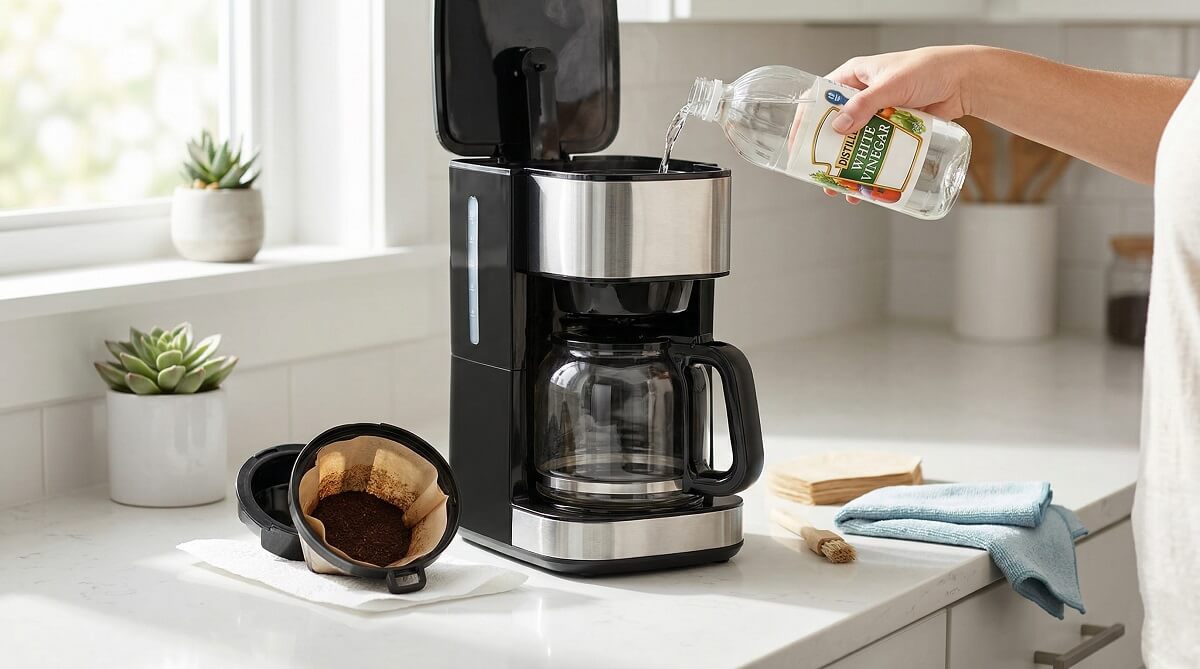
Your coffee maker’s water reservoir ranks among the top 10 germiest spots in the average American home, according to NSF International’s household germ study — higher than the bathroom door handle, higher than the toilet seat. Half of the reservoirs tested had yeast and mold; 9% had coliform bacteria. The good news: a monthly cleaning with white vinegar addresses most of this, and the whole process takes about 30 to 45 minutes, most of which is just waiting.
The basic process is straightforward. You fill the reservoir with a 1:1 mix of white vinegar and water, run the brew cycle halfway, pause for 30 minutes to let the acid work, then finish the cycle and follow up with two or three rinse cycles of clean water. That’s it. The vinegar’s acetic acid reacts with the calcium carbonate in hard water mineral deposits — breaking them down into water-soluble calcium acetate plus CO₂ gas — and flushes them out. If your coffee has started tasting dull or bitter, or your machine is brewing noticeably slower, mineral buildup is almost certainly the cause.
Who Should Do This (and Who Can Hold Off)
✅ Do this if:
- You brew coffee daily or most days of the week
- Your tap water is on the harder side — common in Texas, Florida, Nevada, Indiana, Arizona, and much of California
- Your machine brews slower than it used to
- Coffee tastes more bitter than the beans should produce
- You notice white or chalky deposits on visible parts of the machine
- It’s been more than a month since the last cleaning
❌ You can hold off if:
- You only cleaned it within the past two to three weeks
- You use exclusively filtered or bottled water (mineral content is much lower)
- Your machine has a built-in descale indicator that hasn’t triggered yet
What Happens Inside Your Coffee Maker Over Time
Two separate problems, two different cleaning approaches
Most people don’t realize that a coffee maker accumulates two distinct types of residue, and they require different treatments. Coffee oils — natural compounds that come off the beans during brewing — coat the internal tubing, filter basket, and carafe. Left long enough, those oils go rancid and make your coffee taste stale. Dish soap and warm water handle that.
Mineral scale is a different problem entirely. Hard water carries dissolved calcium and magnesium from the limestone and chalk formations it flows through underground. When that water heats up inside your machine’s boiler and lines, those minerals precipitate out and stick to surfaces — a process that repeats every single brew cycle. Over months, you get a chalky white coating on the heating element and inside the water lines. This is limescale, also called calcium carbonate (CaCO₃), and it’s the reason your machine slows down and your coffee comes out cooler than it should.
Why vinegar dissolves limescale (the short chemistry version)
White vinegar contains acetic acid. When acetic acid contacts calcium carbonate, a straightforward chemical reaction occurs: CaCO₃ + 2CH₃COOH → Ca(CH₃COO)₂ + H₂O + CO₂. In plain terms, the hard scale breaks down into calcium acetate (which is water-soluble and flushes right out), water, and carbon dioxide gas. The hot water that cycles through your machine during brewing accelerates this reaction significantly. Those tiny bubbles you sometimes see during descaling? That’s the CO₂ being released. According to Wikipedia’s overview of descaling agents, heat amplifies acid activity, which is part of why the brew-cycle method works better than simply soaking in cold vinegar.
How often should you clean?
For daily coffee drinkers, once a month is the practical minimum. Brew a few times a week? Every two to three months is reasonable. If you live in a hard water area — the U.S. Geological Survey’s water hardness data puts Indiana, Nevada, Texas, Arizona, and parts of Southern California among the hardest — consider cleaning every three weeks. Your local water utility report will tell you exactly how hard your water is.
What to Gather Before You Start
What you need
- White distilled vinegar — standard 5% acidity, the kind you find in any grocery store. Don’t use cleaning vinegar (6%+ acidity), which can be too harsh on rubber seals.
- Fresh water — filtered water is preferred in hard water areas, but tap water is fine for the rinse cycles
- Dish soap — for the carafe and removable parts
- Soft cloth or sponge
- Paper filters — one for the descaling run, one per rinse cycle
What NOT to use
- Apple cider vinegar — it works chemically, but leaves a stronger, more complex smell that takes several extra rinse cycles to eliminate. Stick with plain white.
- Bleach or hydrogen peroxide — unsafe for food-contact surfaces and can damage internal components
- Harsh abrasive scrubbers on the carafe — they scratch glass and create surfaces where residue clings more easily
- Dish soap inside the reservoir — suds are nearly impossible to fully rinse out and will ruin your next few cups
Warranty note: Some manufacturers specify that using non-approved descalers can void your warranty. If your appliance is still under warranty, check the manual. According to Proctor Silex’s official cleaning guide, white vinegar is an explicitly approved agent for their drip machines; Keurig officially recommends their proprietary descaling solution and their warranty terms reflect that.
How to Clean a Drip Coffee Maker with Vinegar
Part 1: Daily after-use cleaning (5 minutes)
A quick daily routine prevents oil buildup and keeps mold from getting a foothold in the damp reservoir:
- Discard used coffee grounds (compost them if you can)
- Remove the filter basket and carafe; wash with warm, soapy water. Most glass carafes and filter baskets are dishwasher-safe on the top rack — check your model’s manual
- Wipe down the exterior and warming plate with a damp cloth after it cools
- Leave the reservoir lid open after the last brew of the day — airflow dries out the interior and makes mold growth much less likely
Part 2: Monthly deep clean with vinegar (30–45 minutes, mostly waiting)
This is the descaling process that removes mineral scale from the internal components. You’re running an acidic solution through the water lines, giving it time to dissolve deposits, then flushing it out.
- Empty the machine. Remove any paper filter and grounds. Discard leftover water in the reservoir.
- Mix equal parts white vinegar and water. For a standard 12-cup drip maker, you’ll need about 6 cups of total solution (3 cups vinegar + 3 cups water). Pour the mixture into the water reservoir. For a heavily scaled machine, some guides suggest undiluted vinegar — start with the 1:1 ratio first.
- Place an empty paper filter in the basket. This catches any mineral debris that dislodges during the cycle.
- Start the brew cycle. Let it run for about 30–60 seconds — until the machine has pulled about half the solution through — then turn it off or hit pause.
- Let it soak for 30 minutes. This dwell time is where the acetic acid does most of its work on the scale inside the heating element and tubing. Don’t skip this step; running the full cycle without pausing reduces the contact time significantly.
- Finish the cycle. Turn the machine back on and let it brew through the remaining solution.
- Discard the solution from the carafe. Toss the used filter.
- Run 2–3 full rinse cycles with fresh water. Replace the filter each time. This flushes out the dissolved minerals and any remaining vinegar residue. How to know you’re done: the water runs clear, and there’s no vinegar smell from the carafe.
If your machine has a “Clean” or “Descale” button (common on Ninja, some Hamilton Beach models, and certain Cuisinart machines): fill the reservoir with the vinegar-water mix, then press the Clean button instead of starting a normal brew cycle. The machine automates the soak-and-flush sequence — typically a 45–60 minute cycle — and handles the timing for you. Still run 2 rinse cycles with clean water afterward.
How to Clean a Keurig or Single-Serve Coffee Maker
Single-serve machines follow the same general logic as drip brewers, but the execution looks different. These appliances have smaller reservoirs and run one cup at a time, so the descaling happens across multiple short brew cycles rather than a single extended one.
- Remove the water filter (if your model has one) and any K-cup pod
- Fill the reservoir with a 1:1 mix of white vinegar and water
- Place a large mug under the dispenser. Run brew cycles one at a time (at the largest cup setting), discarding the liquid from the mug after each cycle
- When the reservoir is about half empty, pause and let the machine sit for 30 minutes
- Continue running brew cycles until the reservoir is empty
- Fill the reservoir with fresh water and run at least 3 rinse cycles (more if you still smell vinegar)
One important note on Keurig specifically: the company officially recommends using their Keurig Descaling Solution rather than vinegar, and their warranty language reflects this. White vinegar works in practice — many thousands of Keurig owners use it without issue — but if your machine is under warranty and you want to play it safe, use the official solution. Keurig’s general recommendation is to descale every 3–6 months.
Cleaning the Carafe and Other Removable Parts
Everyday carafe cleaning
Warm water and a few drops of dish soap handles most daily residue. Rinse thoroughly. Most glass carafes are dishwasher-safe, but check your manual — thermal (stainless) carafes often aren’t.
Removing the oily film from the carafe
Coffee has significant natural oil content, and over time that oil leaves a brownish, slightly waxy film on the inside of the glass that dish soap alone won’t always shift. A popular DIY approach: add about 1 cup of ice cubes to the carafe, followed by 1–1.5 tablespoons of kosher or table salt and 1 tablespoon of water. Swirl gently for 30–60 seconds. The salt creates a mild abrasive action and the ice provides friction against the glass walls. Dump everything out, then rinse with cold water — not hot, since a sudden temperature change can crack glass.
The water reservoir
Wash the reservoir by hand with warm, soapy water. Skip the dishwasher — the high heat can warp the plastic over time. Let it air dry completely with the lid open before reassembling.
Vinegar Alternatives When You Want a Different Option
White vinegar is the standard recommendation for a reason — it’s cheap, safe, widely available, and chemically effective. But there are times when you might prefer something else, whether that’s the smell, a specific machine requirement, or a particularly stubborn scale situation.
| Method | How It Works | Best For | Approximate Cost |
|---|---|---|---|
| Lemon juice (1:1 with water) | Citric acid dissolves calcium carbonate — arguably more effective per gram than acetic acid | Light to moderate buildup; prefer a citrus scent over vinegar smell | ~$0.50–$1.00 per use |
| Baking soda (¼ cup + 1 cup warm water) | Mild alkaline abrasive; neutralizes odors; not an acid so doesn’t descale | Coffee oil residue, carafe staining — NOT effective for mineral scale | ~$0.05 per use |
| Commercial descaler tablets (e.g., Affresh) | Citric or sulfamic acid-based formula; optimized concentration for coffee makers | Heavy buildup; warranty-safe option; hands-off process | Check current pricing on Amazon |
| Denture tablets (1–2 tablets + warm water) | Effervescent cleaning action; mild abrasives | Moderate buildup; an option if you have them on hand | ~$0.25 per use |
Note on baking soda: It’s often listed as a coffee maker cleaner, but it’s alkaline (not acidic) and won’t dissolve mineral scale. It’s useful for deodorizing and removing oil residue from the carafe, but it’s not a descaler. If your main problem is limescale, use an acid-based method.
Signs Your Coffee Maker Is Telling You It’s Time
Most machines don’t have a dashboard light for “I’m overdue for a descale.” Instead, you get these signals:
- The brew cycle takes noticeably longer than it used to
- Coffee comes out cooler than expected — scale on the heating element reduces efficiency
- The carafe only fills halfway when set to brew a full pot
- You see white, chalky deposits on the carafe spout, reservoir edges, or anywhere water exits
- Coffee smells off or musty before you’ve even added anything to it
- The machine makes gurgling or sputtering sounds mid-cycle
- Coffee tastes noticeably more bitter than the same beans brewed elsewhere
Any two of these together is a clear indication the brewer is due for a full vinegar descaling run, not just a quick rinse.
Frequently Asked Questions
How much vinegar do I use to clean a coffee maker?
For most drip machines, equal parts white vinegar and water is the right starting point. A 12-cup brewer typically needs about 6 cups of total solution — 3 cups vinegar, 3 cups water. For heavily scaled machines, HGTV recommends up to 4 cups of undiluted vinegar; Proctor Silex specifies 2 cups undiluted. If you’re unsure, start with the 1:1 diluted version and increase if the buildup isn’t clearing after two cleaning sessions.
How many times should I run vinegar through my coffee maker?
Run the vinegar solution once — but follow it with at least 2 full brew cycles of clean water, and 3 if you can still detect a vinegar scent. Each rinse cycle should use a fresh paper filter.
Can I use apple cider vinegar instead of white vinegar?
It has the same basic chemistry, but apple cider vinegar carries sugars, colors, and a more complex smell that’s harder to rinse out completely. You’ll likely need extra rinse cycles, and some residual odor may linger. Spend the dollar on plain white distilled vinegar.
Will vinegar damage my coffee maker?
A 30-minute monthly soak is generally safe for most machines. Prolonged exposure — leaving vinegar sitting for several hours — can degrade rubber gaskets and seals over time. Also check your machine’s warranty; some manufacturers (Keurig in particular) specify their own descaling solution and their warranty may not cover damage from unauthorized cleaners.
How do I get the vinegar taste out after cleaning?
Run 2–3 full brew cycles with fresh water. If the taste persists after 3 cycles, run a fourth. Using filtered water for the rinse cycles can also help flush residue more effectively than heavily mineralized tap water.
How often should I clean my coffee maker with vinegar?
Monthly for daily drinkers. Every 2–3 months if you brew a few times per week. More frequently if you’re in a hard water region — the Southwest, Midwest, and parts of the South have particularly mineral-heavy tap water. Your coffee will tell you if you’re waiting too long: slower brew times and increased bitterness are the first signs.
What’s the difference between cleaning and descaling?
Daily cleaning removes coffee oils and grounds — the visible stuff. Descaling targets mineral scale inside the machine’s heating element and water lines — the buildup you can’t see. Vinegar handles descaling. Dish soap handles the oils. You need both, on different schedules.
My machine has a “Descale” or “Clean” button. Do I still need to do this?
Yes, but the machine does more of the work for you. Fill the reservoir with the vinegar-water mix, press the button, and the machine handles the soak timing and cycle pauses automatically. Still run 2 rinse cycles with clean water afterward to flush everything out.
If your machine is getting long in the tooth despite regular cleanings, it might be time for an upgrade. Check current prices on top-rated drip coffee makers on Amazon. For single-serve machines, see current options at Amazon’s single-serve coffee maker selection.
