


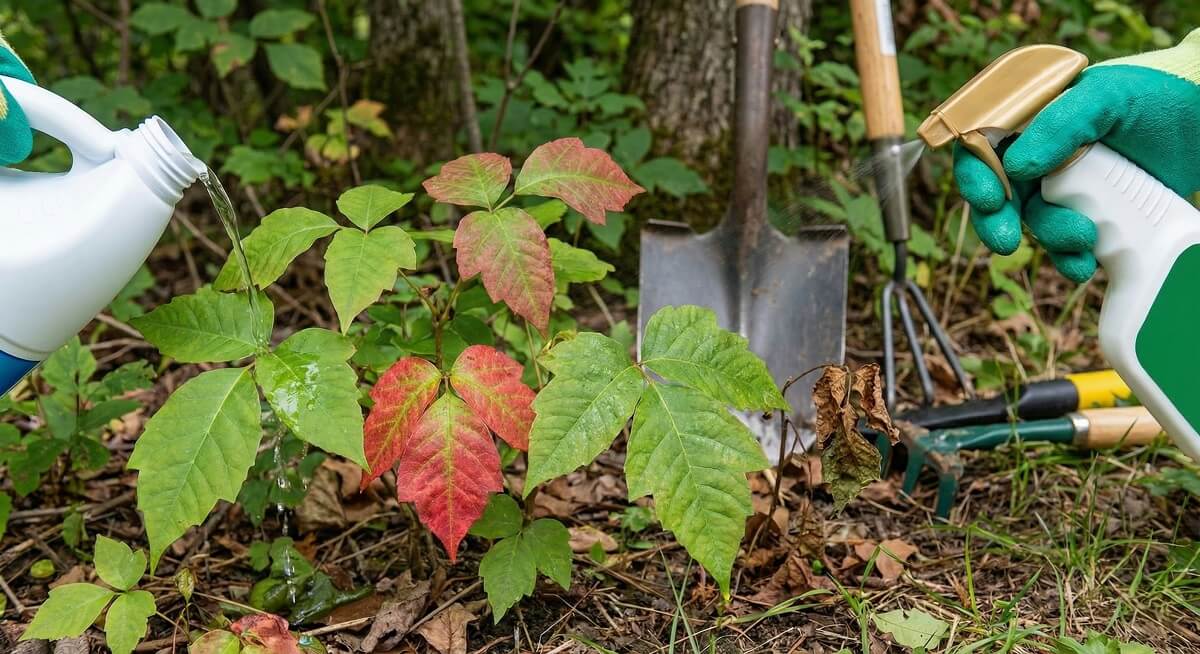
Yes, household bleach can damage and kill poison ivy leaves on contact, but it’s not an effective long-term solution. Bleach works as a contact killer—it destroys the foliage it touches, causing leaves to curl and brown within hours. The problem? It doesn’t penetrate to the root system, so the plant typically regrows within a few weeks.
Using bleach in your yard comes with real downsides. It harms surrounding plants, damages soil health by killing beneficial microorganisms, and alters soil pH. For homeowners dealing with poison ivy, targeted herbicides like triclopyr or careful manual removal deliver far better results than pouring bleach on the problem. If you’re also battling other stubborn plants, our cover various yard maintenance challenges.
If you’re facing a small, isolated patch in a crack or along a sidewalk edge where you don’t care about other vegetation, bleach might knock it back temporarily. For anything in or near your garden, lawn, or landscaping, skip the bleach and use a method that actually reaches the roots.
Should You Use Bleach on Poison Ivy?
Bleach Might Work If:
- You have a tiny patch in an isolated area (driveway crack, sidewalk edge)
- You don’t care about surrounding vegetation or soil health
- You need a quick, temporary knockdown and have bleach on hand
- The area won’t be replanted or used for gardening
Skip Bleach If:
- The poison ivy is near your garden, lawn, or desirable plants
- You want permanent removal (bleach won’t reliably kill roots)
- You’re concerned about soil health and beneficial organisms
- You have a large or established infestation
Does Bleach Actually Kill Poison Ivy?
Bleach (sodium hypochlorite) is a strong oxidizer that damages plant tissue on contact. When you spray it on poison ivy leaves, you’ll see results quickly—often within 24 to 48 hours, the leaves will curl, discolor, and appear dead.
But here’s the catch: bleach is a contact killer. It only destroys what it directly touches. Poison ivy has an extensive underground root system (rhizomes) that stores energy and allows the plant to regrow. Since bleach doesn’t penetrate the soil to reach these roots, you’re essentially just burning off the top growth while leaving the plant’s recovery system intact.
Gardening experts on forums like Houzz have noted this limitation: “The instant results you see probably will not do the job. Like vinegar, it’s obviously a contact killer and not absorbed into the roots that need to be killed as well.”
Why Bleach Isn’t the Best Choice for Poison Ivy Removal
The Root Problem
Poison ivy’s extensive rhizome system is why this plant is so stubborn. The thick, woody rootstocks store energy underground, and even when you destroy all visible growth, the roots remain alive and ready to send up new shoots. According to the University of Missouri Extension, poison ivy commonly regrows after treatment, making repeat applications necessary regardless of what you use.
Soil and Environmental Concerns
When bleach breaks down in soil, it releases salt (sodium chloride), water, and chlorinated organic compounds. According to research from the Pacific Northwest Pest Management Handbooks, sodium hypochlorite alters soil chemistry by reducing beneficial microbial populations and increasing salinity.
The practical effects include:
- Killing beneficial soil bacteria that help plants absorb nutrients
- Harming earthworms and other soil life
- Making soil more alkaline, which affects what will grow there
- Creating potential runoff issues near water sources
Turfgrass management experts generally discourage bleach use, noting it “will likely damage the surrounding soil, harming neighboring plants and making it unsuitable for most plants to grow back in that area for a long time.” For tips on maintaining healthy soil and lawn care, check out our .
Damage to Surrounding Plants
Bleach doesn’t discriminate. Any plant it contacts will be damaged or killed—your lawn, flowers, shrubs, everything. Unlike selective herbicides that target specific plant types, bleach destroys all vegetation it touches. Overspray or runoff can damage plants several feet away from your target area.
If You Still Want to Try Bleach: How to Use It
This method isn’t recommended, but if you choose to try it anyway, here’s how to minimize damage:
What You’ll Need
- Household bleach (standard concentration, undiluted)
- Spray bottle or pump sprayer
- Protective gear: waterproof gloves, long sleeves, eye protection
- Cardboard or plastic sheeting to shield nearby plants
Application Steps
- Choose a dry, calm day with no rain expected for at least 24 hours
- Set up barriers around plants you want to protect
- Apply undiluted bleach directly to poison ivy leaves
- Avoid over-saturating the soil—spray leaves, don’t soak the ground
- Monitor for several days and repeat as needed
- Expect multiple applications over several weeks
What to Expect
- Leaves may curl and brown within hours
- Full dieback of above-ground growth: 2-7 days
- Regrowth likely within 2-4 weeks from surviving roots
- You may need 3-5 or more applications to exhaust the root system
Better Alternatives to Bleach for Killing Poison Ivy
Manual Removal (Most Thorough for Small Areas)
For small patches, digging out the entire root system is the most reliable method. Use a shovel to carve out soil at least 8 inches deep around the plant, removing as much of the root system as possible. This requires full protective gear—long sleeves, pants, waterproof gloves, and eye protection.
Bag all plant material in heavy-duty garbage bags and seal completely. Never burn poison ivy—the smoke carries urushiol (the rash-causing oil) into the air and can cause severe reactions if inhaled.
Targeted Herbicides (Most Effective for Larger Areas)
Triclopyr-based products are specifically designed for woody plants and vines, making them ideal for poison ivy. According to the University of Missouri Extension, triclopyr is “one of the most effective active ingredients” for poison ivy control. It targets broadleaf plants while leaving grass unharmed.
Products containing triclopyr include Brushtox Brush Killer, Ortho Brush-B-Gon, and BioAdvanced Brush Killer. Apply to cut stems or foliage during active growth for best results.
Glyphosate-based products (like Roundup) are effective but non-selective—they’ll kill grass and other plants too. The University of Georgia Extension notes that poison ivy can recover from glyphosate, so repeat applications are often needed. Apply on warm, sunny days when the plant is actively growing.
For either herbicide type, plan for multiple applications. Poison ivy’s extensive root system means complete elimination rarely happens with one treatment.
Natural Alternatives
Vinegar and salt solution: Mix 1 gallon of white vinegar with 1 cup of salt and 1 tablespoon of dish soap. Spray directly on leaves. This has the same limitation as bleach—it’s a contact killer that won’t reach roots—but it’s less damaging to soil. Multiple applications needed. Vinegar is also useful for other household tasks—see our .
Boiling water: Pour directly on the crown of the plant. Requires many repeated applications and won’t penetrate deep roots, but poses no chemical concerns.
Smothering: Cover the area with heavy cardboard or an opaque tarp for 6-8 weeks. This starves the plant of light and eventually kills even the roots. Effective but slow, and only practical for isolated patches.
Poison Ivy Removal Methods Compared
| Method | Kills Roots? | Safe for Soil? | Kills Nearby Plants? | Applications Needed | Cost |
|---|---|---|---|---|---|
| Bleach | No | No | Yes | 3-5+ | $ |
| Triclopyr herbicide | Yes | Mostly | Broadleaf only | 1-2 | $$ |
| Glyphosate herbicide | Yes | Mostly | Yes (all plants) | 1-2 | $$ |
| Manual removal | Yes | Yes | No | 1 | Free |
| Vinegar/salt spray | No | No | Yes | 3-5+ | $ |
| Smothering | Yes | Yes | Yes (covered area) | 1 | $ |
How to Identify Poison Ivy Before You Treat It
The “Leaves of Three” Rule
The classic rhyme holds true: “Leaves of three, let it be.” Poison ivy always has three leaflets per leaf stem. The center leaflet typically has a longer stem than the two side leaflets. Leaves can be smooth or slightly serrated, and they often have a waxy or glossy appearance.
Seasonal Appearance Changes
- Spring: Reddish, shiny new growth
- Summer: Green leaves, may be glossy
- Fall: Red, orange, or yellow coloring
- Winter: Bare vines with hairy-looking aerial roots
Growth Habits
Eastern poison ivy grows as a climbing vine that can scale trees, fences, and buildings. Western poison ivy tends to grow in a low shrub form. Both types spread via underground rhizomes, which is why they’re so hard to eliminate. If you’re working on general garden maintenance, you might also want to learn .
Safety Precautions When Removing Poison Ivy
Protective Gear Checklist
- Long sleeves and pants (disposable coveralls are ideal)
- Waterproof or heavy-duty gloves
- Eye protection
- Closed-toe shoes or boots
- Face mask if spraying herbicides
What to Do If You’re Exposed
According to Mayo Clinic, washing within 20 minutes of contact might prevent a rash from forming, and washing within 60 minutes can reduce its severity. Scrub thoroughly with soap and water—urushiol is an oily substance that takes effort to remove.
The rash typically appears 12 to 48 hours after exposure and lasts 2 to 3 weeks. For minor reactions, over-the-counter hydrocortisone cream and antihistamines can help with itching. See a doctor if the rash covers a large area, affects your face or genitals, shows signs of infection, or doesn’t improve within 7-10 days.
Disposal Rules
- Bag all plant material in heavy-duty garbage bags
- Seal bags completely before putting in trash
- Never burn poison ivy—smoke carries urushiol and can cause severe internal reactions
- Don’t add to compost
- Wash clothes separately in hot water—see our for best results
- Clean tools with rubbing alcohol
When to Call a Professional
Consider hiring a professional if:
- The infestation covers a large area
- Poison ivy is growing up trees or structures
- Repeated DIY attempts haven’t worked
- You or family members are highly allergic
- The area is near water sources where chemical runoff is a concern
According to Fixr.com, professional poison ivy removal costs $400 to $600 on average. Herbicide-only treatment runs $300 to $500, while manual removal costs $700 to $850. Removal from trees is typically the most expensive at $500 to $850. Most professionals charge $50 to $75 per hour, with ladder work costing up to $100 per hour extra.
Many services include a 3 to 6 month guarantee covering regrowth, which can be worth the investment if you’ve struggled with recurring infestations.
Frequently Asked Questions
Will bleach kill poison ivy permanently?
No. Bleach can kill the leaves and above-ground portions, but it typically doesn’t penetrate to the root system. The plant will likely regrow from the roots within a few weeks. For permanent removal, you need a systemic herbicide or complete manual removal of the roots.
How long does it take for bleach to kill poison ivy?
Visible damage to leaves can occur within hours. Full dieback of sprayed foliage typically takes 2 to 7 days. However, regrowth from roots often appears within 2 to 4 weeks, requiring repeat applications.
Is it safe to use bleach on poison ivy in my garden?
Not recommended. Bleach will damage any plants it contacts and harms beneficial soil organisms. If you have a garden nearby, manual removal or careful spot-treatment with a selective herbicide like triclopyr is safer for your soil and surrounding plants.
What kills poison ivy permanently?
Manual removal of the entire root system or systemic herbicides (triclopyr, glyphosate) that are absorbed into the plant and transported to the roots. Contact killers like bleach or vinegar only destroy what they touch and don’t provide lasting control.
Can I pour bleach on poison ivy to kill it?
You can, but spraying is more targeted. Pouring creates runoff that damages surrounding soil and plants. Either way, bleach isn’t the most effective approach—it won’t reach the roots and requires multiple applications while harming your yard.
What is the fastest way to get rid of poison ivy?
For small patches, manual removal with full protective gear provides same-day results. For larger areas, triclopyr-based brush killers applied according to label directions work within 2 to 4 weeks. Expect to treat any surviving regrowth.
Does vinegar work better than bleach for poison ivy?
They’re similarly limited—both are contact killers that won’t reach the roots. Vinegar may be slightly gentler on soil, but neither provides permanent removal. Repeated applications of either will be needed, and both damage surrounding plants.
Can I use bleach on my skin if I touched poison ivy?
No, never use bleach on skin. It can cause chemical burns and severe irritation. Wash immediately with soap and water, scrubbing thoroughly to remove the oily urushiol. For active rashes, use over-the-counter hydrocortisone cream. See a doctor for severe or widespread reactions.
Dealing with poison ivy takes patience, but using the right removal method will save you time and frustration. For most homeowners, a brush-killing herbicide or careful manual removal delivers better results than household bleach. Whatever approach you choose, wear full protective gear—urushiol can remain active on surfaces for years, and a bad rash is no fun for anyone. Browse more on ChubbytIps for help with other yard challenges.
