


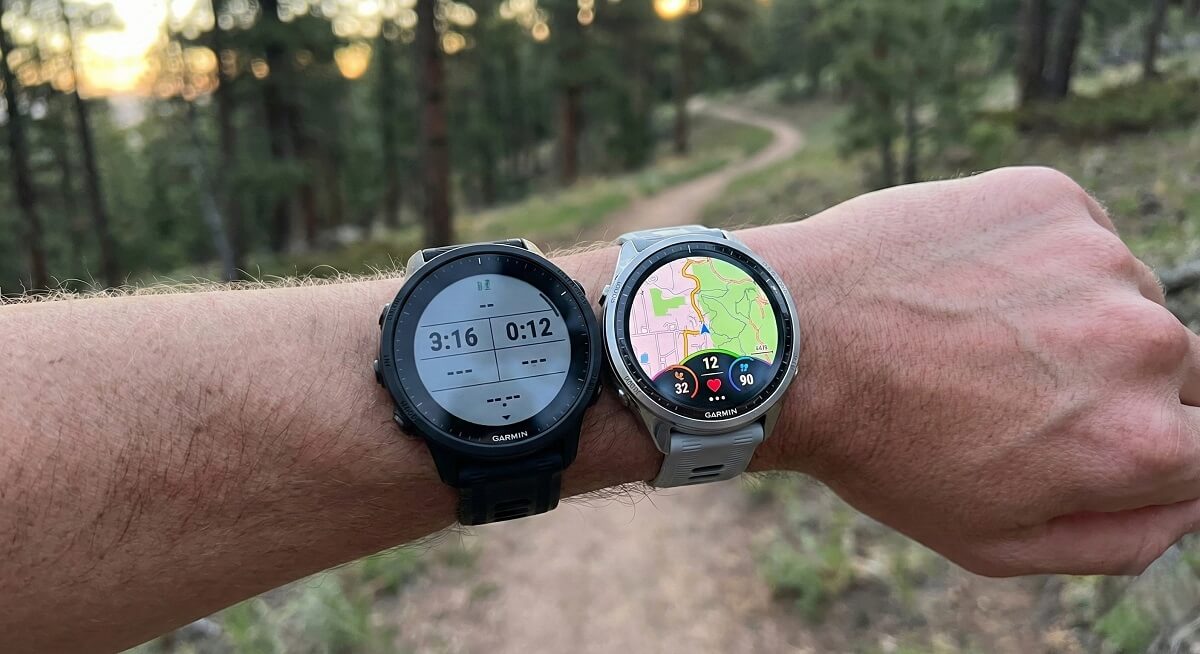
The Garmin Forerunner 965 and Forerunner 955 are two of the best GPS running watches you can buy, and choosing between them comes down to one main question: how much do you value display quality versus battery life? The 965 delivers a stunning AMOLED screen with vibrant colors and sharp resolution, while the 955 (especially the Solar model) counters with longer battery life and a lower price tag.
Here’s the reality: both watches offer identical training features, accurate GPS tracking, and comprehensive health metrics. The difference isn’t in what they can do, but in how you experience it. The 965’s 1.4-inch AMOLED display makes viewing maps and data easier, especially indoors. The 955’s MIP display excels in bright sunlight and sips power instead of gulping it. With the standard 955 starting around $499 and the 965 at $599, you’re paying $100 more for that premium screen experience.
If you’re upgrading from an older Garmin or buying your first premium running watch, the 965 is hard to beat in 2026. But if maximum battery life matters more than screen flash, or if you want to save some cash, the 955 remains an excellent choice that won’t leave you disappointed.
Quick Decision Guide: Which Forerunner Is Right for You?
✅ Choose the Forerunner 965 if:
- You want the brightest, sharpest display for easy reading in any condition
- You value modern aesthetics with the premium titanium bezel
- You can charge your watch weekly without hassle
- Display quality and visual experience matter more to you than maximum battery endurance
- You frequently use maps and navigation features during workouts
✅ Choose the Forerunner 955 (Standard) if:
- You’re working with a tighter budget and $100 savings matters
- You prefer the proven MIP display technology
- You want solid 15-day battery life without solar charging
- You don’t need the flashiest screen and prefer function over form
✅ Choose the Forerunner 955 Solar if:
- Maximum battery life is your absolute top priority
- You train outdoors frequently in sunny conditions where solar charging helps
- You want week-plus battery life even with heavy GPS use
- You like the peace of mind that comes with extended power reserves
❌ Skip both watches if:
- You need a more budget-friendly option (consider the instead)
- You want the absolute latest sensor technology (the Epix Pro has newer features)
- You need a smaller case size (both models only come in 47mm)
- You’re looking for a casual fitness tracker rather than a serious training tool
Garmin Forerunner 955 vs 965: At-a-Glance Comparison
Before we dive into the details, here’s how these three models stack up on paper. The specs reveal the key trade-offs you’ll be making between display technology and battery endurance.
| Feature | Forerunner 955 | Forerunner 955 Solar | Forerunner 965 |
|---|---|---|---|
| Display Type | 1.3″ MIP | 1.3″ MIP with Power Glass | 1.4″ AMOLED |
| Resolution | 260 x 260 pixels | 260 x 260 pixels | 454 x 454 pixels |
| Case Size | 46.5 x 46.5 x 14.4mm | 46.5 x 46.5 x 14.4mm | 47.2 x 47.2 x 13.2mm |
| Weight | 52g | 53g | 53g |
| Bezel Material | Fiber-reinforced polymer | Fiber-reinforced polymer | Titanium |
| Battery (Smartwatch) | Up to 15 days | Up to 20 days | Up to 23 days (7 days with always-on) |
| Battery (GPS Mode) | Up to 42 hours | Up to 49 hours | Up to 31 hours |
| Multi-band GPS | ✓ | ✓ | ✓ |
| Wrist Running Dynamics | ✓ | ✓ | ✓ |
| Music Storage | 32GB | 32GB | 32GB |
| Maps | ✓ | ✓ | ✓ |
| Launch Price | $499 | $599 | $599 |
Note: Prices shown are MSRP. Check current prices at Amazon, Best Buy, and Garmin’s website for the latest deals.
Display Showdown: Why This Is THE Deciding Factor
Let’s get straight to it: the display difference is what sets these watches apart. Everything else—the training features, GPS accuracy, health metrics—is essentially identical. Your choice between the 955 and 965 will likely come down to how you feel about AMOLED versus MIP screen technology.
The AMOLED Advantage (Forerunner 965)
The Forerunner 965’s 1.4-inch AMOLED display is a genuine upgrade over the 955’s screen. With a resolution of 454 x 454 pixels compared to the 955’s 260 x 260, you’re getting 3.05 times more pixels packed into a slightly larger screen. As Tom’s Guide notes in their comparison, “The AMOLED screen has a resolution of 454 x 454 pixels; it’s extremely bright and easy to see in all weather conditions.”
What does this mean in real-world use? Text appears sharper, maps show more detail, and data fields are easier to read at a glance. The colors are vibrant—not oversaturated like some AMOLED screens, but noticeably richer than the MIP display. If you’re used to a modern smartphone or an Apple Watch, the 965’s screen will feel familiar and comfortable.
The AMOLED display particularly shines (literally) in low-light conditions. Indoor workouts, early morning runs before sunrise, or checking your stats in a dimly lit room—these are all scenarios where the 965 makes life easier. Coach magazine’s reviewer found “it’s easier to read the AMOLED screen in most conditions, especially when indoors, under cloud cover or in dappled light.”
Map navigation is another area where the AMOLED screen earns its keep. The higher resolution and better contrast make it easier to spot trail intersections, upcoming turns, and points of interest. If you frequently use during runs or hikes, the 965’s display is genuinely more useful.
The MIP Display Defense (Forerunner 955)
Don’t write off the 955’s Memory-in-Pixel (MIP) display just because it’s not the newer technology. This screen type has powered Garmin watches for years, and it has some real advantages that matter for outdoor athletes.
Sunlight readability is where MIP displays dominate. The technology works by reflecting ambient light, which means the brighter the sun, the easier the screen is to read. No need to crank up the brightness or shade the watch with your hand during a sunny afternoon run. The 955 is always readable outdoors without any fuss.
Battery efficiency is another MIP strength. Since the display isn’t generating its own light, it draws minimal power. You can leave the 955’s screen on 24/7 without the battery hit you’d take with the 965’s always-on mode. This always-on capability means you never have to twist your wrist or tap the screen to see the time—it’s just there.
There’s also the matter of long-term durability. MIP displays don’t suffer from burn-in issues that can affect AMOLED screens over time. While burn-in is rare with normal use (more on this later), it’s not a concern at all with MIP technology. Your 955’s display will look the same in three years as it does on day one.
Real-World Visibility: Which Screen Wins Where?
Here’s a practical breakdown of which display works better in different scenarios:
- Bright outdoor running (full sun): The 955’s MIP display wins. It’s designed for this environment and requires no brightness adjustment.
- Indoor gym workout: The 965’s AMOLED screen is easier to read without natural light.
- Night running or pre-dawn training: The 965’s backlit AMOLED screen is far superior. The 955’s backlight works, but the AMOLED is brighter and clearer.
- Casual time checks throughout the day: Tie, but the 955 has an edge since it’s always-on without battery penalty.
- Viewing detailed maps mid-workout: The 965’s higher resolution makes a noticeable difference.
One more consideration: some users find the AMOLED screen more prone to visible scratches. Wareable’s reviewer noted that “in just a few weeks with the FR965, it’s picked up more screen and bezel scratches than we experienced in nine months of wearing the FR955.” If you’re hard on your gear, a screen protector for the 965 is worth considering.
Battery Life: The Trade-Off You Need to Understand
Battery life is where the tables turn. The 955, particularly the Solar version, delivers longer endurance—especially for GPS-intensive activities. But the gap isn’t as dramatic as you might expect, and the 965 still offers solid performance for most users.
Official Specs vs Real-World Performance
Let’s start with Garmin’s official battery life estimates:
| Mode | FR955 | FR955 Solar | FR965 |
|---|---|---|---|
| Smartwatch Mode | Up to 15 days | Up to 20 days | Up to 23 days (7 days w/ always-on) |
| GPS-Only Mode | Up to 42 hours | Up to 49 hours | Up to 31 hours |
| Multi-band GPS | Up to 20 hours | Up to 22 hours | Up to 19 hours |
| GPS + Music | Up to 8.5 hours | Up to 8.5 hours | Up to 10.5 hours |
Here’s the interesting part: the 965 actually claims better smartwatch battery life than the 955 (23 days vs 15 days). But there’s a catch—that’s with always-on display turned off and gesture wake enabled. Turn on always-on mode, and you’re looking at around 7 days, which is less than the standard 955.
Real-world testing tells a more nuanced story. In Wareable’s review, the 965 “typically lasts 6-8 days with daily GPS workouts and always-on display enabled,” while the 955 stretched to “8-12 days under similar conditions.” Coach magazine’s long-term review found the 965 lasted “six or seven days on a charge with always-on enabled,” versus “around eight days on average” for the 955 Solar with heavy training loads (50-60 miles of running per week).
For GPS tracking, the 955 Solar is the clear endurance champion. With 49 hours of GPS battery life, it can handle back-to-back ultramarathons or multi-day hiking trips. The 965’s 31 hours is still excellent for most runners—that’s good for tracking several marathons before needing a charge—but the 955 Solar offers meaningful extra headroom for ultra-endurance athletes.
Solar Charging: Does It Actually Matter?
The 955 Solar adds Power Glass that converts sunlight into battery power. According to Garmin’s specs, solar charging extends smartwatch battery life from 15 to 20 days (a 33% boost) and GPS mode from 42 to 49 hours (a 17% increase).
The effectiveness of solar charging depends heavily on your lifestyle. If you train outdoors frequently in sunny conditions—think desert running, alpine hiking, or cycling in clear weather—you’ll notice the benefit. One Garmin Forums user noted, “I’ve been very happy with the 955 Solar. Battery life is much, much better than either the 945 or 935.”
But if you mostly run indoors, train in cloudy climates, or spend most of your day indoors, the solar benefit is minimal. The watch needs direct sunlight exposure to generate meaningful charge. Coach’s review summed it up: “You will get more battery life from the Forerunner 955, especially if using the Solar version in sunny conditions.”
For most runners, the solar premium ($100 more than the standard 955) is a nice-to-have rather than essential. The standard 955’s 15-day smartwatch life and 42-hour GPS tracking already covers typical training schedules. The Solar version makes sense for ultrarunners, thru-hikers, or anyone who genuinely needs maximum battery life.
Training Features: Identical Where It Counts
Here’s some good news: you’re not sacrificing any training capabilities regardless of which watch you choose. The 955 and 965 offer the exact same suite of advanced metrics, and Garmin has updated both watches to maintain feature parity through software updates.
What’s the Same (And Why That’s Great)
Both watches include Garmin’s full arsenal of training tools:
- Training Readiness: A daily score that tells you if your body is ready for hard training or needs recovery time, based on sleep quality, HRV, stress, and recent workouts
- HRV Status: Heart rate variability tracking to monitor recovery and overall cardiovascular health
- Morning Report: A comprehensive daily briefing with sleep quality, HRV, training outlook, and weather
- Training Load and Recovery: Acute and chronic training load tracking to prevent overtraining
- Wrist-based Running Dynamics: Ground contact time, stride length, vertical oscillation, and more—all without a chest strap or foot pod
- Multi-band GPS with SatIQ: Accurate GPS tracking that automatically switches between modes for optimal accuracy and battery life
- Full mapping and navigation: TopoActive maps with turn-by-turn directions, breadcrumb trails, and point-to-point routing
- PacePro: Grade-adjusted pacing strategies for races with elevation changes
- ClimbPro: Real-time information about upcoming climbs during trail runs
- VO2 Max estimation: Track fitness improvements over time
- Race Predictor: Estimated finish times for various distances based on your current fitness
- 32GB music storage: Download playlists from Spotify, Amazon Music, or Deezer for phone-free runs
- Garmin Pay: NFC payments so you can leave your wallet behind
According to Android Authority’s comparison, “Both devices offer 32GB of onboard storage…Even the sensors are largely identical, including multi-band GNSS, SatIQ technology, and Garmin’s Elevate heart rate sensor. As is often the case on Garmin’s devices, we found heart rate data and GPS tracking to be highly accurate on both generations.”
The 965 initially launched with a few exclusive features like Chronic Training Load, but Garmin has since updated the 955 to include these tools. As Tom’s Guide noted, newer features “are going to be rolled out to the Forerunner 955 and Fenix 7 shortly” after appearing on the 965. This pattern of software updates means you’re not missing out on training capabilities by choosing the older model.
Any Actual Differences?
The only real differences are in the user experience rather than functionality. The 965’s AMOLED screen makes viewing detailed maps and data fields easier, but it doesn’t add features that the 955 lacks. Both watches track the same activities, analyze your training the same way, and connect to the same external sensors.
One minor consideration: Garmin sometimes releases new features to the latest models first before rolling them back to older watches. The 965 might get new metrics a few months before the 955 receives them via firmware update. But historically, Garmin has been good about maintaining feature parity across their premium watches.
Bottom line: Your decision shouldn’t be based on training features. They’re equal in this department.
Build Quality and Long-Term Durability
Both watches feel well-built and ready for serious training, but there are subtle differences in materials and construction that affect durability and aesthetics.
Materials Breakdown
The most obvious difference is the bezel. The 965 features a titanium bezel that gives it a more premium look and feel, while the 955 uses a fiber-reinforced polymer bezel. As Bandletic notes in their comparison, “the Garmin Forerunner 965 enhances by applying a titanium bezel, giving it a more premium feel.”
Despite the different bezel materials, both watches weigh essentially the same—around 53g without a strap. The 965 is slightly thinner (13.2mm vs 14.4mm), making it a bit more streamlined on your wrist, but the difference isn’t dramatic.
Glass protection differs slightly. The 955 uses Gorilla Glass DX (or Power Glass on the Solar version), while the 965 has Gorilla Glass 3. DC Rainmaker noted that this is actually a downgrade from the 955’s glass, though in practice, both are scratch-resistant enough for daily use.
Both watches have 5 ATM water resistance, meaning they’re suitable for swimming and showering but not for high-velocity water sports like waterskiing. This is standard for Garmin’s running-focused watches.
Durability in the Real World
Here’s where user reports get interesting. The AMOLED screen on the 965, while gorgeous, may be more prone to visible scratches than the MIP display on the 955. Wareable’s review specifically mentioned, “In just a few weeks with the FR965, it’s picked up more screen and bezel scratches than we experienced in nine months of wearing the FR955.”
This doesn’t mean the 965 is fragile—Gorilla Glass 3 is still tough stuff. But if you’re hard on your gear or frequently bang your watch against rocks, trees, or gym equipment, consider adding a screen protector to the 965. The 955’s MIP screen seems to hide scratches better and may be inherently more resistant to surface damage.
On the flip side, the titanium bezel on the 965 should hold up better to daily wear than the polymer bezel on the 955. Titanium is scratch-resistant and won’t show wear as obviously as polymer materials can over years of use.
One durability concern worth mentioning: AMOLED burn-in. While rare with normal use, AMOLED displays can develop permanent ghost images if you leave the same content on screen for extended periods at high brightness. Garmin’s official guidance states, “To extend the display life, you should avoid displaying static images at high brightness levels for long time periods.”
Reports of burn-in exist but aren’t widespread. One Garmin forums user reported an Epix Gen 2 (which uses the same AMOLED technology) experiencing burn-in “after a bit less than 3 years, never used with AOD, no max brightness.” However, the consensus from multiple reviewers is that “burn-in simply isn’t an issue for the overwhelming vast majority of users in today’s displays.” The MIP display on the 955 doesn’t have this concern at all.
Pricing and Value Analysis: Which Gives You More?
Let’s talk money. The Forerunner 955 launched at $499, the 955 Solar at $599, and the 965 at $599. These are still the general price points you’ll find in 2026, though sales and promotions can shift the value equation.
Price-to-Performance Breakdown
At first glance, the pricing creates an interesting situation. The 955 Solar and the 965 cost the same, which means you’re choosing between solar-enhanced battery life or an AMOLED display at the same price point. Android Authority put it well: “The Forerunner 955 Solar launched at $599, or the same price as the Forerunner 965. That tightens the race as we’d recommend the Solar model to shoppers considering the 955 series.”
The standard 955 saves you $100 compared to the 965. That’s meaningful money, especially considering you’re getting all the same training features and GPS accuracy. As Tom’s Guide notes, “if you’re on a budget, the Forerunner 955 is the cheaper of the two watches. Not only is it likely to be on sale now the 965 has been released, but even full-price it’s $100 cheaper.”
Here’s the value proposition for each:
- Standard 955 ($499): Best pure value. You save $100 and only give up the AMOLED screen and titanium bezel. If you’re budget-conscious or don’t care about display tech, this is the smart buy.
- 955 Solar ($599): Makes sense if you train outdoors frequently and want maximum battery life. At the same price as the 965, it’s a legitimate alternative for ultrarunners and multi-day adventurers.
- 965 ($599): The premium option. You’re paying for the better screen, thinner profile, and titanium bezel. If the display quality and modern aesthetics matter to you, the extra cost is justified.
Don’t forget to check for deals. Garmin watches frequently go on sale around Black Friday, Prime Day, and other shopping events. The 955, being the older model, often sees deeper discounts. Tom’s Guide noted finding the 955 at $469 on Best Buy during one sale period.
Hidden Costs and Accessories
Beyond the watch price, consider a few additional costs:
- Screen protector: Recommended for the 965 ($10-20)
- Extra charging cables: Helpful for travel ($10-15 each)
- Replacement bands: Both use QuickFit 22mm bands ($20-50 depending on material)
- Chest strap for more accurate HR: Optional but useful for interval training ($60-120)
These accessories apply to both watches equally, so they don’t change the relative value proposition.
Long-Term Value and Resale
Garmin watches hold their value reasonably well on the secondhand market. The 955, being older, has depreciated more than the 965, but both retain decent resale value compared to some competitors. If you take care of your watch and decide to upgrade in a few years, you can typically recoup 40-60% of the original price.
Software support is another consideration for long-term value. Garmin historically supports their premium watches for several years with firmware updates. The Forerunner 945, for example, continued receiving feature updates well after the 955 launched. You can expect both the 955 and 965 to stay current through at least 2027-2028.
Real-World Use Cases: Which Watch for Your Training?
Let’s get specific about which watch makes sense for different types of athletes and training goals.
For Marathon and Ultra Runners
If you’re logging serious mileage and racing long distances, battery life becomes crucial. The 955 Solar is the standout choice here. With 49 hours of GPS tracking, you can complete back-to-back ultramarathons or multi-day stage races without recharging mid-event.
The 965’s 31 hours is still enough for most marathoners and even 50-mile ultras, but if you’re racing 100-milers or multi-day FKT attempts, the Solar’s extra endurance provides important security. Plus, if you’re on the trail for 10+ hours, you’re likely getting enough sun exposure to benefit from solar charging.
Display quality matters less during ultra efforts since you’re mainly checking pace and distance rather than detailed maps. The 955’s always-on MIP display is easier to glance at mid-stride without wrist gestures.
For Triathletes
Both watches handle triathlon training and racing well, with multi-sport modes that let you transition smoothly between swim, bike, and run. The choice here comes down to personal preference rather than functionality.
The 965’s AMOLED screen is easier to read when wet, which helps during open water swimming when you need to check navigation or distance. The higher resolution also makes viewing bike maps during long rides more convenient.
However, triathletes who do long-course events (Ironman distance) might appreciate the 955 Solar’s extended battery life. An Ironman can take 10-17 hours to complete, and knowing you have plenty of battery reserve removes one worry on race day.
For Casual Runners and Fitness Enthusiasts
If you’re running 3-5 times per week with occasional long runs, and you mix in some cycling, gym workouts, or yoga, either watch gives you more features than you’ll probably use. The decision here is more about daily wear experience.
The 965 feels more like a modern smartwatch that happens to be excellent for running. The AMOLED screen makes checking notifications, viewing weather, and scrolling through data easier throughout the day. If you’re wearing the watch 24/7 as your primary timepiece, the 965’s aesthetics and display quality enhance the everyday experience.
The standard 955 makes sense if you want to save money and don’t need the premium features. You’re still getting comprehensive training metrics and accurate tracking for all your workouts, just with a less flashy presentation.
For Trail Runners and Hikers
Trail runners and hikers rely heavily on navigation features, which is where the 965’s AMOLED screen shows its value. The higher resolution and better contrast make it easier to spot trail junctions, read topographic details, and identify landmarks on the map.
That said, the 955’s MIP display is superior in bright sunlight, which is common on exposed trails above treeline or in desert environments. If you primarily run in sunny conditions, the 955 might actually be easier to read during key navigation moments.
For all-day hikes or fastpacking trips, the 955 Solar’s 49-hour GPS battery life is hard to beat. You can track an entire weekend adventure without worrying about battery conservation strategies.
The Verdict: Which Should You Buy?
After comparing every aspect of these watches, here’s our take: The Forerunner 965 is the better overall choice for most runners in 2026, but the 955 remains an excellent value pick depending on your priorities.
Our Top Pick: Forerunner 965
The 965 earns the top spot because its AMOLED display genuinely improves the daily experience of using the watch. Maps are easier to read, data fields are clearer, and the overall interface feels more modern and responsive. For most runners who charge their watch weekly anyway, the battery life difference isn’t a dealbreaker.
At $599, it’s not cheap, but you’re getting Garmin’s full suite of training tools wrapped in a package that looks and feels premium. The titanium bezel adds a touch of class, and the thinner profile (13.2mm vs 14.4mm) makes it more comfortable for all-day wear.
The 965 makes the most sense if you value user experience and don’t want to compromise on display quality. It’s the watch to buy if you want the best that Garmin currently offers in the Forerunner line.
Best Value: Forerunner 955
Don’t overlook the standard 955. At $100 less than the 965, it delivers all the same training features, accurate GPS tracking, and comprehensive health metrics. You’re only giving up the fancy screen and titanium bezel—everything that matters for actual training is identical.
If you’re budget-conscious, or if you simply don’t care about having the latest display technology, the 955 is a smart buy. The MIP display is perfectly functional, battery life is excellent, and you’re saving real money that could go toward running shoes, race entries, or other gear.
Best for Endurance Athletes: Forerunner 955 Solar
Ultrarunners, thru-hikers, and anyone doing multi-day adventures should seriously consider the 955 Solar. The 49 hours of GPS battery life provides crucial margin for long events, and the solar charging can extend that further in sunny conditions.
At $599, it costs the same as the 965, so you’re choosing between display quality and battery endurance. For most casual runners, the 965’s screen is more valuable. But if you’re doing events where battery life is a limiting factor, the Solar is the practical choice.
What About Upgrading from the 955?
If you already own a 955 and are wondering whether to upgrade to the 965, our answer is probably not—unless the screen quality really bothers you.
The training features are identical, GPS accuracy is the same, and you’d be spending $599 mainly to get a better display. That’s a tough value proposition when your current watch already does everything well. Save your money and wait for the next generation (likely a 975 or 970) that might bring more substantial upgrades.
The exception: If you find a great trade-in deal or can sell your 955 for good money, upgrading might make sense if you genuinely value display quality and use navigation features frequently.
Frequently Asked Questions
Is the AMOLED display on the 965 worth the extra cost?
It depends on your priorities. The AMOLED screen is noticeably sharper and easier to read indoors, and it makes viewing maps more convenient. If you value user experience and modern aesthetics, the $100 premium over the standard 955 is justified. But if you mainly care about training features and GPS accuracy—which are identical between the models—you can save money with the 955 and not miss out on anything functional.
Does the Forerunner 965 have solar charging?
No, the Forerunner 965 does not offer solar charging. Only the Forerunner 955 Solar has Power Glass that converts sunlight into battery power. Garmin likely omitted solar from the 965 because AMOLED displays already consume more power, and adding solar charging might not provide significant practical benefit to offset the added cost and complexity.
Which watch has better battery life?
The Forerunner 955 Solar has the best battery life, with up to 20 days in smartwatch mode and 49 hours in GPS mode. The standard 955 offers 15 days and 42 hours respectively. The 965 claims 23 days in smartwatch mode (without always-on display) but only 31 hours in GPS mode. For real-world use with daily GPS tracking, expect 8-12 days from the 955, and 6-8 days from the 965 with always-on display enabled.
Are the training features the same on both watches?
Yes, both watches offer identical training features. This includes Training Readiness, HRV Status, wrist-based Running Dynamics, multi-band GPS, VO2 Max estimation, PacePro, ClimbPro, and all of Garmin’s advanced metrics. The 965 initially launched with a few exclusive features, but Garmin has since updated the 955 to achieve feature parity. You’re not missing out on training capabilities by choosing the older model.
Will the 955 get the same software updates as the 965?
Garmin has shown a pattern of supporting both models with firmware updates to maintain feature parity. While the 965 might receive new features a few months earlier, Garmin typically rolls out updates to the 955 as well. The company has historically supported their premium watches for several years—for example, the Forerunner 945 continued receiving updates well after the 955 launched. Expect both watches to stay current through at least 2027-2028.
Which is more durable?
Both watches are well-built, but there are trade-offs. The 965’s titanium bezel is more scratch-resistant than the 955’s polymer bezel, but some users report the 965’s AMOLED screen showing scratches more easily than the 955’s MIP display. The 955’s MIP technology also doesn’t have any risk of burn-in, while AMOLED screens can theoretically develop ghost images over time (though this is rare with normal use). For maximum durability, consider adding a screen protector to whichever watch you choose.
Can both watches track the same sports?
Yes, both the 955 and 965 support the same activity profiles, including running, trail running, cycling, swimming, triathlon, strength training, hiking, and dozens of other sports. They connect to the same external sensors, offer the same mapping and navigation features, and analyze your training identically. The only difference is how you view this information on screen—the experience, not the functionality.
Does the AMOLED screen have burn-in issues?
While AMOLED burn-in is possible if you leave static images on screen at high brightness for extended periods, it’s rare with normal watch use. Garmin includes automatic screen timeouts and shifts displayed content to minimize burn-in risk. Some reports exist of burn-in on Garmin’s AMOLED watches after 2-3 years, but these cases are uncommon. The consensus from multiple reviewers is that burn-in “isn’t an issue for the overwhelming vast majority of users.” The 955’s MIP display doesn’t have this concern at all.
Which is better for ultramarathons?
The Forerunner 955 Solar is better for ultramarathons and long-distance events. With 49 hours of GPS battery life, it can handle 100-mile races and multi-day adventures without recharging. The 965’s 31 hours is enough for most ultras up to 50-60 miles but may require battery conservation strategies for longer events. The Solar’s extended endurance provides important peace of mind when you’re on the trail for 20+ hours. Plus, outdoor ultra events give you sun exposure that helps the solar charging work.
Is the 955 Solar worth $100 more than the standard 955?
The Solar premium makes sense for specific users. If you train outdoors frequently in sunny conditions, do ultra-distance events, or multi-day adventures, the extended battery life (20 days smartwatch, 49 hours GPS) is valuable. However, for most runners who train a few times per week and can charge weekly, the standard 955’s 15 days and 42 hours is already plenty. The solar benefit is most noticeable for people spending long periods outside in direct sunlight—ultrarunners, thru-hikers, and outdoor athletes in sunny climates.
Where to Buy the Forerunner 955 and 965
These Garmin watches are widely available from major retailers. Here’s where to check current prices and availability:
- Amazon: Often has competitive pricing and fast Prime shipping. Check for lightning deals and price drops.
- Best Buy: Good for in-store pickup and easy returns. Sometimes offers exclusive bundle deals.
- REI: Members get 10% back in dividends. Excellent return policy for outdoor gear.
- Garmin Official Store: Direct from the manufacturer, with full warranty coverage and occasional promotions.
Both watches typically see their best discounts during Black Friday, Amazon Prime Day (July), and around major running season peaks (spring and fall). If you’re not in a rush, waiting for a sale can save you $50-100.
Note that all major retailers offer similar return policies (typically 30 days), so you can try the watch and return it if it doesn’t work for you. Just keep the packaging intact and avoid heavy use during your trial period.
Whether you choose the Forerunner 955 or 965, you’re getting one of the best GPS running watches available. Both offer accurate tracking, comprehensive training metrics, and the reliability Garmin is known for. Check current prices at the retailers above, and pick the model that fits your priorities and budget. Your training data will thank you.
