


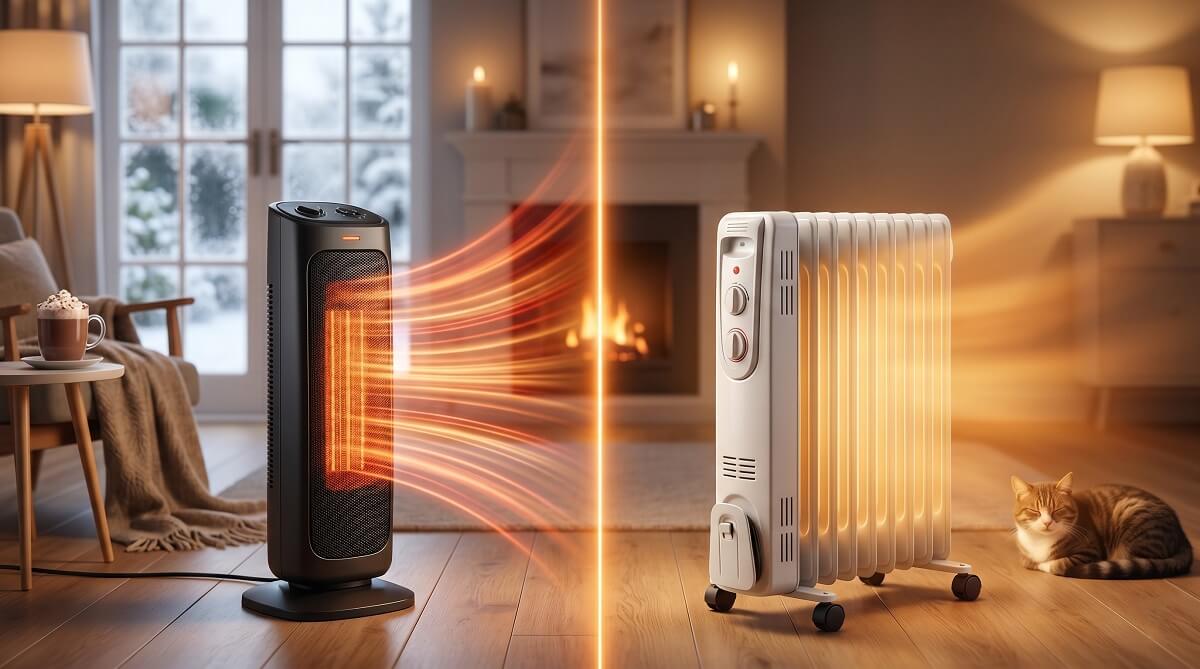
Short answer: if you need a room warmed up in the next five minutes and you’ll only run the heater for a couple of hours, a ceramic heater is the right call. If you want quiet warmth through the night or consistent heat for a long evening in your home office, an oil-filled radiator does the job better — and for less money over time.
Both types draw the same 1,500 watts at full power, so the hourly operating cost is identical. What separates them is heat-up time, noise, how long the warmth lasts after you turn it off, and total cost of ownership once you factor in that oil heaters tend to last 10–15 years versus 5–8 years for ceramic models. At the current US average of about 16.8–17.2 cents per kWh , those lifespan differences add up.
This guide covers everything competitors skip: the actual monthly and five-year cost math, three rounds of CPSC safety recalls you should know about, and a room-sizing table so you can figure out whether 750W or 1,500W is enough for your space.
How Each Heater Actually Works
Ceramic Heaters — Fast Heat, Fan-Driven
A ceramic heater uses a PTC (Positive Temperature Coefficient) element — a type of ceramic that self-regulates its temperature. As the element heats up, its electrical resistance increases, which naturally limits how hot it can get. A small fan blows room air across the ceramic element and pushes warm air out into the space.
The result: you feel warm air within 60–90 seconds of turning it on. The tradeoff is noise (the fan runs continuously at 35–50 dB) and the fact that the room cools back down quickly once you shut it off. Ceramic heaters are also lighter — most weigh between 3 and 6 pounds — so they’re easy to carry room to room. For specific model picks, see our .
Oil-Filled Radiators — Slow Heat, Long Hold
An oil-filled radiator works more like a hot water bottle than a fan heater. An electric heating element warms a reservoir of diathermic oil sealed inside metal fins. The oil never burns or evaporates — it just stores and transfers heat. The fins radiate warmth outward and set up a convection current that gradually warms the room from floor to ceiling.
There’s no fan, no moving parts, and no noise. Heat-up time runs 15–30 minutes depending on room size and temperature, but the payoff is that the fins hold heat for 30–60 minutes after you cut power. Most oil radiators weigh 10–20 pounds and aren’t designed to be moved constantly, though most have wheels.
Who Should (and Shouldn’t) Buy Each Type
✅ Choose a Ceramic Heater If…
- You need a room warmed up in under 5 minutes
- You use the heater in short bursts — 1 to 3 hours at a time
- Portability matters (ceramic units are easy to move between rooms)
- You’re heating a small space under 150 square feet
- Your budget is tight: decent ceramic heaters start around $25–$55
✅ Choose an Oil-Filled Radiator If…
- You want quiet warmth in the bedroom overnight — zero fan noise matters to you
- You run the heater for 4 or more hours in one session
- You have allergies or asthma (no moving air means no dust circulation)
- You’re heating a medium room between 150 and 300 square feet
- You want a longer-lasting appliance and lower total cost over years
❌ Neither Type Is a Good Fit If…
- You’re trying to heat a large open-plan space — a mini-split or baseboard heater is a better tool for that job
- You’re already at capacity on a 15A shared circuit — a 1,500W heater draws 12.5A and needs its own outlet
- You plan to use an extension cord — the CPSC explicitly prohibits this for space heaters of any type
The Real Cost of Running Each Heater
Cost Per Hour at Current US Electricity Rates
Both a ceramic heater and an oil-filled radiator max out at 1,500 watts. The formula is simple: divide watts by 1,000 to get kilowatts, then multiply by your rate per kWh. At the current US residential average of about 16.8–17.2 cents per kWh (EIA, December 2025), a 1,500W heater costs roughly 25–26 cents per hour at full power. A 750W setting cuts that to 13 cents per hour.
| Wattage | Cost at $0.168/kWh | Cost at $0.172/kWh |
|---|---|---|
| 750W (low setting) | $0.13/hr | $0.13/hr |
| 1,500W (full power) | $0.25/hr | $0.26/hr |
Since both heater types draw the same wattage, the cost per hour is the same. Where oil heaters gain an edge is usage pattern: their residual heat means you can turn them off 30–45 minutes before you leave a room and still feel warmth, effectively cutting your active run time.
Monthly Cost at Typical Usage Levels
Running a 1,500W heater at full power for 4 hours a day for 30 days comes out to $30.24 per month at $0.168/kWh (1.5 kW × 4 hr × 30 days × $0.168). At 8 hours per day — a reasonable all-day work-from-home scenario — that doubles to $60.48. These figures are the same for ceramic and oil heaters running at the same wattage.
| Daily Use | Monthly Cost | Annual Cost |
|---|---|---|
| 2 hours/day | $15.12 | $181 |
| 4 hours/day | $30.24 | $363 |
| 8 hours/day | $60.48 | $726 |
Total Cost of Ownership Over 5 Years
Purchase price and hourly running costs tell only part of the story. Oil-filled radiators typically last 10–15 years with zero consumable parts. Ceramic heaters average 5–8 years, and the fan and filter need periodic cleaning to maintain efficiency — a clogged filter on a ceramic heater reduces airflow and can shorten motor life.
A representative ceramic model like the Dreo DR-HSH004 runs about $53 at retail. A capable oil radiator like the De’Longhi EW7707CM carries an MSRP of around $130. Assume 4 hours of daily use during a 5-month heating season:
| Ceramic (Dreo) | Oil (De’Longhi) | |
|---|---|---|
| Purchase price | $53 | $130 |
| Annual running cost (4h × 150 days × $0.25/hr) | $151 | $151 |
| 5-year running cost | $755 | $755 |
| 5-year total | $808 | $885 |
| Lifespan | 5–8 years (may need replacement after Year 5) | 10–15 years (still going at Year 5) |
After 5 years, the ceramic heater has cost about $77 less — but you may be buying a replacement. The oil radiator keeps running and continues to pay down its higher upfront cost. If you stretch the comparison to 10 years and buy a second ceramic heater, the oil radiator wins on total cost. Our covers which specific models hold up best long-term.
Safety — What the CPSC Data Actually Shows
Space heaters cause roughly 1,700 residential fires per year in the US, according to the CPSC. Most discussions of heater safety stop at surface temperature comparisons, but the recall database tells a more specific story — one that oil heater buyers in particular should know about.
Three Major Oil-Filled Radiator Recalls
The CPSC has issued several significant recalls of oil-filled radiators over the past two decades:
- Holmes HOH2505/HOH2520 (2007): Approximately 300,000 units recalled due to a poor internal electrical connection that could cause overheating, fire, and burn hazards. There were 59 incidents including 4 fires.
- King of Fans Maxi-Heat Model 70030 (2005): Approximately 202,000 units recalled after weld failures in the heating fins allowed oil to leak, creating burn and fall hazards.
- Holmes HOH3000/HOH3000B (2015): Approximately 34,000 units recalled after units were found to spray heated oil unexpectedly, posing a scald hazard.
None of this means oil heaters are unsafe as a category — major brands like De’Longhi and Pelonis have solid safety records. But it does mean you should check the CPSC recall database before buying any space heater, and register your product so you receive recall notifications.
Surface Temperature and Clearance
Ceramic heaters typically reach 120–175°F on their outer casing. Oil radiator fins can reach 140–200°F — potentially hotter to the touch than you’d expect. Both types require a minimum 3-foot clearance from curtains, bedding, furniture, and other flammables. Keep children and pets away from either type when running.
The Extension Cord Rule (Don’t Break This One)
A 1,500W heater draws 12.5 amps on a standard 120V circuit. Extension cords — even heavy-duty ones — are not rated for continuous high-current loads and can overheat at the connection point, creating a fire risk. Plug your heater directly into a wall outlet. If there’s no outlet where you need it, the answer is hiring an electrician, not running an extension cord.
Air Quality and Comfort
Does a Ceramic Heater Dry Out the Air?
Neither heater type produces or destroys moisture — electric resistance heating doesn’t involve combustion, so there’s no byproduct gas. What does happen is that heating the air in a room reduces relative humidity. A room at 68°F and 40% RH can drop to around 28–32% RH when heated to 75°F with the same amount of moisture present in the air.
The EPA recommends keeping indoor RH between 30–50%. Dropping below 30% can dry out nasal passages and skin, and aggravate respiratory conditions. If you’re running a heater for long periods in a dry climate, a simple hygrometer (under $15) tells you whether you need a humidifier to compensate. This applies to both heater types, though ceramic heaters’ continuous air circulation tends to accelerate the drying effect slightly faster.
Allergy and Asthma Considerations
Ceramic fan heaters circulate air through the room, which also stirs up settled dust and allergens. Clean or replace the filter every 3 to 6 months — a clogged filter not only reduces heat output but pushes more particulates into the room. Oil radiators have no fan and no filter, making them the preferred choice for people with asthma, dust sensitivities, or year-round allergies.
Choosing the Right Size for Your Room
The widely used rule of thumb is 10 watts per square foot for a normally insulated room. That means a standard 1,500W heater is designed to supplement heat in a space up to about 150 square feet. Well-insulated rooms need a bit less; drafty older construction or rooms with high ceilings need more.
| Room Size | Recommended Wattage | Better Heater Type |
|---|---|---|
| Up to 100 sq ft (small bedroom, bathroom) | 750W–1,000W | Ceramic (fast warm-up, lower power draw) |
| 100–150 sq ft (standard bedroom, home office) | 1,000W–1,500W | Either — ceramic for quick heat, oil for overnight |
| 150–250 sq ft (living room, dining area) | 1,500W+ | Oil-filled radiator (better heat retention for larger spaces) |
| 250+ sq ft | Multiple units or alternative heating system | Neither type is adequate alone |
Keep in mind the DOE recommends using space heaters only as supplemental heat — they’re not designed to replace a primary heating system for whole-home warmth.
Ceramic Heater vs Oil Heater — Full Comparison
| Feature | Ceramic Heater | Oil-Filled Radiator |
|---|---|---|
| Heat-up time | 1–3 minutes | 15–30 minutes |
| Heat retention after shutoff | Under 5 minutes | 30–60 minutes |
| Noise level | 35–50 dB (fan audible) | Completely silent |
| Typical max wattage | 1,500W | 1,500W |
| Cost per hour (full power, $0.168/kWh) | ~$0.25 | ~$0.25 |
| Typical purchase price | $25–$80 | $50–$150 |
| Estimated lifespan | 5–8 years | 10–15 years |
| Air circulation | Yes (fan-driven) | No (radiant + convection) |
| Weight / portability | 3–6 lbs (very portable) | 10–20 lbs (wheeled, less portable) |
| Best room size | Up to 150 sq ft | 150–300 sq ft |
| Overnight use | Use with caution; fan risk if blocked | Lower fire risk; preferred for overnight |
| Good for allergies? | No (circulates air and dust) | Yes (no moving air) |
| Maintenance | Clean/replace filter every 3–6 months | Occasional fin dusting; no consumable parts |
Frequently Asked Questions
Which is cheaper to run: a ceramic heater or an oil heater?
At the same wattage setting, they cost exactly the same per hour. A 1,500W heater of either type costs about 25 cents per hour at the current US average of around 16.8 cents per kWh. The oil heater can save money over longer sessions because its residual heat means you can turn it off earlier and the room stays warm — effectively reducing actual run time.
Can you leave a ceramic heater on all night?
Modern ceramic heaters have tip-over shutoff and overheat protection, and some are designed for extended use. That said, the CPSC advises against leaving any space heater running while you sleep. If you do use one overnight, make sure it has updated safety certifications (look for ETL or UL listings), keep it on a hard, flat surface, and maintain at least 3 feet of clearance from bedding and curtains.
Can you leave an oil-filled radiator on overnight?
Oil heaters are generally considered safer for overnight use than ceramic heaters — no fan means no blockage risk, and the sealed oil system doesn’t involve combustion. Still, the safest approach is to use the built-in thermostat to cycle the unit on and off, rather than running it at full power continuously. Check that your specific model hasn’t been subject to a CPSC recall before using it overnight.
Which heater is better for a bedroom?
For most people, an oil-filled radiator is the better bedroom choice: silent operation won’t disturb sleep, and the residual heat keeps the room comfortable after shutoff. If you need a bedroom warmed up quickly before getting in bed, a ceramic heater can do that job in a few minutes — then turn it off before you sleep.
Do ceramic heaters dry out the air?
Indirectly, yes. All electric resistance heating reduces relative humidity by warming the air without adding moisture. If your indoor RH drops below 30%, you may notice dry skin, irritated nasal passages, or static electricity. A hygrometer (under $15) lets you monitor levels. The EPA’s target range is 30–50% RH; if you drop below that, a small humidifier counteracts the drying effect.
Are oil-filled heaters a fire hazard?
The oil inside is sealed and doesn’t burn under normal operating conditions. But the CPSC recall record shows that internal electrical faults and weld failures have caused fires, burns, and oil leaks in specific models. Before buying or using an oil heater, check your model against the CPSC recall database at cpsc.gov. Buy from reputable brands and look for ETL or UL certification.
Which is better for allergies or asthma: ceramic or oil?
Oil-filled radiators are the clear choice for allergy and asthma sufferers. With no fan, they don’t circulate air and don’t stir up dust, pollen, or pet dander. Ceramic heaters run a fan constantly, which can move settled allergens back into the breathing zone. If you use a ceramic heater, keep the filter clean — wash or replace it every 3 to 6 months.
How long do oil-filled heaters last compared to ceramic?
Oil-filled radiators typically last 10–15 years with minimal maintenance. Ceramic heaters average 5–8 years; the fan and motor are the failure points, and a clogged filter accelerates wear. If you’re planning long-term use, the oil heater’s higher upfront cost ($50–$150 vs. $25–$80 for ceramic) pays for itself over time.
Can I use a space heater with an extension cord?
No. A 1,500W heater draws 12.5 amps continuously — more than most extension cords handle safely over a sustained period. The connection point between the cord and the outlet or plug can overheat and spark a fire even when the cord itself is technically rated for the amperage. Always plug a space heater directly into a wall outlet.
Which heater is better for a home office?
It depends on your setup. For a small dedicated office under 100 square feet where you work in 1–2 hour blocks, a ceramic heater heats the space quickly and you can turn it off when you step away. For an all-day work-from-home setup where you want background warmth without fan noise distracting you during calls or focus work, an oil-filled radiator delivers consistent, silent heat.
Ready to pick one? Check current prices and availability for ceramic heaters on Amazon or Best Buy. For oil-filled radiators, start with the De’Longhi EW7707CM on Amazon or browse Best Buy’s oil radiator selection. Whatever you buy, register the product with the manufacturer and check cpsc.gov for any existing recalls before plugging it in.
