


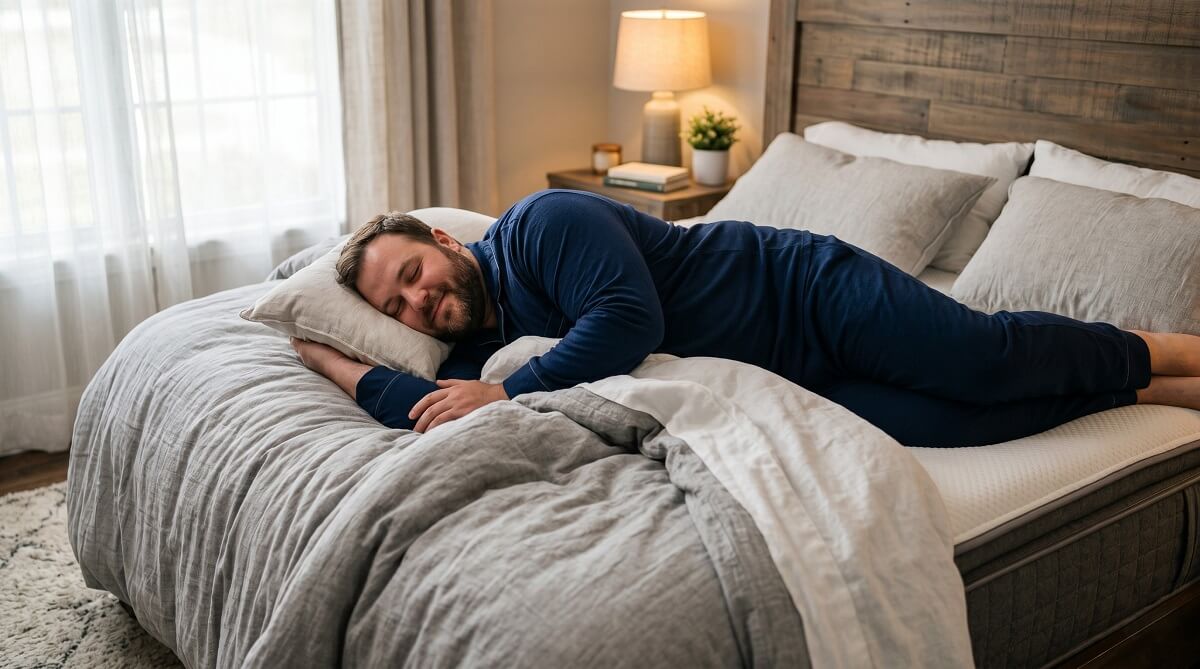
If you’re over 230 lbs and have watched a mattress go from supportive to saggy inside of two years, the problem usually isn’t bad luck — it’s that most mattresses aren’t built for heavier bodies. The you’ll find online mostly cover standard sleepers. This one doesn’t. Every pick here is a hybrid engineered specifically for higher-weight sleepers — verified weight capacity, an independent test score, and real specs — not just marketing copy.
Our top pick for most heavier sleepers is the WinkBed Plus. It supports up to 450 lbs per side (900 lbs combined), earned a 9.34/10 from NapLab’s 360-mattress test database, and offers exceptional edge support — which matters a lot when you’re getting in and out of bed multiple times a night. For couples or anyone prioritizing high weight capacity, the Big Fig Classic supports 550 lbs per side (1,100 lbs combined) and comes in under $2,000 direct.
Below you’ll find six picks at different price points and firmness levels, plus an honest explanation of what engineering actually separates a mattress built for heavy people from a regular bed with a premium price tag.
Who Should (and Shouldn’t) Use This Guide
✅ Best For
- Sleepers 230 lbs and up looking for a bed that won’t sag by year two
- Couples where one or both partners are 250+ lbs
- Anyone whose lower back pain worsens on softer, sinking mattresses
- Hot sleepers who need actual cooling — not just a “cooling cover” label
- People who use the full edge of the bed (for sleeping, sitting, or getting up)
❌ Skip This Guide If
- You weigh under 200 lbs — standard mattress guides will serve you better
- You prefer deep, enveloping memory foam (most options here are firmer by design)
- Your budget is under $1,000 — purpose-built models carry a real cost premium
Our Top Picks at a Glance
Six models engineered for higher-weight sleepers, all verified for weight capacity and independently reviewed. For context on how , the buying guide section below explains the key numbers.
| Mattress | Price (Queen) | Type | Firmness | Weight Cap./Side | Trial | Warranty |
|---|---|---|---|---|---|---|
| WinkBed Plus | ~$1,999 (check winkbeds.com) | Hybrid | Slightly Firm (7/10) | 450 lbs | 120 nights | Lifetime |
| Big Fig Classic | $1,949 at bigfigmattress.com | Hybrid | Slightly Firm (7/10) | 550 lbs | 120 nights | 20 years |
| Saatva HD | ~$2,999–$3,399 (check saatva.com) | Innerspring Hybrid | Slightly Firm (7/10) | 500 lbs | 365 nights | Lifetime |
| Titan Plus Core | ~$1,349 (check titanmattress.com) | Hybrid | Medium-Firm (6/10) | 500 lbs | 120 nights | Lifetime |
| Nolah Evolution Comfort+ | ~$1,624–$2,499 (check nolahmattress.com) | Hybrid | Medium (5.5/10) | 500 lbs | 120 nights | Lifetime |
| Leesa Plus Hybrid | $1,319 at leesa.com | Hybrid | Medium-Firm (6/10) | 500 lbs | 120 nights | Lifetime |
Prices verified as of March 17, 2026. Sales are common — check manufacturer sites for current deals.
The 6 Best Mattresses for Heavy People
WinkBed Plus — Best Overall
Who it’s for: Heavier back and side sleepers 250–450 lbs who want the closest thing to a “does everything right” mattress.
The WinkBed Plus is the heavier-sleeper version of WinkBeds’ flagship model. The main difference: a denser latex comfort layer replaces the poly foam used in the standard version, and the pocketed coil unit has a higher coil count with firmer individual coils. The result is a mattress that handles 450 lbs per side (900 lbs combined) without feeling like you’re sleeping on a platform.
In NapLab’s testing, the WinkBed Plus scored 9.34/10 overall — top 3% of the 360+ mattresses they’ve evaluated. It earned perfect 10s in cooling, edge support, and pressure relief. Firmness sits at a 7/10 (slightly firm), with 2.5 inches of measured sinkage — deep enough for side sleepers to get pressure relief at the shoulder and hip, not so deep that back sleepers lose lumbar support.
The standard retail price is around $2,856 for a queen, but WinkBeds runs frequent sales. The most common sale price is around $1,999 — check winkbeds.com before buying. All orders come with a 120-night trial and lifetime warranty.
- ✅ Best for: back and side sleepers 250+ lbs, hot sleepers, anyone who needs strong edge support
- ❌ Skip if: you’re a stomach sleeper who needs a flatter, very firm surface — the 2.5″ sinkage may be too much
Big Fig Classic — Best Value for High Weight Capacity
Who it’s for: Heavier couples (combined 700+ lbs) and anyone who prioritizes the highest verified weight capacity at a reasonable price.
Big Fig builds one mattress and focuses entirely on heavier sleepers. The Classic model is a 12.5-inch hybrid with three layers of high-density foam, a gel-infused perforated latex layer, and a pocketed coil system with 1,600 individually wrapped coils in a king (queen has 1,200+). According to the manufacturer’s product page, it supports up to 1,100 lbs combined — which works out to 550 lbs per side, the highest capacity on this list.
The THERMOGEL COOLING® quilted top is one of the few cooling technologies in this category that’s been verified to activate under moisture rather than just passively wicking heat. Big Fig also hand-tufts each mattress — the string fasteners keep all layers from shifting over time, which is part of why they back it with a 20-year warranty instead of the standard lifetime model. Forbes called it the best overall mattress for heavy people; NapLab scored it 9.31/10, putting it in the top 4% of all mattresses tested.
Current price: $1,949 for a queen direct from bigfigmattress.com. Promotions are common (a $400 off code was active at time of writing).
- ✅ Best for: heavier couples, hot sleepers, anyone who needs the highest weight capacity available
- ❌ Skip if: you want a softer, more cradling feel — the Big Fig is firm, with only 1.5 inches of measured sinkage
Saatva HD — Best for Long-Term Investment (and Couples)
Who it’s for: Back and stomach sleepers 300+ lbs who want the most durable construction available and don’t mind paying for it.
The Saatva HD is the only mattress on this list that doesn’t ship in a box. You get white-glove delivery — Saatva sends a team to set it up and haul away your old mattress at no extra charge. That’s genuinely useful when you’re dealing with a 15.5-inch, 500-lb-per-side bed.
Construction goes deeper than most. The coils use 12.5-gauge steel — significantly thicker than the 14–15 gauge standard. The foam layers are rated at 5.0 PCF, versus 1.5–2.5 PCF in typical models. The latex layer is zoned for targeted support at the lumbar, hips, and shoulders. In NapLab’s testing, it scored 9.22/10 with perfect marks for pressure relief, off-gassing (no smell at delivery), edge support, and sex performance — the only model here with a 10/10 in that last category, if that’s relevant to you.
The 365-night trial is the longest on this list by a significant margin. MSRP is $3,399 for a queen; saatva.com runs $400 off deals regularly, bringing it to $2,999. Still the most expensive pick here — but for someone over 300 lbs who has replaced two or three standard mattresses in five years, the math starts to look different.
- ✅ Best for: back/stomach sleepers 300+ lbs, couples, anyone who wants white-glove delivery and a 365-night trial
- ❌ Skip if: you’re price-sensitive — this is the most expensive option on the list by a wide margin
Titan Plus Core — Best Value Under $1,500
Who it’s for: Heavier sleepers on a tighter budget who still need 500 lbs-per-side support and don’t want to compromise on coil quality.
Brooklyn Bedding’s Titan Plus line was built specifically for plus-size sleepers, and the Core model is the straightforward entry point. At around $1,349 for a queen (check titanmattress.com — Brooklyn Bedding runs frequent 25%+ off sales), it delivers 500 lbs per side capacity at a price most other heavy-sleeper beds can’t match. If you need before committing, the buying guide section above covers the core specs in detail.
The 14-inch profile has a thicker-than-average coil zone. The foam-over-coil design provides good pressure relief for back sleepers without the slow-sink feel of memory foam. Where the Titan Plus Core falls slightly short compared to pricier options is response time — in NapLab’s testing on the Plus Elite variant, full coil recovery runs around 2 seconds, versus 0.4–0.8 seconds for the WinkBed Plus and Big Fig. For most sleepers that’s not noticeable; for combination sleepers who move a lot, it can feel slightly sluggish.
- ✅ Best for: budget-aware heavier sleepers, back sleepers, hot sleepers (the coil system breathes well)
- ❌ Skip if: you move around a lot at night or want fast bounce — the response time is slower than alternatives
Nolah Evolution Comfort+ — Best for Side Sleepers
Who it’s for: Heavier side sleepers 250–500 lbs who want more cushioning without sacrificing structural support.
The Comfort+ is the softer option on this list — a 5.5/10 firmness, which is genuine medium feel. Most plus-size mattresses default to firm because it’s harder to provide support at a softer feel. The Nolah Evolution Comfort+ makes the trade-off work by using a 6-inch comfort layer (46% thicker than average for this category, per NapLab data) over a zoned pocketed coil unit with reinforced 13.5-gauge coils.
The extra comfort material gives side sleepers enough cushion at the shoulder and hip to prevent pressure buildup — a real problem on firmer plus-size beds. The zoned coil system pushes back harder under the hips and lower back to maintain alignment even as the surface compresses. NapLab scored it 8.83/10 for the Comfort+ variant, with a perfect 10 in pressure relief.
MSRP is $2,499 for a queen; nolahmattress.com regularly discounts to around $1,624–$1,749 (check current pricing, as promotions change frequently).
- ✅ Best for: heavier side sleepers, anyone who wants a softer feel with legitimate support underneath
- ❌ Skip if: you primarily sleep on your back or stomach — the medium feel may not provide enough firmness for spinal alignment at higher weights
Leesa Plus Hybrid — Most Affordable Entry Point
Who it’s for: Solo heavier sleepers who need a purpose-built model at the lowest price on this list.
The Leesa Plus Hybrid is currently the most affordable entry on this list at $1,319 for a queen (regular price $1,649; check leesa.com for current promotions). It supports up to 1,000 lbs combined (500 lbs per side), uses 981 pocketed coils in queen size, and comes in at 13 inches — slightly thinner than the other picks but still above the standard 10–12 inch range.
The main trade-off is motion isolation. In NapLab’s testing, the Leesa Plus recorded the highest motion transfer of any model on this list — a 12.23 m/s² acceleration score versus 4.63 for the Big Fig and 7.87 for the Helix Plus Elite. For a solo sleeper or a couple where one partner is a very heavy sleeper, this probably doesn’t matter. For a light sleeper sharing the bed with a heavy partner, it will.
All other categories — cooling, pressure relief, edge support — score well above average. The 120-night trial and lifetime warranty match what you get from the pricier options.
- ✅ Best for: solo heavier sleepers, budget-focused buyers, anyone who doesn’t share the bed with a light sleeper
- ❌ Skip if: motion transfer is a dealbreaker for you — this is the weakest category for the Leesa Plus
Don’t Overlook the Foundation
A purpose-built mattress won’t perform as designed on the wrong base. Most standard slatted frames aren’t rated for the combined weight of two heavy sleepers plus a mattress that can weigh 80–120 lbs itself.
What Your Bed Frame Actually Needs
For heavier sleepers, the three things to check are: total weight rating (the frame itself, not just a “suggested” capacity), slat spacing, and center support. Slat spacing should be no more than 3 inches apart for foam and hybrid mattresses — wider gaps allow the mattress to bow between slats over time. A center support rail is essential for queen and king sizes if you’re regularly putting 400+ lbs on the bed.
cover foundations in more detail. For the mattresses on this list, Big Fig offers a purpose-built rated to 2,000 lbs with 18 slats and dual center rails; the Saatva HD requires pairing with the Saatva HD Foundation for the warranty to be valid. Both WinkBeds and Leesa sell compatible platform bases.
Adjustable Bases and Heavy Sleepers
Adjustable bases can work well for heavier sleepers who have acid reflux, snore, or need elevated positioning for back pain relief. The Big Fig Adjustable Base is rated to 1,250 lbs, which is one of the few options designed explicitly with heavier users in mind. Most standard adjustable frames cap out at 600–750 lbs total — fine for the mattress, tighter if you’re both heavier people using it together.
Frequently Asked Questions
What weight is considered “heavy” for a mattress?
Most standard mattresses are rated to 250 lbs per side. Sleep Doctor notes that at 230 lbs and above, it’s worth looking at mattresses specifically engineered for higher-weight sleepers — not because standard beds immediately fail, but because the comfort layers compress faster under more load, which shortens the mattress’s useful life and can affect spinal alignment sooner than you’d expect.
Do heavy people need a firmer mattress?
Not necessarily firmer, but they need a mattress built to handle the load. A standard soft mattress will compress to its support base quickly under heavier bodies. The more important specs are foam density (1.8+ PCF for comfort layers), coil gauge (14 or lower for plus-size models), and total thickness. A medium-firmness mattress with high-density foam — like the Nolah Evolution Comfort+ — can work well for heavier side sleepers who need more cushioning.
Are hybrid mattresses better than all-foam for heavy people?
Generally yes. The coil layer provides structural push-back that all-foam construction can’t sustain long-term under heavier loads. Foam compresses and stays compressed; coils return to shape. Hybrids also breathe better — the coil system creates natural air channels through the mattress, which helps heavy sleepers who tend to sleep warm.
How thick should a mattress be for a heavy person?
Most sleep researchers recommend 12 inches as the minimum for heavier sleepers. The models in this guide range from 12.5 to 15.5 inches. The extra depth primarily goes into a taller coil zone (8–9.5 inches), not more foam, which is the correct engineering approach for supporting higher body weights.
How long do mattresses last for heavy sleepers?
Standard mattresses typically last 5–7 years for plus-size sleepers — shorter than the 7–10 year average for lighter bodies. Beds with high-density foam and reinforced coils can extend that to 8–12 years when paired with an appropriate foundation. The Big Fig’s third-party durability test used a 350-lb weight load simulating 20 years of use; the mattress passed. See our for tips on extending the life of any heavy-duty model.
What’s the best mattress for a heavy couple?
The Big Fig Classic (550 lbs per side, 1,100 lbs combined) has the highest verified weight capacity on this list and strong motion isolation. The Saatva HD (500 lbs per side) is the better pick if one partner is a back or stomach sleeper and you’re both prioritizing durability over the long term. If motion transfer is important, avoid the Leesa Plus Hybrid.
Do I need to replace my bed frame when switching to a plus-size mattress?
Possibly. Check your current frame’s weight rating — not the suggested sleep weight, but the frame’s structural capacity. Many standard frames are only rated for 300–500 lbs total. A 15.5-inch queen hybrid mattress can weigh 100+ lbs on its own; add two heavier sleepers and you may exceed what a standard frame is designed to handle. Check slat spacing (ideally ≤ 3 inches) and whether there’s a center support rail for queen/king sizes.
Are any of these mattresses available on Amazon?
Some variants are. The Titan Plus line from Brooklyn Bedding is available on Amazon. For the WinkBed Plus, Big Fig Classic, and Saatva HD, buying directly from the manufacturer is typically the better route — direct pricing is competitive, and trial/warranty support is cleaner through the original seller.
The Bottom Line
For most heavier sleepers, the WinkBed Plus is the best starting point — verified weight capacity, top-tier independent test scores, and a price that typically lands under $2,000 during sales. For the highest weight capacity on the list, the Big Fig Classic handles 550 lbs per side and backs it up with a 20-year warranty. On a tighter budget, the Titan Plus Core and Leesa Plus Hybrid get you purpose-built support for under $1,400.
Check current pricing directly — all of these brands run frequent sales, and buying direct usually means better trial and warranty support than going through a third-party retailer.
See current prices and specs at: WinkBed Plus | Big Fig Classic | Saatva HD | Titan Plus | Leesa Plus Hybrid
