


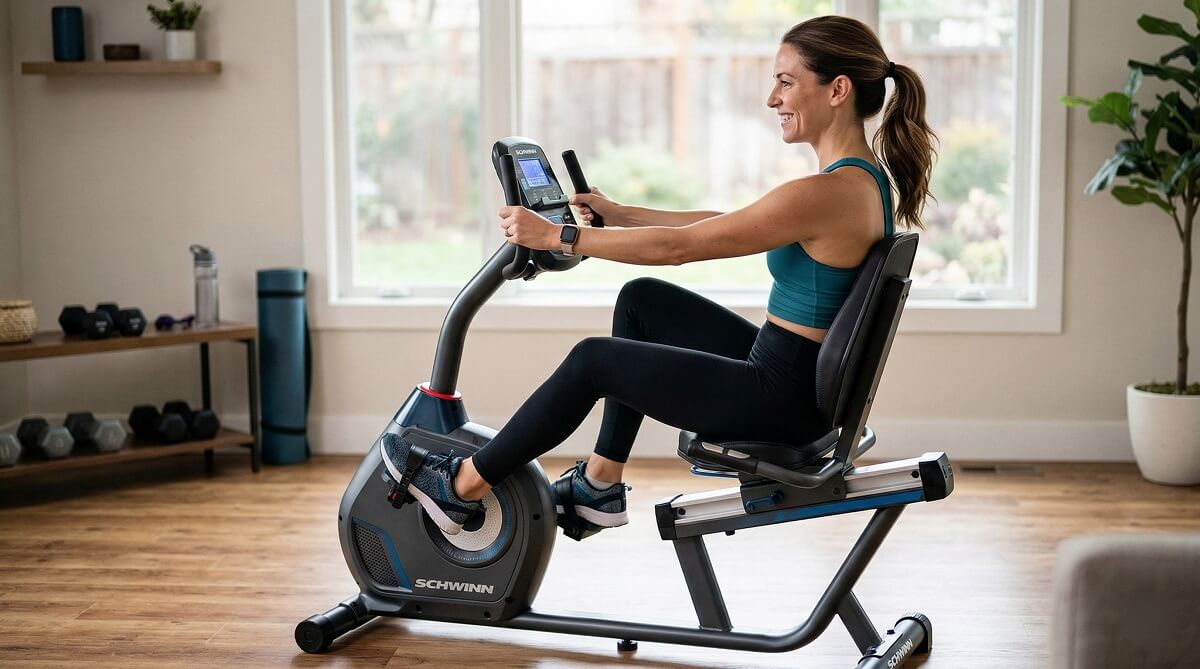
The Schwinn 290 recumbent bike offers comfortable, low-impact cardio at a mid-range price point. With 25 levels of magnetic resistance, app connectivity for Zwift and JRNY, and a 330-pound weight capacity, it handles most home fitness needs. Testing from OutdoorGearLab shows it works well for users between 5’1″ and 6’2″ who want casual to moderate workouts without mandatory monthly subscriptions.
Current pricing sits around $800-900 depending on retailer promotions (MSRP $999 per Schwinn’s official site). That positions it between budget recumbents like the Marcy ME-709 (~$185) and premium models pushing $2,000+. requires balancing quality against budget constraints.
Based on independent testing and user reviews across multiple retailers, the 290 delivers on its core promise of comfortable recumbent cycling. The main trade-offs involve its large footprint (over 66 inches long) and unusually wide pedal spacing (222mm Q-factor) that may bother some users during extended sessions.
Who Should (and Shouldn’t) Buy the Schwinn 290
✅ Best For:
- Users 5’1″ to 6’2″ tall, up to 300 pounds
- needs (knee, back, or hip concerns)
- Home gyms with 6+ feet of floor space
- Casual to moderate workout frequency (3-5x per week)
- Those wanting app connectivity without mandatory subscriptions
- People who value comfort over aggressive training positions
❌ Skip If:
- You’re over 6’3″ or under 5’0″ (seat adjustment limited to 13.2 inches)
- You need for small spaces
- You prefer aggressive, high-intensity interval training
- You have severe mobility limitations (step-through gap is narrow at 4 inches)
- You’re sensitive to wide pedal spacing (Q-factor at 222mm is unusually wide)
- You need precise power metrics for training zones
Key Specs at a Glance
Here’s how the Schwinn 290 compares to its primary competitors in the recumbent bike market:
| Feature | Schwinn 290 | Marcy ME-709 | Sole R92 | Schwinn 230 |
|---|---|---|---|---|
| Price (Feb 2026) | $800-900 | ~$185 | $1,100-1,300 | $549-599 |
| Resistance Levels | 25 (magnetic) | 8 (magnetic) | 20 (ECB) | 16 (magnetic) |
| Weight Capacity | 330 lbs | 300 lbs | 300 lbs | 330 lbs |
| Display | 7″ LCD | Basic LED | 9″ LCD | Smaller LCD |
| App Compatibility | JRNY, Zwift | None | SOLE+ (free) | JRNY, Zwift |
| Dimensions (L x W x H) | 66.4″ x 28″ x 47″ | 48″ x 24″ x 38″ | 56″ x 29″ x 60″ | ~65″ x 28″ x 47″ |
| Frame Warranty | 10 years | 3 years | Lifetime | 10 years |
| Assembly Time | ~55 min | ~40 min | ~60 min | ~50 min |
Prices reflect February 2026 market data. Check current retailer pricing as promotions vary.
What We Like About the Schwinn 290
Comfortable for Extended Workouts
The padded, ventilated seat back keeps you comfortable during 30-60 minute sessions. The 290’s seat offers 13.2 inches of adjustment, accommodating users from roughly 5’1″ to beyond 6’2″ based on OutdoorGearLab’s testing with multiple rider heights. Their 5’1″ tester wasn’t maxed out at the shortest position, and their 6’2″ tester had room to spare.
The recumbent position puts less strain on your back and neck compared to upright bikes. If you have joint concerns or are recovering from injury, this relaxed positioning makes it easier to maintain proper form without discomfort.
Smooth, Reliable Resistance System
The 25 levels of magnetic resistance provide smooth, consistent tension throughout your pedal stroke. Unlike some budget models that slip or jerk at higher resistance levels, the 290 uses a belt drive system that feels like pushing through water—even during high-output intervals.
OutdoorGearLab’s testing confirmed the resistance stays consistent across all 25 levels, though they did note the power meter under-reports actual wattage by approximately 20%. The measurement is consistent (helpful for tracking relative progress), just not accurate compared to certified power meters.
App Connectivity Without Forced Subscriptions
The 290 works as a standalone bike with 13 built-in workout programs—no subscription required. You can hop on, select a program, and start pedaling. The 7-inch LCD display tracks time, speed, distance, calories, cadence, resistance level, and watts.
If you want more variety, optional JRNY app integration costs $11.99/month or $99/year according to Bowflex’s subscription page (includes 2-month free trial with purchase). The app provides adaptive workouts, trainer-led classes, and virtual routes with terrain control that automatically adjusts resistance. You can also connect to Zwift for virtual cycling with other riders.
The bike includes Bluetooth speakers and a USB charging port, making it easy to keep your phone or tablet powered during workouts.
Quality Build and Warranty
At 107.6 pounds, the 290 feels stable during use. OutdoorGearLab testers noted no wobble or flex, even during hard pushes at high resistance. The 10-year frame warranty significantly outlasts budget competitors like the Marcy ME-709 (3-year frame warranty).
Full warranty coverage per Schwinn’s product page:
- Frame: 10 years
- Mechanical parts: 2 years
- Electronics: 1 year
- Labor: 90 days
Transport wheels make moving the 108-pound bike manageable despite its weight and size.
Limitations to Consider
Large Footprint Demands Space
At 66.4 inches long (over 5.5 feet), the 290 is one of the longer recumbent bikes available. OutdoorGearLab’s actual measurements came in slightly smaller at 64.5 inches, but it’s still substantial. You’ll need dedicated floor space and at least 2 feet of clearance on all sides—roughly 11 square feet minimum.
The bike doesn’t fold or collapse for storage. If you’re in a small apartment or tight space, the Marcy ME-709 is 18 inches shorter and may fit better.
Wide Q-Factor May Cause Discomfort
The 290’s Q-factor (distance between pedal platforms) measures 222mm. That’s unusually wide for an exercise bike. OutdoorGearLab notes that most exercise bikes range from 150-190mm, with only a few topping 200mm.
Research published in the NIH journal found that increasing Q-factor from 150mm to 276mm increased peak knee abduction moment by 47-56%. A 222mm Q-factor falls in the higher range that showed increased knee loading. The study notes that prolonged exposure to wide Q-factors may contribute to patellofemoral pain syndrome.
Not everyone experiences problems with wider pedal spacing, but if you have existing knee tracking issues or are sensitive to stance width, this could irritate your knees during longer sessions. Try the bike in-store if possible before committing.
Limited Adjustability
The seat only moves forward and back—it also rises as it moves back, which feels counterintuitive. Taller folks with longer legs end up positioned higher than shorter riders. There’s no seat back angle adjustment or handlebar positioning options.
The forward handlebars and side handles are fixed in position. This lack of adjustability may not accommodate users with specific back conditions who need customized positioning.
Step-Through Design Has Trade-offs
The 4-inch clearance at the lowest point is higher than some competitors, with a narrower opening for your foot to pass through. OutdoorGearLab testers preferred to sit on the seat first and rotate into place rather than stepping through, which they described as a “tight squeeze.”
This isn’t a dealbreaker for most users, but those with severe mobility limitations or balance issues may prefer recumbents with wider step-through designs.
Power Meter Accuracy Issues
OutdoorGearLab tested the 290’s power meter against Garmin Rally power meter pedals and found it under-reports wattage by approximately 20%. The measurements are consistent (same input produces same reading), just not accurate.
For general fitness and tracking relative progress over time, this works fine. If you train in specific power zones or need precise metrics, consider equipment with certified power meters.
Assembly and Setup
What to Expect
OutdoorGearLab’s tester assembled the 290 in 55 minutes, including time to read the instructions. The process isn’t technically challenging—all necessary tools come in the box, and the instructions use clear diagrams.
Having a second person helps with positioning the main frame, but one person can handle it alone. The bike ships in a large box with substantial styrofoam packaging.
Space Requirements
Operating dimensions: 66.4 inches long x 28 inches wide x 47 inches high. You’ll want at least 2 feet of clearance on all sides for comfortable mounting/dismounting and maintenance access. Total recommended space: approximately 11 square feet minimum.
The width is manageable at 28 inches, but the 66-inch length extends further than many people expect. before ordering.
JRNY App: Worth the Subscription?
What You Get
The JRNY app offers two subscription tiers:
JRNY App (for equipment without built-in screens): $11.99/month or $99/year
- Adaptive workouts that adjust to your fitness level
- 200+ virtual routes with terrain-matched resistance
- Trainer-led classes in various durations
- Progress tracking and achievements
- Up to 3 user profiles
- 2-month free trial included with purchase
JRNY All-Access (for touchscreen equipment): $19.99/month or $149/year
- Everything in App tier
- Streaming entertainment (Netflix, Prime Video)
- Up to 6 user profiles
Cost Analysis
At $99/year, JRNY costs less than Peloton ($44/month or $528/year) but more than some alternatives. The 2-month free trial lets you test whether the content justifies the ongoing cost.
You can cancel anytime, and the bike remains fully functional with its 13 built-in programs. add up quickly if you’re using multiple services.
Alternatives
Zwift offers another option for virtual cycling (pricing varies by region). You can also use free YouTube workout videos on a tablet placed on the media shelf. The bike tracks your metrics either way.
Who Should Buy the Schwinn 290
Ideal User Profile
The Comfortable Cardio Seeker: You want low-impact exercise due to joint concerns, value comfort over aggressive training positions, have dedicated space for permanent equipment, and appreciate tech features without mandatory subscriptions.
The Value-Conscious Buyer: Your budget sits around $800-1,000, you want better quality than $200 budget bikes, you don’t need commercial-grade equipment, and you plan moderate use (30-60 minutes, 3-5x weekly).
The Connected Fitness Enthusiast: You enjoy Zwift or similar cycling apps, want metrics tracking (speed, distance, calories, watts), like variety in built-in workout programs, and value Bluetooth connectivity for music and media.
Real-World Use Cases
- Recovery from injury: Low-impact cardio during physical therapy or rehabilitation
- Senior fitness: Easy mount/dismount with supportive seated position
- Multi-user household: Seat adjusts for different heights (5’1″ to 6’2″+)
- Home gym enthusiasts: Large but stable, doesn’t require ceiling clearance
Who Should Skip the Schwinn 290
Height Outliers
The 13.2-inch seat adjustment range accommodates most users between 5’1″ and 6’2″, possibly wider. If you’re over 6’3″ or under 5’0″, you may find the positioning uncomfortable for extended sessions.
Space-Constrained Users
Small apartments, dorm rooms, and tight spaces won’t accommodate the 66-inch length comfortably. Consider the Marcy ME-709 (18 inches shorter) or folding upright bikes if space is limited.
Serious Athletes
If you need precise power meters for training zones or want commercial-grade build for daily intense use, consider higher-end models with certified power accuracy.
Mobility-Impaired Users
The narrow 4-inch step-through opening may challenge users who struggle with balance or need transfer assistance. Medical-grade recumbents often feature wider openings designed for accessibility.
Knee-Sensitive Individuals
If you have existing knee tracking issues or react negatively to wide stance widths, the 222mm Q-factor could aggravate symptoms. Biomechanics research suggests narrower Q-factors (150-170mm) reduce knee stress.
Schwinn 290 vs. Top Alternatives
vs. Marcy ME-709 (Budget Option)
Choose Marcy ME-709 (~$185) if:
- Budget is the primary concern
- You’ll use it 1-2x weekly for light cardio
- You need smaller footprint (48 inches vs 66 inches)
- Basic 8 resistance levels meet your needs
Upgrade to Schwinn 290 if:
- You want smoother, quieter operation
- You need more resistance progression (25 vs 8 levels)
- App connectivity matters (JRNY/Zwift)
- Better warranty protection (10-year vs 3-year frame)
vs. Sole R92 (Direct Competitor)
Sole R92 advantages ($1,100-1,300):
- Higher price but lifetime frame warranty per Sole’s product page
- Larger 9-inch display vs 7-inch on Schwinn
- SOLE+ app included free (no subscription)
- Shorter length (56 inches vs 66 inches)
Schwinn 290 advantages ($800-900):
- $300-500 less expensive
- Higher weight capacity (330 lbs vs 300 lbs)
- More resistance levels (25 vs 20)
- Integration with Zwift and JRNY ecosystems
Choose based on priorities: Sole R92 for lifetime warranty and free app, Schwinn 290 for better value and higher capacity.
vs. Schwinn 230 (Lower Model)
Price difference: Schwinn 230 costs $549-599, roughly $200-300 less than the 290 according to BarBend’s comparison.
What you lose stepping down to 230:
- Fewer resistance levels (16 vs 25)
- Smaller, less clear display
- Less comfortable seat (firm plastic pan vs padded lumbar support)
- No Bluetooth speakers
- No USB charging port
What stays the same:
- Core frame and build quality
- 330-pound weight capacity
- 13 built-in workout programs
- JRNY and Zwift compatibility
- 10-year frame warranty
If you mainly want joint-friendly cardio and don’t care about extra comfort features, the 230 meets basic needs. The 290 justifies its higher price if you’ll use it frequently and value the better seat and smoother resistance.
Maintenance and Long-Term Ownership
Routine Care
The magnetic resistance system requires no lubrication—one of the benefits over friction-based designs. Regular maintenance involves:
- Weekly: Wipe down seat, console, and frame to remove sweat
- Monthly: Check bolts and tighten if needed (vibration can loosen connections)
- Quarterly: Inspect belt drive for wear or tracking issues
Common Issues from User Reviews
Based on reviews from OutdoorGearLab, Big Guy Treadmill Review, and various retailers:
- Console button wear: The bubble-style plastic overlay buttons can crack after prolonged use
- Seat slider lever stiffness: Some users report the adjustment lever feels stiff
- Minor frame wobble: Users over 300 pounds occasionally report slight instability
- JRNY subscription confusion: Some buyers expect unlimited content without understanding the trial converts to paid subscription
Overall, user feedback remains positive for intended use cases (casual to moderate home fitness).
Expected Lifespan
Based on warranty coverage and typical home use patterns:
- Frame: 10+ years with proper care
- Electronics: 3-5 years average (console, resistance motor)
- Belt drive: 5-7 years with regular inspection
- Seat cushion: 3-5 years depending on usage frequency
Frequently Asked Questions
How much does the Schwinn 290 cost in 2026?
The MSRP is $999, but actual selling prices range from $749-899 depending on retailer and current promotions. As of February 2026, Scheller’s Fitness lists it at $798 (marked down from $999), and 360 Fitness Superstore shows $799.95. Always check current pricing across multiple retailers before purchasing, as sales and promotions vary.
What’s the difference between Schwinn 290 and 270?
Schwinn discontinued the 270 model. The current lineup includes the 230 (entry-level) and 290 (mid-range) recumbent bikes. If you’re comparing older 270 specs, the 290 generally offers more resistance levels and updated console technology.
Can you use the Schwinn 290 without a subscription?
Yes, absolutely. The bike includes 13 built-in workout programs accessible through the console without any subscription. The JRNY app ($11.99/month or $99/year) and Zwift are optional add-ons for enhanced features like adaptive workouts, trainer-led classes, and virtual routes. give you full core functionality with zero ongoing costs.
How long does the Schwinn 290 take to assemble?
OutdoorGearLab’s tester completed assembly in 55 minutes, including time to read instructions. Expect 45-60 minutes for most people. All necessary tools come in the box, and the instructions use clear diagrams. A second person helps with positioning the main frame but isn’t required.
Is the Schwinn 290 good for tall people?
The 13.2-inch seat adjustment accommodates users from approximately 5’1″ to beyond 6’2″ based on independent testing. OutdoorGearLab’s 6’2″ tester had room to spare. If you’re over 6’3″, you may find the positioning marginal for comfort during longer sessions. Users under 5’0″ similarly approach the adjustment limits.
What is Q-factor and why does it matter?
Q-factor measures the distance between pedal platforms—essentially your stance width while pedaling. The 290’s Q-factor is 222mm, which is unusually wide for exercise bikes (most range 150-190mm). Research shows wider Q-factors increase knee joint loading by 47-56%, potentially contributing to knee discomfort during extended use. Not everyone experiences issues, but it’s a consideration if you have existing knee problems or are sensitive to stance width.
Does the Schwinn 290 work with Peloton app?
The bike doesn’t have direct Peloton integration, but you can place a tablet running the Peloton app on the media shelf. The 290 won’t automatically adjust resistance to match Peloton classes, and your metrics won’t sync to Peloton’s system. For integrated experiences, the bike officially supports JRNY and Zwift through Bluetooth connectivity.
How accurate is the calorie counter on the Schwinn 290?
Calorie estimates derive from the power meter reading, which OutdoorGearLab found under-reports actual wattage by approximately 20%. This means calorie counts likely run lower than actual burn. Use the numbers for relative tracking session-to-session rather than absolute accuracy. For precise calorie tracking, consider pairing with a chest strap heart rate monitor.
Can you watch Netflix while using the Schwinn 290?
Yes, via a tablet or phone placed on the media shelf. The console doesn’t have built-in streaming capabilities. The USB charging port keeps your device powered during workouts. If you subscribe to JRNY All-Access ($19.99/month), that tier includes streaming entertainment integration.
What’s the warranty on the Schwinn 290?
Frame: 10 years / Mechanical parts: 2 years / Electronics: 1 year / Labor: 90 days. The 10-year frame warranty significantly outlasts budget competitors (Marcy ME-709 offers only 3 years). Electronics coverage is the shortest period but typical for consumer fitness equipment.
Where to Buy
Authorized Retailers
As of February 2026, the Schwinn 290 is temporarily unavailable on the official Schwinn website but available through authorized retailers:
- Amazon: Check for current pricing and customer reviews (search “Schwinn 290 recumbent bike”)
- Scheller’s Fitness & Cycling: $798 (marked down from $999)
- 360 Fitness Superstore: $799.95 (in-store special)
- Local specialty fitness stores: Call for availability and delivery options
Price Watch
MSRP sits at $999, but common sale prices range $749-850. typically appear during major shopping events (Black Friday, New Year fitness promotions). Some retailers bundle equipment mats or extended warranties with purchase.
Financing Options
Many retailers offer financing through services like Affirm or Klarna. Terms vary, but typical offers include 0% APR for 12 months on purchases over $500 (subject to credit approval). Check specific retailer terms before committing.
Final Verdict
The Schwinn 290 fills a specific niche: comfortable, app-connected recumbent cycling for users who want better quality than budget bikes without paying for commercial-grade equipment. If you fit the height range (5’1″ to 6’2″), have floor space for a 66-inch length, and want low-impact cardio with optional tech features, it represents solid value at $800-900.
Skip it if:
- You’re outside the height range (over 6’3″ or under 5’0″)
- The 222mm Q-factor concerns you (narrow knees, previous tracking issues)
- Space is limited (won’t accommodate 66-inch length)
- You need precise power metrics for zone training
Consider upgrading to more expensive models ($1,500+) if:
- You weigh over 300 pounds and want extra capacity
- You plan daily, intense use beyond casual/moderate frequency
- You want certified accurate power meters
- Commercial-grade build justifies higher cost for your use case
Consider downgrading to budget options (~$200) if:
- You’re testing recumbent cycling for the first time
- Workout frequency will be light (1-2x weekly)
- App connectivity doesn’t matter
- Basic 8 resistance levels meet your needs
For most home fitness enthusiasts seeking comfortable, reliable recumbent cycling with modern features, the Schwinn 290 hits the sweet spot between budget limitations and quality requirements. to find the right fit for your needs.
Check current prices and availability:
- Amazon — Compare models and read customer reviews
- Schwinn Official — Check for restocks and promotions
Compare with alternatives:
- Marcy ME-709 — Budget option (~$185)
- Sole R92 — Premium competitor with lifetime frame warranty
