


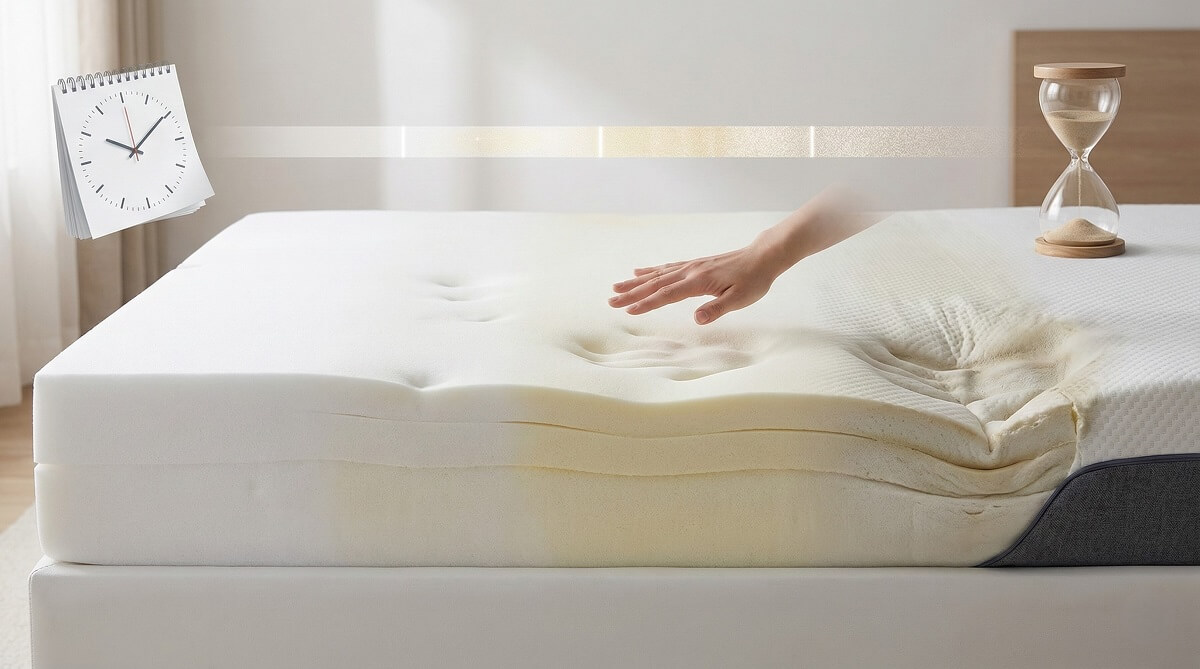
Memory foam mattresses typically last 7 to 10 years, but that’s just an average. A budget model under $500 might start sagging in 3 to 5 years, while a premium mattress with high-density foam can easily reach 12 to 15 years. The difference comes down to foam quality, measured in PCF (pounds per cubic foot), and how well you care for it.
Here’s what matters more than the price tag: foam density. High-density memory foam (5+ PCF) resists sagging and breakdown far better than low-density alternatives (under 3 PCF). Your weight, sleeping position, and even your local climate play a role too. A $1,200 mattress lasting 10 years works out to $120 per year—comparable to a $400 mattress that only lasts 4 years at $100 annually, except you’ll need to replace the cheaper one twice as often.
This guide breaks down actual longevity by quality tier, using verified 2026 pricing and independent testing data. You’ll learn which factors truly affect lifespan, how to spot the warning signs that replacement time is near, and practical ways to extend your mattress’s useful life.
Quick Answer: The Lifespan Breakdown
Not all memory foam mattresses are created equal. Here’s what you can realistically expect based on what you buy and how you use it:
✅ Expect 8-10 Years If:
- You buy a reputable mid-range brand (Casper, Nectar, Leesa)
- You rotate your mattress every 3 to 6 months
- You use a waterproof mattress protector from day one
- You weigh under 230 pounds
- Your bedroom stays reasonably cool and dry
⚠️ Expect 5-7 Years If:
- You purchase a budget model under $500
- You’re a heavier sleeper over 230 pounds
- You live in a hot, humid climate without climate control
- You skip regular rotation and maintenance
- You place it on an unsupportive or damaged foundation
❌ Replace Sooner (3-5 Years) If:
- Visible sagging or body impressions appear deeper than 1.5 inches
- You wake with new aches and pains that weren’t there before
- Allergy symptoms or skin issues develop
- The foam feels permanently compressed and doesn’t bounce back
- It sleeps noticeably hotter than when you bought it
Memory Foam Lifespan by Quality Tier
The mattress industry doesn’t make this easy, but the single most reliable predictor of longevity is foam density, measured in PCF. Higher density means more material per square foot, which translates to better durability and longer-lasting support.
Budget Memory Foam Mattresses ($300-$600)
Typical lifespan: 4-6 years
Budget mattresses typically use foam with a density of 2.5 to 3.5 PCF. This lower density means less material and faster breakdown. You’ll often notice softening around the 3-year mark, with sagging becoming obvious by year 4 or 5.
Example: The Nectar Classic starts at $379 on sale (regular price $649 for a queen) and comes with a 365-night trial and lifetime warranty. Even at the budget end, Nectar offers solid value with medium-density foam that should reach the 6 to 8-year range with proper care.
At this price point, don’t expect premium features like advanced cooling technology or reinforced edge support. The foam will compress faster if you’re over 200 pounds, and hot sleepers may find these mattresses trap more heat as they age.
Mid-Range Memory Foam Mattresses ($700-$1,500)
Typical lifespan: 7-10 years
Mid-range options use higher-quality foam in the 3.5 to 4.5 PCF range. This sweet spot balances cost with durability. You’re paying for denser foam that resists sagging, plus extras like gel-infused cooling layers and better edge support.
Example: The Casper One starts at $749 (twin) or $999 (queen size) with a 10-year warranty and 100-night trial. Casper uses a medium-firm feel that works well for most sleepers and maintains its shape better than budget models.
These mattresses handle daily use from couples and heavier individuals more gracefully. Expect consistent support through year 7, with gradual softening after that. Many still feel comfortable at the 10-year mark, though technically past their peak performance.
Premium Memory Foam Mattresses ($1,600+)
Typical lifespan: 10-15 years
Premium mattresses use high-density foam rated at 5+ PCF, sometimes reaching 8 PCF in the support core. This is the most durable memory foam you’ll find. Brands like Tempur-Pedic pioneered the category and still represent the longevity gold standard.
Example: Tempur-Pedic mattresses range from $1,699 to over $5,000 for a queen, with most models landing between $2,000 and $3,000. The Tempur-Adapt entry-level series starts at $1,699 and includes TEMPUR-Material that’s designed to last 10+ years. You get a 90-night trial and 10-year warranty.
The higher price buys you foam that resists compression significantly longer. Even after a decade, premium mattresses often show minimal sagging. The trade-off: these mattresses are heavier, sleep warmer (though newer models address this), and cost substantially more upfront.
Cost-Per-Year Analysis
Looking at annual cost rather than sticker price changes the value equation:
- Budget ($400 / 4 years): $100 per year, but you’ll replace it twice in the time a premium lasts once
- Mid-range ($1,000 / 8 years): $125 per year, solid balance of upfront cost and longevity
- Premium ($2,400 / 12 years): $200 per year, higher annual cost but longest total lifespan
If you plan to stay in your home long-term and want to minimize the hassle of replacement, premium pays off. If you move frequently or prefer upgrading every few years anyway, mid-range offers the best value.
5 Factors That Affect How Long Your Memory Foam Mattress Lasts
1. Foam Density and Quality (PCF Ratings)
Foam density is the weight of foam per cubic foot, measured in pounds per cubic foot (PCF). According to the Sleep Foundation, memory foam breaks down into three categories:
- Low-density (under 3 PCF): Breaks down quickly, typically lasting 5 years or less
- Medium-density (3 to 5 PCF): Standard for most mattresses, lasts 6 to 8 years
- High-density (over 5 PCF): Premium foam that can exceed 10 years
As the Sleep Foundation notes, denser foams are more durable and resist sagging better, while also showing greater resistance to accidental damage and tears. The downside: they’re heavier, more expensive, and can retain more heat. Lower-density foams offer better temperature regulation, which matters if you live in a warm climate.
Unfortunately, most manufacturers don’t advertise exact PCF ratings. If you’re shopping, look for terms like “high-density foam” or check if the warranty covers sagging—longer warranties usually indicate denser foam.
2. Your Body Weight and Sleeping Position
Heavier sleepers compress foam faster. If you weigh over 230 pounds, expect the lower end of any lifespan estimate. Two people sharing a mattress also accelerates wear compared to solo sleepers.
Sleeping position matters too:
- Side sleepers: Create concentrated pressure at hips and shoulders, leading to faster localized compression in those areas
- Back sleepers: Distribute weight more evenly, causing less dramatic sagging but still wearing the center zone
- Stomach sleepers: Need firmer foam (which tends to last longer) to prevent spine misalignment
If you’re a side sleeper over 200 pounds, budget for the shorter end of the lifespan range. Rotating your mattress helps distribute this wear more evenly.
3. Climate and Temperature
Heat accelerates chemical breakdown in polyurethane foam. Memory foam is temperature-sensitive by design—it softens with heat to contour to your body. Over years, this repeated heating and cooling cycle wears down the material.
Humidity creates additional problems. Moisture promotes mold, mildew, and bacteria growth, which can degrade foam integrity and create health issues.
Regional USA considerations:
- Hot, humid climates (Southeast, Gulf Coast): Expect shorter lifespans without air conditioning. Use a dehumidifier in the bedroom if possible
- Dry, hot climates (Southwest): Heat still matters, but low humidity helps. Keep the bedroom cool
- Moderate and cool climates (Pacific Northwest, Northeast, Upper Midwest): Ideal conditions for memory foam longevity
A bedroom kept between 60°F and 67°F extends foam life. Using electric blankets or heating pads directly on the mattress accelerates breakdown—place a layer between the heat source and foam.
4. Foundation and Support System
Memory foam needs proper support from underneath to maintain its shape. An unsupported or sagging foundation causes the mattress to dip prematurely.
Foundation options:
- Platform beds: Solid surface provides excellent support, extends mattress life
- Slatted bases: Work well if slats are no more than 3 inches apart. Wider gaps let foam sag through over time
- Box springs: Traditional innerspring box springs aren’t recommended for memory foam—they’re designed for innerspring mattresses. Use a solid or low-profile foundation instead
- Adjustable bases: Compatible with most memory foam, but check manufacturer guidelines
Check your foundation when you buy a new mattress. An old, sagging box spring will void most warranties and cut lifespan in half.
5. Care and Maintenance Habits
Proper care can add 2 to 3 years to your mattress’s lifespan. Here’s what actually makes a difference:
- Regular rotation (every 3-6 months): Distributes wear evenly. Most memory foam mattresses can’t be flipped due to specific top and bottom layers, but rotating head-to-foot prevents body-shaped depressions
- Using a waterproof protector: Blocks sweat, body oils, and spills that seep into foam and accelerate breakdown. Worth the $40-$100 investment from day one
- Proper cleaning (2x per year): Vacuum the surface to remove dust and allergens. Spot-clean spills immediately with mild detergent and water, then air dry completely
- Avoiding jumping or standing: Sounds obvious, but concentrated force damages foam structure faster than sleeping ever will
These habits are free or low-cost but significantly impact longevity. Skipping them can shorten even a premium mattress’s life by several years.
7 Telltale Signs Your Memory Foam Mattress Needs Replacing
Even with perfect care, all mattresses eventually wear out. Watch for these signs that it’s time to shop for a replacement:
1. Visible Sagging or Body Impressions Deeper Than 1.5 Inches
Run a yardstick or straightedge across your mattress surface. If there’s a dip of 1.5 inches or more where you sleep, the foam has lost its supportive properties. Most warranties cover sagging beyond this threshold, so check your coverage before buying a new one.
Body impressions under 1 inch are normal and don’t necessarily mean replacement is needed. But once you hit the 1.5-inch mark, you’re sleeping in a hammock rather than on proper support.
2. You Wake Up with New Aches, Pains, or Stiffness
Pay attention to your body. If you’re suddenly waking with lower back pain, hip discomfort, or shoulder stiffness that wasn’t there six months ago, your mattress may no longer provide adequate support.
This is especially telling if the pain improves after you’ve been up and moving for an hour. That suggests your sleeping surface, not a medical condition, is the culprit.
3. Allergy or Asthma Symptoms Worsen
Over 8 to 10 years, even well-maintained mattresses accumulate dust mites, dead skin cells, and allergens. If you notice increased sneezing, congestion, or wheezing when you wake up, your aging mattress could be the cause.
A mattress protector helps, but it’s not a permanent solution. Eventually, the accumulated biological debris makes replacement the healthier choice.
4. The Mattress Feels Unevenly Soft or Lumpy
Run your hand across the surface. Quality memory foam should feel consistent. If you notice areas that are noticeably softer, firmer, or lumpy compared to others, the foam layers are breaking down unevenly.
This inconsistent feel means you’re not getting uniform support across your body. Some areas are over-compressed while others aren’t supporting you at all.
5. It Sleeps Hotter Than It Used To
Degraded foam loses its breathability. If your mattress used to sleep comfortably but now leaves you sweating through the night, the foam structure has likely broken down.
Memory foam’s open-cell structure allows some airflow when new. As it deteriorates, cells collapse and trap more heat against your body. Cooling gel layers also lose effectiveness over time.
6. Visible Stains, Odors, or Damage That Can’t Be Cleaned
Despite your best efforts, some stains and smells become permanent. If your mattress has yellowed significantly, smells musty even after cleaning, or shows tears and damage, it’s past its useful life.
This isn’t just aesthetics—stubborn odors often indicate bacterial growth or mold, which create health risks.
7. It’s 8-10 Years Old (or Older)
Even without obvious problems, materials deteriorate over time. If your mattress is approaching or past the 10-year mark, replacement makes sense for both comfort and hygiene.
Sleep quality often degrades gradually enough that you don’t notice until you try a new mattress and realize how much better you feel.
Rule of thumb: If you notice three or more of these signs, start shopping. If you’ve hit the 8 to 10-year mark regardless of condition, it’s a good time to upgrade.
How to Make Your Memory Foam Mattress Last Longer (5 Proven Tips)
These practical steps can extend your mattress’s lifespan by 2 to 3 years, saving you hundreds of dollars:
1. Rotate It Every 3-6 Months
Set a calendar reminder for every March, June, September, and December. Rotate your mattress 180 degrees so your head is where your feet used to be. This simple habit prevents the concentrated wear pattern that causes premature sagging.
Don’t flip it unless the manufacturer specifically says it’s double-sided. Most memory foam mattresses have a designated top layer optimized for comfort and a firmer support bottom—flipping them puts the wrong side up.
2. Use a High-Quality Mattress Protector From Day One
A waterproof but breathable protector blocks sweat, body oils, spills, and allergens that seep into foam and break it down. Look for protectors that are:
- Waterproof with a thin membrane (not plastic-backed)
- Breathable so they don’t trap heat
- Machine washable
- Fitted style that won’t shift during sleep
Expect to spend $40 to $100 for a quality queen-size protector. It pays for itself by extending mattress life and maintaining warranty coverage (most warranties void if you stain the mattress).
3. Choose the Right Foundation
Follow your manufacturer’s guidelines. Most memory foam mattresses need:
- A solid platform, or
- Slats spaced no more than 3 inches apart with center support
If you’re using an older foundation, inspect it for sagging or broken slats. Replace the foundation at the same time as the mattress to start fresh. Putting a new mattress on an old, damaged foundation is like putting new tires on a bent wheel—it won’t last as long as it should.
4. Clean It Properly (But Not Too Often)
Vacuum your mattress every 2 to 3 months using the upholstery attachment. This removes surface dust, dead skin, and allergens before they work their way deeper into the foam.
Deep clean once or twice a year:
- Strip all bedding
- Vacuum thoroughly
- Spot-clean any stains with a mix of mild detergent and water (use as little liquid as possible)
- Let air dry completely—prop it up or turn on fans. Never put a wet mattress back on the bed
Avoid soaking the mattress. Memory foam doesn’t dry easily, and trapped moisture promotes mold. For serious spills, blot immediately, use minimal cleaning solution, and ensure complete drying before covering again.
5. Control Bedroom Temperature and Humidity
Keep your bedroom between 60°F and 67°F if possible. This temperature range slows foam deterioration and also happens to be ideal for sleep quality.
In humid climates, use a dehumidifier to keep bedroom humidity below 50%. High moisture accelerates breakdown and creates conditions for mold growth.
Avoid heat sources: Electric blankets, heating pads, and even persistent direct sunlight through a window can heat the foam beyond its designed range and accelerate aging. If you use a heated blanket, place a layer between it and the mattress surface.
Cost Savings from Proper Care
Let’s say your mattress would normally last 7 years, but proper care extends it to 10 years. At an average replacement cost of $1,000, that’s 3 extra years saving you from a $1,000 purchase—working out to $333 in value per year of extended life.
A $60 mattress protector, $0 rotation routine, and minimal cleaning supplies easily pay for themselves many times over.
Memory Foam vs. Other Mattress Types: Which Lasts Longest?
Memory foam holds up well compared to other common mattress types, but it’s not always the longest-lasting option:
| Mattress Type | Average Lifespan | Pros | Cons | Best For |
|---|---|---|---|---|
| Memory Foam | 7-10 years (up to 15 for premium) |
Excellent pressure relief, motion isolation, no noise, good durability | Can sleep hot, less edge support, off-gassing smell when new | Side sleepers, couples, those with joint pain |
| Latex | 10-20 years | Most durable, naturally resistant to dust mites and mold, responsive feel | Expensive ($1,500+), heavy, limited availability | Long-term investment, eco-conscious buyers, hot sleepers |
| Hybrid (foam + coils) |
6-10 years | Balance of contouring and support, better airflow than all-foam, good edge support | Coils can sag or squeak over time, more expensive than all-foam | Combination sleepers, heavier individuals, those who want bounce |
| Innerspring | 5-7 years | Affordable, widely available, bouncy feel, good airflow | Shortest lifespan, less pressure relief, can squeak, more motion transfer | Budget shoppers, stomach sleepers, those who prefer traditional feel |
Winner for longevity: Latex mattresses outlast everything else, often reaching 15 to 20 years. Natural latex is incredibly resilient and maintains its properties longer than any foam or spring system.
Best value (cost per year): Memory foam and hybrid mattresses offer similar cost-per-year value when you factor in their 7 to 10-year lifespan and lower upfront costs compared to latex. Memory foam edges ahead slightly for pure value if you’re on a budget.
Shortest lifespan: Traditional innerspring mattresses wear out fastest. The coils lose tension and support over time, leading to sagging and discomfort within 5 to 7 years—often sooner with heavy use.
Understanding Memory Foam Warranties (And When They Actually Help)
Warranties sound reassuring, but reading the fine print reveals they’re more limited than most people realize.
What Most Warranties Cover
- Manufacturing defects: Faulty seams, zipper failures, or foam that arrives damaged
- Sagging over a specific depth: Usually 1.5 inches for most brands, measured without anyone on the mattress
- Structural failures: Foam that splits, cracks, or separates from the cover
What Warranties DON’T Cover
- Normal wear and “body impressions” under the threshold: A 1-inch dip doesn’t qualify even if it bothers you
- Comfort preferences: “Too soft” or “too firm” isn’t a defect
- Stains or physical damage: Spills, tears, burns, or odors void most warranties immediately (hence the protector recommendation)
- Damage from improper support: Using the wrong foundation voids coverage
- Normal softening over time: Foam naturally becomes less firm as it ages
Warranty Length by Brand (2026)
| Brand | Warranty Length | Sleep Trial | Notes |
|---|---|---|---|
| Nectar | Lifetime (Forever Warranty) | 365 nights | Most generous trial and warranty in industry |
| Casper | 10 years (limited) | 100 nights | Standard for mid-range brands |
| Tempur-Pedic | 10 years (limited) | 90 nights | Premium brand with premium pricing |
| Leesa | 10 years (limited) | 100 nights | Standard mid-range offering |
Source: Sleep Foundation warranty comparison
Do Longer Warranties Mean Longer Lifespans?
Not necessarily. Nectar’s “Forever Warranty” is impressive marketing, but mattresses still wear out. The warranty covers defects and excessive sagging, not gradual loss of comfort or support.
A 10-year warranty from Casper or Tempur-Pedic doesn’t mean the mattress suddenly fails at year 11. It means the manufacturer is confident their product won’t develop covered defects for a decade. Many mattresses continue performing adequately beyond the warranty period.
Conversely, a lifetime warranty doesn’t prevent normal aging. Your foam will soften, you’ll develop body impressions under 1.5 inches, and sleep quality will gradually decline—all of which fall outside warranty coverage.
Bottom line: Longer warranties offer peace of mind against manufacturing defects, but don’t treat them as lifespan guarantees. Focus on foam quality (PCF rating) and brand reputation for more reliable longevity predictions.
Frequently Asked Questions
How long do memory foam mattresses really last?
Most memory foam mattresses last 7 to 10 years with proper care. Budget models (under $500) typically last 4 to 6 years, mid-range options last 7 to 10 years, and premium mattresses can reach 12 to 15 years. Lifespan depends heavily on foam density (PCF rating), your body weight, care habits, and climate.
Do expensive memory foam mattresses last longer than cheap ones?
Yes, significantly. Premium mattresses use denser foam (5+ PCF) that resists compression and sagging much longer than low-density foam (under 3 PCF) found in budget models. A $2,000 Tempur-Pedic can easily last 12+ years, while a $400 budget mattress might sag within 4 to 5 years. The quality difference is real and measurable through independent testing.
Can you make a cheap memory foam mattress last as long as an expensive one?
No amount of care can fully compensate for low-density foam. However, you can extend a budget mattress’s life by 1 to 2 years through diligent maintenance: rotating every 3 months, using a quality protector, keeping the bedroom cool, and ensuring proper foundation support. You’ll still hit the limits of the foam’s material properties sooner than with premium mattresses.
How do you know when to replace a memory foam mattress?
Replace when you notice: (1) sagging deeper than 1.5 inches, (2) waking with new aches or pains, (3) increased allergy symptoms, (4) uneven or lumpy feel, (5) sleeping hotter than before, (6) permanent stains or odors, or (7) reaching the 8 to 10-year mark. If you experience three or more of these signs, it’s time to shop for a replacement.
Do memory foam mattresses get harder or softer over time?
Memory foam gets softer over time. The foam’s cellular structure breaks down from repeated compression, losing its ability to bounce back fully. You’ll notice this gradual softening most in areas where you sleep regularly—typically the center of the mattress. This is why rotation helps extend lifespan by distributing wear more evenly.
Does sleeping hot mean my memory foam mattress is wearing out?
Not always, but it can be a sign. New memory foam often sleeps warm because of its dense, heat-trapping nature. If your mattress used to sleep comfortably but now feels noticeably hotter, the foam structure has likely degraded. As cells collapse, airflow decreases and heat retention increases. This typically happens in the later years of a mattress’s life.
Will a mattress topper extend the life of my memory foam mattress?
A topper can add 1 to 2 years by providing a fresh comfort layer and protecting the underlying mattress from direct wear. However, it won’t fix structural sagging or restore lost support. Think of a topper as a Band-Aid for minor softening or discomfort, not a solution for a mattress that’s truly worn out. Once you hit significant sagging, replacement is the only real fix.
How long do memory foam toppers last compared to full mattresses?
Memory foam toppers typically last 3 to 5 years—shorter than full mattresses because the foam is thinner (usually 2-3 inches) and less dense. They experience the same compression forces but have less material to absorb wear. Toppers are a good short-term comfort upgrade but not a long-term replacement for a quality mattress.
Do memory foam mattresses in guest rooms last longer?
Yes, substantially. A mattress used occasionally instead of nightly can last 15+ years because it accumulates far less wear. The foam doesn’t undergo the daily heating, compression, and body oil exposure that breaks down frequently-used mattresses. If your guest room mattress is 10 years old but only used a few times per year, it’s likely still in good shape.
What should I do with my old memory foam mattress?
Four states have official mattress recycling programs: California, Connecticut, Oregon, and Rhode Island. California residents have access to 240+ collection sites (99% of residents live within 15 miles of one), while Connecticut offers 135+ locations. Visit ByeByeMattress.com to find nearby drop-off sites. In other states, check local waste management for bulk pickup options, donate to charities if it’s still usable, or search for private recycling centers. Recycling fees range from $16 to $22.50 depending on the state.
Bottom Line: Invest in Quality or Replace More Often?
The data is clear: foam density determines longevity more than any other factor. A premium mattress costs 3 to 5 times more than a budget model but lasts 2 to 3 times longer. The annual cost difference is smaller than you’d think.
If you value long-term durability and can afford the upfront investment, premium makes sense. You’ll replace it half as often and likely sleep better throughout its life. If $2,000+ isn’t in the budget, a solid mid-range mattress from Nectar or Casper offers excellent value at under $1,000.
Budget mattresses have their place—for guest rooms, temporary living situations, or if you genuinely prefer replacing every 4 to 5 years to stay current. Just know what you’re buying.
Whatever tier you choose, proper care adds years to the lifespan. Rotate regularly, use a protector, maintain a cool bedroom, and ensure proper support. These free or low-cost habits pay bigger dividends than any single purchase decision.
Ready to find a mattress that’ll last? Check current prices and deals on top-rated memory foam mattresses at Amazon, or visit manufacturer sites like Nectar, Casper, and Tempur-Pedic for their latest promotions.
