


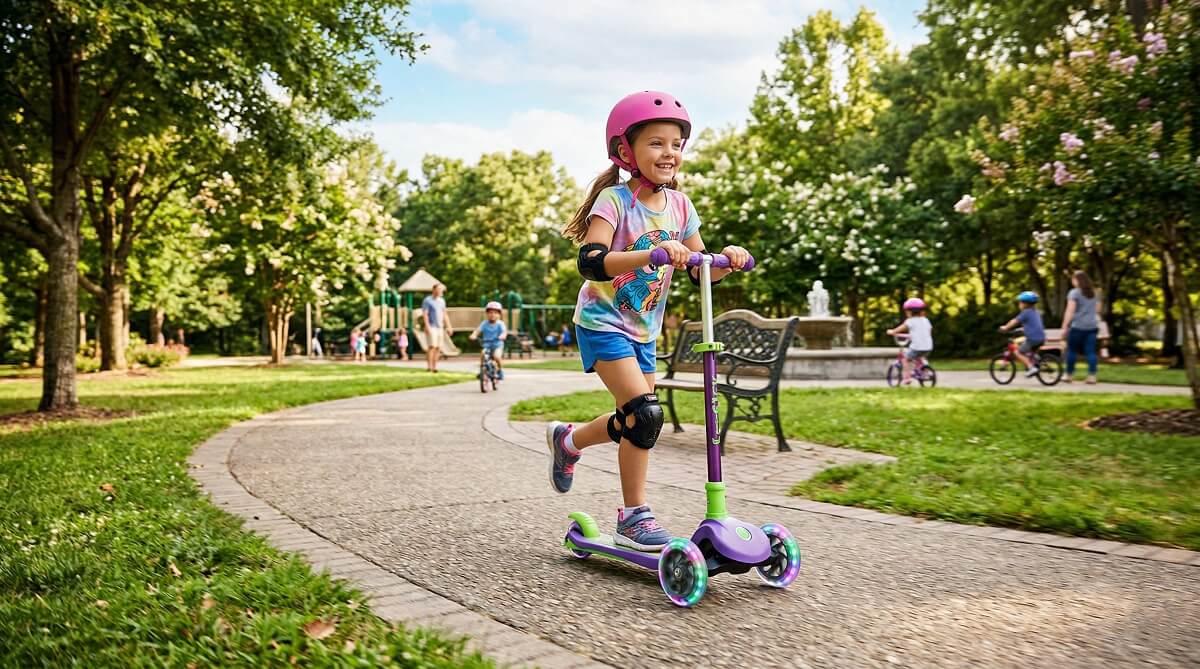
At 8, most kids are ready to graduate from three-wheel kickboards to a proper two-wheel scooter — and the difference in speed and fun is immediately obvious. The trick is finding one that handles real pavement without feeling like you’re riding a lawnmower over gravel, and that still fits comfortably as your child grows through the next few years.
After digging through real parent testing data, current Amazon pricing, and manufacturer specs, four scooters stood out for this age: the Razor A5 Lux (about $100, our everyday pick), the Micro Kickboard Sprite (about $120, best for quality and longevity), the WAYPLUS 8″ Kick Scooter (from $74, best budget), and the Segway Ninebot C2 Lite ($200, best electric). If your 8-year-old is interested in skateparks, we also cover what to look for in an entry-level stunt scooter.
One thing applies across all of them: a CPSC-certified bike helmet is mandatory, not optional. Knee pads are a smart addition for kids still working on their confidence. With that squared away, here’s everything you need to pick the right ride.
Who Should (and Shouldn’t) Get an 8-Year-Old a Two-Wheel Scooter
✅ Good Fit
- Kids who can ride a bike without training wheels — balance transfers directly
- School-run families who want something foldable and easy to carry
- Riders who’ll use it mostly on pavement, bike paths, or flat driveways
- Anyone who wants one scooter that’ll last through age 12 or 13
❌ Not the Right Fit
- Kids still working on basic balance — go with a three-wheel kickboard like the Micro Maxi Deluxe first
- Parents looking for a skatepark-ready trick scooter — those are a separate category (covered below)
- Riders who need something truly off-road — these are pavement scooters, not trail bikes
Is an 8-Year-Old Ready for a Two-Wheel Scooter?
Most 8-year-olds are ready — but it depends more on balance experience than birthday. The key question: can your child ride a bike without training wheels? If yes, two wheels will feel natural. Two-wheel scooters use the same turn-to-steer mechanics as a bike (you move the handlebars to change direction, not your body weight).
If your child has only ridden three-wheel kickboard-style scooters, there’s a short adjustment period. The lean-to-steer habit from three-wheelers doesn’t apply here. Most kids figure it out in an afternoon.
One practical sizing note: the average 8-year-old in the US stands about 50 inches tall and weighs around 56 pounds, according to . For comfortable scooting, the handlebar should hit somewhere around waist height — roughly 28 to 34 inches from the ground. Every scooter in our picks adjusts well within that range, with room to grow.
What Actually Matters When Buying a Scooter for an 8-Year-Old
Wheel Size: Go 8 Inches
The single biggest ride-quality factor is wheel size. Eight-inch (200mm) wheels roll over sidewalk cracks, pebbles, and expansion joints without the jarring jolts you get from smaller wheels. If your kid is commuting to school or doing longer rides around the neighborhood, smaller wheels get exhausting fast. The Razor A5 Lux and WAYPLUS both run 8″ wheels. The Micro Sprite uses slightly smaller wheels but compensates with higher-quality bearings and a smoother overall build.
Handlebar Height Range
Look for a handlebar that adjusts from at least 28″ up to 36″ or taller. Your 8-year-old needs comfortable reach now, and you want the scooter to still fit at 11 or 12. All four of our picks offer at least 6 inches of adjustment range — enough headroom for several years of growth.
Weight Capacity vs. Scooter Weight
At around 56 lbs average weight, an 8-year-old is well within any scooter’s limit — even the most budget models handle 100+ lbs. What actually matters here is how heavy the scooter itself is. If a parent ends up carrying it home from school, that 8-pound Razor feels very different from the 6.3-pound Micro Sprite after a few blocks.
Foldability
Essential for school use or fitting in a car. One-click folding mechanisms (Micro Sprite) are slightly faster than the lever systems on Razor models, but both work fine day to day. If you’re doing a daily school run, a built-in kickstand is also worth having — it lets your kid park the scooter without laying it down in the dirt.
Deck Width
Narrower decks on budget models (like the original Razor A2) feel cramped for kids 8 and up. The A5 Lux has a notably wider and longer deck than earlier Razor models — one of the main reasons it’s the upgrade for this age. At 8, feet are bigger and posture is more upright; a wider deck makes a real difference in comfort.
The 5 Best Scooters for 8-Year-Olds
1. Razor A5 Lux — Best Overall Pick
Price: ~$99.99 on Amazon | Age: 8+ | Weight limit: 220 lbs | Wheel size: 8″ urethane | Handlebar height: 29″–38″ | Scooter weight: 8.38 lbs
The A5 Lux is the natural step up from Razor’s classic lineup, and it earns its popularity. Those 8″ urethane wheels are the main differentiator — they handle the bumps and sidewalk cracks that make smaller-wheeled scooters such a rough ride. The deck is wider and longer than the A3 or A2, which matters when feet are getting bigger. Handlebar adjustment runs from 29 to 38 inches, giving you solid coverage from age 8 through the early teens.
Real-world parent testing from TwoWheelingTots confirms what the specs suggest: those 8″ wheels “make running into pesky pebbles and sidewalk cracks a non-event,” and the scooter can carry an adult too (220 lb limit). It’s foldable, comes with a retractable kickstand, and requires no assembly.
Trade-off: At 8.38 lbs it’s the heaviest scooter in our picks, which matters if a parent ends up carrying it. The foam grips also wear faster than rubber alternatives.
2. Micro Kickboard Sprite — Best for Quality and Longevity
Price: $119.99 at Micro Kickboard official store | Age: 6+ | Weight limit: 220 lbs | Scooter weight: 6.3 lbs | Deck: 130×330 mm
The Micro Sprite costs about $20 more than the A5 Lux, and that gap shows in how it rides. TwoWheelingTots rated it the #1 overall kids’ scooter after testing 30+ models — kid testers reported no “clackity clack” joltiness common with most kick scooters, and even small curb jumps “didn’t hurt” on landing. The Swiss engineering is genuinely felt in everyday use.
It weighs 6.3 lbs (about 2 lbs lighter than the A5 Lux), folds with a one-click mechanism, and comes with a kickstand. The handlebar adjusts high enough to comfortably fit teens and adults. If you want one scooter that’ll outlast multiple kids without showing wear, this is the one.
Trade-off: The wheels are slightly smaller than the A5 Lux’s 8″ — fine for smooth pavement, but the A5 edges it out on rougher surfaces. Also less common in physical retail stores; easier to order online.
3. WAYPLUS 8″ Kick Scooter — Best Budget
Price: From ~$74 on Amazon | Age: 6+ | Weight limit: 240 lbs | Wheel size: 8″ (200mm) | Handlebar heights: 31″, 33.8″, 35″, 37″ | Rating: 4.6/5 (3,401 reviews)
The WAYPLUS punches well above its price by including 8″ wheels and ABEC-9 bearings — specs you’d normally find on two-wheelers costing $30–40 more. Four handlebar height settings cover riders from about 4 feet to over 6 feet. The push-button fold and included carrying strap make it practical for school use. A 240-pound weight limit means the whole family can ride it.
The catch with budget scooters is always long-term durability, and the WAYPLUS doesn’t have the same multi-year track record as Razor or Micro. But with 3,400+ Amazon ratings averaging 4.6 stars, it’s clearly working for a lot of families. A good option if you’re not sure how committed your 8-year-old will be, or if budget is a real constraint.
Trade-off: Less brand recognition; no independent long-term durability data; foam grips on entry-level models wear faster.
4. Segway Ninebot C2 Lite — Best Electric Scooter for 8-Year-Olds
Price: $199.99 at Segway official store | also at Best Buy | Age: 6–10 | Max speed: 9.9 mph | Range: 5.9 miles / ~70 min | Weight limit: 110 lbs
If your 8-year-old is specifically asking for an electric scooter, the Segway C2 Lite is the safest choice in this age range. The maximum speed of 9.9 mph (in Sport mode) keeps things manageable, and parents can restrict it further through the app. Standard mode caps acceleration for beginners. The solid tires eliminate the flat tire headache common with pneumatic options, and IPX4 water resistance means light rain won’t ruin it.
The UL-2272 certification matters here — that’s the US safety standard for electric personal mobility devices, confirming the electrical system has been independently tested. For parents weighing safety on an e-scooter, that stamp of approval from a recognized testing lab carries real weight.
Trade-off: Electric scooters require charging and supervision. The 110-pound weight limit is a real ceiling — heavier kids will need to look at the C2 Pro instead. Electric scooters are also not allowed on public roads or most bike paths in most US states; they’re best suited for sidewalks, driveways, and closed-off areas.
5. Entry-Level Stunt Scooter — Best for Skatepark-Curious Kids
Options to consider: Madd Gear Carve Pro, Razor Beast | Age minimum: 8+ | Price range: $80–$150
Age 8 is typically the minimum entry point for stunt/trick scooters. These are purpose-built for skateparks — they’re non-folding by design (fixed structure handles jump impacts that adjustable joints can’t), have lower, wider handlebars for aerial control, and use reinforced decks and forks.
The trade-off is that stunt scooters don’t work as commuters. They’re heavier, can’t be adjusted as your child grows, and aren’t designed for long-distance rolling. If your 8-year-old wants to learn tricks at the skatepark, get a dedicated stunt scooter. If they mainly want to ride around the neighborhood and to school, one of the kick scooters above will serve them better.
Comparison: Top 4 Scooters for 8-Year-Olds
| Scooter | Price | Age | Weight Limit | Wheel Size | Scooter Weight | Folds | Best For |
|---|---|---|---|---|---|---|---|
| Razor A5 Lux | ~$100 | 8+ | 220 lbs | 8″ urethane | 8.38 lbs | Yes | Everyday use, value |
| Micro Kickboard Sprite | ~$120 | 6+ | 220 lbs | 120mm front | 6.3 lbs | Yes | Quality, long-term use |
| WAYPLUS 8″ Kick Scooter | ~$74 | 6+ | 240 lbs | 8″ (200mm) | ~7 lbs | Yes | Budget pick |
| Segway Ninebot C2 Lite | $200 | 6–10 | 110 lbs | Solid 7″ | ~13 lbs | Yes | Electric option |
Prices as of March 2026. Check current pricing before purchasing — these fluctuate, especially around major sales events.
Kick Scooter vs. Electric Scooter at Age 8: Which Makes More Sense?
A kick scooter is the better starting point for most riders this age. Kick scooters develop balance, coordination, and leg strength in ways that motorized models don’t. There’s no charging required, no speed-limit concerns, and they’re generally permitted in more places without any legal gray areas.
Electric scooters make sense if your child already has solid kick scooter experience and you have a safe, flat, traffic-free area for them to ride — like a neighborhood cul-de-sac, school parking lot on weekends, or a park path. The Segway C2 Lite’s parent-controlled speed modes help ease the transition, but adult supervision is still the expectation at this age.
One practical note: electric scooters are not allowed on public roads in most US states. They’re typically permitted on sidewalks and private property. before purchasing.
Safety Gear Every 8-Year-Old Rider Needs
Scooter injuries are real, and almost all of them are preventable with the right gear. The US Consumer Product Safety Commission (CPSC) recommends a CPSC-certified bicycle helmet for all scooter riders — not just as a suggestion, but as a standard.
- Helmet: CPSC-certified bike helmet, properly fitted. Non-negotiable.
- Knee pads: Especially useful while building confidence on a new scooter
- Elbow pads: A reasonable addition for early riders
- Closed-toe shoes: Flip-flops and sandals are a foot injury waiting to happen on a scooter
- First rides: Flat, open pavement away from traffic — a quiet parking lot or driveway works well
Non-motorized children’s scooters must meet ASTM F2264 safety standards in the US. Electric scooters should carry UL-2272 certification (the Segway C2 Lite has this). If you see a scooter without either marking, that’s a red flag worth investigating before buying.
Frequently Asked Questions
What is the best scooter for an 8-year-old?
The Razor A5 Lux is the most practical all-around pick — about $100 on Amazon, 8″ wheels that handle real pavement well, a 220-pound weight limit, and a handlebar that adjusts from 29 to 38 inches. If budget isn’t a constraint and you want the smoothest ride, the Micro Kickboard Sprite at ~$120 is the higher-quality option.
Should an 8-year-old use a two-wheel or three-wheel scooter?
Most 8-year-olds who can ride a bike without training wheels are ready for two wheels. Three-wheel kickboards (like the Micro Maxi Deluxe) remain a capable option if balance isn’t quite there yet — they work up to age 12 and some kids genuinely prefer the lean-to-steer feel. But if your child is bike-confident, two wheels will feel faster and more satisfying.
What size scooter does an 8-year-old need?
Look for handlebar adjustment that covers roughly 28 to 36 inches from the ground. The average 8-year-old is about 50 inches tall, so the ideal handlebar height lands near their waist (roughly 28–32 inches). Most of our picks cover this range comfortably. The key rule: when standing on the deck, your child should grip the handlebars with slightly bent elbows, not reaching up or hunching down.
Is an electric scooter safe for an 8-year-old?
With supervision and the right model, yes. The Segway Ninebot C2 Lite is the safest electric option for this age — it caps at 9.9 mph, has parent-controlled speed modes via app, solid tires that can’t go flat, and carries UL-2272 certification for electrical safety. Adult supervision is still the expectation, and electric scooters should stay off public roads.
How long does a kids’ electric scooter battery last?
The Segway C2 Lite offers about 5.9 miles or roughly 70 minutes per charge, depending on rider weight and terrain. Heavier riders and hilly surfaces will reduce that range. Plan for daily charging if your child is using it regularly — it charges from a standard outlet.
What’s the difference between a kick scooter and a stunt scooter?
Kick scooters (like the Razor A5 Lux) fold, have adjustable handlebars, and are built for commuting and casual riding. Stunt scooters are non-folding, have fixed-height lower handlebars, and are reinforced specifically for skatepark tricks and jumps. Age 8 is the typical minimum for stunt models. They’re not interchangeable — get a kick scooter for the school run and neighborhood riding, a stunt scooter if the skatepark is the destination.
How do I know if the handlebar height is right?
When your child stands on the deck, the handlebars should sit near their waist or slightly above. They should reach the grips comfortably with slightly bent elbows — not stretching up or hunching. Most scooters in this age range have clickable or lever-adjustable stems that require no tools to change. If you’re buying online, measure from the floor to your child’s waist and compare to the scooter’s minimum handlebar height.
Do kids need helmets on scooters?
Yes. A CPSC-certified bicycle helmet is the appropriate standard for scooter riding in the US. Many states have specific laws requiring helmets for riders under 16 or 18. Even where it’s not legally required, head injuries from scooter falls are among the most preventable injuries in children’s outdoor play — gear up every time.
Check current prices and stock on Razor A5 Lux on Amazon, WAYPLUS on Amazon, or the Segway C2 Lite at the official Segway store and Best Buy. Prices fluctuate, so it’s worth double-checking before checkout.
