


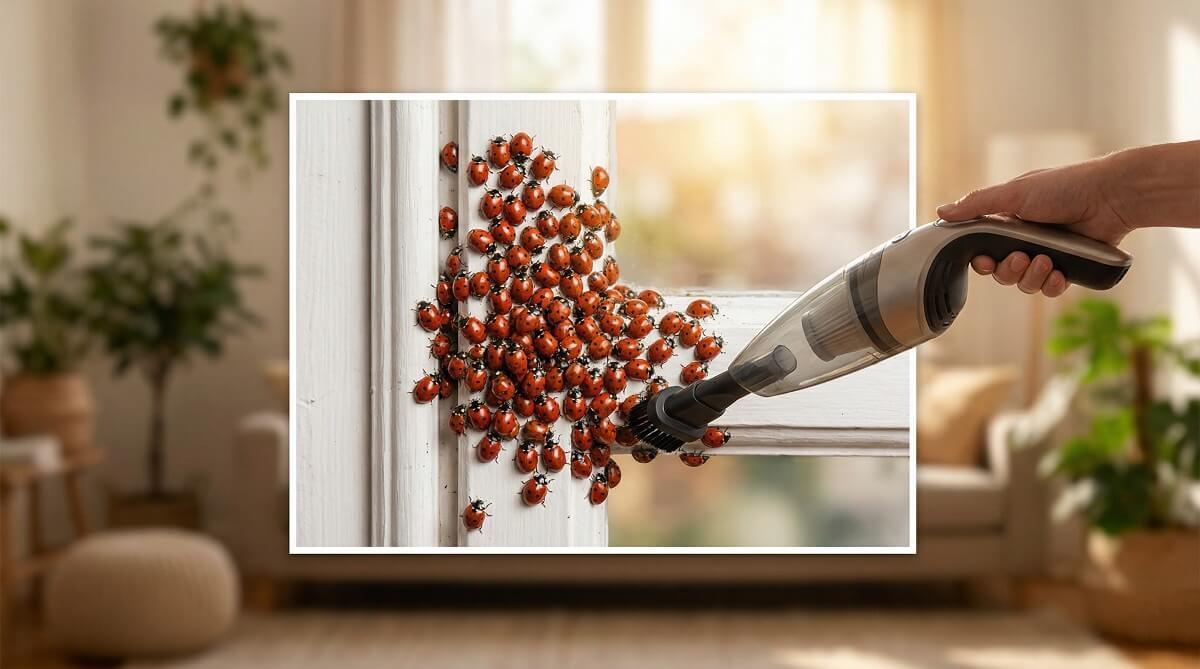
Those orange-ish bugs clustering around your sunny windows in October aren’t native ladybugs — they’re Asian lady beetles, an introduced species that pushes into homes each fall to ride out winter. The quickest fix for what’s already inside: a vacuum. The fix that stops next year’s wave before it starts: sealing cracks on the south and southwest sides of your house before temperatures drop below 45°F.
Here’s the thing most pest guides won’t tell you. Squishing them or spraying aggressively indoors backfires. When threatened, Asian lady beetles release hemolymph — a foul-smelling yellow fluid that stains surfaces and, worse, sends out a chemical signal that draws even more beetles to that spot. So how you remove them matters almost as much as whether you remove them.
Below you’ll find 8 removal and prevention methods ranked by effort and effectiveness — from a DIY light trap you can set up tonight to a fall exterior spray that keeps them out year after year.
Is This Actually a Ladybug Problem?
✅ These methods are right for you if:
- You’re seeing clusters of orange or red spotted beetles near windows, attic vents, or south-facing walls — especially in fall and early winter
- The bugs are sluggish and disoriented indoors (that’s normal — they’re in diapause, a dormancy state)
- You want to avoid chemical pesticides, especially around kids or pets
- You’re dealing with dozens of bugs, not hundreds
❌ Call a professional instead if:
- You’re seeing hundreds emerging from wall voids or ceiling gaps in spring
- You’ve had the same severe infestation three or more years running despite sealing efforts
- You’re not certain it’s a ladybug — carpet beetles and drugstore beetles can look similar and require different treatment
Asian Lady Beetle vs. Native Ladybug: Why It Matters
The red-domed ladybug with 11 black spots you probably drew as a kid? That’s the native species — it stays outdoors and rarely invades homes. The pest crawling across your windowsills is the multicolored Asian lady beetle (Harmonia axyridis), which looks similar but behaves very differently.
How to Tell Them Apart
| Feature | Native Ladybug | Asian Lady Beetle |
|---|---|---|
| Color | Bright red | Orange to reddish-orange (varies) |
| Spots | Exactly 11 black spots | 0–22 spots (highly variable) |
| Head marking | None | Black M or W shape behind head |
| Invades homes? | Rarely | Yes — every fall |
The Asian lady beetle was first intentionally released by USDA researchers in 1916 to control aphids on crops. Wild populations weren’t found here until 1988, near the port of New Orleans. By 1994, the species had spread coast to coast — and with it, the annual fall invasion that now affects homeowners across most of the country.
Why They Come Inside in the First Place
Asian lady beetles go into diapause — a hormonally regulated dormancy state triggered by shorter days and falling temperatures. As outdoor temps approach 40–45°F, they start looking for a protected, warm spot to wait out winter. Light-colored buildings on the south or southwest side of a property catch afternoon sun and stay warmer, making them prime targets. Once a scout finds a good spot, it releases pheromones that pull in dozens more.
That’s the key insight: you’re not dealing with a random wandering bug. You’re dealing with a coordinated, chemically-guided group that will return to the same spot next year if you don’t break the cycle.
8 Ways to Get Rid of Ladybugs in the House
1. Vacuum Them Up (Fastest for Active Clusters)
Vacuuming is the most immediate solution for bugs already inside. It works well — with one caveat. When you suck up a cluster, the defensive fluid they release can coat your vacuum hose and canister, and the heat from the motor will then blow that smell throughout your house every time you vacuum afterward.
How to do it right: Use a shop vac or a stick vacuum that’s easy to clean. Empty the bag or canister immediately into an outdoor trash bin after each pass. If using a bagless vacuum, rinse the canister with warm, soapy water right away. Vacuuming releases less fluid than sweeping, which is why it’s preferred over a broom.
2. DIY Soapy Water Light Trap (Best Overnight Fix)
Asian lady beetles are strongly attracted to light. You can use that against them. Fill a pie dish or roasting pan with about an inch of water and a few drops of dish soap — the soap breaks the water’s surface tension so bugs can’t escape once they land. At bedtime, turn off every light in the room and place a single lamp right next to the dish. Bugs will navigate toward the light source, hit the water, and that’s the end of it.
In the morning, dump the contents, rinse, and repeat in the next problem room. This costs almost nothing and requires zero chemicals.
3. Scent Deterrents (To Repel New Arrivals)
Asian lady beetles communicate through pheromones, which makes them unusually sensitive to strong smells. Overwhelming their chemical signals with competing scents disrupts their ability to aggregate. Several scents work reliably:
- Wintergreen oil: Soak a cotton ball with 15–20 drops, wipe it along windowsills and frames. Strong and long-lasting.
- Bay leaves: Tuck small pouches into window corners and crevices. Mild but persistent.
- Citrus oil: A few drops in water, sprayed around potential openings. The scent ladybugs find most unpleasant.
- Whole cloves: Small sachets in problem areas, refreshed monthly.
- Unscented dryer sheets: Actually, use heavily scented ones (Gain works well for this). Rub over window screens and sills — the strong fragrance masks the pheromone trail.
None of these are instant kills, but they reduce the attractiveness of a room that already had an aggregation — which helps break the pheromone recruitment cycle.
4. Diatomaceous Earth at Entry Points
Food-grade diatomaceous earth (DE) is a fine powder made from fossilized algae. Under magnification, it’s razor-sharp silica — when insects crawl through it, microscopic cuts in their exoskeleton cause dehydration and death within 48 hours. For humans and pets, it’s harmless.
Sprinkle a thin line along windowsills, interior baseboards near problem windows, and around the outside foundation. The catch: it loses effectiveness when wet, so reapply after rain or cleaning.
Harris Food Grade Diatomaceous Earth (2lb) on Amazon runs around $16–$17 as of early 2026 — enough for an entire season. Check current pricing before purchasing.
5. Sticky Fly Ribbons (For Attics and Unused Spaces)
Fly ribbons are unglamorous but effective. Hang them near windows in the attic, guest rooms, or sunrooms where you’re not spending time — out of sight, doing quiet work. The sweet, sticky scent draws ladybugs in. Replace every 6–8 weeks regardless of how full they look; dust reduces the tackiness before bugs do. A box of four ribbons runs about $5 at any hardware store.
6. Duct Tape for Individual Bugs
If you just have a few beetles and want to pick them up without triggering their defensive spray, wrap a small piece of duct tape around your finger (sticky side out) and press it gently against the bug. It lifts the beetle without the contact pressure that triggers hemolymph release. Works especially well for getting them off curtains or bedding without leaving stains.
7. Seal Gaps and Cracks (The Highest-Leverage Prevention)
Every method above is reactive — this one actually stops the invasion from happening. Asian lady beetles get in through openings you probably haven’t thought much about.
Where to check:
- Window frames and door frames — especially any daylight-visible gaps
- Foundation cracks on the south and southwest sides
- Utility pipe penetrations and gaps
- Dryer vents (ensure flaps close completely)
- Soffit vents, gable vents, ridge vents
- Damaged or torn window screens
When to do it: September or early October, before the first cold snap. That’s the window when beetles are actively scouting for overwinter shelter. Do it after temperatures have already dropped, and you’ll find beetles already inside.
Standard caulk for windows and doors costs about $5–$10 per tube. Foam weatherstripping for door bottoms runs $8–$15. Fixing a torn screen is around $10–$20 in materials.
8. Exterior Perimeter Spray (For Severe or Recurring Cases)
If you’ve sealed entry points and still face a heavy annual invasion, a residual pyrethroid insecticide applied to the exterior can dramatically reduce the number that reach your walls. Products like Cyper WSP (cypermethrin-based) applied to south and southwest exterior walls — from ground level up as high as you can reach — create a treated barrier. Concentrate on windows, eaves, soffits, and any penetrations.
Timing is everything here: spray in late summer or early fall, before beetles aggregate. Spraying in November after they’ve clustered accomplishes much less. Always follow label directions and keep pets away from treated surfaces until dry.
This is the only method on this list that involves pesticides, and it’s not your first step — it’s for the homeowner who has tried mechanical exclusion for two seasons and still comes home to a ceiling covered in bugs.
Common Mistakes That Make the Problem Worse
Don’t Crush Them
Crushing releases hemolymph — that yellowish fluid leaves a stain on whatever surface it hits (carpet, upholstery, painted walls) and sends out a pheromone distress signal that can actually attract more beetles to the same spot. If a ladybug lands somewhere inconvenient, use the duct tape method or a tissue and release it outside.
Skip the Indoor Spray
Spraying insecticide indoors is largely ineffective for this pest. The beetles hiding in wall voids won’t be reached, and the ones that wander into living spaces are already past the entry-point stage. The University of New Hampshire Cooperative Extension specifically advises against interior insecticide use for Asian lady beetles — the focus should be on exclusion.
About Those Chrysanthemums
Several pest control sites claim that planting chrysanthemums (mums) repels ladybugs. This one’s worth questioning. Chrysanthemums contain pyrethrin compounds, but research by gardening experts at Epic Gardening shows that these plants actually attract ladybugs to gardens, where they serve as natural predators for aphids. The scent ladybugs associate with mums is an invitation, not a warning. Potted mums near windows are unlikely to deter an indoor infestation. Stick to the methods above.
Are Ladybugs Actually Dangerous?
Short answer: no. Here’s the longer version for anyone who found one in their kid’s bedroom and is now genuinely worried:
- Disease: Asian lady beetles carry no known human diseases. Research published in Allergy and Asthma Proceedings confirmed they pose no disease transmission risk — even if one pinches you.
- Biting: Ladybugs have no teeth. They can use their mouthparts to give a small pinch when picked up or cornered. It’s sharp for a second, like a pinprick. No venom, no swelling.
- Allergies: This is where some people run into trouble. Asian lady beetles contain at least two proteins that can trigger allergy symptoms — runny nose, itchy eyes, sneezing — similar to a dust mite sensitivity. People with existing insect allergies should be more cautious around large aggregations. Check with an allergist if symptoms are severe.
- Pets: Not toxic if a pet eats one or two. A mouthful is inadvisable and may cause temporary digestive upset due to the defensive fluid, but it’s not an emergency-vet situation.
- Property damage: None. They don’t chew wood, eat fabric, or damage food stores. They also don’t breed or lay eggs indoors — so an infestation doesn’t compound itself the way a rodent or cockroach problem can.
The real irritants are the smell from disturbed beetles, the yellow staining if you crush them, and the psychological unpleasantness of sharing your living room with 40 spotted bugs.
Quick Comparison: Ladybug Removal Methods
| Method | Estimated Cost | Effort | Non-Toxic | Best For |
|---|---|---|---|---|
| Vacuum | Free (you have one) | Low | Yes | Active clusters, fast removal |
| Soapy water light trap | <$1 | Low | Yes | Overnight passive removal |
| Scent deterrents | $5–$15 | Low | Yes | Disrupting pheromone signals |
| Diatomaceous earth | ~$17/2lb bag | Low | Yes | Entry point barrier |
| Sticky fly ribbons | $5–$10 | Low | Yes | Attics, unused spaces |
| Duct tape pickup | Pennies | Low | Yes | Individual bugs on fabric |
| Seal gaps + caulk | $15–$40 | Medium | Yes | Long-term prevention |
| Exterior perimeter spray | $20–$40 | Medium | No | Severe/recurring infestations |
| Professional pest control | $100–$300+ | None (for you) | Varies | Large-scale infestations |
Frequently Asked Questions
What is the fastest way to get rid of ladybugs in the house?
Vacuum up visible clusters immediately, then set a soapy water light trap overnight in the most affected room. These two steps together handle most active infestations within 24 hours. For longer-term relief, caulk and seal any gaps on the south-facing side of your house before the next cold snap.
Why do I get so many ladybugs in my house every fall?
Asian lady beetles are overwintering insects — they enter a dormancy state called diapause as daylight shortens and temperatures fall toward 40–45°F. Your house, especially its sun-warmed south side, looks like ideal shelter to them. The pheromones the first arrivals release draw more to the same location, which is why the numbers can grow quickly once a few find a way in.
Do ladybugs bite?
They don’t bite in the traditional sense — no teeth. They do have mouthparts that can deliver a small pinch if you pick one up or it feels threatened. It’s a brief, sharp sensation but causes no venom injection and heals in seconds. On rare occasions, people with insect allergies may react — if that’s you, use gloves when handling them.
Will ladybugs go away on their own in spring?
Yes. Once temperatures consistently reach around 55°F, diapause breaks and they become active again, looking for a way back outside. The problem is that if they’ve left a pheromone trail in your walls, the same spot will attract a new group next fall — so spring departure doesn’t mean the cycle is broken.
Is diatomaceous earth safe around kids and pets?
Food-grade DE is considered safe for households with children and pets. It works through physical abrasion, not chemical toxicity. The main precaution: avoid breathing the dust when applying it (it’s an irritant when inhaled in quantity). Apply with a mask on, then the settled powder is fine.
What smells do ladybugs hate most?
Wintergreen oil is consistently the most effective — the scent is strong and persistent. Citrus (lemon or orange oil), whole cloves, and bay leaves also disrupt the pheromone signals they rely on. Heavily perfumed dryer sheets work on window screens and sills as a low-effort option.
Can ladybugs damage my home or belongings?
No structural damage, no fabric damage, no food contamination. The only tangible damage is the yellow hemolymph staining on light-colored surfaces if they’re crushed — that can be stubborn to remove from carpet or upholstery. Otherwise, they’re a nuisance pest, not a destructive one.
What year did Asian lady beetles arrive in the US?
USDA researchers first intentionally released them in 1916 as a biological pest control agent, but the beetles didn’t establish wild populations until 1988, near New Orleans. By 1994 they had spread across the entire continental US. The exact pathway — planned releases, accidental shipping imports, or both — is still debated by entomologists.
Most of these fixes cost under $20 total. Check current prices on diatomaceous earth, caulk, and weatherstripping on Amazon or at your local Home Depot or Lowe’s.
