


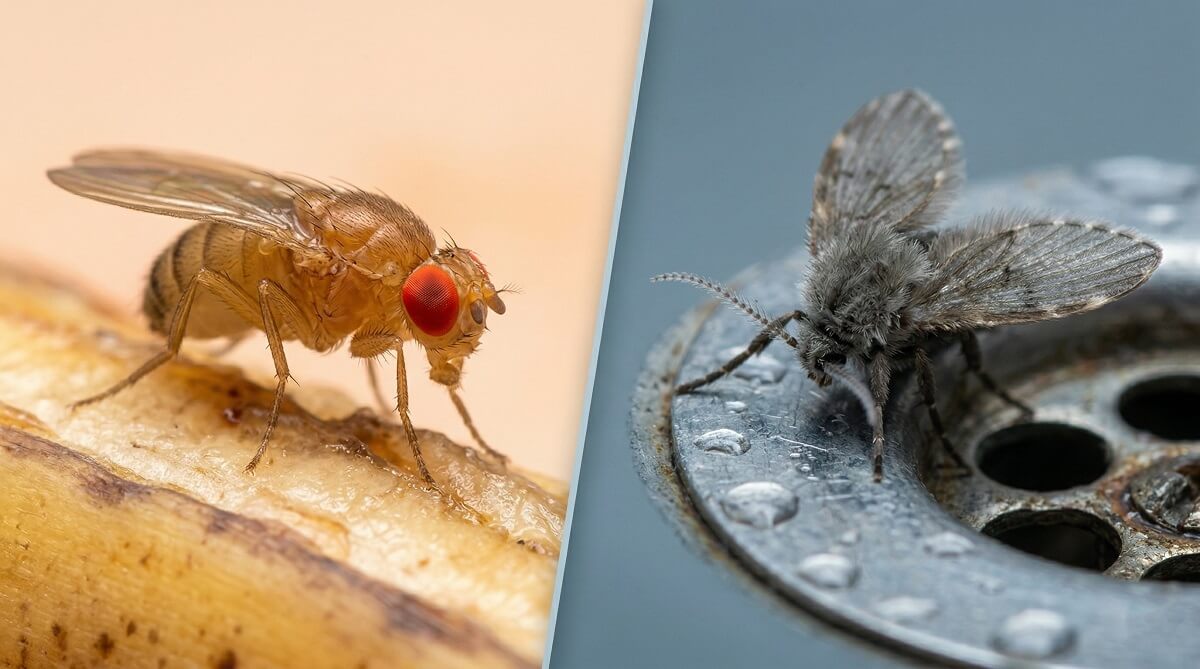
Fruit flies and drain flies are two distinct insects that happen to share your kitchen or bathroom. Fruit flies breed in fermenting produce, spilled juice, and residue inside garbage disposals. Drain flies breed in the slimy biofilm that lines the inside of your pipes. Getting the identification right matters — the fix for each is completely different, and treating one problem with the other’s solution will just waste your time.
Here’s the quick tell: if the flies are hovering over your counter near fruit, a compost bin, or the garbage, you’re almost certainly looking at fruit flies. If they’re fluttering up from a sink or floor drain — especially in a bathroom you don’t use often — drain flies are the likely culprit. This guide covers both: how to tell them apart at a glance, the fastest home fixes, which popular remedies don’t actually work, and when to bring in a pest control professional.
Who Should Read This Guide
✅ Read this if:
- You’re seeing small flies in your kitchen or bathroom and can’t figure out what type they are
- You’ve tried cleaning and the flies keep coming back
- You want to know which DIY methods actually work before spending money on the wrong products
- You’re dealing with multiple drains and aren’t sure which one is the source
❌ This guide won’t cover:
- Outdoor fly control or large-scale commercial applications
- Mosquitoes, gnats from outdoor standing water, or horse flies
Fruit Fly vs. Drain Fly: At-a-Glance Comparison
Browse our how-to guides for more home pest identification help. The table below covers the key differences you need to make a fast, accurate call.
| Feature | Fruit Fly | Drain Fly |
|---|---|---|
| Size | ~1/8 inch (3mm) | ~1/8 to 1/5 inch |
| Color | Tan to light brown | Gray to black |
| Eyes | Distinctive red (some dark-eyed varieties) | Black |
| Wings | Clear, held flat over body | Large, fuzzy, held tent-like over body (moth style) |
| Body texture | Smooth, streamlined | Covered in fine hairs — bristly all over |
| Breeding site | Fermenting fruit, overripe produce, drain rims with food residue | Biofilm inside drains, p-traps, floor drains |
| Flight style | Direct, quick darting | Erratic, fluttery — like a tiny moth |
| Most active | Daytime, especially morning and evening | Evenings primarily |
| Lifecycle | 7–10 days (egg to adult) | 8–24 days (egg to adult) |
| Primary fix | Remove food source + ACV trap | Mechanical drain cleaning + enzyme treatment |
How to Identify Your Fly in About 60 Seconds
Skip the guessing. Run one of these quick tests before spending any money on traps or cleaners.
The Counter Clearance Test (for fruit flies)
Remove all fruit, open juice containers, and exposed food from your counters. Seal your garbage bin. Check back in 20–30 minutes. If the flies thin out or disappear, you’re dealing with fruit flies — they stay close to their food source. No change? Move to the next test.
The Drain Tape Test (for drain flies)
Before bed, tape a piece of clear plastic wrap loosely over the suspected drain, leaving a slight gap around the edges so air can still move. Check it the next morning. Small insects caught on the underside of the plastic confirm drain flies are breeding in that pipe. You may also notice them resting on walls and ceiling near the drain during daylight hours — they don’t stray far from their source.
The “Where Are They Resting?” Rule
- On or near fruit, the garbage, or the counter: almost certainly fruit flies
- On bathroom or kitchen walls, ceiling, or tile near a drain: almost certainly drain flies
- Hovering above a potted plant’s soil: fungus gnats (a third, separate species — see FAQ)
Fruit Flies: What They Are and Why They Show Up So Fast
What Fruit Flies Look Like
The common house fruit fly (Drosophila melanogaster) is about 1/8 inch long with a tan or yellowish-brown body and — its most distinctive feature — bright red eyes. Their wings are clear and extend slightly past the abdomen. Up close, their abdomens show faint dark banding. The dark-eyed fruit fly (Drosophila repleta) looks similar but has black eyes and runs slightly larger at about 3/16 inch.
Where Fruit Flies Come From
Most home infestations start one of two ways: these insects hitchhike into the house on store-bought produce that’s already carrying eggs, or they fly in through open windows and doors and locate a suitable breeding spot inside. Once they detect fermenting sugars — overripe bananas, a splash of wine on the counter, an uncleaned garbage disposal — they move in fast.
More home pest prevention tips can help you close off common entry points before a small problem becomes a bigger one.
How Fast Do Fruit Flies Reproduce?
This is where fruit flies become a serious nuisance. Under warm conditions, the entire lifecycle from egg to adult takes as little as 7–8 days, according to the UC Cooperative Extension IPM Program. A single female can lay between 100 and 600 eggs over her lifetime. The math is sobering: one pregnant female that arrived on a bag of peaches can produce hundreds of adults within two weeks, and those adults start reproducing immediately.
Can Fruit Flies Make You Sick?
The risk is real but indirect. A 2018 peer-reviewed study in the Journal of Food Protection found that Drosophila repleta — a common house fruit fly — was capable of transferring E. coli O157:H7, Salmonella, and Listeria from a contaminated food source to clean surfaces. Individual flies accumulated roughly 2,900 colony-forming units of E. coli within two hours of exposure, and bacteria levels remained stable on surfaces for 48 hours after contact.
Fruit flies aren’t disease vectors in the way mosquitoes are — they don’t inject pathogens. They walk across contaminated surfaces (garbage, rotting produce) and then walk across your food. The contamination risk is highest when you have a large, established infestation near food prep areas.
Drain Flies: What They Are and Why Cleaning Alone Doesn’t Fix Them
What Drain Flies Look Like
Drain flies are sometimes called moth flies, and once you see one up close, the name makes sense. They’re roughly the same size as fruit flies — about 1/8 inch — but their bodies and wings are covered in fine hairs, giving them a dusty, fuzzy look. At rest, they hold their wide, rounded wings tent-like over their backs, forming a triangular silhouette when viewed from above. Coloring ranges from light gray to dark brown or black. Their erratic, fluttery flight pattern looks nothing like a fruit fly’s quick, direct movement.
Where Drain Flies Come From
These pests breed specifically in the gelatinous biofilm that forms on the inner walls of drains, p-traps, floor drains, and overflow pipes. This film — a mix of decomposed organic matter, bacteria, and moisture — is their food source and their nursery. The UC IPM Pest Notes on Moth and Drain Flies identifies sink and shower drains, grease traps, sump pump areas, and areas around leaking pipes as the most common breeding sites.
Drain flies are common outdoors and simply enter through gaps, open doors, or windows. They’ll settle in any drain with standing biofilm — including guest bathrooms, utility sinks, or basement floor drains that rarely get used.
Drain Fly Lifecycle: Why They’re So Persistent
The lifecycle from egg to adult spans 8 to 24 days depending on temperature. Eggs hatch within approximately 48 hours. Larvae then feed in the biofilm for 9–15 days before pupating; adults emerge 20–40 hours after that. Female drain flies lay multiple batches of eggs throughout their two-week adult lifespan. A drain with established biofilm keeps producing new adults continuously — scrubbing bathroom surfaces won’t stop them if the pipe interior goes untreated.
Are Drain Flies Dangerous?
Drain flies don’t bite and don’t transmit diseases directly. The more significant issue is for people with asthma or respiratory sensitivities — the fine hairs and scales shed from their bodies can trigger irritation when inhaled in enclosed spaces. Their presence is also a reliable indicator that your drain contains significant bacteria-rich organic buildup.
What If You Have Both at the Same Time?
It’s not unusual. The kitchen might have fruit flies breeding near the compost bin while the bathroom has drain flies emerging from a floor drain that hasn’t been run in weeks. The two infestations are entirely independent — they don’t share breeding sites, and the solution for one does nothing for the other.
Diagnose each drain separately using the tape test, then address each with its specific method. Tackling the fruit fly situation first usually gets the fastest visible results (24–48 hours after removing the food source), which confirms you’re making progress. The drain fly fix takes longer — typically 1–2 weeks with proper mechanical cleaning and enzyme treatment — so start that process at the same time rather than waiting.
How to Get Rid of Fruit Flies
Step 1: Remove the Source (Non-Negotiable)
No trap will outpace an active breeding site. Toss any overripe or damaged produce. Empty the garbage bin and recycling container — rinse them if there’s residue at the bottom. Wipe up any juice, wine, or sticky spills, including hard-to-reach spots under appliances. Clean the garbage disposal by running ice and a small amount of dish soap through it, then flush with water.
Step 2: Set an Apple Cider Vinegar Trap
Pour about an inch of apple cider vinegar into a small bowl or jar. Add one or two drops of dish soap — this breaks the surface tension so flies that land on the liquid actually drown instead of escaping. Covering the jar with plastic wrap and poking small holes in it makes the lure more focused. Replace every 2–3 days. Most households see a significant drop in fly counts within 48 hours of removing the source and setting traps.
Step 3: Don’t Overlook the Drains
Fruit flies also breed in organic residue on drain rims, stoppers, and disposal blades — not just on exposed food. Scrub the drain stopper and the inside of the drain opening with a small brush and dish soap. A flush with boiling water (for metal drains) can clear residue from the drain rim, though it won’t penetrate deep enough to affect full pipe biofilm.
Step 4: Prevent Re-Infestation
Refrigerate fruit once it starts to ripen. Keep garbage bin lids closed and empty the bin frequently during warmer months. Rinse juice and alcohol containers before putting them in recycling. A weekly wipe-down of the drain rim removes one more potential breeding spot before eggs get a chance to develop.
How to Get Rid of Drain Flies
The single most important thing to understand about drain fly control: you have to physically remove the biofilm. Pouring chemicals down the drain without scrubbing is largely ineffective. Check our buying guides for product recommendations across common home maintenance needs.
Step 1: Mechanical Cleaning (The Essential First Step)
Get a bottle brush or drain-specific pipe brush with stiff bristles. Work it up and down the inside walls of the drain and into the pipe as far as it reaches. The goal is to physically scrape off the biofilm — the gelatinous layer where larvae live and feed. UC IPM guidelines are explicit: bleach and boiling water do not remove this film. You also need to clean the p-trap (the U-shaped pipe under the sink) — turn off the water supply, place a bucket under the trap, unscrew it, clean it thoroughly outside, and reinstall. This step alone often resolves infestations that have persisted for weeks despite other cleaning efforts.
Step 2: Enzyme Drain Treatment
After mechanical cleaning, follow up with an enzyme-based drain product. Unlike bleach, these formulas contain live bacteria and enzymes engineered to digest the organic matter lining pipe walls. Pour it in, let it sit overnight without running water, and repeat every few days. Green Gobbler Fruit Fly Goodbye Gel on Amazon is formulated specifically for this use case and is also available at Lowe’s and Walmart — check current pricing before ordering. Bio-Clean and Invade Bio Drain are other solid options for persistent cases.
Step 3: Run Water Through Unused Drains Weekly
Guest bathrooms, utility sinks, and basement floor drains are the most common sources of recurring infestations because nobody uses them. When a p-trap dries out, it loses the water barrier that blocks sewer odors and pests from entering. Running water through any neglected drain weekly keeps the trap full and flushes out early-stage buildup before it becomes a problem.
Step 4: Fix Any Plumbing Issues
A slow drip under a sink or a crack in a drain pipe creates the persistently moist conditions these insects prefer. If an infestation keeps returning to the same spot after cleaning, have a plumber check for hidden leaks or pipe damage. This is especially common in older homes with deteriorating drain pipe seals.
When to Call a Pest Control Professional
DIY fixes resolve most household infestations. Consider calling a professional if:
- The problem persists for more than two weeks after thorough drain cleaning and enzyme treatment
- You can’t locate the source — drain flies can emerge from hidden pipe leaks inside walls or under slabs
- The infestation spans multiple drains throughout the house simultaneously
- You suspect a broken or deteriorating drain pipe is feeding the biofilm buildup
A licensed pest control technician can use a drain scope camera to find hidden breeding sites and apply commercial-grade biological treatments to affected pipes. For fruit flies, a professional can also identify sources you might have missed — fermenting liquid behind an appliance, a crack in tile grout trapping organic matter, or a slow drain in a refrigerator condensate line.
Frequently Asked Questions
Can fruit flies come out of drains?
Yes. Fruit flies breed in the organic residue that builds up on drain stoppers, disposal blades, and the upper section of drain pipes — not just on exposed produce. If removing all food sources doesn’t clear the problem, scrub the drain opening and stopper as well. The tape test can confirm whether a specific drain is a source.
Do drain flies bite?
No. Drain flies do not bite humans. They’re a nuisance pest, not a biting or stinging species. People with asthma may experience irritation from the microscopic hairs shed by drain flies in enclosed spaces, but that’s a respiratory reaction rather than a bite.
What’s the fastest way to get rid of fruit flies?
Remove every potential food source first — this is the step most people skip. Then set an apple cider vinegar trap with a drop of dish soap. Most households see a meaningful drop in fly numbers within 24–48 hours after the source is eliminated. Traps alone, without removing the breeding site, only reduce the population temporarily.
How long does it take to get rid of drain flies?
With proper mechanical drain cleaning followed by enzyme treatment, most household infestations clear up within one to two weeks. Relying on enzyme cleaners without scrubbing first extends that timeline. Skipping the p-trap entirely often means the problem returns within days.
Can I use bleach to kill drain flies?
Bleach is not an effective solution. Pouring bleach or boiling water down a drain does not remove the gelatinous biofilm where drain flies breed and lay eggs. Bleach kills surface bacteria but doesn’t penetrate or dissolve the biofilm layer. Mechanical scrubbing comes first — bleach can follow as a surface disinfectant on the drain opening, but it won’t address what’s inside the pipe.
What’s the difference between drain flies and fungus gnats?
Fungus gnats are a third separate insect frequently confused with both. They breed in the moist soil of potted houseplants, not in drains or on fruit. Their bodies are mosquito-like — thin, long-legged — and they hover above and around plant pots. Drain flies are fuzzier and wider, and they cluster near plumbing fixtures. If your flies are around a plant rather than a drain or food source, fungus gnats are the likely culprit. Let the soil dry out between waterings to disrupt their lifecycle, and consider yellow sticky traps near affected plants.
Are fruit flies more dangerous than drain flies?
Both are primarily nuisances rather than significant health threats. Fruit flies carry a higher food contamination risk — a peer-reviewed study confirmed they transfer E. coli, Salmonella, and Listeria from contaminated surfaces to food. Drain flies don’t carry foodborne pathogens in the same way but can aggravate asthma and respiratory conditions through shed body particles. Neither species causes structural damage to your home.
How did drain flies get into my house?
Drain flies are present almost everywhere outdoors. They enter homes through open doors, windows, and utility gaps — the same routes most household insects use. Once inside, they head for drains with standing water and biofilm buildup. A single drain they can breed in is enough to establish an infestation. Homes with unused floor drains, guest bathrooms with dry p-traps, or aging pipes with rough interior surfaces are especially susceptible. See more home maintenance tips on ChubbytIps.
For drain fly treatment, check current pricing on Green Gobbler Fruit Fly Goodbye Gel on Amazon — also stocked at Lowe’s and Walmart. If the problem persists after two weeks of DIY treatment, contact a licensed pest control company in your area for a drain inspection.
