


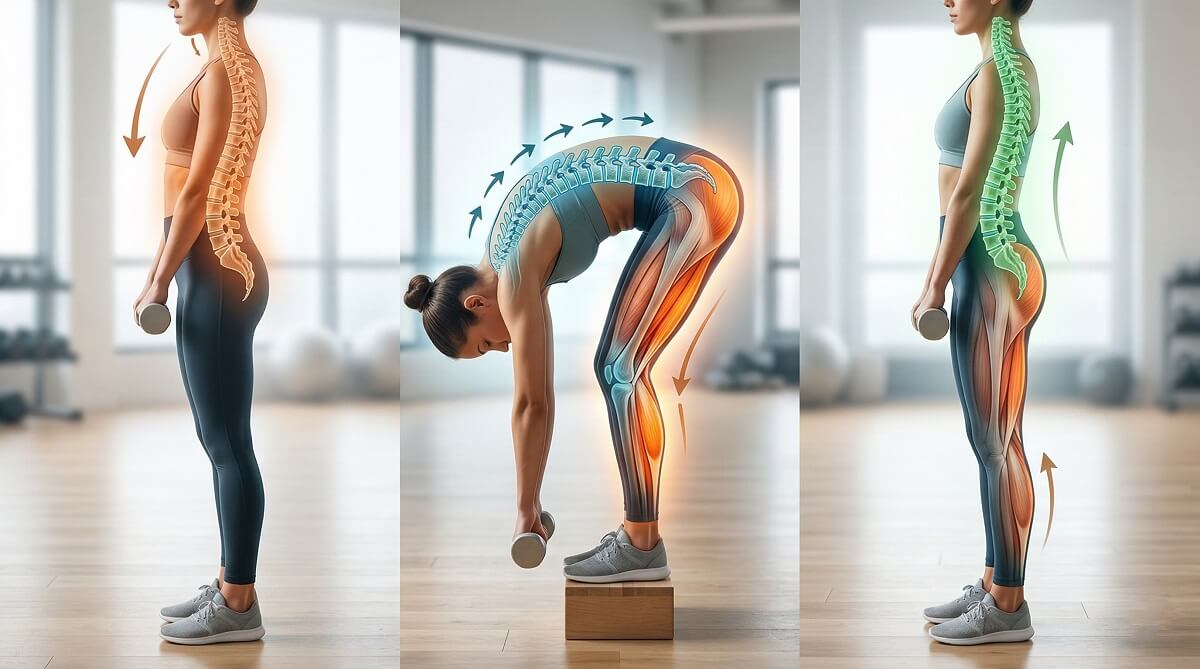
The Jefferson curl is a loaded forward fold where you deliberately round your entire spine while holding weight. That sounds like everything your gym coach told you never to do — and that’s exactly why it’s worth understanding. Done correctly, it trains your back in positions it actually encounters in daily life, stretches your hamstrings under load, and builds the kind of spinal control that makes you more resilient over time, not less.
The catch? Load and form are everything. Light weight, slow tempo, full control — that’s the Jefferson curl done right. Heavy, rushed, or by someone with an active disc injury — that’s how it earns its bad reputation. This guide lays out what the research says, what coaches and physical therapists actually recommend, who benefits most, and how to get started without hurting yourself.
Quick reference:
- Primary muscles: Erector spinae, hamstrings, glutes
- Secondary muscles: Lower trapezius, adductors, core stabilizers
- Best for: Athletes, people with tight hamstrings, those wanting end-range spinal strength
- Starting load: Bodyweight or 5–10 lbs
- Beginner sets/reps: 3 × 5–8, 5-second descent, 2–3×/week
- Skip if: Active disc herniation, sciatica, or acute back pain
Who Should (and Shouldn’t) Do the Jefferson Curl
✅ Best For
- Athletes who need end-range spinal mobility — gymnasts, grapplers, Olympic weightlifters
- Anyone with chronically tight hamstrings (desk workers, runners, deadlifters)
- Intermediate lifters adding posterior chain variety to their program
- Yoga practitioners who want loaded stability to complement passive flexibility
- People dealing with general low back stiffness (not acute injury)
❌ Skip If
- You have an active disc herniation or sciatica — pain radiating down the leg is a red flag
- You can’t hip hinge cleanly without rounding — build that pattern first
- You need a primary back strength exercise — this is complementary, not a replacement for deadlifts
- You rush through reps — slow, deliberate control is non-negotiable here
- A physician has told you to avoid spinal flexion
What Is the Jefferson Curl (And Why It Looks Like Everything You’ve Been Told to Avoid)
Stand on a small elevated surface — a pair of weight plates stacked 2–4 inches high, a step box, or a wooden block. Hold a light dumbbell, kettlebell, or barbell in both hands. Then, starting from your neck, deliberately curl your entire spine forward, one vertebra at a time, until the weight hangs below your feet. That’s the Jefferson curl.
The elevated surface matters. It lets the weight travel below your foot level, which maximizes the stretch through your hamstrings and lower back. Without elevation, you’d run out of range of motion before the exercise does its job.
Where did this come from? The exercise has roots in German New School gymnastics and has been used in Olympic weightlifting and gymnastics conditioning programs for decades. The name’s origin is debated — some attribute it to a variation of the Jefferson Deadlift, others say the connection is looser. Either way, it’s been quietly used by serious coaches long before social media made it controversial.
How It Differs From a Deadlift or Romanian Deadlift
The deadlift and Romanian deadlift (RDL) keep your spine neutral — braced and rigid throughout. That’s intentional. You’re loading the hip hinge pattern with a stable spine so you can move heavy weight safely.
The Jefferson curl does the opposite on purpose. The spine intentionally rounds. You’re training loaded spinal flexion — a completely different stimulus aimed at building strength and mobility in a range most exercises deliberately avoid. Think of them as complementary, not competing.
Jefferson Curl Benefits — What This Exercise Actually Delivers
1. Stronger Erector Spinae Through a Full Arc of Motion
Most back exercises — deadlifts, rows, hyperextensions — keep the spine locked in a neutral position. The erector spinae work isometrically, meaning they maintain length without significantly shortening or lengthening. That builds strength, but only in one position.
The Jefferson curl changes the equation. Your erectors lengthen under load on the way down (eccentric phase) and then shorten as you return to standing (concentric phase). Over time, this builds strength across a wider range — the kind of capacity that matters when you’re lifting something off the floor in a compromised position or taking impact in a contact sport.
2. Hamstring Flexibility That Actually Sticks
Passive stretching — the kind you do in yoga or post-workout — lengthens the muscle temporarily. You gain range, but not much strength in that new range. Load it, and the picture changes.
A study in PMC (PMC2953312) tested this on 75 male athletes. A single session of eccentric resistance training through full hip flexion produced a 9.48° improvement in hamstring range of motion — compared to 5.50° from static stretching. That’s roughly 72% greater immediate gains. A separate 6-week study (PMC522148) confirmed that over time, eccentric training matches static stretching for long-term range-of-motion improvements while also building strength in that range.
The Jefferson curl applies this principle directly. You stretch the hamstrings while they’re working against gravity — which is why consistent practice tends to yield gains that last beyond the session itself. Most people notice measurable improvements in hamstring mobility within 4–6 weeks of twice-weekly practice.
3. Spinal Articulation — Teaching Each Vertebra to Move
The cue “one vertebra at a time” sounds like coaching jargon until you actually try it. Moving that slowly, you’ll immediately notice which segments of your spine are stiff and which ones compensate by moving too much. That’s the hidden value of this drill.
Many chronic back pain cases involve segments that don’t move independently, forcing adjacent vertebrae to pick up the slack. The Jefferson curl demands participation from every section of the spine — if one segment isn’t contributing, you feel it. Over weeks of consistent practice, those rigid spots tend to loosen up and start doing their share.
4. Posterior Chain Resilience for Athletes
If you participate in contact sports, martial arts, wrestling, or gymnastics, your spine encounters flexion under load whether you train it or not. The question is whether it encounters that position for the first time under high stress, or after weeks of controlled preparation.
Training loaded spinal flexion deliberately — at light loads, with full control — builds tolerance for those positions. Avoiding the movement entirely leaves a gap in your preparedness. This is the argument that coaches in strength sports have made for years, and it’s the reason the Jefferson curl appears in serious programming long before it ever showed up on fitness influencer feeds.
5. Better Posture and Body Awareness
According to Experience Life, the drill also delivers “better posture and body mechanics” and “increased body awareness and proprioception” — both of which hold up practically. The slow, segmented descent demands genuine attention to where your body is in space. That kind of focused, intentional movement tends to carry over into how you hold yourself throughout the day.
Muscles Worked in the Jefferson Curl
| Muscle | Role | What It Does |
|---|---|---|
| Erector spinae | Primary | Lengthens on descent, contracts on return — full range eccentric/concentric |
| Hamstrings | Primary | Stretched under load through the descent; engaged on the way back up |
| Glutes | Secondary | Active in controlling descent and driving the return to standing |
| Lower trapezius | Secondary | Helps control shoulder blade and upper back position throughout |
| Adductors | Secondary | Stabilization during the movement |
| Core stabilizers | Secondary | Intra-abdominal pressure management, anti-rotation |
How to Do the Jefferson Curl — Step by Step
Equipment
You need something to stand on (2–4 inches of elevation is standard — a pair of 45 lb plates side by side, a small wooden box, or a step platform all work) and something to hold. A single dumbbell or kettlebell held in both hands is the easiest starting point. Budget options: entry-level 10–15 lb kettlebells typically run in the $20–$40 range on Amazon; check current pricing before purchasing as it fluctuates.
Step 1 — Setup
Stand on your elevated surface, feet roughly hip-width apart. Hold the weight in both hands in front of your body, arms hanging straight. Soft bend in the knees — not locked, not heavily bent. Take a breath to set yourself.
Step 2 — The Descent
Tuck your chin toward your chest first. Then begin rounding from your upper back — thoracic spine first, then through your mid-back, then lower back. Take 4–5 seconds going down. The goal is to feel each section of the spine participating, not just folding from the hips.
Step 3 — The Bottom Position
At the bottom, the weight should hang below the level of your feet. You’ll feel a significant pull through your hamstrings and lower back. Let your pelvis tip slightly forward — don’t fight it. Pause here for 1–2 seconds. If you feel pain (not the stretch discomfort), stop.
Step 4 — The Ascent
Reverse the movement from the bottom up. Start with your lower back uncurling, then through your mid-back and thoracic, with your head and chin lifting last. Use your hamstrings and glutes to assist. Take 3–4 seconds coming up. Your chin shouldn’t lift until your spine is nearly upright.
Common Mistakes to Avoid
- Bending the knees too much — reduces the hamstring stretch and defeats the purpose
- Rushing the descent — the slow tempo is where the benefit lives
- Going too heavy, too soon — more weight here means less control and more risk
- Bouncing at the bottom — the movement should be deliberate throughout, not momentum-driven
- Initiating from the hips — start the movement from the neck, not a hip hinge
Is the Jefferson Curl Safe? The Spinal Flexion Debate, Explained
This is where the exercise gets complicated — and where most articles either oversell the risk or ignore it entirely. Here’s a straight take.
What the Concern Is
Dr. Stuart McGill, one of the most cited spine researchers in the world, has documented that repeated lumbar flexion under load can damage spinal discs. On his website backfitpro.com, he describes the mechanism: “When the spine loads are high in magnitude with repeated flexion motion, the collagen fibres delaminate in a cumulative fashion, and slowly the nucleus of the disc will work through the delaminations and create a disc bulge.”
That’s a real finding. Repetitive high-load spinal flexion is a genuine injury mechanism — and it’s why you don’t want to do barbell good mornings for hundreds of reps with heavy weight.
What the Concern Doesn’t Mean
McGill’s research is about high-load, repetitive flexion. The Jefferson curl protocol — light weight, 5–12 controlled reps, 2–3 times per week — is a different scenario. The spine handles low-load flexion fine, and in fact needs it to remain healthy. Avoiding all spinal movement doesn’t strengthen the discs; it just means the first time you encounter a demanding flexion position in real life, your back hasn’t prepared for it.
The clinical take from Pinnacle Hill Chiropractic (2024) captures this well: the Jefferson curl isn’t appropriate for everyone, but context matters. For someone with severe low back stiffness and limited lumbar flexion, it can be a productive tool. For someone with an active disc herniation and sciatica, it’s contraindicated until the acute phase resolves.
The Takeaway
If you’re healthy, can perform a basic hip hinge without pain, and start with controlled bodyweight-only practice, the Jefferson curl carries manageable risk. If you have current back issues, consult a physical therapist or physician before adding this to your program.
How to Program the Jefferson Curl — Sets, Reps, and Frequency
Beginner — Mobility Focus
Start here before you ever pick up a weight for this exercise.
- Load: Bodyweight first; once form is consistent, progress to 5–10 lbs
- Sets/Reps: 3 sets × 5–8 reps
- Tempo: 5 seconds down, 1–2 seconds hold at bottom, 3–4 seconds up
- Frequency: 2×/week
- When in workout: After warm-up, before heavy posterior chain work
This protocol comes from 919 Spine’s clinical recommendations and is consistent with guidance from Experience Life’s fitness experts.
Intermediate — Hypertrophy and Strength
- Load: 10–35 lbs (based on control, not ambition)
- Sets/Reps: 3–4 sets × 8–12 reps
- Tempo: 4 seconds down, 1 second hold, 3 seconds up
- Frequency: 2–3×/week
- Placement: Posterior chain day finisher, or before deadlifts as a mobility warm-up
The Garage Strength coaching team uses this range specifically for eccentric posterior chain development — the slow descent under load is what drives the hypertrophy response.
Where It Fits in a Weekly Program
The Jefferson curl works well as:
- A morning mobility drill (bodyweight, 1–2 sets) before more demanding work
- A warm-up exercise before deadlifts or Romanian deadlifts
- A posterior chain finisher on leg day
Don’t pair it with other high-volume spinal loading on the same session. If you’re doing heavy Romanian deadlifts and Jefferson curls back-to-back, you’re asking a lot of the same structures.
Jefferson Curl vs. Romanian Deadlift — How They Actually Differ
These two exercises both target the posterior chain. The confusion is understandable. Here’s the real distinction:
| Feature | Jefferson Curl | Romanian Deadlift (RDL) |
|---|---|---|
| Spine position | Intentionally rounded | Neutral / braced throughout |
| Primary stimulus | Spinal mobility + eccentric erectors | Hip hinge strength + hamstring tension |
| Load capacity | Very light (5–35 lbs) | Moderate to heavy |
| Main goal | Mobility + end-range strength | Strength + hypertrophy |
| Risk profile | Higher if misused or overloaded | Lower for general population |
| Typical user | Athletes, coaches, mobility-focused lifters | Most gym-goers, general strength training |
| Knee position | Mostly straight, soft bend | Soft bend maintained |
The practical answer: if you’re already doing RDLs and want to add spinal mobility work, the Jefferson curl complements it well. They’re not substitutes for each other.
Frequently Asked Questions About the Jefferson Curl
Is the Jefferson curl bad for your spine?
For healthy people using light loads and controlled form, the evidence doesn’t support this. The concern — documented by researchers like Stuart McGill — involves high-load, repetitive flexion over many cycles. The Jefferson curl protocol (5–12 reps, light weight, slow tempo) is a different scenario. That said, anyone with existing disc pathology should consult a physical therapist before trying it.
How heavy should I go on Jefferson curls?
Lighter than you’re tempted to go. Beginners: bodyweight or 5–10 lbs. Most intermediate lifters cap out at 25–45 lbs. The exercise is about controlled range of motion — adding more weight typically just compresses your spine and reduces the quality of movement.
Can beginners do the Jefferson curl?
Yes — start with bodyweight only. If you can’t complete a slow, segmented descent with no weight, adding load won’t fix the problem. Bodyweight practice for a few weeks first is a reasonable approach.
Does the Jefferson curl help lower back pain?
It depends on what’s causing the pain. Chronic stiffness with limited lumbar flexion: possibly yes, as it’s used in some clinical settings for exactly this. Active disc herniation or sciatica: no — avoid it and see a professional first. Pain that shows up when you practice: stop immediately.
How long before I see results?
Most people notice improved hamstring flexibility within 3–4 weeks of twice-weekly practice. Research on eccentric training shows meaningful range-of-motion gains within 6 weeks. Spinal mobility improvements tend to take a bit longer to feel significant — 6–8 weeks of consistent work.
How does the Jefferson curl compare to a deadlift?
They train different things. The deadlift builds strength with a neutral spine under heavy load. The Jefferson curl builds mobility and end-range strength with the spine in flexion under light load. Both have a place in a well-rounded program.
Should I use a box or elevated surface?
Yes — 2–4 inches of elevation is the standard. Without it, the weight hits the floor before you reach the end of your hamstring range. Standard 45 lb plates stacked flat work fine. A small wooden box or step platform also works.
Can I do Jefferson curls every day?
Not recommended. Two to three sessions per week allows time for tissue adaptation. Bodyweight-only practice daily is possible but not necessary — rest and recovery are part of how the flexibility gains accumulate.
Getting Started
All you need is a light kettlebell or dumbbell and something to stand on. A 10–15 lb kettlebell typically runs in the $20–$40 range — check current prices on Amazon. For the elevated surface, a pair of standard weight plates or a small step box works perfectly.
Start with bodyweight. Go slow. The pace of descent is where this exercise either works or doesn’t — five seconds down isn’t a suggestion, it’s the mechanism. Add load only when the form feels natural and unhurried.
