


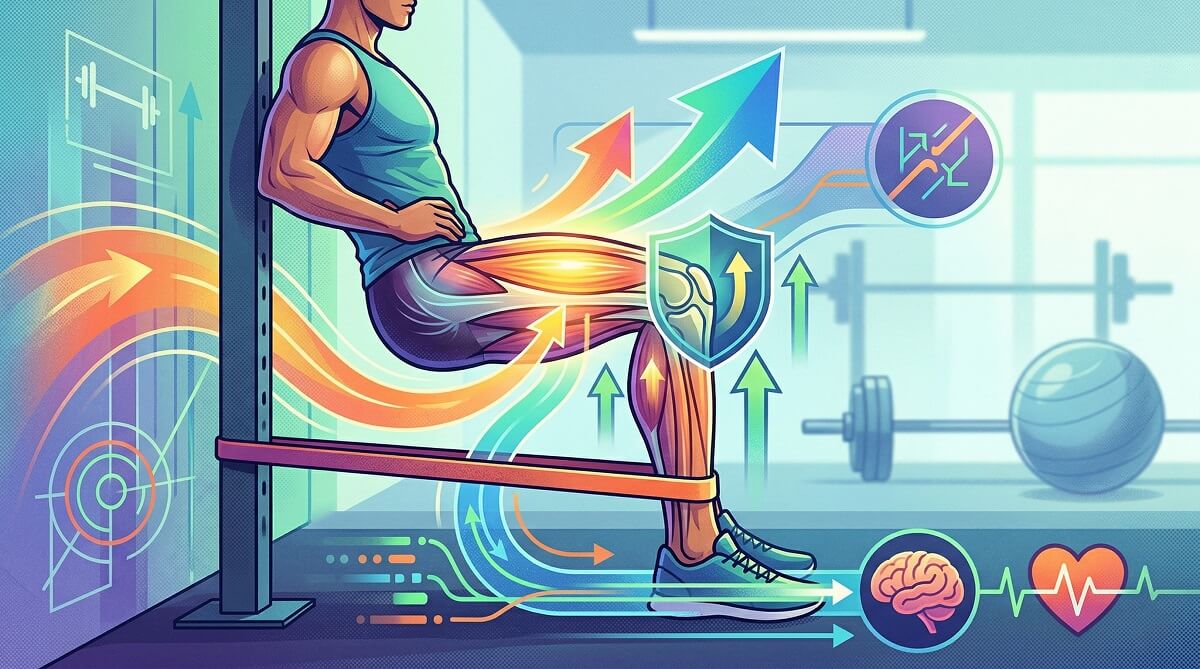
The Spanish squat is one of the few lower-body movements where going easy on your knees and hammering your quads aren’t mutually exclusive goals. By threading a resistance band behind both knees and anchoring it to a rack or post, the exercise locks your shins into a near-vertical position — dramatically cutting compressive force on the kneecap while pushing most of the load directly into the front of your thighs.
Physical therapists have been using this variation for years to treat patellar tendinopathy. Now it’s showing up in mainstream strength programs too — and the science backs the hype. A 2022 study published in BMC Sports Science, Medicine and Rehabilitation found that the Spanish squat produced significantly higher activation in the rectus femoris and vastus lateralis — two key quad muscles — compared to both general squats and wall squats across 22 participants. If you’re putting together a lower-body training setup, our fitness equipment buying guides can help you sort out the rest of your gear.
Whether you’re dealing with anterior knee pain, trying to build stronger quads for sport, or just want a variation that doesn’t leave your knees aching the next morning, the Spanish squat is worth understanding before you dismiss it as a niche rehab drill.
Who Should (and Shouldn’t) Try the Spanish Squat
✅ Best For
- People with patellar tendinopathy or anterior knee pain (under physical therapist guidance)
- Athletes in running, skiing, or surfing who need powerful, stable quads
- Anyone whose regular squats cause knee discomfort
- Gym-goers looking for quad isolation with minimal hip and back loading
- Beginners learning proper squat mechanics — the band enforces vertical shins by design
❌ Skip If
- You have an acute knee injury or recent surgery (get clearance from your provider first)
- You’re in the early stages of ACL rehab (discuss with your physical therapist)
- Your knee pain comes from the patellofemoral joint specifically — this exercise may make it worse, not better
- You have no access to a resistance band and a fixed anchor point
What the Spanish Squat Actually Is (And Why the Band Changes Everything)
The Spanish squat is a lower-body exercise where you loop a long resistance band or non-elastic strap around a fixed object at approximately knee height, then step back and place the band behind both knees. As you squat down, the band pulls the backs of your calves toward the anchor point — which keeps your tibia (shin bone) in a near-vertical position throughout the entire movement.
That vertical tibia is the whole point. In a conventional squat, your shins naturally angle forward as you lower down. That forward lean is what drives your kneecap into the femur below it — the mechanism behind patellofemoral compression and much of the knee pain associated with squatting. The Spanish squat’s band removes that forward translation. Your knees stay in place, your chest stays upright, and the quad muscles have to do all the work that would otherwise be shared with your hips and back. For more movement breakdowns like this, browse our fitness how-to guides.
One important nuance: the band isn’t helping you lift. It’s constraining your position. Think of it less like an assisted pull-up band and more like a seatbelt that keeps your mechanics honest while the muscles do the actual work.
Spanish Squat vs. Regular Squat — Key Differences
| Feature | Regular Squat | Spanish Squat |
|---|---|---|
| Shin angle | Forward lean | Near-vertical |
| Patellofemoral load | Higher compression | Significantly reduced |
| Quad isolation | Moderate | High |
| Hip involvement | High | Reduced |
| Spinal loading | Moderate to high | Minimal |
| Equipment needed | None (bodyweight) | Resistance band + anchor |
The Real Benefits of Spanish Squats
Stronger Quads — Especially the VMO and Outer Quad
The vertical shin position forces your knee extensors to carry the load without sharing it with your hips or back. According to the 2022 BMC Sports Science study, the Spanish squat produced significantly greater activation in the rectus femoris (RF: χ²=21.523, p<0.001) and the vastus lateralis (VL: χ²=7.101, p=0.029) compared to both general squats and wall squats. The study concluded the Spanish squat “could be a potential option to include for prescribing exercise or designing rehabilitation programs.”
Why does that matter in practice? The vastus medialis (the teardrop-shaped muscle just above and inside the kneecap) and the vastus lateralis are the two portions of the quad most responsible for knee stabilization during dynamic movements like running and jumping. Building them directly reduces the likelihood that other structures — tendons, ligaments, the IT band — end up overloaded.
Reduced Knee Pain and Tendon Load
The Spanish squat was originally developed as a treatment for patellar tendinopathy, the overuse injury that causes pain at the front of the knee just below the kneecap. The exercise works on two levels. First, keeping the tibia vertical eliminates the forward shear force that typically compresses the patellofemoral joint during squatting. As ACE Physical Therapy explains, “the Spanish squat increases tension within the lower extremities but does not increase the compressive force in the patella femoral joint.”
Second, loading the patellar tendon under controlled isometric tension produces what clinicians call an analgesic effect — a temporary reduction in pain signals from the tendon to the brain. This effect lasts roughly an hour, which is long enough to complete the rest of a rehab session with significantly reduced discomfort. A December 2023 case series in the International Journal of Sports Physical Therapy found that the Spanish squat with and without electrical stimulation showed promising pain-reduction results in athletes with patellar tendinopathy.
Important caveat: If your knee pain originates from the patellofemoral joint (the kneecap-femur interface) rather than the patellar tendon, the Spanish squat may actually increase pain — not reduce it. The two conditions feel similar but have different mechanical causes. See a physical therapist before using this exercise to manage knee pain.
Better Squat Mechanics and Posture
One underrated benefit is that the Spanish squat trains correct positioning passively. Because the band physically prevents your shins from going forward, your torso has to stay upright and your weight has to stay over your midfoot. Do enough reps and your body starts to internalize that alignment — which carries over to conventional squats, deadlifts, and any other loaded movement pattern. If you’re building a home gym around this kind of training, check out our fitness equipment reviews.
It also addresses knee valgus (inward knee collapse) by creating awareness of knee position during the movement. Trainer Kelsey Wells, CPT, CSCS, who created the PWR program for Sweat, notes the exercise “can also help address common issues, like letting the knees cave inward” — a frequent problem that increases injury risk across squatting and jumping movements.
Accessible and Scalable
You need one piece of equipment: a long loop resistance band and something solid to loop it around. A squat rack upright works perfectly. A fence post, a heavy piece of furniture bolted to the floor, or a pull-up bar at the right height all work too. The exercise scales from pure bodyweight for beginners to heavy kettlebell holds for experienced athletes. You can also adjust difficulty by changing the band: a thicker band gives more counterbalance support (easier); a thinner band provides less support (harder). Think of it like an assisted pull-up in reverse.
How to Do a Spanish Squat (Step-by-Step)
- Set up your anchor. Loop a long resistance band (41-inch loop band / superband) around a power rack upright or similar fixed object at knee height. The anchor should be at roughly the same height as the back of your knees.
- Step into the band. Back up until the band sits snugly behind both knees — in the crease of the knee, not above or below it. You want even tension across both sides.
- Set your stance. Feet shoulder-width apart, toes pointing forward or slightly out. Stand far enough back that the band already has some tension before you begin.
- Lean back slightly. Let the band take your weight — you should feel it pulling at the backs of your knees. This is your starting position.
- Squat down. Keep chest up and core braced. Lower until thighs reach parallel to the floor, or as deep as your mobility allows. Your shins should stay close to vertical throughout.
- Pause at the bottom. For a strength rep: hold 1–2 seconds. For rehab: hold up to 45 seconds at this position.
- Drive through midfoot and heels to stand back up. That’s one rep.
Which Resistance Band Do You Need?
For Spanish squats, you want a long loop band (41 inches / about 1 meter) rather than a short mini-band. The band needs enough length to anchor to a rack and still loop comfortably behind both knees as you step back. Resistance level should be medium to heavy — enough tension to support and counterbalance you without pulling you forward. Long loop bands from brands like Rogue, Serious Steel, or similar retailers typically run $15–$30 per band for lighter and medium resistance levels. Check current pricing on Amazon, as availability and prices vary.
Common Mistakes to Avoid
Letting Your Knees Cave In
Focus on pushing your knees out in line with your second and third toes. If your knees keep collapsing inward, reduce the depth of your squat until you build enough hip abductor and quad strength to maintain alignment.
Leaning Too Far Forward
If you’re tilting forward instead of staying upright, one of two things is happening: the band doesn’t have enough tension (anchor it closer or use a thicker band), or you’re not stepping back far enough from the anchor. The whole mechanism of this exercise depends on the band pulling you upright — don’t fight it.
Rushing the Movement
A fast Spanish squat is a wasted Spanish squat. The benefits come from sustained tension on the quadriceps and tendon, not from the number of reps. Slow, controlled descents with a deliberate pause at the bottom deliver significantly more stimulus than bouncing through a set.
Placing the Band Too High or Low
The band should sit in the back of the knee joint, not on the calf below it or the hamstring above it. Improper placement changes the mechanics and reduces the effectiveness of the vertical shin constraint.
Jumping Straight to Heavy Loads
Bodyweight is plenty to start with. Get your shin angle, depth, and hold duration right before adding a kettlebell. Poor form with load is how a knee-friendly exercise stops being knee-friendly.
Programming Spanish Squats: Building Them Into Your Routine
Sets, Reps, and Hold Time by Goal
| Goal | Sets | Reps / Hold Duration | Rest Between Sets |
|---|---|---|---|
| Learn the movement / beginners | 2–3 | 12–15 reps bodyweight | 60–90 seconds |
| Quad strength building | 3–4 | 6–10 reps with load | 90–120 seconds |
| Patellar tendon rehab (isometric) | 3–5 | 45-second hold at ~70–90° knee flexion | 2 minutes |
| Advanced loading | 4–5 | 6–8 reps with heavy kettlebell goblet hold | 2–3 minutes |
For rehab use, the protocol from physiotherapy resources calls for 3–5 sets of 45-second isometric holds, performed 1–3 times daily during the pain management phase. The analgesic effect this creates is why it’s typically done at the start of a session. For general strength training, 2–3 days per week as part of a lower-body program is appropriate.
Where to Slot It in a Workout
If you’re using Spanish squats for knee pain management, perform them at the beginning of your session — the temporary pain-reducing effect carries you through the rest of the workout. For strength and muscle building, they work well as an accessory movement after your main compound lifts (squats, deadlifts, lunges). You’ll find more training structure tips in our how-to guides section.
Alternatives and Progressions
If You Can’t Do Spanish Squats Yet
Wall Sit: Lean your back against a wall, slide down until hips and knees are at 90 degrees, and hold. No equipment needed. Builds isometric quad strength and improves knee stability — a solid stepping stone before adding the band setup.
Box Squat: Squatting back to a box or chair teaches the “sit back” mechanics that carry into the Spanish squat. Use a box height that keeps your thighs at or near parallel without rounding your lower back.
Leg Press (high, narrow foot position): Loads the quads with minimal axial compression. Useful if knee pain makes any standing squat variation uncomfortable during the early rehab phase.
When You’re Ready for More
Loaded Spanish Squat: Hold a kettlebell or dumbbell in a goblet position (cradled at chest height). Start light — even 8–12 kg changes the difficulty significantly.
Single-Leg Spanish Squat: Loop the band behind just one knee. This variation massively increases unilateral quad demand and is an effective bridge to pistol squats for athletes with strong bilateral technique.
Slow Eccentric (5-second lower): Eccentric loading — resisting gravity on the way down — places extra mechanical stress on tendons, which is particularly effective for tendon remodeling in rehab contexts. Need more gear for your lower-body training? Browse our fitness buying guides for equipment recommendations.
Frequently Asked Questions About Spanish Squats
Are Spanish squats safe for people with bad knees?
That depends on the type of knee problem. Spanish squats are well-supported for patellar tendinopathy — the tendon irritation that causes pain below the kneecap. They reduce patellofemoral compression and produce a temporary analgesic effect that can make the rest of rehab more manageable. However, if your pain stems from the patellofemoral joint itself (the kneecap-femur interface), the exercise may aggravate it. Always get a diagnosis and clearance from a physical therapist before using this exercise to manage knee pain.
What muscles do Spanish squats work?
The primary target is the quadriceps — specifically the rectus femoris and vastus lateralis, which research shows are activated at higher levels than in conventional squats. The glutes, hamstrings, and core are also engaged as stabilizers, though the hip involvement is considerably lower than in a standard squat. The calves work isometrically to maintain ankle position.
How do Spanish squats differ from sissy squats?
Both are quad-dominant knee-flexion exercises, but the mechanics diverge at the band placement. The sissy squat uses a bench or anchor on the front of the shin (anterior tibialis), which compresses the knee more than the Spanish squat does. The Spanish squat’s band pulls from the back of the knee (calf area), which keeps tibia more vertical and reduces that compression. For people with knee concerns, the Spanish squat is generally the safer option.
Can I do Spanish squats every day?
For the isometric rehab version (45-second holds), yes — physical therapists often prescribe them 1–3 times daily during the early pain management phase. For the strength-focused dynamic version, 2–3 sessions per week with rest in between is more appropriate, the same as any other resistance training movement.
What resistance band do I need for Spanish squats?
You need a long loop band (41 inches / about 1 meter when at rest), not a short mini-band. Resistance level should be medium to heavy — enough to counterbalance you without pulling you off your feet. Beginners often find that a thicker band (more support) makes learning the movement easier. Long loop bands in the appropriate resistance range typically cost $15–$30 from major fitness equipment brands. Check current pricing on Amazon by searching “41 inch resistance band” or “superband.”
Do Spanish squats build muscle or just help with rehab?
Both. The research showing superior RF and VL activation versus general squats was conducted on healthy participants, not just rehab patients. For quad hypertrophy and strength, the Spanish squat competes favorably with leg extensions because it delivers high quad activation through a closed-chain movement — meaning the foot stays planted, which also builds stability and functional strength. Adding load (kettlebell, dumbbell) increases the hypertrophy stimulus further.
How long before I see results from Spanish squats?
For pain management, the analgesic effect starts immediately and can last up to an hour per session. For strength and quad development, expect noticeable improvements in 4–8 weeks of consistent training at appropriate intensity. Tendon adaptations from the rehab protocol typically take 8–12 weeks to consolidate — tendons respond to load more slowly than muscle tissue.
Should I feel pain during Spanish squats?
Muscle burn and fatigue — yes, that’s normal and expected. Sharp knee pain or pain that worsens during or after the exercise — no. If the exercise increases your knee pain, stop and consult a physical therapist. A score of 3–4 out of 10 on a pain scale is generally considered acceptable during rehab-phase isometric holds, per standard tendinopathy management protocols.
Ready to Try Spanish Squats?
All you need to get started is a long loop resistance band and somewhere solid to anchor it. A squat rack is ideal, but a sturdy fence post or the base of a heavy piece of furniture works too. Pick up a 41-inch loop band on Amazon — medium or heavy resistance is a good starting point for most people.
If you’re using this movement for knee pain or injury rehab, work with a physical therapist who can confirm the diagnosis and guide the dosing protocol. The Spanish squat is a solid tool — it’s just most effective when you know exactly what problem you’re solving. For more exercise breakdowns, head to our fitness how-to section.
