


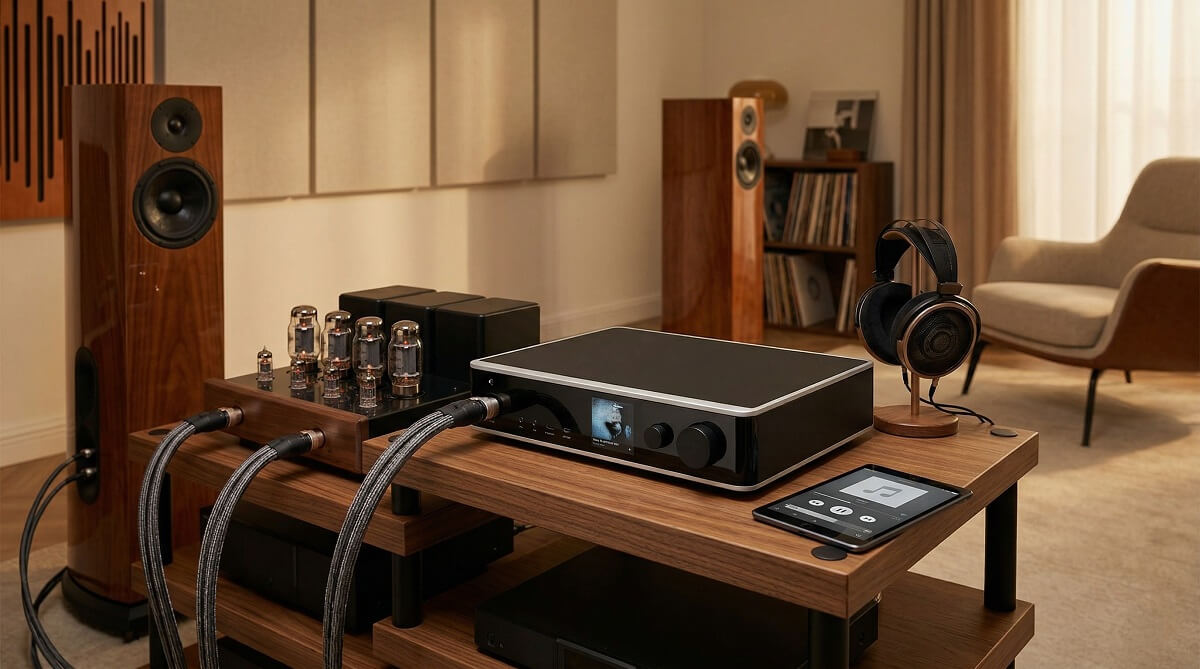
You don’t need to spend $5,000 to stream music at genuinely audiophile quality. The Bluesound NODE ICON, sitting at $1,199, is our top overall pick — it packs a dual-mono DAC, balanced XLR outputs, THX AAA headphone amplification, and Dirac Live room correction into a single unit that earned . If budget matters, the Eversolo DMP-A6 at $859 delivers comparable DAC performance with the added bonus of native Apple Music hi-res support — something most streamers still can’t manage.
The category has changed fast over the past two years. Streaming services like Tidal and Qobuz now deliver lossless and hi-res audio up to 24-bit/192kHz, and the hardware to play them properly has become far more accessible. The days when a “good” streamer meant a $4,000 purchase are largely gone — though the high-end options remain for those who want them. Whether you’re spending $329 or $1,999, there’s a capable network player in this guide for you.
One note before we dive in: a streamer is only as good as the rest of your audio chain. If you’re pairing this with quality speakers and an amplifier — or a great pair of headphones — you’ll hear the difference. If you’re running it into a soundbar, you won’t.
Who Should (and Shouldn’t) Buy an Audiophile Music Streamer
✅ Best For
- Serious listeners already subscribed to Tidal, Qobuz, or Apple Music hi-res
- Anyone with a quality amplifier and speakers looking to add a clean digital source
- Headphone listeners who want lossless streaming without a computer in the chain
- Roon users who need certified-ready hardware
- Apple Music subscribers tired of the 48kHz AirPlay ceiling
❌ Skip If
- You’re streaming Spotify at standard quality — the bottleneck isn’t the hardware
- Your speakers and amplifier top out at entry-level quality
- You need multi-room audio across a whole house — look at Sonos first
- You’re not ready to invest in the rest of the audio chain
What Is an Audiophile Music Streamer?
A music streamer — also called a network player or digital audio player — connects to your home network and pulls hi-res audio from streaming services or local storage, then sends that audio to your amplifier or speakers. Unlike a Bluetooth speaker or Apple TV, a dedicated streamer is built from the ground up for sound quality: quieter power supplies, better DAC chips, lower jitter, and outputs designed to integrate with audiophile-grade components.
Streamer vs. Streaming DAC vs. Network Transport
The terminology in this category is genuinely confusing, so here’s a quick breakdown:
- Network transport (streamer-only): Outputs a digital signal only (coaxial, optical, USB, I2S). You need a separate external DAC to convert to analog. Examples: PS Audio AirLens ($1,999), Bricasti M5.
- Streaming DAC (all-in-one): Includes both the streaming engine and a built-in DAC, outputting analog directly to your amplifier via RCA or XLR. Examples: Bluesound NODE ICON, Eversolo DMP-A6, WiiM Ultra, Cambridge Audio CXN100.
- Integrated streamer/amp: Combines streaming, DAC, and amplification in one box. Examples: NAD C700, Naim Uniti Atom.
For most listeners, a streaming DAC is the practical choice. Unless you already own a high-quality external DAC worth $2,000 or more, the built-in DACs in today’s better streaming units will likely outperform what you’d find in a separate budget DAC anyway.
What Makes a Streamer Audiophile-Grade?
Several factors separate a real audiophile network player from a smart speaker dressed up with a fancier box:
- DAC chip quality: Higher-end units use ESS Sabre chips (ES9038Q2M, ES9039Q2M), AKM, or Burr-Brown silicon. The chip type affects dynamic range, noise floor, and harmonic distortion.
- Balanced XLR outputs: Balanced connections reject noise on longer cable runs and pair better with professional-grade amplifiers. Not all streamers have them.
- Bit-perfect output: The streamer should transmit audio without altering sample rate or bit depth. Some older units resample everything — a deal-breaker for critical listening.
- Streaming service support: Tidal Connect, Qobuz Connect, Roon Ready certification, and — increasingly important — native Apple Music support (not just AirPlay).
- Network reliability: Dual-band Wi-Fi (or Gigabit Ethernet) minimizes dropouts. Wired Ethernet remains the most reliable option if you can run a cable.
Top Audiophile Music Streamers for 2026 — Our Picks
Best Overall: Bluesound NODE ICON — $1,199
The NODE ICON is the most complete music streamer at its price. It earned , and once you spend time with it, you understand why. The dual-mono DAC design — using two separate ESS Sabre ES9039Q2M chips rather than a single stereo chip — delivers a notably quieter noise floor and better channel separation than what you get from budget streamers. Measured specs back this up: Bluesound’s official specs show SNR of -129dB via XLR and THD+N of 0.0004%.
What stands out practically is how much the NODE ICON covers in one device. Balanced XLR outputs for clean long-cable runs. Two full-size 1/4″ headphone jacks with THX AAA amplification — the same technology used in dedicated headphone amps costing several hundred dollars more. HDMI eARC for TV integration. Dirac Live room correction readiness (requires a paid upgrade and calibration microphone, but the capability is built in). And the BluOS platform, which handles 23+ streaming services including Tidal Connect, Qobuz Connect, Spotify Connect (including lossless), and Roon Ready certification.
FutureAudiophile described it as “a game-changing component in the audiophile marketplace” in their June 2025 review, noting strong midrange clarity and an impressive soundstage. One flag from user reviews: intermittent popping between tracks in some configurations — something Bluesound has been addressing, but keep in mind if you’re sensitive to playback artifacts.
The NODE ICON is a division of Lenbrook Industries, which also makes NAD Electronics and PSB Speakers. That lineage matters: BluOS is one of the most stable and regularly updated operating systems in the streamer market.
Key specs: 2x ESS ES9039Q2M (dual-mono), SNR -129dB (XLR), THD+N 0.0004%, DSD256, 32-bit/192kHz PCM, Wi-Fi 5 dual-band, Gigabit Ethernet, Bluetooth 5.2 aptX Adaptive, 5″ HD display
Check current price: Bluesound NODE ICON on Amazon
Best Value: Eversolo DMP-A6 Gen 2 — $859
The Eversolo DMP-A6 has earned something close to cult status in audiophile circles — and the Gen 2 version adds refinements while keeping the price at $859. The primary reason it stands out from comparably-priced competitors is its Android-based operating system, which allows it to run the native Apple Music app at full hi-res (up to 24-bit/192kHz). , which caps Apple Music at 48kHz.
The hardware is also genuinely strong. An ESS9038Q2M DAC chip — the same generation used in units costing two to three times more. XLR balanced outputs. A 6-inch touchscreen that makes on-device navigation practical. An internal SSD slot if you want local music storage. HDMI output for multi-channel PCM. Roon Ready certification. The DMP-A6 supports PCM up to 32-bit/768kHz and DSD512 — specs that would have been considered high-end-only a few years ago.
One practical note on sound: the Eversolo’s DAC has a clean, detailed character. As one reviewer noted, it pairs particularly well with warmer amplifiers. If your system already leans bright, worth factoring that synergy into your decision.
There’s also a Master Edition Gen 2 at $1,399, which uses improved internal components for a more refined top-end and fuller midrange. Most listeners will be well-served by the standard version, but the Master Edition closes the gap to the NODE ICON meaningfully.
Key specs: ESS9038Q2M DAC, XLR + RCA outputs, HDMI output, 32-bit/768kHz PCM, DSD512, Roon Ready, native Apple Music support, 6″ touchscreen, internal SSD slot
Check current price: Eversolo DMP-A6 on Amazon
Best Budget Streamer: WiiM Ultra — $329
At $329, the WiiM Ultra is the strongest argument that audiophile-quality streaming doesn’t have to cost over $1,000. It uses an ESS Sabre ES9038Q2M DAC — the same chip class as the Eversolo — with measured specs of SNR 121dB(A) and THD+N of 0.00018%, according to independent spec testing. The headphone amplifier uses a TI TPA6120A2 chip and includes a 3.5″ color touchscreen.
The WiiM Ultra supports AirPlay 2, Chromecast, Spotify Connect, Tidal Connect, Qobuz Connect, and Roon Ready. It has Wi-Fi 6E and Bluetooth 5.3. For the price, the connectivity list is hard to fault. What it lacks compared to the NODE ICON and DMP-A6: no balanced XLR output, no native Apple Music hi-res (AirPlay 2 only), and no HDMI. If none of those matter to you, the WiiM Ultra is a serious value.
FutureAudiophile reviewed it in April 2025 and confirmed the $329 price holds up in practice.
Check current price: WiiM Ultra on Amazon
Best Premium Transport: PS Audio AirLens — $1,999
The PS Audio AirLens is for a specific buyer: someone who already owns a high-quality external DAC and wants the cleanest possible digital feed. It’s a network transport — no built-in DAC, digital output only. What you’re paying for is an exceptionally quiet power supply, I2S output (for direct connection to PS Audio DACs), and a carefully engineered digital stage that minimizes jitter and electrical noise before it reaches your DAC.
Roon Ready, AirPlay 2, and multi-protocol support are all present. This isn’t a product for most listeners — but if you’re running a $3,000+ DAC, the AirLens is a logical partner. Check current price on PS Audio’s site.
Also Consider: Cambridge Audio CXN100 — ~$1,099
Cambridge Audio has over 50 years of audio engineering heritage, and the CXN100 reflects that pedigree. It’s a streaming DAC with an ESS ES9016K2M chip, clean implementation, and support for all major streaming services including Roon. Its app is polished, and Cambridge’s build quality tends to age well. It doesn’t have balanced XLR outputs or a touchscreen, but at around $1,099 it’s a solid alternative to the NODE ICON for listeners who prefer Cambridge’s house sound — slightly warmer, less analytical. Check current price at Upscale Audio or Amazon.
Music Streamer Comparison Table
| Model | Price (USD) | DAC Chip | Balanced XLR | Apple Music Hi-Res | Roon Ready | Display |
|---|---|---|---|---|---|---|
| Bluesound NODE ICON | $1,199 | 2x ESS ES9039Q2M (Dual Mono) | ✓ | AirPlay 2 (48kHz cap) | ✓ | 5″ HD |
| Eversolo DMP-A6 Gen 2 | $859 | ESS ES9038Q2M | ✓ | Native (full hi-res) | ✓ | 6″ Touch |
| WiiM Ultra | $329 | ESS ES9038Q2M | — | AirPlay 2 (48kHz cap) | ✓ | 3.5″ Touch |
| PS Audio AirLens | $1,999 | None (transport only) | — | AirPlay 2 | ✓ | — |
| Cambridge Audio CXN100 | ~$1,099 | ESS ES9016K2M | — | AirPlay 2 (48kHz cap) | ✓ | Small LCD |
Prices as of March 2026 — check retailer links above for current availability and any price changes.
Which Streaming Service Sounds Best?
Hardware quality only matters if the source material is up to the task. Here’s where the major services stand in 2026:
Tidal — HiRes FLAC up to 24-bit/192kHz
Tidal retired MQA on July 23, 2024, according to Tidal’s official format update. Their current “Max” tier now streams HiRes FLAC natively — up to 24-bit/192kHz — without the controversial unfolding process MQA required. This makes Tidal more straightforward to evaluate and use on any Roon Ready or Tidal Connect compatible device.
Qobuz — Hi-Res FLAC up to 24-bit/192kHz
Qobuz has long been the audiophile-preferred streaming service. Their hi-res tier streams FLAC up to 24-bit/192kHz, and their download store added DXD (24-bit/352.8kHz) and DSD in late 2024. Qobuz integrates cleanly with Roon and supports native app playback on most dedicated streamers. Catalog depth for classical, jazz, and acoustic music is particularly strong.
Apple Music — Hi-Res Lossless up to 24-bit/192kHz (with caveats)
Apple Music’s Hi-Res Lossless tier technically reaches 24-bit/192kHz, but getting there on a third-party streamer is complicated. AirPlay 2 — the protocol most streamers use to receive Apple Music — is capped at 48kHz. To access full hi-res resolution, you either need a streamer running the native Apple Music app (Eversolo DMP-A6, FiiO R7, HiFi Rose, Shanling EM5) or connect an iOS device directly to an external DAC via USB.
Amazon Music HD
Amazon Music HD offers lossless streaming up to 24-bit/192kHz via their Ultra HD catalog. It’s included with Amazon Music Unlimited and is compatible with Alexa-enabled streamers. Less focused on audiophile integration than Qobuz or Tidal, but a reasonable option if you’re already in the Amazon ecosystem. for a more detailed breakdown.
The Apple Music Problem — and How to Actually Solve It
Apple Music is the streaming service with the most friction in the audiophile world. Apple doesn’t allow third-party streamers to access the Apple Music library directly through a native app in the same way Tidal and Qobuz do. Instead, most streamers receive Apple Music via AirPlay 2, which is limited to ALAC at 48kHz — fine for casual listening, not ideal if you’ve paid for Hi-Res Lossless.
There are currently three practical workarounds:
- Android-based streamer with native Apple Music app: The Eversolo DMP-A6, FiiO R7, HiFi Rose RS130, and Shanling EM5 run a modified Android OS that can install and run the Apple Music app natively. This bypasses AirPlay entirely and delivers the full hi-res signal. The Eversolo has the added advantage of phone app mirroring, so you can browse music on your phone and have it reflected on the unit — a practical convenience the others lack according to community reports.
- iOS device → external DAC via USB-C: An iPhone or iPad connected via USB-C (or Lightning with a camera adapter) to a quality external DAC delivers bit-perfect hi-res from Apple Music. iOS automatically adjusts the sample rate to match the track. This is a reliable if slightly inelegant solution.
- Mac Mini or MacBook as a dedicated music server: Using a Mac with the LosslessSwitcher utility or Audirvana allows automatic sample rate switching from macOS, delivering full Apple Music hi-res to a connected USB DAC.
If Apple Music at full resolution is a priority, the Eversolo DMP-A6 is currently the most practical dedicated streamer solution at a reasonable price point.
How to Choose the Right Audiophile Streamer
Streamer-Only vs. Streaming DAC — The Practical Decision
If you already own an external DAC that cost over $1,500, buying a network transport (like the PS Audio AirLens) and running digital into your DAC may give you better results than replacing everything with an all-in-one unit. But for most listeners building or upgrading a system, a streaming DAC like the NODE ICON or DMP-A6 is the cleaner, more cost-effective choice.
The Connectivity Checklist
- Do you need balanced XLR outputs? (Important for runs over 10 feet or for pairing with professional-grade amps) → NODE ICON or DMP-A6
- Do you need native Apple Music hi-res? → DMP-A6
- Are you using Roon? → All five picks above are Roon Ready
- Do you want headphone output on the streamer? → NODE ICON (THX AAA) or WiiM Ultra
- Do you need TV integration via HDMI eARC? → NODE ICON or WiiM Ultra
Amplifier Pairing and System Synergy
This is under-discussed in most streamer guides. The character of a DAC’s output interacts with what comes after it. The Eversolo DMP-A6 has a clean, detailed, slightly analytical sound — it rewards pairing with a warmer amplifier. The Bluesound NODE ICON with its dual-mono design has a fuller presentation that works across a wider range of amplifier types. If your system is already bright or forward-sounding, factor the DAC’s tonal character into your decision before you buy. cover amplifier matching in more depth.
Wi-Fi vs. Ethernet
All of the units listed support both. Wired Gigabit Ethernet is more reliable for uninterrupted hi-res streaming. Dual-band Wi-Fi (or Wi-Fi 6E in the WiiM Ultra’s case) is good enough for most home setups if running a cable isn’t practical. The NODE ICON uses Wi-Fi 5; the WiiM Ultra has Wi-Fi 6E for future-proofing.
Frequently Asked Questions
What is the best music streamer for audiophiles overall?
The Bluesound NODE ICON ($1,199) is our top pick for most listeners in 2026. It combines a dual-mono ESS DAC, balanced XLR outputs, THX AAA headphone amplification, and the stable BluOS platform in one device. It won What Hi-Fi?’s Product of the Year award in 2025. For those prioritizing value, the Eversolo DMP-A6 Gen 2 ($859) is a compelling alternative with native Apple Music hi-res support.
What is the best audiophile music streamer under $1,000?
The Eversolo DMP-A6 Gen 2 at $859 is the standout choice under $1,000. It has an ESS9038Q2M DAC, balanced XLR output, Roon Ready certification, a 6″ touchscreen, and — uniquely — native Apple Music hi-res support via its Android OS. The WiiM Ultra at $329 is an exceptional value if you don’t need balanced outputs or Apple Music native support.
Do I need a separate DAC if my streamer has one built in?
Not for most setups. The built-in DACs in the NODE ICON and DMP-A6 are genuinely high-quality — not afterthoughts. You’d need to spend $1,500 or more on a dedicated external DAC before you’d hear a meaningful improvement. The argument for a separate DAC only becomes compelling if you already own one or if you’re building a very high-end reference system.
Which music streamers support Apple Music in full hi-res?
Streamers running a native Android-based OS with the Apple Music app installed — including the Eversolo DMP-A6, FiiO R7, HiFi Rose RS130, and Shanling EM5 — can play Apple Music at full hi-res resolution. All other streamers receive Apple Music via AirPlay 2, which is limited to 48kHz. Alternatively, connecting an iPhone or iPad directly to an external DAC via USB-C delivers full hi-res from Apple Music.
Is the Bluesound Node good enough for audiophiles?
The standard Bluesound Node (not the ICON) is a capable entry-level streamer, but its single-stereo DAC and lack of balanced outputs put it in a different tier than the NODE ICON. Many audiophiles use the standard Node as a starting point — it’s well-made and the BluOS platform is excellent. The NODE ICON is the step up worth making if you care about balanced outputs, headphone quality, or Dirac Live room correction.
What streaming service has the best audio quality for audiophiles?
Qobuz is generally considered the audiophile-preferred service for its consistently high-resolution catalog and clean delivery. Tidal now offers HiRes FLAC at up to 24-bit/192kHz after retiring MQA in 2024. Apple Music’s Hi-Res Lossless tier matches those specs but requires extra steps to access on dedicated streamers. All three are solid choices — the difference between them at equal resolution is subtle; catalog depth and interface often matter more in practice.
What is Roon and do I need it?
Roon is a music management and playback platform that unifies your streaming services and local library with rich metadata, music discovery, and DSP features. It’s well-loved by audiophiles for its interface and network playback quality. It requires a paid subscription ($15/month or ~$830 lifetime) and runs on a dedicated server (Nucleus, Mac Mini, NAS, or PC). None of the network players in this guide require it — they all work fine with their native apps — but if you’re serious about library management and multi-room audio, .
Is AirPlay lossless?
AirPlay 2 transmits lossless ALAC audio, but is capped at 48kHz sample rate. For most recorded music (which is 44.1kHz CD quality), AirPlay 2 works cleanly. For 24-bit/96kHz or 24-bit/192kHz hi-res material, AirPlay 2 resamples down to 48kHz — which is audibly fine for most listeners but technically not full hi-res. If you want native hi-res beyond 48kHz from a streaming service, you need a protocol other than AirPlay: Tidal Connect, Qobuz Connect, or native app support (Eversolo, FiiO).
Do I need Dirac Live room correction?
Room correction can make a more audible difference than almost any component upgrade, especially in typical home listening rooms with reflective surfaces and asymmetric placement. Dirac Live, built into the NODE ICON (via a paid upgrade), measures your room acoustics and applies compensation filters. It’s not essential — many audiophiles prefer working on room acoustics directly with treatment panels — but if your room is untreated and you can’t move your speakers, Dirac Live is genuinely valuable.
Can I use an audiophile streamer in a multi-room audio setup?
Yes, with some limits. The Bluesound NODE ICON can connect wirelessly with other BluOS-compatible devices (Bluesound speakers, soundbars, and zone players) for whole-home audio. This won’t integrate directly with a Sonos system, though — Sonos uses its own proprietary protocol. If you need true multi-room integration with existing Sonos hardware, a Sonos Port is the cleanest bridge. For audiophile listening in one dedicated room alongside Sonos everywhere else, run them as separate systems.
Check Current Prices
Prices in this category shift with new model releases and sales. Here’s where to check current availability:
- Bluesound NODE ICON on Amazon
- Eversolo DMP-A6 on Amazon
- WiiM Ultra on Amazon
- Cambridge Audio CXN100 on Amazon
- PS Audio AirLens on PS Audio
For a hands-on buying experience with audio-specialist staff, Crutchfield and B&H Photo are excellent alternatives to Amazon for this category.
