


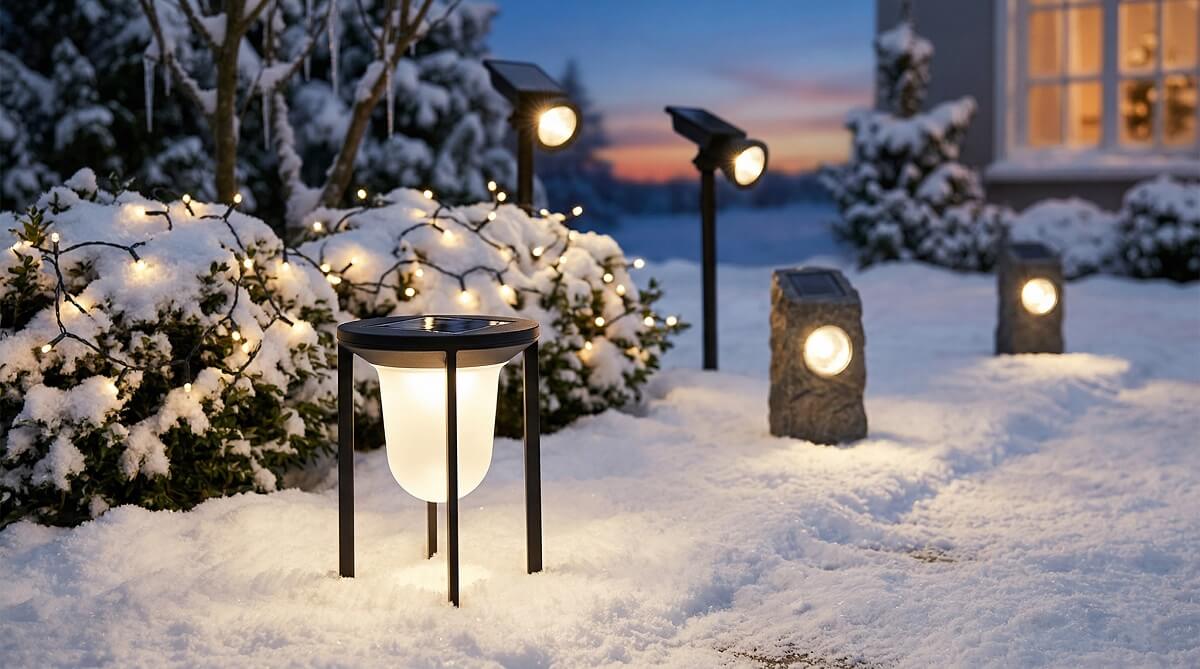
Most outdoor solar lights dim out by December — not because solar power fails in winter, but because the wrong fixtures were chosen for the job. The fix isn’t complicated: focus on three specs when buying — a monocrystalline panel, a lithium-ion or LiFePO4 battery, and at least an IP65 waterproof rating. Lights built around these features hold up when cheap alternatives go dark. cover this category in depth if you want a broader look at outdoor gear that lasts.
For most homeowners, the Ring Solar Pathlight ($29.99–$34.99) is the best all-around pick — it’s independently tested, runs a lithium-ion battery, pumps out 80 lumens, and has a motion sensor built in to stretch battery life through long winter nights. For decorative use, the Brightech Ambience Pro solar string lights hold up in snow and rain at a price that makes them easy to try. If you already own solar fixtures that are underperforming, a few simple positioning and maintenance moves can double their winter output without spending a dime.
Below you’ll find the breakdown: which products earn their keep in cold weather, what the specs actually mean in plain terms, and four quick fixes for lights you already own.
Who Should (and Shouldn’t) Go Solar Outdoors in Winter
✅ Best For
- Homeowners who want reliable pathway or driveway lighting year-round without the wiring hassle
- Security-conscious buyers who need motion-activated fixtures through winter nights — motion sensors cut battery draw dramatically
- Anyone in northern climates (Minnesota, New England, Pacific Northwest) who’s burned through cheap solar fixtures before and wants to know what actually works
- Renters who can’t install hardwired outdoor lighting
- Decorative string light users — lower lumen requirements mean even modest solar output is enough
❌ Skip Solar If
- You need consistent 8+ hours of bright (500+ lumen) illumination every night regardless of weather — grid-tied LED is the only guarantee there
- Your yard is heavily shaded with no south-facing installation spots
- You need commercial-grade parking lot or street lighting (consider hardwired or commercial solar systems instead)
- You’re buying based on “solar” alone without checking the battery type or IP rating
Why Most Solar Lights Fade in Winter
Three things stack up against standard solar fixtures once temperatures drop, and understanding them helps you buy smarter or squeeze more out of what you have.
Shorter Charging Days
A typical summer day in the northern US gives you 14–16 hours of potential sunlight for charging. In December, that window drops to 7–9 hours across most of the country — and even less in states like Alaska or Minnesota. A fixture that produces 6 hours of runtime from a full summer charge may only squeeze out 2–3 hours on a winter day with weaker, shorter sun exposure.
Weaker Sun Angle
The sun sits 20–30° lower in the sky in winter compared to summer. Solar panels mounted flat lose significant charging efficiency at that angle — up to 40% less energy captured versus optimal positioning. This is why tilting your panels matters so much in cold months. According to solar expert Andrei Marveaux, Director at SolarTech Solutions, you can “easily make massive improvements to the output of your solar lights by simply adjusting the angle.” In winter, aim for a 45°–60° tilt facing south rather than the flat 5–10° that works fine in summer.
Battery Capacity Loss in Cold
This is the one most people miss. Standard NiMH batteries — found in most budget pathway lights — can lose 20–30% of their capacity below freezing. Lithium-ion cells handle cold better. LiFePO4 (lithium iron phosphate) handles it best: according to LiTime’s technical specifications, LiFePO4 cells discharge reliably from -4°F to 140°F (-20°C to 60°C). Cold weather testing data shows LiFePO4 retaining up to 80% of its rated capacity at -22°F (-30°C), while standard lithium-ion cells lose 40–60% of stored energy at -4°F (-20°C).
3 Specs That Separate Winter-Ready Solar Lights from the Rest
Walk past these three checkboxes and you’ll be replacing fixtures every two winters. Clear them, and you’ll find options that operate reliably year-round. for installation tips on outdoor solar fixtures.
1. Panel Type: Monocrystalline Over Polycrystalline
Monocrystalline solar panels convert 20–22% of available sunlight into electricity. Polycrystalline panels run 15–17% — adequate in summer, but noticeably weaker on short, gray winter days. For cold-weather operation, monocrystalline is worth the extra cost. Even better: look for MPPT (Maximum Power Point Tracking) charging controllers. Standard PWM controllers waste energy when panels aren’t at peak conditions. According to Renogy’s technical guide, MPPT controllers improve energy harvest by 5–30% in low-light and cold conditions compared to PWM — that gap matters most in January when every photon counts.
2. Battery Chemistry: LiFePO4 > Li-Ion > NiMH (for Cold Weather)
NiMH is common in cheap solar stake lights. It’s adequate in mild climates but unreliable once temperatures drop below freezing. Lithium-ion is a meaningful step up — better cold operation, 300–500 charge cycles typical. LiFePO4 (lithium iron phosphate) is the top choice if you’re in a genuinely cold climate:
- Discharge range: -4°F to 140°F (-20°C to 60°C)
- Charge range: 32°F to 122°F (charging below freezing risks battery damage, so the panel needs to be in daylight above freezing to top off the power cell)
- Lifespan: 2,000+ charge cycles — roughly 5–8 years under normal residential use
- Cold retention: ~80% capacity at -22°F vs ~40–60% loss for standard Li-ion at -4°F
You’ll pay more upfront for LiFePO4 fixtures, but the longer lifespan and stronger cold reliability make them cost-effective if you live north of the 40th parallel.
3. Waterproofing: What the IP Ratings Actually Mean
IP ratings follow the IEC 60529 standard and tell you what a fixture can physically handle:
- IP65 — Dust-tight, protected from water jets from any direction. The minimum for any outdoor solar light. Handles rain and snow splash well.
- IP67 — Withstands submersion up to 1 meter for 30 minutes. Better for ground-flush lights in areas with heavy snowmelt or pooling.
- IP68 — Continuous submersion rated. Overkill for most residential use, but ideal for underwater or below-grade fixtures.
For most homeowners: IP65 is fine for wall-mounted and stake lights. Go IP67 if you’re in a wet northern climate with regular freeze-thaw cycles.
Best Outdoor Solar Lights That Work in Winter
These picks cover the most common use cases — pathway lighting, security, decorative strings, and heavy-duty commercial. Prices are current as of March 2026; check retailer pages for the latest deals. for other outdoor gear comparisons.
| Product | Price | Best For | Battery | Lumens | IP Rating | Winter Suitability |
|---|---|---|---|---|---|---|
| Ring Solar Pathlight | $29.99–$34.99 | Security / Pathway | Li-ion | 80 lm | IP55 | ✅ Strong — motion sensor conserves power; smart connectivity for easy control |
| VOLT Solar Motion Sensor Security Light | $24.99 | Budget Security | Check specs | Check specs | Check specs | ✅ Solid value entry point — verify battery type before buying for extreme cold |
| VOLT G3 Solar Brass Path Light Kit (2-Pack) | $129.99 | Premium Pathway | Check specs | Check specs | Check specs | ✅ Premium construction from an established solar lighting brand |
| Brightech Ambience Pro Solar String Lights (27ft) | ~$25.99 | Decorative / Patio | Built-in | Ambient (warm) | WeatherTite (snow/rain tested) | ✅ Survived winds up to 50 MPH, rain and snow — 5–6 hr runtime per charge |
| SOLTECH SATELIS PRO | Quote-based | Commercial / Heavy-Duty | LiFePO4 600Wh | 10,000 lm | IP65 | ✅✅ Rated -40°F to 140°F; engineered for heavy snow and frigid climates |
| Beau Jardin Solar Path Lights (8-Pack) | ~$30–$50 | Decorative Pathway | NiMH AA | 10 lm | IP65 | ⚠️ Moderate — field-tested in cold wet New England winter; NiMH limits output in hard freezes |
Top pick for most homeowners: The Ring Solar Pathlight is the only fixture in this list with an independently tested 80-lumen output (the brightest in Reviewed.com’s field testing), a lithium-ion battery, and motion-activation that stretches the power cell significantly further on cold winter nights. At $29.99–$34.99, it’s not the cheapest option — but it delivers the most consistent, verifiable cold-weather reliability among residential path lights.
Best for frigid climates: The SOLTECH SATELIS PRO is commercial-grade — 10,000 lumens, a 145W monocrystalline panel, LiFePO4 battery rated for -40°F, and 50+ hours of max autonomy on a full charge. It’s priced by quote for commercial projects, but it’s the benchmark for what a truly winter-proof solar LED can do.
4 Things to Do Right Now to Get More from Your Existing Lights
Already own solar fixtures that underperform in cold weather? Run through these before spending anything new.
1. Tilt the Panel Toward the Winter Sun
In summer, a flat 5–10° tilt is fine — the sun is nearly overhead for most of the day. In winter, it rides low across the southern sky, and a flat panel captures far less energy. Electrician Bobby Lynn, owner of Live Wire Electrical with 20+ years of experience, puts it plainly: “With the sun sitting lower in the sky during these months, tilting your panels directly towards it can really improve their sunlight capture. This step is important in areas with shorter daylight hours as it helps the batteries charge better, making sure your lights stay bright.”
Target a 45°–60° angle facing directly south. For most US latitudes, this adjustment alone can meaningfully improve charging during December and January. Many adjustable solar fixtures let you change the panel angle without tools.
2. Clean the Panel — Takes 90 Seconds, Helps a Lot
Snow reflects sunlight. Ice blocks it. Even a thin film of water droplets refracts and scatters incoming light, cutting panel efficiency. Solar expert Andrei Marveaux notes that “snow, ice, and other debris can block sunlight. Keeping them clean will guarantee the panels absorb as many rays of light as possible.”
Use a soft, damp cloth — no abrasive scrubbers or harsh chemicals that scratch the panel surface. Wipe panels down when the sun comes out after a storm. Even a light film of road grime can knock output down 10–15%.
3. Swap NiMH Batteries for Lithium-Ion
Many budget solar stake lights use standard AA or AAA NiMH batteries that you can physically swap out. If yours do, replace them with rechargeable lithium-ion cells of the same size. Lithium-ion handles cold better, holds a charge longer, and survives more charge cycles before degrading. Affordable rechargeable lithium AAs are available on Amazon. Check your battery compartment label first — not all solar fixtures allow battery replacements. for other options.
4. Move Fixtures to a Better Spot for Winter
South-facing, shade-free locations are more critical in winter than any other season. The sun’s path shifts enough that a spot with good sun in October can be in shadow by December — blocked by a fence, overhang, or neighboring structure. Spend 10 minutes walking your yard on a clear winter afternoon to see where the light actually falls. Relocating a stake light 3–4 feet can mean the difference between 2 and 6 hours of charge time per day.
Frequently Asked Questions
Do solar lights work in winter in cold states like Minnesota or Michigan?
Yes, but output drops noticeably with cheap fixtures. Cities like Minneapolis average 3–4 peak sun hours per day in December — enough to power quality solar lights with LiFePO4 batteries and monocrystalline panels. Inexpensive models with NiMH batteries will struggle in temperatures below 20°F (-7°C). The solution is choosing the right battery chemistry upfront, not avoiding solar entirely. has more on matching products to climate needs.
How long do solar lights stay on in winter?
It depends on battery capacity and panel efficiency. A mid-range fixture with a 2,000mAh lithium-ion battery might run 4–6 hours in winter compared to 8–10 hours in summer. Premium commercial models like the SOLTECH SATELIS PRO — with a 600Wh LiFePO4 battery and MPPT charging — can deliver 50+ hours of autonomy. For most residential pathway lights, expect roughly 40–60% of summer runtime during peak winter months.
Can I charge outdoor solar lights with a USB cable in winter?
Some models include a USB backup charging port — the Linkind SP6 is a standout example. This matters during extended cloudy spells when the panel can’t get enough sun to fully charge the battery. Most budget lights don’t have this option, so check specs before buying if you’re in an area that sees weeks of heavy cloud cover.
Should I store solar lights indoors during winter?
Optional, not required, for most quality fixtures rated IP65 or better. If your area sees prolonged sub-zero temperatures for weeks on end, bringing them inside protects the battery. If you do store them: remove the battery first, charge it to around 50%, and store it in a cool (above-freezing) dry location. Reinstall in spring and fully charge before use.
What IP rating do I need for solar lights in snow?
IP65 is the practical minimum for any outdoor solar light — it handles rain, snow splash, and general weather exposure reliably. For heavy snowfall regions, freeze-thaw climates, or ground-level installations that may sit in snowmelt, IP67 is a smarter choice. IP68 is worth considering only for below-grade or underwater fixtures.
How often should I replace solar light batteries?
Standard NiMH batteries in budget solar lights typically last 1–2 years. Lithium-ion cells run roughly 2–3 years (300–500 charge cycles). LiFePO4 batteries are rated for 2,000+ cycles — that’s 5–8 years for most residential users. Replace any type when nightly runtime drops below half the original spec, or when the fixture stops switching on reliably.
Do motion sensor solar lights last longer in winter?
Yes, significantly. A motion sensor fixture that idles at low brightness (30–50%) when no one’s around can extend total battery runtime by 2–4x compared to a constant-on light. That makes motion-sensor models the practical choice for northern climates where winter charging is limited. The Ring Solar Pathlight and VOLT Solar Motion Sensor Security Light both use this approach effectively.
Ready to Buy?
Check current prices on Amazon for outdoor solar lights or browse VOLT Lighting’s solar lineup for premium residential options. Prices shift seasonally — buying in fall before peak demand often saves 10–20% on name-brand fixtures.
