


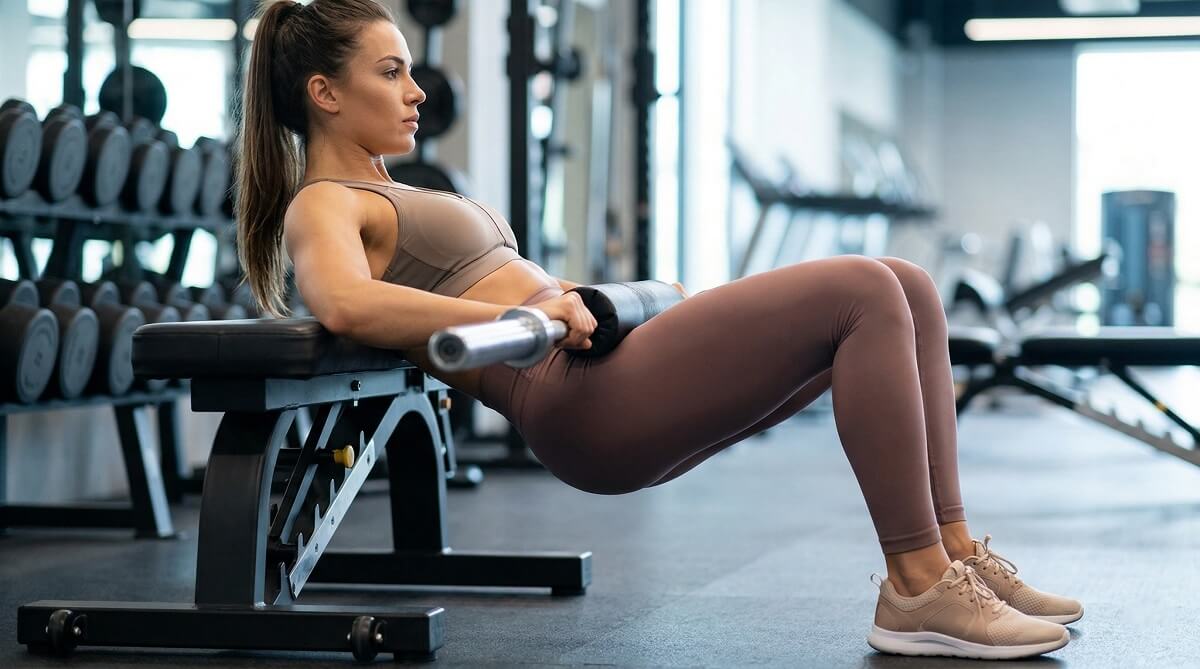
The “glute shelf” — that rounded, lifted look at the top of your butt — comes primarily from the gluteus medius, a muscle on the upper outer hip that most glute routines underwork. Hip thrusts and squats build size in the gluteus maximus (the large lower-mid section), but they barely touch the medius. If you want definition at the top, you need to add abduction movements and single-leg exercises that put direct load on this smaller but visually important muscle.
The good news: research-backed training is straightforward here. A 2009 study in the Journal of Orthopaedic & Sports Physical Therapy measured how hard the glute medius fires during 12 common exercises. Side-lying hip abduction topped the list at 81% of maximum voluntary contraction. Single-leg exercises like the single-limb deadlift and squat also scored well (59–64%). Clamshells, which everyone recommends, came in at just 38–40%. The point: exercise selection matters, and not all “glute” moves hit the upper portion equally.
One more honest note before we get to the exercises: bone structure plays a role in how prominent your shelf looks. The angle of your sacrum (sacral slope) gives some people a natural head start. You can’t change that. What you can change is the muscle mass underneath — and that’s more than enough to produce visible results with consistent training.
Who Should (and Shouldn’t) Focus on Glute Shelf Exercises
✅ Best For
- People already doing hip thrusts and squats who feel their upper butt lags behind
- Runners, athletes, and anyone working on single-leg stability and hip alignment
- Anyone rehabbing a knee or hip — the glute medius is central to both
- Beginners who want to build a balanced glute routine from day one
❌ Skip or Deprioritize If
- You’re in your first few weeks of training — nail compound lifts first, then add isolation
- You expect these exercises alone to build significant overall glute mass — they won’t; hip thrusts and squats do that
- You have no resistance bands and no gym access — options are limited, but not zero (bodyweight side-lying abductions still work)
What Actually Creates the Glute Shelf (Anatomy Without the Jargon)
The Three Glute Muscles — Which One Builds the Shelf
Your glutes are made up of three main muscles: the gluteus maximus, gluteus medius, and gluteus minimus. The maximus is the largest — it occupies most of the rear and powers hip extension in movements like deadlifts and squats. The minimus sits deepest, mostly as a stabilizer. The medius is the shelf muscle.
The gluteus medius sits on the upper, outer portion of the hip, fanning from the outer edge of the pelvis down to the top of the femur. Its main job is hip abduction — lifting your leg away from your body’s midline — and keeping your pelvis level when you’re on one leg. Every time you walk, run, or stand on one foot, it’s firing. That’s also why targeting it requires abduction movements and single-leg exercises, not just the standard bilateral glute work most people default to.
Why Bone Structure Matters (And What You Can’t Change)
Your sacral slope — the angle of your sacrum within the pelvis — affects how naturally prominent your upper glute shelf looks. People with a steeper sacral slope start with a more visible shelf shape. That’s genetics, not training. Worth knowing so you don’t spend six months comparing your results to someone with a completely different skeletal structure.
What training does accomplish is building the glute medius muscle regardless of your starting anatomy. Thicker, more developed muscle fills in the upper hip area in a way that’s visible and functional — better balance, stronger single-leg lifts, and reduced knee/hip pain during other exercises.
The 7 Best Glute Shelf Exercises (Ranked by Research-Backed Effectiveness)
These are ordered from highest-supported glute medius activation to useful supplementary moves. Each includes a home gym alternative so you’re not locked into needing a cable machine.
1. Side-Lying Hip Abduction
This is the most research-supported exercise for the glute medius. According to Distefano et al. (2009), it activates the glute medius at 81% MVIC — the highest of any exercise tested. It’s also the most accessible: no equipment required.
How to do it:
- Lie on your side on a mat, body in a straight line, legs stacked. Rest your head on your lower arm.
- Engage your core and keep your hips stacked — don’t let your top hip roll backward.
- Lift your top leg upward in a controlled arc, leading with your heel (not your toes). Don’t rotate your hip.
- Pause at the top, feeling the contraction in your upper outer hip.
- Lower slowly — 2–3 seconds on the way down. Stop just before your legs touch.
- Repeat for 12–15 reps per side, 3 sets.
Home alternative: Bodyweight works fine. Add an ankle weight or loop a resistance band above your knees for progressive challenge.
Progression: Side plank with hip abduction — same movement, but you’re holding a side plank throughout. Harder, but the upper glute contraction is intense.
2. Lateral Band Walk (Crab Walk)
A staple warm-up and finisher for glute medius work. The band forces your hips to maintain abduction against constant resistance as you step sideways. Resistance bands for this type of training are inexpensive — a set of five loop bands from brands like Fit Simplify runs around $12.95 on Amazon (check current pricing).
How to do it:
- Loop a resistance band just above your knees. Stand with feet shoulder-width apart.
- Dip into a quarter squat — hips back, chest up, knees tracking over toes. Stay in this position throughout.
- Step laterally to the right: step your right foot out, then bring your left foot in — maintaining tension on the band the whole time.
- Do 10–15 steps in one direction, then reverse. That’s one set.
- Do 2–3 sets, resting 60 seconds between sets.
Home alternative: Any looped resistance band around the knees or ankles works. No gym needed.
Pro tip: Stay genuinely low in the quarter squat. Most people gradually stand up — that’s when you lose the glute medius engagement.
3. Single-Leg Romanian Deadlift (SL RDL)
One of the most functional glute shelf exercises because it trains hip stability under load — exactly what the glute medius is designed to do. Distefano et al. (2009) found single-limb deadlifts activate the glute medius at 59% MVIC, while also working the glute maximus and hamstrings.
How to do it:
- Stand holding a dumbbell or kettlebell in one hand. Start with the weight in the opposite hand from your standing leg (contralateral load) — this improves balance and increases glute medius demand.
- Shift weight to one foot. Keep a soft bend in the standing knee throughout.
- Hinge at the hips, pushing them back as your torso tips forward. Let your free leg trail behind you for balance.
- Lower the weight toward the floor, keeping your back flat and spine neutral. Go until you feel a stretch in your standing-leg hamstring.
- Drive through your heel to return upright. Squeeze your glute at the top.
- Repeat for 8–10 reps per leg, 3 sets.
Home alternative: A dumbbell or kettlebell is ideal. No barbell needed. Bodyweight works for beginners — just slow the movement down.
4. Bulgarian Split Squat
A compound single-leg movement that hits both the gluteus medius (stabilizing the working hip) and gluteus maximus (driving the movement). The elevated rear foot increases the range of motion and puts more emphasis on the front leg’s glutes.
How to do it:
- Stand about two feet in front of a bench or sturdy chair. Place your rear foot on it, laces down.
- Hold dumbbells at your sides (or a single dumbbell for more upper glute demand with a slight lean).
- Lower your body by bending your front knee, keeping your torso slightly forward over your front foot.
- Descend until your front thigh is roughly parallel to the floor (back knee approaches but doesn’t slam into the ground).
- Press through your front heel to return to the start.
- Do 8–10 reps per leg, 3 sets.
Home alternative: Use a couch, step, or any sturdy elevated surface. No gym required.
Pro tip: Lean forward slightly at the hip — this shifts load to the glutes rather than the quad.
5. Cable Hip Abduction
Few gym machines isolate the glute medius as cleanly as a cable pulley with an ankle attachment. Unlike resistance bands, the cable maintains constant tension through the full range of motion rather than increasing at the end range. A 2020 systematic review (Moore et al.) found that standing hip abduction with added resistance generates high activity (>40% MVIC) across all glute medius segments.
How to do it:
- Attach an ankle strap to a low cable pulley. Secure it to your outer ankle.
- Stand sideways to the machine, using it for light hand support. Feet hip-width apart.
- Lift your working leg out to the side in a controlled arc. Don’t tilt your torso — that’s compensation, not glute work.
- Pause at the top, hold 1–2 seconds, then lower slowly.
- Do 12–15 reps per side, 3 sets.
Home alternative: Loop a long resistance band around a door anchor at ankle height. Same movement, less constant tension — but still effective. See resistance band accessories for setup options.
6. Hip Thrust (Wide Stance + Knee Band)
Standard hip thrusts mostly hit the gluteus maximus. Adding a resistance band above the knees and widening your stance changes the equation: the band forces your knees out, which activates the glute medius throughout the movement. A 2023 study found that band-resisted hip thrusts elicit greater upper glute maximus EMG activity compared to standard hip thrusts — and the wider stance/band combination is a practical way to involve the medius without adding an extra exercise.
How to do it:
- Set up with your upper back against a bench, feet flat on the floor, wider than hip-width apart.
- Loop a resistance band just above your knees. Keep your knees pressing out against the band throughout.
- Add a barbell across your hips (or use a dumbbell on your lap for a lighter option).
- Drive your hips upward by squeezing your glutes. Hold 1–2 seconds at the top.
- Lower with control. Don’t let the band collapse your knees inward.
- Do 8–12 reps, 3–4 sets.
Home alternative: Glute bridge on the floor with a resistance band above the knees. Or elevate your feet on a couch for extra range of motion.
7. Curtsy Lunge
An underused exercise that targets the glute medius through a unique diagonal loading pattern. Unlike forward lunges, the cross-body step creates an adduction/abduction demand that directly challenges the upper outer hip. Most competitors skip this one — it’s a genuine gap in their coverage.
How to do it:
- Stand with feet hip-width apart. Hold dumbbells at your sides.
- Step your right foot back and around to the left — like a curtsy. Your right knee should lower toward the floor behind your left heel.
- Keep your front (left) knee tracking over your toes, torso upright.
- Push through your front heel to return to standing.
- Alternate sides, or do all reps on one side before switching.
- Do 10–12 reps per leg, 3 sets.
Home alternative: Bodyweight version works well for beginners. Add dumbbells as you progress.
How to Program These Into Your Routine
Research on training frequency supports working each muscle group at least twice per week for hypertrophy — a finding backed by a 2016 meta-analysis by Schoenfeld et al. in Sports Medicine. For the glute medius specifically, that means two dedicated sessions per week — or one full session plus adding upper glute movements as warm-ups on a second lower-body day.
Beginner Template (2 Days/Week)
| Day | Exercise | Sets × Reps |
|---|---|---|
| Day 1 | Hip Thrust (band + wide stance) | 3 × 10–12 |
| Day 1 | Side-Lying Hip Abduction | 3 × 12–15 per side |
| Day 1 | Lateral Band Walk | 2 × 12 steps each direction |
| Day 2 | Bulgarian Split Squat | 3 × 8–10 per leg |
| Day 2 | Single-Leg RDL (light weight) | 3 × 8–10 per leg |
| Day 2 | Curtsy Lunge (bodyweight) | 3 × 10 per leg |
Intermediate Template (2–3 Days/Week)
| Day | Exercise | Sets × Reps |
|---|---|---|
| Day 1 | Hip Thrust (barbell + band) | 4 × 8–10 |
| Day 1 | Cable Hip Abduction | 3 × 12–15 per side |
| Day 1 | Single-Leg RDL | 3 × 8–10 per leg |
| Day 2 | Bulgarian Split Squat (weighted) | 3 × 8–10 per leg |
| Day 2 | Curtsy Lunge (weighted) | 3 × 10–12 per leg |
| Day 2 | Lateral Band Walk (finisher) | 3 × 15 steps each direction |
Using Upper Glute Exercises as a Warm-Up
Lateral band walks and side-lying hip abductions work well as warm-up sets before squats or deadlifts. Two quick sets activates the glute medius before your compound lifts, which can improve glute engagement throughout your session. Keep these sets light and controlled — the goal is activation, not fatigue.
Three Principles That Actually Drive Results
Most glute articles give you a list of six tips that all boil down to the same thing. Here are three that actually matter specifically for glute shelf development:
1. Progressive Overload on Abduction Exercises
Most people plateau on glute medius work because they stay with the same band resistance for months. The glute medius responds to progressive overload just like any other muscle. Move up resistance levels on your loop bands regularly, or add ankle weights to side-lying abductions. On cable hip abductions, increase the weight by one plate every few weeks.
2. Mind-Muscle Connection — Specifically for the Glute Med
Before you start any abduction exercise, place your hand on your upper outer hip (between your hip bone and the top of your leg). That’s where the glute medius sits. As you do the exercise, feel it contract under your hand. If you don’t feel it there, the movement is happening from somewhere else — usually your hip flexor or lower back. Slow down and reduce the weight until you can feel the right muscle working.
3. Check Your Pelvic Tilt Before Each Set
Anterior pelvic tilt — where your lower back arches excessively and your pelvis tilts forward — reduces glute medius engagement significantly. Before every set, stand tall, brace your core lightly, and tuck your pelvis to neutral. You don’t need to squeeze hard, just neutral. This puts the glute med in a better mechanical position to fire through the full range. Good form fundamentals always start with posture, and this muscle is no different.
Frequently Asked Questions
What exactly is the “glute shelf” and what creates it?
The glute shelf is the rounded, lifted look at the top of the butt — the part that gives the glutes a full, three-dimensional shape rather than a flat appearance. It’s primarily created by the gluteus medius, the muscle on the upper outer hip. Unlike the gluteus maximus, which builds the overall mass of the rear, the medius shapes the upper portion. Training it with abduction and single-leg exercises over time adds visible definition in that specific area.
How long before I see results from upper glute training?
For most people training consistently twice a week with progressive overload, noticeable changes in muscle size and shape appear within 8–12 weeks. The timeline varies based on training experience, nutrition (sufficient protein and calories), sleep quality, and genetics. Strength improvements in these exercises — being able to lift more or use a heavier band — often show up within 4–6 weeks, which is a good early indicator things are working.
Can I build a glute shelf with just bodyweight exercises?
To a degree — yes. Side-lying hip abductions are highly capable bodyweight movements (81% glute medius activation per the 2009 JOSPT study). Curtsy lunges and single-leg RDLs work bodyweight as well. But without progressive overload, progress stalls. A basic set of resistance loop bands — available on Amazon for $10–15 — adds enough challenge to keep making gains without a gym membership.
What’s the difference between the Kas glute bridge and a standard hip thrust?
Both share a similar setup (back on a bench, feet planted). The hip thrust uses a full range of motion and is designed for explosive power and loading the entire posterior chain heavily. The Kas glute bridge uses a shorter, more controlled range of motion with emphasis on keeping constant tension on the glutes — no relaxing at the bottom. It’s better for glute isolation and time under tension, making it useful for the upper glute max portion when you want to avoid hip flexor or hamstring takeover.
Do men need to train upper glutes differently than women?
No meaningful difference. The glute medius anatomy and function is the same regardless of sex. Men often neglect upper glute work because the goal framing (the “glute shelf” aesthetic) is marketed toward women. But strong glute medius function directly improves squats, deadlifts, running mechanics, and knee health — all relevant regardless of gender. Men can follow the same exercise selection and programming recommendations.
How do I know if I’m targeting my glute medius or compensating with my hip flexors?
During side-lying abductions and standing hip abductions, hip flexor compensation usually looks like this: your torso leans away from the working leg, your hip rotates forward, or the movement originates from your lower back rather than your outer hip. The fix: place your hand on your upper outer hip, slow the movement way down, and reduce the range of motion until you feel the right muscle contracting first. If you can’t feel it there, drop the weight or band resistance.
Is soreness after glute training a sign it’s working?
Soreness is a sign of muscle damage from novelty — it tends to be higher when you start a new exercise or return to one after a break. It’s not the best indicator of a productive workout. Consistent progressive overload (more reps, more resistance, better form) is a much more reliable signal. That said, mild soreness in the outer upper hip area after first trying side-lying abductions or lateral band walks is a good sign you’re in the right area.
Should I do glute shelf exercises before or after my main leg workout?
Light activation versions (band walks, bodyweight side-lying abductions) work well before your main compound lifts to prime the glute medius. Heavier versions — cable abductions, weighted split squats, loaded SL RDLs — are better placed after your primary compound exercises when they’re their own workout focus. Avoid doing heavy single-leg work when you’re already fatigued from heavy squats; form breaks down and you lose the technique precision these movements require. For a broader look at lower body programming, see our buying guides section for equipment and training resources.
If you’re just getting started, a set of resistance loop bands covers lateral band walks, side-lying abductions, and banded hip thrusts — the core of any home upper glute routine. Check current prices on Amazon for Fit Simplify bands or browse all glute band options on Amazon. Prices fluctuate, so verify before buying.
