


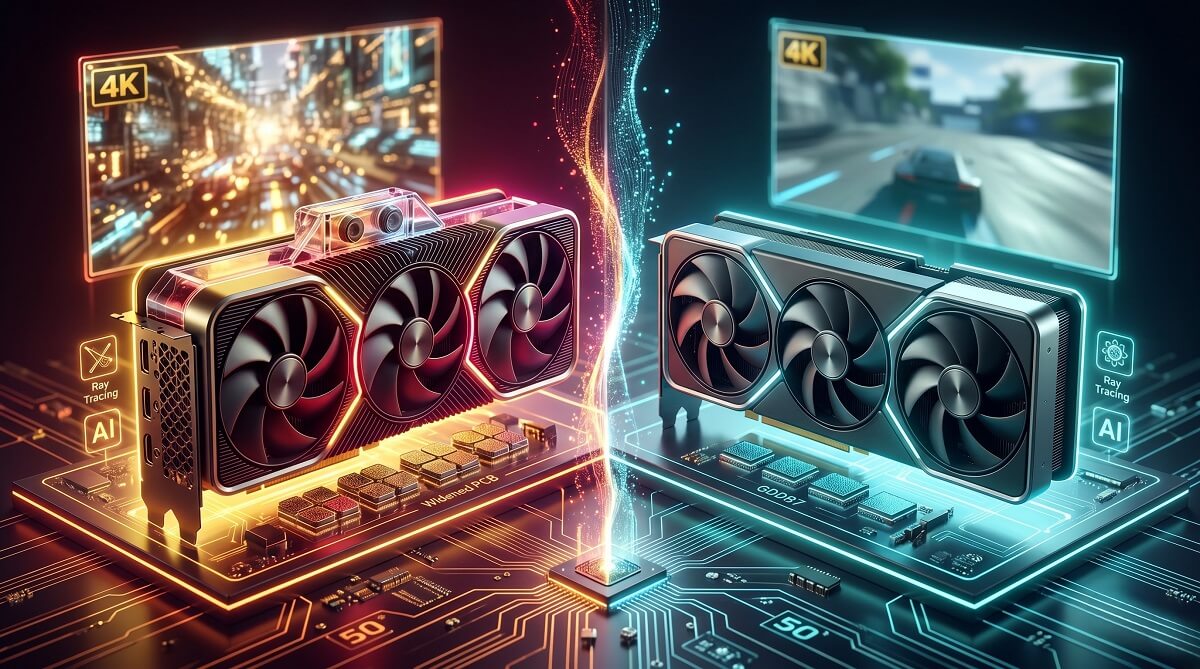
The short version: the RTX 5090 is 30% to nearly 70% faster than the RTX 5080 at 4K, depending on the game — a bigger gap than any previous NVIDIA generation pairing. It also costs roughly double at street price, and as of March 2026, “double” means closer to triple once you factor in real-world availability. The RTX 5080 handles virtually everything a high-end gamer needs and keeps $1,000+ in your pocket.
For most people — including serious 4K gamers — the . The 5090’s advantages stack up fast in VRAM-hungry workflows: large-scale 3D rendering, on-device AI inference, and video generation tasks where 32GB of frame buffer makes a tangible difference. If that’s not your world, paying the 5090 premium is hard to justify.
Both cards launched January 30, 2025, on NVIDIA’s Blackwell architecture. They share DLSS 4 with Multi Frame Generation, PCIe Gen 5, and the 12V-2×6 connector. What separates them is essentially everything else — core count, VRAM, bandwidth, power draw, and price.
Who Should (and Shouldn’t) Get Each Card
✅ RTX 5090 — Best For
- 3D rendering and VFX artists using Blender, Cinema 4D, or DaVinci Resolve on heavy scenes
- On-device AI workloads — LLM inference, Stable Diffusion with large models, video generation
- 4K gaming with no compromises, maximum frame rates, and a multi-year runway
- Anyone running workflows that regularly exceed 16GB VRAM
❌ Skip the RTX 5090 If
- You game at 1440p or below — the 5080 already maxes it out comfortably
- Your budget is real — street price is $3,000+ in March 2026, well above the $1,999 MSRP
- You’re upgrading from an RTX 4080 — the 5080 gives 7–20% more FPS, nowhere near worth this price
- You don’t run VRAM-intensive applications and have no plans to
Specs at a Glance: RTX 5090 vs RTX 5080
Both cards are built on NVIDIA’s Blackwell architecture using TSMC’s 4N process node. The RTX 5080 uses the GB203 die; the RTX 5090 uses the larger GB202. According to NVIDIA’s official spec pages, here’s how they stack up:
| Spec | RTX 5080 | RTX 5090 |
|---|---|---|
| Architecture | Blackwell (GB203) | Blackwell (GB202) |
| CUDA Cores | 10,752 | 21,760 |
| RT Cores (Gen) | 84 (4th Gen) | 170 (4th Gen) |
| Tensor Cores (Gen) | 336 (5th Gen) | 680 (5th Gen) |
| VRAM | 16GB GDDR7 | 32GB GDDR7 |
| Memory Bus | 256-bit | 512-bit |
| Memory Bandwidth | 960 GB/s | 1,792 GB/s |
| Boost Clock | 2,617 MHz | 2,407 MHz |
| TDP | 360W | 575W |
| Recommended PSU | 850W | 1,000W |
| Power Connector | 12V-2×6 | 12V-2×6 |
| MSRP (Launch) | $999 | $1,999 |
| Street Price (March 2026) | ~$999–$1,400 | ~$3,049+ |
The RTX 5080 runs a faster boost clock than the 5090 — 2,617 MHz vs 2,407 MHz — because the smaller GB203 die can be pushed harder. That said, core count wins in parallel-heavy workloads, which is why the 5090’s raw output is substantially higher despite the lower clock speed.
What the Performance Gap Actually Looks Like
The headline number from is that the RTX 5090 outpaces the 5080 by roughly 30% to 69% at 4K, with most games landing in the 45–55% range. That’s a wider class gap than NVIDIA has put between its flagship and second-tier cards in years.
Gaming at 4K
In GamersNexus’s comprehensive review, the RTX 5090 led the 5080 across every title tested at 4K:
- Final Fantasy XIV (4K): 182 FPS (5090) vs 112 FPS (5080) — 62% faster
- Black Myth: Wukong (4K): 86 FPS (5090) vs 58 FPS (5080) — 48% faster
- Dragon’s Dogma 2 (4K): 133 FPS (5090) vs 85 FPS (5080) — 57% faster
- Dying Light 2 (4K): 5090 leads 5080 by 56%
- Resident Evil 4 (4K): 5090 leads 5080 by 68.9% — the largest single-game gap in testing
Across six titles at 4K, Club386’s testing put the range at 36.3% (Assassin’s Creed Mirage) to 59.9% (Cyberpunk 2077 with DLSS and frame generation). No matter how you slice it, the 5090 is meaningfully quicker at 4K.
Gaming at 1440p — The Sweet Spot Most Buyers Miss
The gap shrinks once you drop to 1440p. In GamersNexus testing, the 5090’s lead over the 5080 falls to 34–46% at 1440p — still substantial on paper, but consider this: the 5080 is already pushing 200+ FPS average in most titles at 1440p. If you’re gaming at 1440p, even on a 144Hz or 165Hz panel, the 5080 has headroom to spare. You’re essentially paying a massive premium for frame counts that your monitor can’t display.
Ray Tracing Performance
The 5090 keeps its advantage in ray tracing, ranging from 30% ahead (Black Myth Wukong at 1080p) to 63% ahead (Dying Light 2 at 4K RT). The RTX 5080 remains a capable RT card — it significantly beats AMD’s RX 7900 XTX in RT workloads — but the 5090 pulls further ahead here than in rasterization.
DLSS 4 and Multi-Frame Generation
Both cards support DLSS 4 with Multi Frame Generation, which is exclusive to the RTX 50 series. MFG uses a transformer-based AI model to generate three to four additional frames for every natively rendered frame, effectively multiplying frame rates. The practical impact is dramatic on paper — Cyberpunk 2077 numbers become playable at 4K — but the technology works best when the native frame rate is already healthy, since it interpolates between real frames. Neither card has an exclusive advantage here; both run MFG identically.
The VRAM Question: Does 16GB Cut It in 2026?
For gaming? Yes, 16GB handles every current title at 4K comfortably, including heavily modded games and high-resolution texture packs. The 5080 isn’t VRAM-constrained for gaming workloads you’re likely to run in the next two or three years.
For AI work? The answer flips. According to Float16’s 2026 AI benchmark comparison, the RTX 5080 cannot run the GPT-OSS-20B model at all — it simply doesn’t have the VRAM to load it. The RTX 5090 handles it at 1,338 tokens per second. For Stable Diffusion, image generation tasks run 2.3× faster on the 5090 (46 seconds vs 106 seconds on the 5080). Video generation is twice as fast (344 seconds vs 712 seconds for Wan2.2-5B).
The : if your use is gaming-only, 16GB is fine. If you’re running on-device AI models, the 32GB of the 5090 isn’t a luxury — it’s a gating requirement for certain workloads.
Power, Thermals, and What Your Build Needs
The RTX 5090 draws 575W under load — a 60% increase over the 5080’s 360W. Both cards use the 12V-2×6 connector introduced with the RTX 40 series, and NVIDIA recommends an 850W PSU for the 5080 and a 1,000W unit for the 5090. If you’re upgrading from an older system, factor in whether your current PSU can handle the 5090’s demands. Pairing a 5090 with a sub-1,000W PSU is asking for instability under heavy gaming or render loads.
Thermals are well-managed on both cards. In GamersNexus thermal testing, the RTX 5080 Founders Edition held 65–66°C GPU temperature under a full workload — genuinely cool for a card this powerful, and notably better than the 5090’s 72°C. Memory temperatures ran 72–75°C on the 5080 (well within spec). The 5090’s GDDR7 memory ran at 90°C, which is within tolerance but worth watching if you’re building in a hot or airflow-restricted case.
The 5080 is also the efficiency winner. In GamersNexus efficiency testing at 4K, the RTX 5080 matched or beat every other card in the test for FPS-per-watt — including the 5090, which burns significantly more power for proportionally less efficiency gain.
Upgrading from an Older Card? Here’s What to Expect
Coming from an RTX 4090
The RTX 5090 gives you roughly 30–40% more gaming performance at 4K over the 4090. It’s a genuine upgrade, but not a must-have for anyone already on the 4090. The 5080 is essentially a sidegrade from the 4090 in gaming — similar performance, less VRAM. Most 4090 owners are better off waiting for the next generation unless they need the 32GB VRAM for professional work.
Coming from an RTX 4080 or 4080 Super
The RTX 5080 is a disappointing generational step for 4080 owners. GamersNexus measured gains of just 7–20% across tested titles — sometimes as low as a 2.5% lead in Starfield at 1440p. If you’re on a 4080, the 5090 makes more sense as an upgrade target (40–50% faster at 4K), but the street price makes that a tough pill to swallow. Consider waiting.
Coming from RTX 3080 or Earlier
Either card is a massive jump. The 5080 gives the 3080 a 57–68% boost in tested titles. For most people upgrading from this generation or older, the 5080 is the obvious choice — no need to stretch for the 5090 when the 5080 already represents such a large step forward.
Current Pricing and the Reality of Buying One
MSRP pricing was $999 and $1,999 when these cards hit shelves on January 30, 2025. Over a year later, finding either at those prices is inconsistent at best.
The RTX 5080 has MSRP Founders Edition stock available sporadically at Best Buy at $999. AIB partner models on Amazon run approximately $1,399–$1,700 as of March 2026.
The RTX 5090 situation is rougher. MSRP units at $1,999 exist but rarely hit shelves before selling out. Price tracking data shows AIB models have risen to a floor of approximately $3,049 in 2026, with many listings significantly higher. Setting a price alert is a better strategy than impulse buying at a markup.
If the 5080’s current pricing gives you pause, it’s worth considering the — a strong performer at 1440p that gives you the same Blackwell architecture and DLSS 4 support at a lower entry point.
Which Card Fits Your Workflow
| Workflow | Recommended | Why |
|---|---|---|
| 4K gaming (serious but not extreme) | RTX 5080 | Handles all titles at 4K; saves $1,000+ |
| 4K gaming (no-compromise / 4K 144Hz+) | RTX 5090 | 30–69% faster; future-proofs for demanding titles |
| 1440p gaming | RTX 5080 or lower | 5080 already overkill; 5090 doesn’t add visible benefit |
| 3D rendering (Blender, Cinema 4D) | RTX 5090 | 47% faster in Blender benchmarks; 32GB handles larger scenes |
| Video editing (DaVinci Resolve) | RTX 5090 (heavy); 5080 (standard) | 14% faster in DaVinci; 32GB matters for long-form 8K workflows |
| On-device AI / LLM inference | RTX 5090 | 32GB required for 20B+ models; 5080 can’t run them |
| Stable Diffusion / image generation | RTX 5090 (large models); 5080 (standard) | 5090 is 2.3× faster for image gen; 5080 handles most SD workflows |
| Power-constrained or compact build | RTX 5080 | 360W vs 575W; 850W PSU vs 1,000W PSU |
Frequently Asked Questions
Is the RTX 5090 worth twice the price of the RTX 5080?
For gaming, no. The RTX 5090 is 30–69% faster at 4K, which is impressive — but it doesn’t double your gaming experience, and it costs more than twice as much at street price in 2026. For professional 3D rendering, AI inference, or video production where raw throughput and 32GB VRAM make a workflow difference, the case gets stronger. It depends entirely on whether those use cases are part of your day-to-day.
How much faster is the RTX 5090 than the 5080 at 4K gaming?
Based on GamersNexus and Club386 benchmark testing, the RTX 5090 is roughly 30% to 69% faster at 4K rasterization, with most titles landing in the 45–55% range. Ray tracing workloads see a similar or slightly larger gap. At 1440p, the lead shrinks to 34–46%.
Does the RTX 5080 support DLSS 4?
Yes. Both the RTX 5080 and RTX 5090 support DLSS 4 with Multi Frame Generation — this feature is exclusive to the RTX 50 series. Neither card has an exclusive advantage here; they run DLSS 4 identically.
Is 16GB of VRAM enough in 2026?
For gaming, 16GB is sufficient for all current titles at 4K, including high-texture configurations. For AI workloads like running large language models locally or generating long-form video, 16GB hits limits quickly — some models simply won’t load. For most gamers, it’s fine; for AI enthusiasts or professional creators with heavy scene files, 32GB opens up meaningful headroom.
What PSU do I need for the RTX 5090?
NVIDIA recommends a 1,000W power supply for RTX 5090 systems. The card draws 575W at peak, and you need headroom above that for the rest of your system. Both cards use the 12V-2×6 connector; if your current PSU doesn’t have one natively, adapter cables are available but a native ATX 3.1 PSU is preferable.
How does the RTX 5080 compare to the RTX 4090?
In gaming benchmarks, they’re close — the RTX 4090 often still leads the 5080 by 10–20% at 4K in tested games. The 5080 is not a clear step above the 4090 in gaming performance. However, the 5080 runs cooler, draws less power, and costs less than 4090 secondary market prices in many cases. If you already own a 4090, the 5080 is not a compelling upgrade.
Is the RTX 5090 good for AI and machine learning?
Yes, particularly for consumer-grade AI inference. Its 32GB of GDDR7 with 1,792 GB/s bandwidth allows it to run large models that the 5080 simply can’t load — the GPT-OSS-20B model, for example, won’t run on 16GB. Image and video generation tasks run roughly 2× faster on the 5090 vs 5080. For serious ML training at scale, dedicated data center hardware (H100, A100) remains the professional tool, but for on-device inference and generative AI, the 5090 is the strongest consumer option.
When did the RTX 5090 and 5080 launch?
Both cards launched on January 30, 2025, at MSRP prices of $1,999 (5090) and $999 (5080). The RTX 5070 Ti and RTX 5070 followed in February 2025.
Check current prices and availability for the RTX 5080 on Amazon or the RTX 5080 at Best Buy. For the RTX 5090, setting a price alert before buying is worth it — availability at MSRP fluctuates and the markup from scalped listings can be steep. for additional comparisons and buying guides.
