


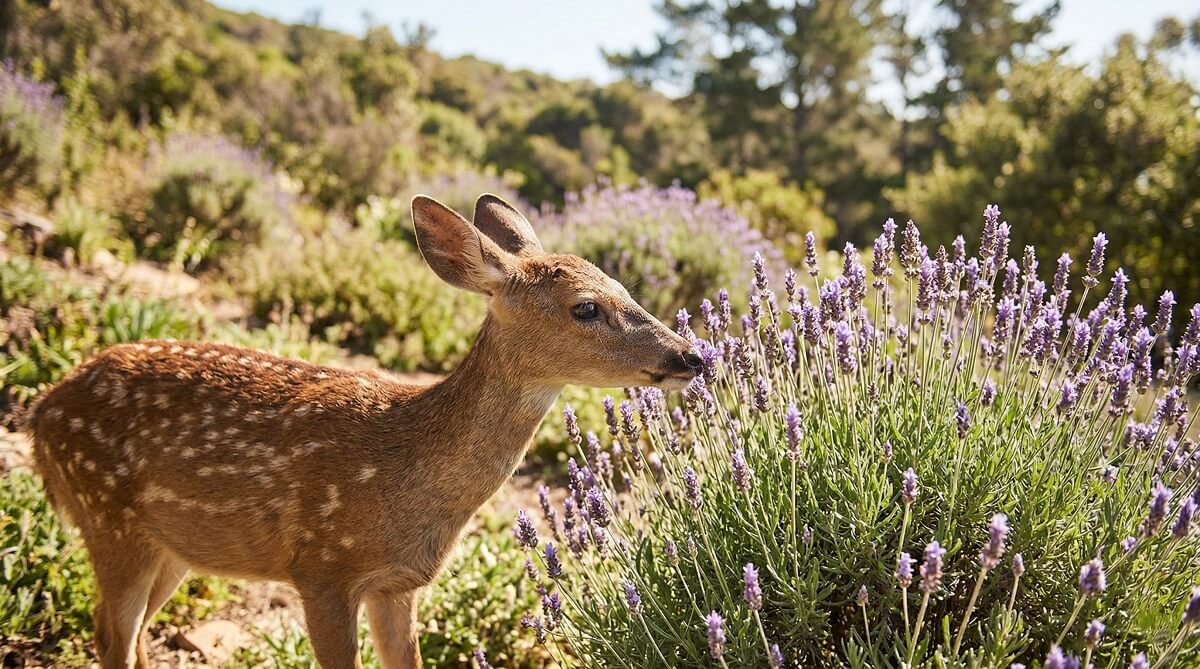
Short answer: deer rarely eat lavender. The plant’s essential oils — particularly a compound called linalool — produce a strong scent that deer find off-putting. Combined with its slightly bitter taste and fuzzy leaf texture, lavender sits near the bottom of any deer’s preferred menu. Most gardeners in moderate deer-pressure areas grow it without any problems.
That said, “deer resistant” is not the same as “deer proof.” A stressed or starving deer will sample almost anything, and lavender planted in regions with very high deer density can still take occasional hits. Your best approach: plant lavender freely and with confidence, use it strategically as a border around more vulnerable plants, and layer it with other deterrent tactics if deer pressure in your area is severe.
Below, we cover exactly why deer avoid lavender, which varieties give you the strongest protection, how to use lavender as a garden barrier, and what to do when lavender alone isn’t cutting it. If birds are also a problem in your garden, we have a separate guide on keeping birds out of garden beds.
Should You Plant Lavender to Deter Deer? Quick Answer Guide
✅ Lavender Is a Solid Choice If You:
- Live in an area with moderate deer pressure and want a low-maintenance solution
- Want a perennial that’s both beautiful and functional
- Are looking to protect nearby plants like roses, herbs, or ornamental grasses
- Garden in USDA Zones 5–9 where lavender thrives naturally
- Want drought tolerance once plants are established
❌ Don’t Rely on Lavender Alone If:
- You’re in an area with very high deer density (20+ deer regularly visiting)
- It’s late fall or winter and natural food is scarce — that’s when deer get bold
- Your lavender plants are less than a year old and not yet fragrant enough to deter
- You’re trying to protect hostas, daylilies, or fruit trees that deer actively seek out
Why Deer Avoid Lavender: The Science Is Actually Interesting
Deer Have an Extraordinary Sense of Smell
Deer are estimated to have up to 297 million olfactory receptors in their nose — roughly 60 times more than humans and well above the 220 million found in dogs, according to widely cited figures in deer research literature. That powerful nose is their primary tool for detecting predators. It also means strong botanical scents register intensely, and unfamiliar or pungent aromas trigger instinctive caution.
Lavender hits both triggers. It’s intensely fragrant, and it smells nothing like the grasses, clover, and soft-leafed plants deer normally eat. That combination makes deer want to move on to something less alarming.
Linalool: The Compound Doing the Heavy Lifting
The main reason deer steer clear of lavender comes down to chemistry. Lavender is rich in a terpene compound called linalool, which gives the plant its signature scent. According to EpicGardening, linalool “makes lavender naturally pest-repellant and deer-deterrent.” You’ll find linalool in other deer-resistant herbs too — oregano, thyme, and basil all contain it.
Beyond linalool, lavender essential oil also contains camphor (2–12%) and 1,8-cineole (eucalyptol, 8–15%). These compounds give lavender its musky, medicinal undertone that’s pleasant to humans but deeply unappealing to deer. Lavandin hybrids — crosses between English and Portuguese lavender — tend to be higher in camphor and eucalyptol than pure English lavender, giving them an even stronger deterrent effect.
Taste and Texture: Two More Strikes Against Lavender
Even if deer push through the scent, the experience doesn’t improve. Lavender leaves are slightly bitter. The foliage has a fuzzy, pubescent texture that deer dislike — the same reason lamb’s ear rarely gets nibbled. Mature lavender also develops woody stems that offer no nutritional value. There just isn’t anything inviting about the plant once you’re a deer.
Is Lavender Fully Deer-Proof? The Honest Answer
No Plant Is Completely Safe When Deer Are Hungry
Experienced gardeners have a saying: the deer forgot to read the memo. Any list of “deer-proof” plants comes with an implied asterisk — hungry deer will eat almost anything. Deer browsing pressure peaks from October through February, according to Michigan State University Extension, when natural forage is limited and deer are under nutritional stress. During a hard winter or severe drought, plants that deer normally pass by can end up getting sampled.
That said, lavender still performs better than most plants under pressure. Its essential oil content doesn’t diminish in winter the way some plants’ deterrent properties do. A well-established lavender hedge remains pungent year-round.
New Transplants Are More Vulnerable
Young lavender plants — those in their first growing season — haven’t yet developed the full essential oil content of established plants. Their aroma is weaker, their stems are still tender, and they’re more likely to be accidentally trampled by deer passing nearby even if they’re not actively eaten. Protect newly planted lavender with a temporary wire cage or hardware cloth for the first growing season while the plant matures and its pungency builds.
Regional Deer Density Changes the Calculus
A rural property in Vermont with a few deer wandering through occasionally is a very different situation from a suburban neighborhood in New Jersey where a herd of 30 deer has lost all fear of humans. In high-pressure urban and suburban areas, deer have fewer options and have learned to eat plants they’d normally pass by. If that’s your situation, lavender alone won’t solve the problem — you’ll need to layer strategies.
Lavender Varieties and Deer Resistance: Which Type to Plant
All lavender species and cultivars are considered deer resistant — the essential oils that repel deer are present throughout the Lavandula genus. Your variety choice matters more for climate survival than for deer deterrence. That said, cultivars with the highest essential oil content will give you the strongest deterrent effect.
| Lavender Type | Scientific Name | USDA Zones | Deer Resistance | Notes |
|---|---|---|---|---|
| English Lavender | Lavandula angustifolia | 5–8 | Very High | Most cold-hardy; high linalool content; best for northern gardens |
| Lavandin (Hybrid) | Lavandula × intermedia | 5–9 | Very High | Largest plants; highest camphor/cineole; strongest deterrent scent |
| Spanish Lavender | Lavandula stoechas | 7–9 | High | Distinctive “rabbit ear” bracts; less cold-hardy; good for warmer climates |
| Spike Lavender | Lavandula latifolia | 6–9 | High | High camphor content; often used in commercial repellent formulas |
Best varieties for deer deterrence: Lavandin hybrids like ‘Provence,’ ‘Grosso,’ and ‘Hidcote Giant’ offer the most potent scent due to elevated camphor and eucalyptol. For colder zones (5–6), stick with English lavender cultivars like ‘Hidcote,’ ‘Munstead,’ or ‘Vera.’
Growing zone information sourced from Utah State University Extension.
How to Use Lavender Strategically to Protect Your Garden
Planting a Lavender Barrier
Lavender works best as a perimeter planting around beds you want to protect — not as a physical wall, but as a scent barrier. The goal is to create a band of aromatic intensity between the deer’s entry path and your vulnerable plants. Plant English lavender 18–24 inches apart; lavandin hybrids need 24–36 inches due to their larger spread, according to Utah State University Extension.
For real deterrence effect, go wide rather than tall. A single row of lavender plants is better than nothing, but two staggered rows create a much more effective scent wall. One forum gardener on Permies noted they’d ringed their main garden beds with lavender 3 feet by 3 feet in size and saw no break-ins, even though deer were frequently present in the area.
Best Companion Plants to Pair With Lavender
Doubling down on fragrant deterrents around your garden gives you a much stronger defense. These plants all share lavender’s deer-resistant properties and work well planted alongside it:
- Catmint (Nepeta) — fuzzy, fragrant ground-layer plant; deer hate the smell
- Russian sage (Perovskia) — tall, airy, intensely aromatic; one of the most reliably deer-resistant plants you can grow
- Salvia — all salvias have fragrant foliage that deer avoid; huge variety of sizes and colors
- Yarrow (Achillea) — herbal scent, tough texture; drought-tolerant like lavender
- Ornamental alliums — onion-family smell is highly effective at discouraging deer; combine with lavender for a multi-scent barrier
Similar barrier planting strategies can also help keep cats out of flower gardens — the same layered fragrant perimeter approach applies.
What Lavender Won’t Protect Against
Lavender can reduce access to nearby plants, but it won’t work as a physical fence. Deer can easily step over or walk around a lavender border to reach hostas, daylilies, or fruit trees they actively want. One gardener on the Permies forum described their prickly pear cactus getting eaten even though it was surrounded by rosemary — deer simply reached over and around. The scent deters casual browsing; it doesn’t stop a determined deer after a preferred target.
When Lavender Isn’t Enough: Layering Your Deer Defense
A Practical Layered Approach
If deer are still getting into your garden despite lavender borders, here’s a progression of strategies to add:
- Layer 1: Fragrant perimeter plants — lavender, catmint, Russian sage, alliums around bed edges
- Layer 2: Commercial deer repellent sprays on vulnerable plants; rotate formulas so deer don’t habituate to a single scent. Products using putrescent egg solids, cinnamon oil, or clove oil (like Messinas Deer Stopper) are applied every 30 days and remain active after rain.
- Layer 3: Physical deterrents — motion-activated sprinklers, sound devices at night
- Layer 4: Partial fencing — if you have a specific high-value area (vegetable garden, rose bed), fence it directly
When to Finally Just Put Up a Fence
If deer are repeatedly breaching your deterrent layers, fencing is the only truly reliable long-term solution. According to Cornell Cooperative Extension guidance, an 8-foot fence is the minimum recommended height to reliably exclude deer — they can clear a 6-foot fence with a running start. Where a full 8-foot perimeter isn’t feasible, two parallel fences standing 4–5 feet tall and spaced 4–5 feet apart can be equally effective, since deer won’t jump a barrier when they can’t see a clear landing zone. A single electric strand at nose height (about 30 inches) baited with peanut butter is a cost-effective option for moderate pressure areas — deer learn quickly after one nose shock.
How to Grow Lavender: Quick Care Reference
Lavender is straightforward to grow once you nail the basic conditions. The biggest mistake most gardeners make is planting it in soil that holds too much moisture.
| Factor | Requirement |
|---|---|
| Sunlight | Full sun, minimum 6–8 hours daily |
| Soil | Well-drained, dry to medium moisture; pH 6.5–7.5; does not tolerate wet feet |
| Water | 1 gallon per plant weekly when newly planted; very drought-tolerant once established |
| Spacing | 18–24 inches apart (English); 24–36 inches (lavandin hybrids) |
| Pruning | Cut back by one-third after first flush of bloom; never cut into old wood |
| Mature size | 1–2 feet tall and wide; takes approximately 3 years to reach full size |
| USDA Zones | English lavender: Zones 5–8 | Lavandin hybrids: Zones 5–9 | Spanish: Zones 7–9 |
Care details sourced from Utah State University Extension.
A Simple Deer-Resistant Garden Layout Using Lavender
Here’s a practical planting plan that layers multiple deer-resistant species for real-world protection:
| Position | Plant | Why It Works |
|---|---|---|
| Outer perimeter | Lavandin (‘Grosso’ or ‘Provence’) | Strongest scent barrier; grows to 2–3 ft wide |
| Second layer (staggered) | Catmint (Nepeta) | Dense, fragrant ground layer; fills gaps between lavender |
| Back border accent | Russian Sage (Perovskia) | Tall (3–5 ft), airy, intensely aromatic; structural interest |
| Entry points / high-traffic spots | Salvia | Fragrant foliage deters deer at key access spots |
| Interplanted throughout | Ornamental alliums | Onion scent adds a completely different deterrent dimension |
Frequently Asked Questions
Do deer eat lavender flowers?
Rarely. Deer typically avoid every part of the lavender plant — leaves, stems, and flowers. The same volatile compounds (linalool, camphor) that make the foliage unappealing are concentrated in the flowers too. In fact, blooming lavender is often at its most pungent, making it the least appealing time for deer to approach.
Can I use lavender as a fence to keep deer away from hostas?
Lavender can reduce deer visits to adjacent plants, but it won’t function as a physical fence. Deer can step over or walk around a lavender border to reach hostas, which they actively seek out. Use lavender as a first deterrent layer, and apply deer repellent spray directly to hostas for additional protection. In areas with heavy deer pressure, a physical barrier around your hostas is the only reliable option.
Is English lavender deer resistant?
Yes. English lavender (Lavandula angustifolia) is one of the most widely grown deer-resistant plants. Its high linalool content produces a strong fragrance that deer consistently avoid. It’s also the most cold-hardy lavender variety, surviving USDA Zone 5 winters.
Do deer eat Spanish lavender?
No. Spanish lavender (Lavandula stoechas) is also deer resistant. Its fragrance differs slightly from English lavender — a bit more medicinal and piney — but deer avoid it for the same reasons. Spanish lavender is less cold-hardy (best in Zones 7–9) but thrives in warmer climates where English lavender struggles.
How hungry do deer have to be before they’ll eat lavender?
In periods of severe food scarcity — typically late winter when snow covers natural forage — deer may sample plants they’d normally avoid, including lavender. According to MSU Extension, deer browsing pressure peaks October through February. Even then, lavender is unlikely to be heavily damaged compared to preferred targets like hostas or ornamental grasses. It’s at the very bottom of the desperation menu.
What lavender variety is best for deer deterrence?
All lavender varieties deter deer, but lavandin hybrids — ‘Grosso,’ ‘Provence,’ and ‘Hidcote Giant’ — are the strongest deterrents because they have the highest essential oil content, including elevated camphor and cineole. For colder gardens (Zones 5–6), choose English lavender cultivars like ‘Hidcote’ or ‘Munstead,’ which share similar deterrent properties.
Do deer eat lavender in pots?
Potted lavender is just as deer resistant as in-ground plants — the scent is equally present regardless of the container. Pots offer the added advantage of portability: you can move them to create temporary barriers or position them near specific plants you want to protect.
How wide should a lavender border be to deter deer?
A single row of lavender helps, but two staggered rows create a much more effective scent barrier. Aim for a border at least 3–4 feet wide. As one permaculture gardener observed, lavender works better when planted for width rather than height — the goal is a continuous band of fragrance, not a tall wall.
Ready to Plant?
Lavender plants are widely available at local nurseries, garden centers, and online retailers. For deer deterrence, start with established 1-quart or 1-gallon plants rather than seeds — larger plants have more developed essential oil content and will begin deterring deer from day one. Check current prices and availability at your local Home Depot or Lowe’s garden center, or browse lavender plants on Amazon for container-grown varieties shipped to your door.
