


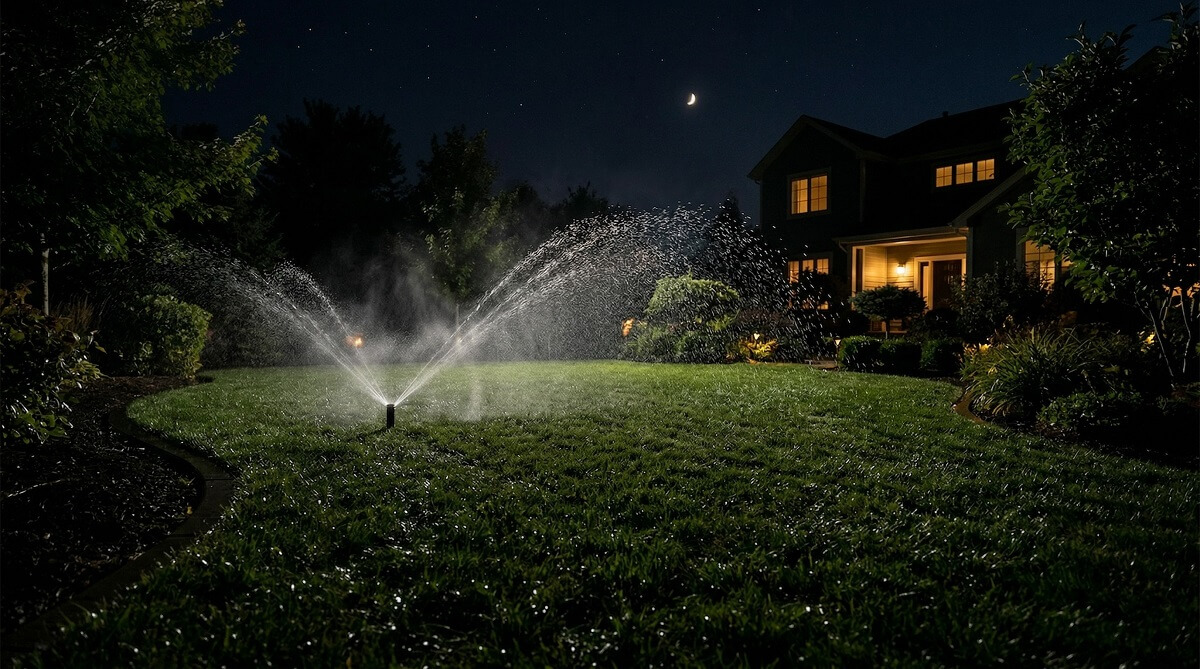
The short answer: doing it once won’t kill your lawn. Making it a habit, though, creates a real opening for fungal disease, soggy soil, and pest activity — problems that are far more expensive to fix than they are to prevent. For most US homeowners, the 6–10am window is the gold standard for irrigation, and the reasons are grounded in basic plant biology, not lawn-care folklore.
That said, there’s a legitimate exception worth knowing about. Dozens of US municipalities — from El Paso, TX to Durham, NC to South Florida — restrict or outright ban daytime watering during summer months. If your water utility runs an odd/even address schedule or prohibits irrigation between 10am and 6pm, nighttime watering isn’t a preference, it’s the only legal option. This guide covers both situations: why morning wins, and how to minimize the damage when you have no choice but to water after dark.
One more thing before we dig in: your grass type matters. Bermuda and Zoysia handle occasional night irrigation more gracefully than Kentucky Bluegrass or Perennial Ryegrass. We’ll break that down by variety so you know exactly where your lawn stands.
When Nighttime Watering Is (and Isn’t) a Problem
✅ Night Watering Is Acceptable When:
- It’s a one-time or occasional occurrence — forgot to run the sprinklers, travel delay, equipment issue
- Your local water authority prohibits daytime irrigation (a growing number of US cities do)
- You’re in an arid, low-humidity climate with fast-draining sandy soil
- You water before 8–9pm, giving grass blades a partial chance to dry
- You’re using drip irrigation that targets roots directly, not leaf surfaces
❌ Skip Night Watering When:
- Your lawn already shows signs of fungal disease (brown patches, dollar spot lesions)
- Your soil is clay-heavy — it drains slowly and stays saturated for hours
- You live in a humid climate (Southeast, Gulf Coast, Pacific Northwest)
- It would become your default watering routine
- Overnight temperatures are above 70°F combined with high humidity — peak conditions for brown patch
Why the 6–10am Window Outperforms Everything Else
There’s a reason every lawn care source — from university extension offices to Pennington Seed’s agronomists — lands on early morning as the optimal irrigation window. It’s not arbitrary. at that time of day that simply don’t exist at any other point.
According to the University of Missouri Extension’s Home Lawn Watering Guide, 6–8am is the target window: water pressure tends to be highest, wind is minimal, and evaporation rates are low enough that the water actually reaches the root zone instead of disappearing into the air. Critically, watering in the AM gives grass blades hours of daylight to dry out before nightfall — which is precisely what night watering denies them.
What About Midday Watering?
Watering midday won’t damage your turf directly. The bigger issue is efficiency: on a 90°F afternoon, you can lose 30–50% of applied water to evaporation before it reaches the roots. You’d need to run sprinklers considerably longer to achieve the same result — which means higher water bills with no benefit to the lawn. For occasional watering it’s fine; as a routine, it’s wasteful.
The Actual Risks of Watering Your Lawn at Night
Grass isn’t passive at night. Its leaf pores — called stomata — close after dark because transpiration (the process of drawing water up from the roots and releasing it through the leaves) only happens when sunlight is present. Water those closed stomata and the moisture has nowhere to go. It sits on the leaf surface for 8 to 10 hours, and that’s where problems start.
Fungal Disease: The Most Costly Consequence
Brown patch and dollar spot are the two most common fungal diseases triggered by prolonged overnight moisture. Both thrive in the 60–85°F temperature range with high humidity — conditions that describe most US summer nights. According to Scotts, treating an established dollar spot or brown patch outbreak requires fungicide applications every 14–21 days, using active ingredients like propiconazole or azoxystrobin. DIY neem oil runs about $2.50–$3.75 per 1,000 square feet per application, per LawnStarter’s cost analysis. Professional chemical treatment can cost as much as an entire seasonal lawn care program when repeated applications are needed.
The visual signs aren’t subtle: straw-colored circular patches (dollar spot) or large irregular brown zones (brown patch) spreading across the turf. By the time they’re visible, the infection is already established.
Pest Activity
Standing moisture overnight draws slugs, fungus gnats, and mosquitoes. Damp nighttime soil is also easier for grubs to navigate and burrow through. Beyond the plant damage these pests cause, wet nighttime grass is genuinely slippery — a practical hazard for pets and kids in the morning.
Waterlogging and Soil Erosion
When soil becomes oversaturated, oxygen can’t reach the root zone. Roots that can’t breathe can’t absorb nutrients efficiently, and extended waterlogging can lead to root rot. On sloped yards, the water that doesn’t absorb overnight runs off, gradually stripping topsoil and creating bare patches over time. Clay soils are especially prone because their fine particles drain far more slowly than sandy or loamy soil.
Your Grass Type Determines How Much Risk You’re Taking
Not all turf handles overnight moisture the same way. The drought-tolerance spectrum runs from Bermuda at the resilient end to Perennial Ryegrass at the vulnerable end — and that ranking maps fairly directly onto night-watering risk.
is one of the most useful things you can do before setting up any irrigation schedule.
Warm-Season Grasses (Lower Night-Watering Risk)
| Grass Type | Weekly Water Need | Sessions per Week | Drought Tolerance |
|---|---|---|---|
| Bermudagrass | 1–1.25 inches | 1–2x | Highest (warm-season) |
| Zoysiagrass | 1 inch | Every 10–14 days | Very High |
| St. Augustine | 1–1.5 inches | 2x | Moderate-High |
Warm-season varieties develop deeper root systems and go dormant in winter rather than from heat. They’re more forgiving of an occasional missed morning window, but they’re still not immune to fungal disease if watered late at night repeatedly during humid summers.
Cool-Season Grasses (Higher Night-Watering Risk)
| Grass Type | Weekly Water Need | Sessions per Week | Disease Sensitivity |
|---|---|---|---|
| Kentucky Bluegrass | 1.5–2 inches | 3x | High |
| Tall Fescue | 1.25–1.5 inches | 2–3x | Moderate (deep roots help) |
| Fine Fescue | 1 inch | 1–2x | Low-Moderate |
| Perennial Ryegrass | 1.25–1.5 inches | 2–3x | High |
Kentucky Bluegrass and Perennial Ryegrass are the most sensitive to prolonged leaf moisture — they’re also the most common cool-season varieties across the northern US, Midwest, and Pacific Northwest. If you have either of these, building good morning-watering habits pays off quickly.
Data sourced from the University of Missouri Extension Home Lawn Watering Guide.
If You Have to Water at Night, Do It Right
Plenty of homeowners have no real choice. If your city runs a mandatory odd/even watering schedule that pushes irrigation into evening hours, or if your work schedule leaves the sprinklers as a “deal with it after dinner” situation, there are ways to reduce the damage.
Many US municipalities now restrict or ban daytime irrigation during summer. El Paso Water prohibits irrigation between 10am and 6pm from April 1 through September 30, with fines ranging from $50 to $500 per violation. Durham, NC limits watering to before 10am or after 6pm on assigned odd/even address days. South Florida’s water management districts run year-round restrictions that specify which days and times different addresses can irrigate. In these situations, you’re not choosing night watering — you’re complying with local law.
Damage-Limiting Tips for Evening/Night Watering
- Water as early as possible. There’s a meaningful difference between watering at 7pm and watering at midnight. Earlier gives blades more time to shed some moisture before temperatures drop and dew sets in.
- Use low-angle sprinkler heads. Rotary or rotor-style heads deliver water closer to soil level than pop-up spray heads, reducing how much moisture ends up sitting on leaf surfaces.
- Water deeply, not frequently. Run sprinklers long enough to wet the top 6–8 inches of soil, then let the soil dry out between sessions. Shallow daily watering keeps the surface perpetually damp — the worst possible scenario for fungal risk.
- Skip nights with heavy dew forecast. If dew is coming regardless, adding irrigation on top compounds the moisture load on grass blades.
- Raise your mow height slightly. Slightly taller grass shades the soil surface, reducing moisture evaporation during the day and improving airflow at the turf level, which helps blades shed moisture faster.
- Watch for disease early. Check your lawn weekly for straw-colored circles (dollar spot) or large brown irregular zones (brown patch). Early treatment is substantially cheaper than dealing with a spread infection.
How Much Water Does Your Lawn Actually Need?
The standard across extension services and agronomists is 1 to 1.5 inches of water per week, counting both rainfall and supplemental irrigation. Split across 2–3 sessions, that breaks down to roughly 0.5 inches per watering — a number you can actually measure rather than estimate.
Two Low-Tech Ways to Measure What Your Sprinklers Deliver
- The tuna can test: Place an empty tuna can (roughly ½ inch deep) halfway between your sprinkler head and the furthest point of spray. Run your sprinklers until the can is half-full. That’s your baseline runtime for a 0.5-inch session.
- The finger test: Press your finger 2–3 inches into the soil. It should feel damp but not muddy. Bone dry means your lawn needs water; muddy means it’s getting too much.
Smarter Irrigation: Cut Waste Without Cutting Corners
According to EPA WaterSense, landscape irrigation accounts for nearly 9 billion gallons of water per day nationally — roughly one-third of residential water use. Up to 50% of that is wasted through evaporation, runoff, or inefficient scheduling. Households with faulty automatic irrigation systems can waste up to 25,000 gallons annually.
Switching to a smart irrigation controller addresses this directly. EPA data shows that replacing a standard clock-based controller with a WaterSense-certified smart controller can reduce irrigation water use by up to 30% and save the average home up to 15,000 gallons annually. The is consistently the top-rated option in this category — it uses local weather data to skip scheduled watering when rain is forecast and adjusts runtime based on temperature and soil conditions. Check current pricing on Amazon.
A smart controller also solves the timing problem: program your morning window once and it runs automatically, eliminating the “I’ll just set it to midnight” workaround that gets so many lawns into trouble.
Seasonal Watering Calendar for US Lawns
| Season | Frequency | Target Time | Notes |
|---|---|---|---|
| Spring | 1–2x per week | 6–10am | Adjust based on rainfall; cool temps reduce evaporation pressure |
| Summer | 2–3x per week | 6–9am (earlier the better) | Higher heat = faster evaporation; municipal restrictions often apply |
| Fall | 1x per week | 7–10am | Taper off as temps drop; grass needs less water approaching dormancy |
| Winter | None (most zones) | N/A | Dormant grass doesn’t need irrigation; risk of frost damage from watering |
Note: These are general guidelines for established lawns. Newly seeded or sodded areas need daily light moisture for 2–3 weeks regardless of season.
How to Tell When Your Lawn Actually Needs Water
Watering on a fixed schedule without checking the lawn is one of the most common sources of over-irrigation. Your turf gives pretty clear signals when it’s actually thirsty:
- Footprint test: Step firmly on the grass. Healthy, well-hydrated turf springs back within 30 seconds. If the impression lingers, the grass lacks the moisture needed for that recovery.
- Color shift: Stressed grass shifts from green toward dull blue-gray before it turns brown. That blue-gray stage is your window to water before real damage sets in.
- Curled or rolled blades: Grass curls lengthwise to conserve moisture when the root zone is dry. Noticeable curling across a section of the yard is a reliable drought stress signal.
- Brown leaf tips: Often the first visible sign of combined heat stress and underwatering — most common at the edges of the yard where soil dries faster.
As Michael Deaton, turf agronomist at Pennington Seed, puts it: “Well-hydrated grass springs back up when stepped on. If grass stays depressed, it may need water. Curled grass blades or dull, blue-gray color are signs grasses are water stressed.” Use the lawn itself as your primary gauge, not just the calendar.
Frequently Asked Questions
Is it bad to water your lawn at night?
Occasionally, no — a one-time night watering won’t cause lasting harm. As a regular practice, though, it creates conditions where fungal diseases like brown patch and dollar spot can establish themselves, since grass leaves stay wet for 8–10 hours without sunlight to dry them. If you must water at night due to local restrictions or schedule constraints, water as early in the evening as possible and as infrequently as your lawn allows.
What’s the best time of day to water grass?
6–10am is the widely recommended window. Water pressure tends to be higher, wind is typically calm, and evaporation rates are low — meaning more water reaches the root zone. Grass blades also have the entire day to dry, which eliminates the fungal disease risk that comes with prolonged overnight moisture.
Does watering at night cause fungus?
It creates the conditions that allow existing fungal spores to germinate and spread. Grass stomata close at night, so moisture can’t evaporate from the leaf surface — it just sits there. Brown patch, dollar spot, and rust are the most common diseases that exploit this. Humid climates and clay soils make the risk higher; arid climates with fast-draining sandy soil are more forgiving.
Can I water my lawn in the evening instead?
Evening (before 8–9pm) is better than midnight, but still not ideal. The earlier you water, the more time grass blades have to partially dry before temperatures drop and dew settles in. If your schedule makes morning watering impossible, aim for as early in the evening as you can manage, and consider a programmable timer or smart controller to automate the 6am window instead.
How do I know if my lawn has too much water?
Soggy, spongy soil underfoot is the clearest sign. You may also see mushrooms or moss establishing in shaded areas, or notice persistent puddles that take hours to absorb after watering. Overwatered lawns are also more prone to thatch buildup and more attractive to grubs, which tunnel easily through perpetually moist soil.
How many minutes should I run my sprinklers?
That depends on your sprinkler output, not a universal timer setting. The tuna can test is the most reliable approach: place an empty tuna can midway between the sprinkler head and its furthest spray point. Run the system until the can holds about half an inch of water. That’s your benchmark runtime for a standard 0.5-inch irrigation session. Most lawns need 2–3 of those sessions per week in summer.
Should I water my lawn every day?
No — and daily watering is usually counterproductive. Frequent shallow watering encourages root systems to stay near the surface where they’re more vulnerable to heat, drought, and disease. Watering deeply 2–3 times per week pushes roots deeper into the soil profile, where moisture is more stable and consistent.
What if my city only allows nighttime watering?
You’re not alone — dozens of US cities restrict daytime irrigation during summer months. El Paso bans watering between 10am and 6pm from April through September; Durham and many Florida water districts limit hours and days through mandatory ordinances. If you’re in this situation, water as early in the allowed window as possible, use low-trajectory sprinkler heads to minimize leaf wetness, and monitor your lawn closely for early disease signs. A smart irrigation controller with weather-skip features can also help avoid unnecessary watering on rainy or humid nights.
Your Lawn Will Tell You What It Needs
The footprint test, the tuna can, the finger in the soil — these low-tech checks will serve you better than any fixed schedule. If your lawn springs back quickly, looks green, and isn’t showing stress signs, you’re doing fine. If you’re committed to shifting your irrigation to mornings and want to automate it, a smart controller is the most practical upgrade available. Check current prices on Amazon or at Best Buy — setup typically takes under 30 minutes and the water savings often offset the cost within a season or two.
