


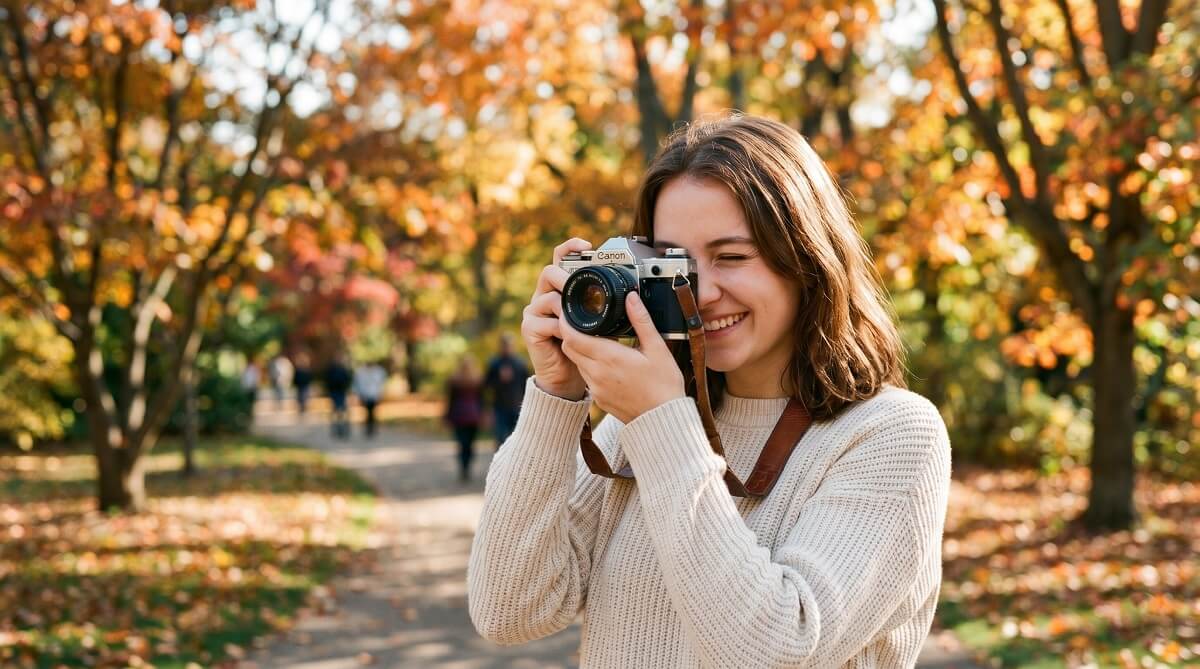
Here are the quick picks before you scroll through the full breakdown. If you want to try film without overthinking it, grab the Kodak Ektar H35 for ~$49.99 on Amazon — it takes about 72 shots per roll, runs on a single AAA battery, and has no settings to mess with. If you want an actual SLR where you control the exposure, the Canon AE-1 Program (typically $150–$250 used) is the most supported vintage camera out there. For learning photography fundamentals, the Pentax K1000 ($75–$125 used) is nearly indestructible and fires without a battery. on ChubbytIps.
Before you buy anything, here’s the honest math. The camera is almost never the biggest ongoing cost. Expect to spend $8–$10 per roll on film and $12–$20 per roll on development and scanning — so roughly $20–$30 per roll all-in. On a 36-exposure roll, that works out to about $0.55–$0.85 per photo. Film photography rewards slower, more deliberate shooting — which is part of the appeal. But it does cost money every time you press the shutter, so go in with eyes open.
Is Film Photography Right for You?
✅ Film is a solid fit if you:
- Want to slow down and put more thought into each frame
- Like the look of film grain and analog color rendering
- Are okay waiting 1–2 weeks to see your photos from a mail-in lab
- Already have a smartphone and want something different
- Are curious about how aperture, shutter speed, and ISO actually work
❌ Hold off if you:
- Need instant feedback or the ability to reshoot on the spot
- Can’t budget $20–$30 per roll for ongoing film and development costs
- Primarily shoot events where missing a shot isn’t an option
- Shoot frequently in very low light without a flash
What Kind of Shooter Are You? (Match Yourself to a Camera)
The biggest mistake first-time film buyers make is picking a camera based on how it looks, not how they actually shoot. Three distinct types of photographers end up buying 35mm cameras — and the right pick for each one is not the same.
Type 1 — The Casual Memory-Maker
You want photos with a film aesthetic, not a photography lesson. You’re not planning to learn f-stops anytime soon. You want to load a roll, take it to a party or a trip, and get something good back from the lab. For you, the Kodak Ektar H35 or Ilford Sprite 35-II are the right call. Both are new cameras (no worrying about a 40-year-old shutter failing) and require zero setup. for more beginner options.
Type 2 — The Aspiring Photographer
You want to understand photography — aperture, ISO, shutter speed, depth of field — and you’re okay with a learning curve. An entry-level SLR with aperture priority mode is the right move. The Canon AE-1 Program, Minolta X-700, or Nikon F100 all fit here. They let you start in auto mode and gradually take over manual control as you get comfortable.
Type 3 — The Full Control Photographer
You want to set every parameter yourself. No automation. The camera is a tool, not a babysitter. The Pentax K1000 or Nikon FM are built for this. They’re fully mechanical, straightforward to learn on, and will make you a better photographer faster because there’s nothing to hide behind.
The 5 Best 35mm Cameras for Beginners (With Real Prices)
1. Kodak Ektar H35 — Best for Zero-Stress Shooting
The H35 is about as simple as film photography gets. You load a roll, pop in a AAA battery, and start shooting. There’s no ISO dial, no aperture ring, no focus ring — just a shutter button and a flash switch. The fixed shutter speed (1/100s) and fixed aperture (f/8) handle everything automatically. What’s clever about it is the half-frame format: each shot uses half a standard 35mm frame, so a 36-exposure roll gives you roughly 72 photos.
The trade-off is smaller negatives, which means more visible grain when scans are enlarged. Shoot It With Film’s review puts it plainly: the H35 is great for composition practice, but don’t expect the sharpness of an SLR. For most beginners, that’s fine. The goal is to develop a shooting habit, not produce gallery prints. WIRED’s Scott Gilbertson called it “my favorite camera for anyone who wants to try film without spending a fortune.”
- Price: ~$49.99 new (Amazon, Walmart, Moment)
- Battery: 1x AAA
- Shots per roll: ~72 (half-frame)
- Manual control: None
- Best for: Casual shooting, parties, travel, anyone unsure they’ll stick with film
Note: The newer Kodak Ektar H35N (~$52) has a glass lens instead of plastic, which improves sharpness noticeably. Worth the extra $2 if you can find it.
2. Canon AE-1 Program — Best All-Around SLR for Beginners
The AE-1 Program is the camera everyone seems to recommend — and for good reason. It was released in 1981 and still has one of the largest user communities of any film camera. That means cheap lenses, detailed repair guides, and a huge base of people who can answer your questions. The “Program” mode makes it fully automatic when you need it; aperture priority and full manual give you room to grow.
The main issue is price. A Canon AE-1 Program in good condition typically runs $150–$250 now — more than double what it cost five years ago. If that feels steep, it’s a fair concern. on ChubbytIps. The AE-1 Program uses a 4LR44 (6v) battery, which is still readily available online and at hardware stores. The motor that advances the film does make a distinctive grinding noise — completely normal, not a fault.
- Price: Typically $150–$250 used (check current pricing on KEH or eBay)
- Battery: 4LR44 or 28A (6v) — widely available
- Lens mount: Canon FD (large, inexpensive used lens selection)
- Manual control: Full — Program auto, Aperture Priority, Manual
- Best for: Beginners who want room to grow into manual shooting
3. Pentax K1000 — Best for Learning Exposure
If you want to actually understand photography, the Pentax K1000 is the camera to start with. It’s fully mechanical — no motor, no automation, no program mode. You set the shutter speed, you set the aperture, and the needle meter tells you whether you’re in the right ballpark. The camera will fire even with a dead battery (the LR44 only powers the light meter, not the shutter). That forces you to understand the relationship between ISO, aperture, and shutter speed in a way that auto-everything cameras never will.
Kyle Agee at PetaPixel, who has been shooting film for 33 years, wrote: “In the entirety of my 33 years in photography, I have only ever seen one truly broken K1000. The one that I did see, looked like it got in a fight with a forklift.” That’s the K1000’s reputation — practically indestructible. Pentax K-mount lenses are still manufactured today (Ricoh/Pentax continues the line), so you’re not locked into a dead ecosystem.
- Price: Typically $75–$125 used (check KEH or eBay for current pricing)
- Battery: LR44 (for meter only — shoots without battery)
- Lens mount: Pentax K-mount (lenses still in production)
- Manual control: Fully manual only — no auto mode
- Best for: Anyone who wants to understand photography fundamentals
4. Nikon F100 — Best Modern Film SLR Value
The Nikon F100 is what happens when you want film photography without the vintage camera headaches. It came out in 1999, runs on two AA batteries (no exotic battery hunting), has a fast and accurate multi-point autofocus system, and is compatible with the same AF Nikkor lenses that Nikon DSLR shooters have been buying cheap for years as everyone migrated to mirrorless. Body-only on eBay in excellent condition can run under $100 at the right moment, though $150–$200 is a more typical range.
The F100 is especially good for anyone coming from a digital Nikon camera — the controls feel familiar. It’s heavier than a K1000 or AE-1 (775g body-only), but that’s the trade-off for modern AF and reliable electronics. on ChubbytIps.
- Price: ~$100–$200 used (body only; check eBay or KEH)
- Battery: 2x AA — no exotic batteries needed
- Lens mount: Nikon F-mount (AF-D and AF-G lenses; inexpensive used selection)
- Manual control: Full — plus Program, Aperture Priority, Shutter Priority, autofocus
- Best for: Anyone who hates vintage battery drama; Nikon DSLR users switching to film
5. Olympus Stylus (Various Models) — Best Compact Point-and-Shoot
The Olympus Stylus line came in many variants through the 1990s and early 2000s. They’re pocketable, fully automatic, and have a reputation for sharp lenses and accurate exposure meters — not things you can say about every old compact. If you want something you can slide into a jacket pocket and actually use, the Stylus is worth a look at $80–$150 used. The main caveat: verify what battery type the model you’re buying uses before purchasing, as some run on CR123A batteries (a bit harder to find and pricier) while others use AA.
- Price: ~$80–$150 used (check eBay or KEH — verify model-specific pricing)
- Battery: Varies by model (CR123A or AA)
- Manual control: Minimal to none (most models fully automatic)
- Best for: Travel, everyday carry, people who want pocketable film photography
Side-by-Side Comparison: Which Camera Fits You?
| Camera | Type | Price (approx.) | Battery | Manual Control | Best For |
|---|---|---|---|---|---|
| Kodak Ektar H35 | Point-and-shoot (new) | ~$50 new | 1x AAA | None | Casual / travel |
| Canon AE-1 Program | Vintage SLR | ~$150–$250 used | 4LR44 (6v) | Full (+ auto/AV modes) | All-around beginner SLR |
| Pentax K1000 | Fully mechanical SLR | ~$75–$125 used | LR44 (meter only) | Manual only | Learning exposure basics |
| Nikon F100 | Modern film SLR (1999) | ~$100–$200 used | 2x AA | Full (+ AF, auto modes) | Modern features, no battery drama |
| Olympus Stylus | Vintage compact P&S | ~$80–$150 used | CR123A or AA | None / minimal | Travel / everyday carry |
Prices verified as of March 2026. Used camera prices fluctuate — check KEH and eBay for current listings.
What Film Actually Costs in 2026 (The Part Most Guides Skip)
This is the part most buying guides leave out. The camera is a one-time expense; film and development are ongoing. Here’s what you’re actually committing to.
Film Cost Per Roll
Kodak Gold 200 is the standard beginner recommendation — warm tones, forgiving exposure latitude, and at $8.49 per roll at Moment (36 exposures), it’s one of the more affordable options that isn’t a disposable. For a more versatile film that handles mixed lighting better, Kodak Ultramax 400 runs roughly $10–$13 per roll depending on the retailer. If black-and-white interests you, Ilford HP5 is around $9–$11 per roll and is famously forgiving when you over or underexpose. Stay away from Kodak Portra 400 until you’re comfortable — it’s excellent, but at $14–$16 per roll it’s pricey for learning on.
Development Cost Per Roll
Mail-in labs have made film development accessible across the US. As of March 2026:
- Memphis Film Lab (memphisfilmlab.org): $6 develop-only; $12 develop + standard scan (3024×2005 px). Great value, small family-run lab now based in Cleveland, OH.
- The Darkroom (thedarkroom.com): from $13 develop + digital scans. Flat $6.95 shipping covers unlimited rolls per order.
- Local labs: Varies widely — $12–$20 per roll including scans is typical in most US cities.
Total Cost Per Photo
Using Kodak Gold 200 ($8.49/roll) and Memphis Film Lab ($12/roll develop+scan): that’s about $20.49 per roll, or roughly $0.57 per photo on a 36-exposure roll. Add shipping and it’s closer to $0.70–$0.85. On the H35 with half-frame (~72 shots), the cost per photo drops to around $0.28–$0.43. Not cheap, but not outrageous either — one less coffee a week covers it easily if you’re shooting a roll per month. on ChubbytIps.
Where to Buy a Film Camera Without Getting Burned
You have options — they’re not all equal, especially for your first camera.
KEH Camera (keh.com) — Tested, Graded, Warranted
KEH is a US-based used camera dealer that grades cameras on a consistent scale (Like New, EX+, EX, BGN) and backs every purchase with a 180-day warranty. Prices are higher than eBay for the same condition, but you’re paying for tested, graded gear and a return policy that actually works. If you’re nervous about buying used, start here.
eBay — Widest Selection, Often the Lowest Prices
The widest selection, often the lowest prices. A few things to look for:
- Sellers with 100+ completed transactions and 99%+ positive feedback
- Listings that mention “CLA” (clean, lubricate, adjust) — means the camera has been serviced
- Detailed interior photos showing the film door and shutter blades
- Ask the seller: “Was this tested with a roll of film?” A responsible seller will tell you directly.
Local Camera Stores — If You Want to Handle It Before Buying
More expensive than eBay, but you can inspect and handle the camera. Good local shops will let you trip the shutter and check the light seals. Ask about the return policy if the first roll comes back blank.
Skip These for Your First Camera
Thrift stores, garage sales, and untested eBay lots. The failure rate is high and you won’t know a camera is broken until you’ve paid to develop a blank roll. Spend the extra $20–$50 and buy from a tested source.
Batteries: The Thing Nobody Warns You About
Modern cameras (Kodak Ektar H35, Nikon F100, Ilford Sprite 35-II) use standard AA or AAA batteries you can grab anywhere. No issues there.
Vintage SLRs are a different story. The Canon AE-1 Program uses a 4LR44 (6v) battery — available on Amazon and at hardware stores, roughly $5–$8 for a pack. The Pentax K1000 uses an LR44 — cheap and universal. Those two are fine.
Where it gets complicated: some older cameras (certain Olympus Trip 35 models, early Canon FTb, Yashica Electro) required mercury PX625 or PX13 batteries that are no longer manufactured. The voltage difference matters — using a standard LR44 as a direct substitute can cause the meter to read incorrectly. Solutions exist (Wein cells, hearing aid battery adapters, Schottky diode adapters), but they add complexity. For your first camera, avoid anything that requires mercury battery workarounds unless you’re comfortable tinkering.
3 Beginner Mistakes That Will Cost You Money (and How to Avoid Them)
Mistake #1: Buying an Untested Thrift Store Camera First
The appeal is obvious — a beat-up Minolta X-700 for $8 at Goodwill sounds like a steal. The problem is that 40-year-old cameras fail in ways that aren’t visible. Light seals dry out and crack. Shutters stick. Film transport mechanisms jam. You won’t know until you’ve shot and paid to develop a roll that came back completely blank. Your first camera should come from a tested source with a return policy.
Mistake #2: Overspending on the Body
A $500 rangefinder will not give you better photos than a $150 Canon AE-1 Program until you’ve shot a dozen rolls and understand exposure. Buy a camera in the $50–$200 range, shoot through 5–10 rolls, and then decide if you want to upgrade. The photography improves, not the equipment. when you’re ready to step up.
Mistake #3: Forgetting to Budget for Ongoing Costs
The camera is a one-time purchase. Film and development are ongoing. At $20–$30 per roll, shooting two rolls a month comes to $40–$60 monthly. That’s not unreasonable, but it catches people off guard. Know your budget before you commit.
Best Film Stocks for Beginners
Keep it simple when you’re starting out. Three films cover every scenario a beginner will run into:
| Film | ISO | Price/Roll (approx.) | Best For |
|---|---|---|---|
| Kodak Gold 200 | 200 | ~$8.49 (Moment) | Outdoors, bright light, warm colors |
| Kodak Ultramax 400 | 400 | ~$10–$13 | Versatile — indoor and outdoor, mixed light |
| Ilford HP5 Plus | 400 | ~$9–$11 | Black-and-white, very forgiving exposure latitude |
Start with Kodak Gold 200 for outdoor shooting and Ultramax 400 for anything indoors or in the evening. Film prices change — verify current pricing at B&H Photo or Amazon before ordering.
Who Should (and Shouldn’t) Buy a 35mm Film Camera Right Now
✅ Film is worth it if you:
- Want a creative hobby with tangible, physical results
- Already shoot on a phone and want a different experience
- Are learning photography and want to understand the fundamentals hands-on
- Like the specific look of film and want the real thing, not a filter
❌ Hold off if you:
- Need reliability for professional work without fallbacks
- Can’t stomach $20–$30 per roll in ongoing costs
- Primarily shoot events where missing shots is a problem
- Expect to get into film casually and never commit to a full roll
Frequently Asked Questions
What is the cheapest 35mm camera for beginners?
The Kodak Ektar H35 at ~$49.99 new is the most affordable functional option that doesn’t require hunting for a working used camera. The Ilford Sprite 35-II is a similar price point. For vintage, the Pentax K1000 ($75–$125) and Konica Autoreflex TC ($25–$50) are consistently the best value for the money on the used market.
Is the Canon AE-1 still worth buying in 2026?
Yes, but it’s no longer the bargain it used to be. Prices have roughly doubled since 2020. In good condition, expect to pay $150–$250. If that feels like too much for a first camera, the Pentax K1000 or Nikon F100 offer comparable or better value at similar or lower price points. The AE-1 Program’s advantage is its massive community and lens ecosystem.
What’s the difference between the Canon AE-1 and the AE-1 Program?
The Canon AE-1 (1976) is a shutter-priority camera with a manual mode. The AE-1 Program (1981) adds a full Program (fully automatic) mode on top. For a beginner, the Program version is easier to start with because you can shoot in auto until you’re ready to take over manually. If you’re deciding between the two, go with the Program.
What is a half-frame camera?
A half-frame camera exposes only half the width of a standard 35mm frame per shot, which doubles the number of photos per roll — a 36-exposure roll yields approximately 72 photos. The Kodak Ektar H35 is the most popular modern half-frame. The trade-off is smaller negatives and more visible grain when enlarged. For casual shooting and social sharing, the quality is fine. For large prints, it’s a limitation.
What film should I start with?
Start with Kodak Gold 200 (~$8.49/roll) for outdoor or bright-light shooting. If you’re shooting in mixed conditions or indoors, move to Kodak Ultramax 400. Both are forgiving, affordable, and widely available. Skip Kodak Portra until you’re comfortable with exposure — it’s excellent but costs $14–$16 per roll.
How much does it cost to develop film?
Mail-in labs are the most accessible option for most beginners. As of March 2026, Memphis Film Lab charges $12/roll for develop + standard digital scan. The Darkroom starts at $13/roll. Add shipping and you’re typically looking at $18–$25 total per roll. Local labs vary — $12–$20 per roll including scans is a typical range in US cities.
Can I buy a 35mm film camera at Target or Walmart?
The Kodak Ektar H35 and Ilford Sprite 35-II are available at major retailers online (Amazon, Walmart, Target). Film (Kodak Gold 200, Ultramax 400) is also sold at these stores. For vintage SLRs, you need a specialist: KEH Camera for tested used gear, or eBay for the widest selection.
Should I buy a new or used film camera?
New cameras (Ektar H35, Ilford Sprite 35-II) have zero reliability concerns and are the safer choice if you’re testing the waters. Used SLRs offer far more creative control per dollar but require buying from a tested source. For your first camera, either works — just don’t buy an untested vintage camera from a thrift store or an unvetted eBay listing.
Ready to start? Check the current price on the Kodak Ektar H35 on Amazon for the easiest entry, or browse tested used SLRs at KEH Camera. For film and accessories, B&H Photo carries the widest selection of 35mm stocks.
