

If you’re shopping for a non-toxic mattress pad, the short answer is this: look for GOTS-certified organic cotton or wool, and skip anything that doesn’t disclose its waterproofing chemistry or flame-retardant approach. Most conventional pads contain PFAS in their waterproofing coatings, VOC-emitting foam fill, and chemical flame retardants that manufacturers aren’t required to name on the label — all against your skin for 8+ hours a night.
The standout picks in 2026 are Whisper Organics ($219.99 queen, GOTS + Fairtrade certified, 500TC quilted cotton), Avocado’s Organic Waterproof Protector ($249 queen, GOTS + GREENGUARD Gold + MADE SAFE, cornstarch-derived waterproof barrier), and Naturepedic (~$199 queen, GOTS + EWG VERIFIED + GREENGUARD). The Birch ($199) and Saatva ($265) for those who want independently tested options. All prices are as of March 2026 — check current pricing before ordering.
Below, we break down what “non-toxic” actually means for this product category, which certifications matter (and which are mostly marketing), and how to avoid confusing a mattress pad with a protector or topper. If you already have a good mattress and just need to know , that’s covered too.
Who Should (and Shouldn’t) Use a Non-Toxic Mattress Pad
✅ Best For
- People with chemical sensitivities, allergies, or asthma — especially useful with GREENGUARD Gold certification
- Parents buying for children’s beds — kids are more vulnerable to chemical exposure during sleep
- Hot sleepers who want breathable organic cotton or wool rather than synthetic foam
- Anyone replacing an older pad with a crinkly plastic-backed waterproof layer
- Eco-conscious shoppers who want certifiable supply-chain accountability
❌ Skip If
- You need heavy-duty flood-level waterproofing — most organic cotton pads are absorbent, not fully waterproof (Avocado’s cornstarch-PU version is an exception)
- Budget is a hard constraint — certified organic adds roughly $30–$80 over conventional options
- You want a significant change in mattress feel — a pad adds minimal height; that’s a topper’s job
What “Non-Toxic” Actually Means for Mattress Pads
The term shows up on a lot of packaging, but it has no legal definition in bedding. Brands can self-apply it freely. What gives it meaning is third-party certification — which we’ll cover in the next section. First, here’s what you’re actually trying to avoid.
The Chemicals in Conventional Mattress Pads
Conventional mattress pads can contain several categories of concerning substances:
- PFAS (“forever chemicals”): Used for water and stain resistance in the fabric outer layers. According to the Environmental Working Group, PFAS are applied to create a barrier that repels liquids — but they accumulate in the body and environment and have been linked to reproductive harm and increased cancer risk.
- Chemical flame retardants: Historically, polybrominated diphenyl ethers (PBDEs) were the standard. Research connected them to hormone disruption, neurodevelopmental issues, and cancer. California and several other states have banned them, but replacement chemicals remain largely untested for long-term safety.
- Formaldehyde: Used in finishes and adhesives; off-gasses as a VOC during initial use. Avocado’s protector carries a Formaldehyde-Free certification from UL Environment, which signals third-party verification — not just a brand claim.
- Polyurethane foam fill: Common in budget pads; emits VOCs during the first weeks of use.
What to Look for Instead
Organic cotton fill with a GOTS-certified supply chain avoids synthetic pesticides, harmful dyes, and formaldehyde in processing. Wool fill is naturally flame-resistant without chemical treatment. If you need a waterproof layer, Avocado’s cornstarch-derived polyurethane barrier is one of the few options with verified certification on that specific layer — rather than a generic “waterproof” claim.
The Certification Guide: Which Labels Actually Matter
Four certifications come up most often when you’re shopping organic mattress pads. They are not the same thing, and stacking them isn’t redundant — each covers a different part of the picture.
GOTS (Global Organic Textile Standard)
The most comprehensive certification for organic textiles. GOTS requires a minimum of 95% organic fibers and covers the entire supply chain — growing, processing, manufacturing, and dyeing. It bans synthetic pesticides, harmful dyes, and formaldehyde-based finishes. A synthetic pad cannot earn GOTS, no matter how it’s processed. If you can only check one box, make it this one.
GREENGUARD Gold
Where GOTS certifies what the product is made of, GREENGUARD Gold certifies how it behaves in your bedroom. It tests for VOC emissions, formaldehyde off-gassing, and other airborne chemical limits. The Gold tier applies stricter standards than basic GREENGUARD and was specifically designed for sensitive environments — schools, healthcare facilities, and children’s products. If allergies or asthma are a concern for your household, this certification is worth prioritizing alongside GOTS.
OEKO-TEX STANDARD 100
Tests the finished product for harmful substances including formaldehyde, pesticides, heavy metals, and certain dyes. A meaningful baseline — but it doesn’t require organic fibers. A fully synthetic mattress pad can earn OEKO-TEX 100. It’s a pass/fail test for chemical residues, not a standard for how the product was made.
MADE SAFE
Screens for over 6,500 chemicals of concern across human health and ecosystem impact. It goes beyond material testing to consider ingredient safety for the whole ecosystem. Both Avocado and Naturepedic carry this certification on select products. Worth noting if you’re also shopping for .
EWG VERIFIED
The Environmental Working Group’s own product standard, stricter than OEKO-TEX on chemical ingredients. Naturepedic is the first mattress brand to receive this designation — a notable distinction given that EWG is best known for holding brands accountable rather than endorsing them.
| Certification | Tests Fibers/Supply Chain? | Tests Emissions/VOCs? | Requires Organic Materials? | Best For |
|---|---|---|---|---|
| GOTS | Yes (full chain) | No | Yes (≥95%) | Knowing what it’s made of |
| GREENGUARD Gold | No | Yes (strictest) | No | Allergies, asthma, indoor air quality |
| OEKO-TEX 100 | Finished product only | Partial | No | Baseline safety check |
| MADE SAFE | Ingredients check | Partial | No | Comprehensive chemical screening |
| EWG VERIFIED | Ingredients check | Yes | No | Strict chemical avoidance |
Mattress Pad vs. Protector vs. Topper: Which One Do You Need?
These three products are frequently confused — and sometimes deliberately so in marketing copy. Here’s the practical breakdown:
| Type | Primary Purpose | Typical Thickness | Waterproof? | Best Use Case |
|---|---|---|---|---|
| Mattress Pad | Light protection + minimal comfort layer | ~1/3″ | Usually no (absorbent) | Softer feel, sweat/light spill protection |
| Mattress Protector | Barrier protection | Very thin (encasement or fitted) | Yes | Full liquid protection, allergen barrier |
| Mattress Topper | Significant feel change | 2–4″ | No | Firming or softening a mattress |
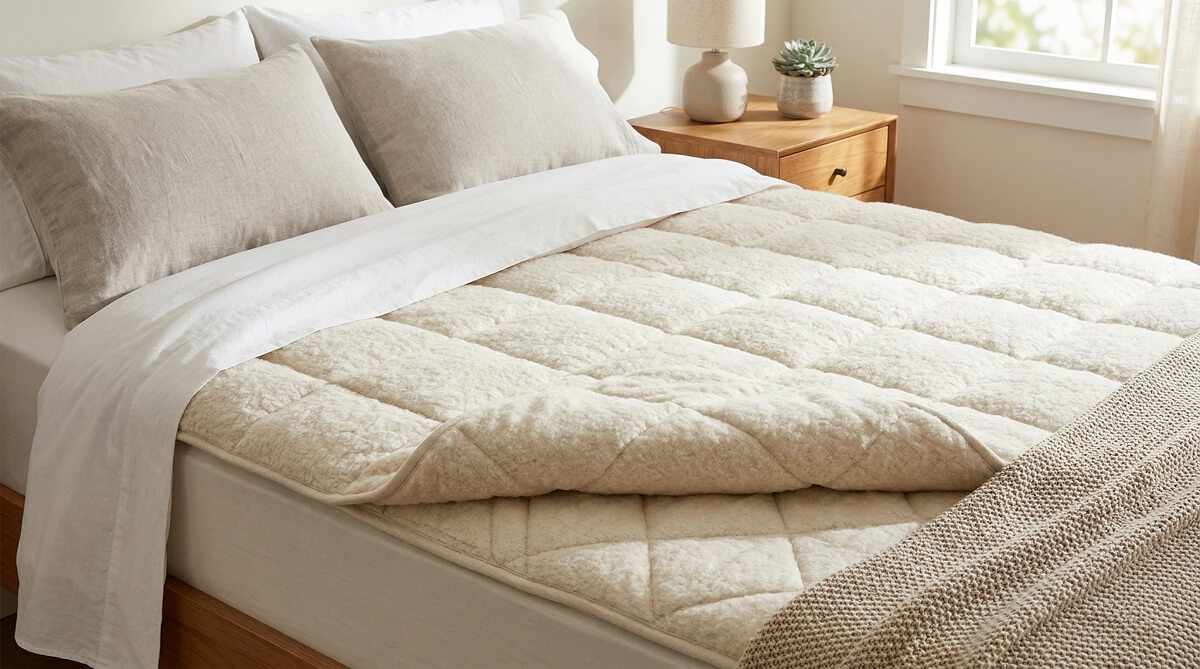
Most of what’s marketed as a “non-toxic mattress pad” is actually a quilted fitted pad — thin, washable, adding a touch of softness while protecting the mattress surface. If you need full waterproofing, look specifically for a protector (like Avocado’s waterproof version). If you want to meaningfully change how your mattress feels, .
Top Non-Toxic Mattress Pads in 2026
Three options stand out for having third-party certifications that actually match their marketing claims. Prices below are queen size as of March 2026, pulled directly from official product pages and confirmed through independent sources including Sleep Foundation’s 2026 mattress pad testing.
Whisper Organics Luxury Quilted Mattress Pad — $219.99 (Queen)
The most comfortable option if soft, breathable cotton is your priority. This is a 500-thread-count pad with 400 GSM fill — substantially thicker than most organic pads. It’s GOTS-certified and Fairtrade-certified, meaning both the materials and the supply chain have been verified. The 1/3″ thickness adds a perceptible plushness without affecting mattress support. Deep pocket fits up to 17″. One note: it’s absorbent, not waterproof — so if you need liquid protection, pair it with a protector underneath or look at Avocado instead.
Check current pricing: Whisper Organics on Amazon or Whisper Organics official site.
Avocado Organic Waterproof Mattress Protector — $249 (Queen)
The most certified option for anyone who needs documented safety credentials. It carries GOTS, GREENGUARD Gold, MADE SAFE, and a Formaldehyde-Free certification from UL Environment. The waterproof layer is derived from cornstarch — not petroleum — making it thinner and quieter than traditional plastic-backed pads. The Good Housekeeping Seal adds two additional years of warranty coverage. Pre-wash before use: the organic cotton will shrink slightly before settling into the correct fit.
The $249 price point is at the high end for a mattress protector, but no other option in this category stacks certifications this thoroughly. Check pricing at Avocado Green Mattress.
Naturepedic Organic Waterproof Mattress Protector — ~$199 (Queen)
The most family-focused option. Naturepedic has been making organic bedding since 2003 and was the first mattress brand to receive EWG VERIFIED status. Their waterproof protector uses organic cotton layers sandwiching a thin polyurethane barrier. Certifications include GOLS, MADE SAFE, GREENGUARD, and 1% for the Planet membership. Naturepedic also makes crib and kids’ mattress protectors in the same certified-organic construction. A spring 2026 sale is running with 15% off sitewide. Check current pricing at Naturepedic.com.
Quick Comparison
| Product | Queen Price | Key Certifications | Waterproof? | Best For |
|---|---|---|---|---|
| Whisper Organics Luxury Quilted | $219.99 | GOTS, Fairtrade | No (absorbent) | Softness + breathability |
| Avocado Organic Waterproof Protector | $249 | GOTS, GREENGUARD Gold, MADE SAFE | Yes (cornstarch PU) | Maximum certifications + waterproofing |
| Naturepedic Organic Waterproof Protector | ~$199 | GOTS, MADE SAFE, GREENGUARD, EWG VERIFIED | Yes | Families, kids, babies |
| Birch Organic Mattress Pad | $199 | GOTS | No | Independently tested comfort |
| Saatva Organic Mattress Pad | $265 | GOTS | No | Premium organic + Sleep Foundation top pick |
Prices as of March 2026. Check current pricing before purchasing.
Sizing and Fit: What to Check Before You Order
Standard mattress pad sizes follow bedding norms, but pocket depth catches buyers off guard more often than the surface dimensions. Here’s the full size rundown — if you need help matching to your bed frame:
- Twin: 39″ × 77″
- Full: 55″ × 76″
- Queen: 62″ × 82″
- King: 78″ × 82″
- Cal King: 74″ × 86″
If your mattress is thicker than 12″ — common with pillow-top or hybrid mattresses — you need a pad rated for deep pocket. Whisper Organics fits up to 17″; Avocado’s deep-pocket version handles up to 22″. A standard pocket won’t seat properly on a thick mattress, and the elastic will pop loose overnight.
Organic cotton pads also shrink slightly when first washed. Avocado explicitly recommends pre-washing before first use. It may take one or two wash cycles before the pad fits snugly and stays in place.
Caring for an Organic Mattress Pad
The care routine is simpler than people assume — organic cotton isn’t fragile, just intolerant of high heat:
- Machine wash warm or cool, gentle cycle
- Wash like colors only; no bleach
- Tumble dry on low heat; remove promptly to prevent wrinkles and fiber stress
- Line drying extends pad life
- Wash every 1–3 months under normal use; sooner after illness or accidents
High heat degrades organic cotton fibers faster than synthetic alternatives, so avoid hot dryer settings. Wool-filled options should be air dried when possible.
Frequently Asked Questions
What is a non-toxic mattress pad?
A mattress pad made from certified organic materials — typically cotton or wool — that avoids PFAS in waterproofing coatings, chemical flame retardants, formaldehyde-based finishes, and synthetic foam fill. “Non-toxic” has no legal definition in bedding; third-party certifications like GOTS and GREENGUARD Gold are what give the claim actual meaning.
Are conventional mattress pads toxic?
Many contain substances worth avoiding — PFAS in waterproof coatings, chemical flame retardants (some of which have been banned in California), and formaldehyde off-gassing from adhesives and finishes. Whether the exposure level constitutes harm is debated, but given you’re sleeping on these materials for 8+ hours nightly, the precautionary case for certified-organic alternatives is reasonable.
What’s the difference between GOTS and OEKO-TEX?
GOTS certifies the entire supply chain and requires at least 95% organic fibers. OEKO-TEX STANDARD 100 tests the finished product for harmful substance residues but doesn’t require organic materials — a synthetic pad can earn it. GOTS is the higher standard if you care where the materials come from. OEKO-TEX is useful as a baseline safety check.
Is a non-toxic mattress pad waterproof?
Most organic cotton quilted pads are absorbent, not waterproof — they protect against sweat and light moisture but won’t contain spills. If waterproofing is required, look for options with a certified-safe barrier layer: Avocado and Naturepedic both use a thin polyurethane layer (Avocado’s is derived from cornstarch) that provides liquid protection without the PFAS concern of conventional waterproof coatings.
Can a non-toxic mattress pad help with allergies?
Yes, in several ways. GOTS-certified cotton is free from the dyes, pesticide residues, and chemical finishes that commonly trigger reactions. GREENGUARD Gold-certified options are tested for VOC emissions specifically, which matters for people with indoor air quality sensitivity or asthma. An organic pad won’t replace a full allergen encasement if dust mites are the core issue, but it removes a layer of chemical exposure that synthetic alternatives add.
How often should I replace my mattress pad?
A well-maintained organic cotton pad typically lasts 3–5 years. Replace sooner if the padding thins noticeably, the elastic loses grip, or the cover shows significant wear. Organic cotton is durable when cared for properly — the main enemy is high-heat drying.
Do I need to wash a new organic mattress pad before using it?
Avocado specifically recommends it — the organic cotton will shrink slightly in the first wash, which is what seats the pad properly on the mattress. It’s a sensible practice for any new organic pad. It also removes any manufacturing residues before the pad contacts your bedding.
Are non-toxic mattress pads worth the extra cost?
The price premium over conventional is roughly $30–$80 for queen size — not trivial, but not extreme. If you have chemical sensitivities, young children in the household, or simply want documented accountability for what’s in your bedding, the case is clear. For a healthy adult without specific concerns, the calculus is more personal. The certifications do represent real accountability, not just marketing language.
Check Current Pricing
The options covered above are available directly from brands and through major retailers. Prices change, and some brands run seasonal sales:
on ChubbytIps for related comparisons on mattress protectors, toppers, and organic bedding.
