


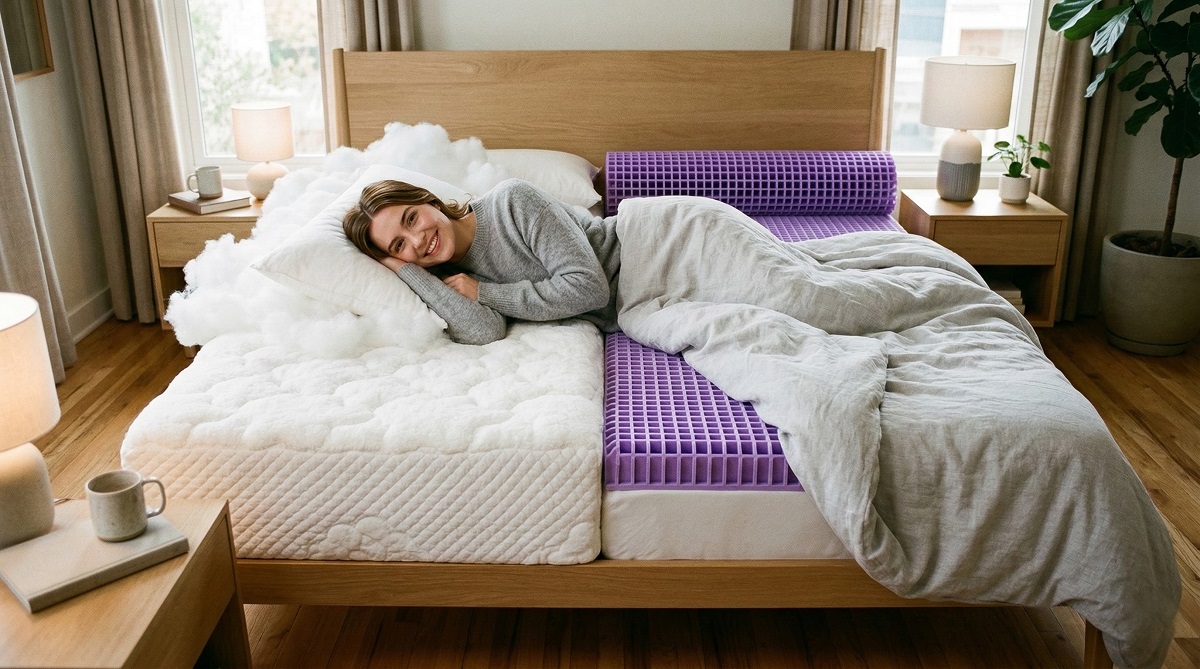
The Puffy Cloud and Purple Mattress represent two completely different approaches to comfort. The Puffy gives you classic memory foam that hugs your body and isolates motion, while the Purple uses a unique gel grid that keeps you floating on top with better airflow. If you’re a side sleeper who wants pressure relief, the Puffy Cloud is the better fit. If you’re a combination sleeper who tosses and turns at night, Purple’s responsive bounce makes changing positions easier.
Price-wise, they’re close during sales—Puffy starts at $449 for a Twin during their February 2026 Presidents’ Day promotion, while Purple’s Twin runs $799 with a $200 discount. The warranty difference is significant: Puffy offers lifetime coverage, while Purple provides a standard 10-year warranty. Both companies give you around 100 nights to test the mattress at home, which is enough time to break it in and decide.
This comparison will help you figure out which mattress makes sense for your sleeping style, budget, and comfort preferences. I’ll go over construction differences, real-world performance for different sleep positions, cooling capabilities, and what you actually get for your money.
Quick Decision Checklist
Choose Puffy if:
- You prefer classic memory foam contouring
- You’re a side sleeper who needs pressure relief
- You want a softer, “sink-in” feel
- You value a lifetime warranty
- You sleep with a restless partner (better motion isolation)
Choose Purple if:
- You want a unique, bouncy feel
- You’re a combination sleeper who moves around
- You sleep hot and need maximum airflow
- You prefer feeling “on” rather than “in” the mattress
- You’re a back or stomach sleeper
Skip both if:
- You weigh over 250 lbs per person (need more support)
- You require very firm support
- You’re on a tight budget (consider budget alternatives)
Quick Comparison at a Glance
| Feature | Puffy Cloud | Purple Original |
|---|---|---|
| Price Range (Feb 2026) | Twin: $449 (sale) Queen: $749-$799 King: varies by model |
Twin: $799 Queen: $1,299 King: $1,799 |
| Mattress Type | All-foam (Cloud) or Hybrid (Lux) | Foam + Hyper-Elastic Polymer Grid |
| Firmness | 6/10 (medium-soft to medium-firm) | 7/10 (firm) |
| Best For | Side sleepers, pressure relief | Combination sleepers, cooling |
| Cooling | Gel-infused foam | GelFlex Grid with 1,400+ air channels |
| Motion Isolation | Excellent | Good |
| Edge Support | Fair | Fair |
| Trial Period | 101 nights | 100 nights |
| Warranty | Lifetime | 10 years |
| Free Bundle | 2 pillows + sleep mask ($315 value) | Sheet set ($169 value) |
| Height | 10 inches | 9.25 inches |
| Weight Capacity | 350 lbs per side (700 lbs total) | 300 lbs per person (600 lbs total) |
Understanding the Core Difference: Memory Foam vs Grid Technology
Puffy’s Memory Foam Layers
The Puffy Cloud uses a traditional foam construction with some modern updates. You get 10 inches total, broken down into three main layers. On top, there’s 2 inches of Cooling Cloud memory foam—that’s gel-infused foam designed to disperse heat while contouring to your body. Below that sits 2 inches of Climate Comfort polyfoam, which acts as a transition layer between the soft top and firm base. The bottom 6 inches are high-density Firm Core Support foam that keeps you from sinking too deep.
All the foam is CertiPUR-US certified, meaning it’s free from harmful chemicals like formaldehyde, heavy metals, and certain flame retardants. The cover is a stain-resistant, hypoallergenic polyester that you can’t remove for washing. It’s a straightforward foam bed that relies on proven materials rather than experimental technology.
Purple’s Proprietary GelFlex Grid
Purple takes a completely different approach. The top 2 inches are made from hyper-elastic polymer formed into a grid pattern with over 1,400 gel columns. This isn’t foam at all—it’s a rubbery material that collapses under pressure but springs back instantly. When you lie down, the columns compress where your body creates pressure (like shoulders and hips) but stay firm where you need support (like your lower back).
Under the grid, Purple uses traditional foam support layers to provide a stable base. The total height comes to 9.25 inches, slightly shorter than the Puffy. The grid itself is what makes Purple unique—you won’t find this material in any other mainstream mattress. The open structure creates natural air channels that let heat escape instead of getting trapped in foam.
What This Means for Your Sleep
The foam versus grid decision comes down to feel. Memory foam like Puffy’s delivers that “sinking in” sensation where the mattress wraps around your body. You feel hugged and cradled. The Purple grid keeps you more “on top” of the mattress with a lifted, floating feel. When you press into Purple, the grid gives way instantly but doesn’t have that slow memory foam response.
For changing positions at night, Purple wins. The grid bounces back immediately, so you don’t get that stuck-in-quicksand feeling some people experience with memory foam. But for staying still in one position—especially side sleeping—Puffy’s foam contours more precisely to pressure points. Neither is objectively better; they’re designed for different sleep styles.
Price Breakdown and Value Analysis
Current 2026 Pricing
As of February 2026, Puffy is running an Early Presidents’ Day Sale with code “PRESIDENT” that brings the Twin size Cloud Mattress down to $449 (from $499). The Puffy Lux Hybrid runs $749-$799 for a Queen, with the company advertising up to $1,350 off during this promotion. You also get a free bundle worth $315 that includes 2 Signature Memory Foam Pillows (valued at $240) and a Signature Sleep Mask ($75).
Purple’s pricing is higher at full MSRP but they’re currently running a $200-off promotion. Here’s the breakdown:
| Size | Current Price | Regular Price | Savings |
|---|---|---|---|
| Twin | $799 | $999 | $200 |
| Twin XL | $899 | $1,099 | $200 |
| Full | $1,199 | $1,399 | $200 |
| Queen | $1,299 | $1,499 | $200 |
| King | $1,799 | $1,999 | $200 |
| Cal King | $1,799 | $1,999 | $200 |
Purple includes a free sheet set worth $169 with mattress purchases during their current promotion. Keep in mind both companies run sales frequently, so if you’re not in a rush, you might find better deals around major holidays.
What You Get for Your Money
The warranty difference is the biggest value gap. Puffy’s lifetime warranty covers defects for as long as you own the mattress, while Purple’s 10-year limited warranty is standard for the industry. Both require you to keep proof of purchase and use the mattress on an appropriate foundation. The lifetime coverage provides Puffy a clear advantage here, especially if you plan to keep the mattress for 8-10 years.
Trial periods are essentially identical—Puffy gives you 101 nights versus Purple’s 100 nights. Both companies recommend you sleep on the mattress for at least 30 nights before requesting a return, which gives the materials time to break in and your body time to adjust. Returns are free with both companies, though you’ll need to coordinate pickup through their customer service.
Shipping is free with both Puffy and Purple to US addresses. Puffy advertises delivery in 1-2 business days, while Purple provides free shipping without specific timeframes listed. Both mattresses arrive compressed in a box that you’ll need to maneuver to your bedroom before unboxing.
Long-Term Value Considerations
Most foam mattresses last 7-10 years before showing significant sagging or loss of support. The Puffy’s all-foam construction should hold up well within that range, and the lifetime warranty protects you if it doesn’t. Purple’s grid is newer technology without decades of long-term data, but the company stands behind it with their 10-year warranty. The polymer grid shouldn’t degrade the same way foam does, but the foam support layers underneath will eventually compress.
Weight capacity matters for longevity. Puffy supports up to 350 pounds per side (700 pounds total for couples), while Purple recommends up to 300 pounds per person (600 pounds total). If you’re near or above these limits, the mattress will wear faster and you might not get the full lifespan you’re expecting.
How They Perform for Different Sleeper Types
Side Sleepers
If you sleep on your side, the Puffy Cloud is the better choice. Independent testing from Sleepopolis rated Puffy at 4.4/5 stars and specifically noted it excels for side sleepers. The softer memory foam (rated 6/10 on firmness) lets your shoulders and hips sink in enough to keep your spine aligned. When you’re on your side, you need the mattress to give way at pressure points or you’ll wake up with shoulder pain and hip discomfort.
The Purple can work for side sleepers, but the firmer 7/10 rating and bouncy grid means you won’t get as much contouring. If you’re a lightweight side sleeper (under 150 pounds), Purple might feel fine. But average and heavier side sleepers will likely find it too firm in the shoulder area. The grid does relieve pressure, but it does it differently than memory foam—more through collapsing columns than through deep contouring.
Back Sleepers
Both mattresses can work for back sleepers, but it depends on your weight and firmness preferences. The Purple’s 7/10 firmness provides more lumbar support and keeps your spine in better alignment if you’re average or heavier weight. The grid holds your lower back up while giving way at heavier areas like your shoulders and butt.
Puffy’s softer 6/10 feel works for back sleepers who want more cushioning. If you’re lightweight (under 150 pounds) or you like a softer feel on your back, the Puffy Cloud delivers enough support without feeling too firm. Heavier back sleepers might sink too deep into the Puffy, which can throw off spinal alignment.
Stomach Sleepers
Purple is the better option for stomach sleeping. The firmer 7/10 surface keeps your hips from sinking too deep, which is the main problem stomach sleepers face with soft mattresses. When your hips sag, your lower back arches unnaturally and you wake up with back pain. Purple’s grid provides resistance where you need it most.
The Puffy Cloud is too soft for most stomach sleepers. At 6/10 firmness, your hips will likely sink deeper than your shoulders, creating that problematic arch in your lower back. If you’re a strict stomach sleeper and want a Puffy mattress, you’d need to move up to their firmer hybrid models.
Combination Sleepers
Purple wins for combination sleepers who change positions throughout the night. The grid’s instant responsiveness makes it easy to roll from back to side to stomach without fighting the mattress. Tom’s Guide noted that “Purple does stand out thanks to its innovative Purple Grid. This flexible layer can adapt effortlessly to different sleeping positions.”
Memory foam naturally restricts movement because it contours so closely to your body. The Puffy Cloud has that “sleeping in” feel that some combination sleepers find limiting. You can still change positions, but it requires more effort than on the bouncy Purple surface.
Couples and Partner Disturbance
For motion isolation, Puffy is the clear winner. Memory foam absorbs movement extremely well, so when your partner gets in and out of bed or rolls over at night, you won’t feel it on your side. If you’re a light sleeper sharing a bed with someone who tosses and turns, Puffy’s excellent motion isolation is worth considering.
Purple’s grid has more bounce and responsiveness, which means it transfers more motion across the surface. It’s not terrible—the foam layers underneath absorb some movement—but it can’t match traditional memory foam for keeping motion isolated. The trade-off is that the bounce makes it easier to move around and change positions.
Edge support is fair on both mattresses, which is typical for foam beds. Neither gives you that solid edge-to-edge support you’d get from a traditional innerspring mattress. If you like to sleep near the edge or sit on the side of the bed, you’ll experience some compression and lack of stability with both options.
Temperature Regulation and Cooling Performance
Puffy’s Cooling Strategy
Puffy addresses heat retention with gel-infused memory foam and a Climate Comfort layer. The gel infusion is designed to disperse body heat instead of trapping it in the foam. The Climate Comfort polyfoam layer adds some breathability and air circulation between the top memory foam and the dense support base.
The cover is breathable polyester that allows some airflow. All these features help, but memory foam naturally sleeps warmer than other materials because it contours so closely to your body. The close contact reduces airflow and traps heat. Puffy’s cooling technology makes it better than basic memory foam, but it won’t feel as cool as mattresses with more advanced airflow designs.
Purple’s Airflow Design
Purple’s grid structure provides passive cooling through open air channels. With over 1,400 gel columns forming the grid, air can move freely through the gaps instead of getting trapped against your body. This design creates natural ventilation without requiring active cooling technology or fans.
The grid keeps you more “on top” of the mattress rather than sinking in, which maintains airflow between your body and the sleep surface. The cover is a breathable blend of polyester, viscose, and lycra that doesn’t block air movement. The foam layers underneath the grid are CertiPUR-US certified polyurethane, which don’t contribute much to cooling but also don’t add significant heat retention.
Who Sleeps Hotter
Purple sleeps cooler than Puffy. The open grid design with constant airflow beats gel-infused memory foam for temperature regulation. If you’re a hot sleeper who wakes up sweating at night, Purple is the better choice. Independent reviewers consistently note Purple’s cooling advantage over traditional foam mattresses.
That said, Tom’s Guide points out that “neither bed will suit very hot sleepers, because it’s the very nature of foam beds to retain heat.” If temperature is your primary concern and you sleep extremely hot, you might need to look at innerspring mattresses, latex, or mattresses with active cooling systems. Both Puffy and Purple will keep average sleepers comfortable, but they’re not designed for people who need maximum cooling.
Construction and Materials Quality
Puffy’s Layer-by-Layer Build
Starting from the top, the Puffy Cloud has a stain-resistant, hypoallergenic polyester cover that you can’t remove. Under that, the first layer is 2 inches of Cooling Cloud memory foam—this is gel-infused memory foam that delivers the initial comfort and pressure relief. The second layer is 2 inches of Climate Comfort polyfoam, which is a transition foam that’s firmer than the top layer but softer than the base.
The bottom layer is 6 inches of high-density Firm Core Support polyfoam. This is the foundation that keeps you from bottoming out and provides the structural stability of the mattress. All foam layers are CertiPUR-US certified, meaning they’re manufactured without ozone depleters, PBDE flame retardants, mercury, lead, heavy metals, formaldehyde, or phthalates. Total height is 10 inches.
Purple’s Unique Construction
Purple starts with a SoftFlex cover made from a blend of polyester, viscose, and lycra. This stretchy, breathable cover flexes with the grid underneath. The star of the show is the 2-inch GelFlex Grid made from hyper-elastic polymer. This grid contains over 1,400 individual gel columns that collapse and rebound based on pressure.
Below the grid, Purple uses polyurethane foam support layers to create a stable base. These foams are CertiPUR-US certified. The total mattress height is 9.25 inches, about three-quarters of an inch shorter than the Puffy. For fire safety, Purple uses a GREENGUARD Gold certified flame barrier made from rayon, polyester, and silica—no fiberglass.
Durability and Expected Lifespan
Foam mattresses typically last 7-10 years before you’ll notice significant sagging or loss of support. The Puffy’s all-foam construction follows this timeline. The high-density support foam should hold up well, and the lifetime warranty protects you if it fails prematurely. Most sagging happens in the softer comfort layers on top, not in the dense support base.
Purple’s grid is made from a more durable material than foam, but the foam layers underneath will eventually compress over time. The 10-year warranty covers defects and significant indentations. The grid itself should outlast traditional foam, but there’s less long-term data since the technology is relatively new compared to memory foam that’s been around for decades.
Setup, Shipping, and Unboxing
Delivery and Packaging
Both mattresses ship free to US addresses in a compressed box. Puffy advertises delivery within 1-2 business days, which is faster than most bed-in-a-box companies. Purple provides free shipping but doesn’t specify exact timeframes on their website.
The boxes are heavy and bulky. You’ll need to get the box to your bedroom before opening it—don’t try to carry the expanded mattress through narrow doorways or up stairs. Both mattresses are compressed and rolled, then vacuum-sealed in plastic inside the shipping box.
Expansion Time and Off-Gassing
Once you unbox the mattress and cut the plastic wrap, it’ll start expanding immediately. Most of the expansion happens in the first few hours, but both companies recommend waiting 24-48 hours for the mattress to reach full size and firmness. You can sleep on it the first night if needed, but the feel will improve after a day or two of expansion.
Off-gassing is normal with foam mattresses. You’ll likely notice a chemical or plastic smell when you first open the box. This is from the foam manufacturing process and the compressed packaging. The smell is stronger with Puffy since it’s all foam, while Purple has less foam content due to the polymer grid. The odor should dissipate within a few days to a week. Keep the room well-ventilated during this period.
Compatibility with Bed Frames
Both mattresses work with most standard bed frames. You can use a platform bed, slatted bed frame, box spring, or adjustable base. If you’re using a slatted frame, make sure the slats are no more than 3-4 inches apart—wider gaps can cause sagging and void your warranty.
Both Puffy and Purple are compatible with adjustable bases, which is helpful if you like to elevate your head or feet while sleeping. You don’t need to buy a special foundation—any flat, supportive surface works. The floor is technically an option, though it’s not ideal for airflow underneath the mattress.
Policies, Warranties, and Customer Support
Trial Periods Compared
Puffy offers a 101-night trial with a money-back guarantee. Purple provides a 100-night trial. Both companies require you to try the mattress for at least 30 nights before requesting a return—this break-in period lets the materials settle and gives your body time to adjust.
If you decide to return the mattress, both companies arrange free pickup. You don’t need to repackage it in the original box. There are no return fees or restocking charges with either company. The refund process typically takes a few days after they receive the returned mattress.
Warranty Coverage
Here’s where Puffy has a significant advantage. The lifetime warranty covers defects in materials and workmanship for as long as you own the mattress. Purple’s 10-year limited warranty is standard for the industry but doesn’t match the lifetime coverage.
Both warranties require you to use the mattress on an appropriate foundation and keep your proof of purchase. They don’t cover normal wear and tear, stains, burns, or damage from improper use. The warranties cover manufacturing defects and indentations beyond a certain depth (typically 1 inch or more).
To make a warranty claim with either company, you’ll need to provide photos, proof of purchase, and documentation of the defect. The process involves contacting customer service and following their claim procedures. Both companies may repair or replace the mattress depending on the issue.
Customer Service Experience
Both Puffy and Purple offer customer support through phone, email, and online chat. Response times vary depending on how busy they are, but both companies generally respond within 24 hours for email inquiries. Phone support is faster if you need immediate assistance.
Purple’s customer reviews on their official website show an aggregate rating of 4.47/5 stars from 29,887 reviews. Common praise includes pain relief and cooling properties. One customer wrote: “After only ONE night on this mattress my hip pain is 100% gone!” These are verified purchase reviews, so they represent actual customer experiences.
Other Models to Consider
Puffy’s Full Lineup
Beyond the Puffy Cloud (all-foam), the company offers hybrid versions with innerspring coils. The Puffy Lux Hybrid adds pocketed coils for more bounce and edge support. The Puffy Royal Hybrid is their premium model with additional comfort layers and enhanced cooling. If you find the Cloud too soft or want better edge support, the hybrid models are worth considering.
The hybrid versions cost more but provide some benefits that pure foam can’t match—better airflow from the coil system, improved edge support, and more bounce. They maintain the memory foam comfort on top while adding the responsiveness of springs underneath.
Purple’s Model Range
Purple offers several models beyond the Original. The Purple Hybrid 2, 3, and 4 feature taller grids (3 or 4 inches instead of 2) and pocketed coil systems underneath. The taller grids provide more pressure relief and support for heavier sleepers. The Purple Restore is their premium model designed specifically for pain relief and recovery.
The grid height makes a significant difference in feel. The 2-inch grid in the Original can bottom out for heavier sleepers (over 250 pounds), while the 3 or 4-inch grids in the Hybrid models provide more cushioning before you hit the support layers underneath. The hybrid models also offer better edge support thanks to the coil systems.
Quick Model Comparison
The Puffy Cloud compares directly to the Purple Original—both are the entry-level, all-foam (or foam plus grid) models. If you’re comparing hybrid models, look at the Puffy Lux Hybrid versus the Purple Hybrid 2. The higher-end models from both companies get expensive quickly, with prices jumping several hundred dollars for each upgrade.
For most people, the base models (Puffy Cloud and Purple Original) provide enough comfort and support. The upgraded models make sense if you’re heavier, want premium features, or have specific pain issues that require more specialized support.
Pros and Cons Summary
Puffy Mattress Strengths
- Better motion isolation than Purple
- Softer, more contouring feel for pressure relief
- Lifetime warranty coverage
- Excellent for side sleepers
- Traditional memory foam comfort that many people prefer
- Higher weight capacity (350 lbs per side)
Puffy Mattress Limitations
- Sleeps warmer than Purple
- Too soft for most stomach sleepers
- Less responsive for changing positions
- Fair edge support (typical for foam)
- Memory foam feel isn’t for everyone
Purple Mattress Strengths
- Unique, responsive feel unlike any other mattress
- Excellent cooling and airflow from grid structure
- Great for combination sleepers
- Firmer support for back and stomach sleepers
- Innovative pressure relief through collapsing columns
Purple Mattress Limitations
- More expensive at MSRP
- Less motion isolation than memory foam
- Bounce may disturb light sleepers
- Shorter 10-year warranty versus lifetime
- Fair edge support (typical for foam-based beds)
- Grid feel is polarizing—you’ll love it or hate it
Who Should Buy Which Mattress?
Buy Puffy If You:
- Sleep primarily on your side
- Want traditional memory foam comfort
- Share the bed with a restless partner
- Prefer sinking into the mattress
- Value a lifetime warranty
- Need maximum pressure relief at shoulders and hips
- Don’t sleep extremely hot
Buy Purple If You:
- Sleep in multiple positions throughout the night
- Run hot at night and need maximum airflow
- Want a unique, bouncy feel
- Sleep mostly on your back or stomach
- Prefer feeling supported on top rather than sinking in
- Value innovative technology
- Don’t need extreme motion isolation
Skip Both and Consider Alternatives If:
- You weigh over 250 lbs per person (look for firmer, higher-density support)
- You’re on a strict budget under $500
- You need very firm support (7.5+/10 on firmness scale)
- You want the absolute best edge support (consider innerspring)
- You prefer natural or organic materials
- You’re an extremely hot sleeper (consider latex or innerspring with cooling)
Frequently Asked Questions
Which mattress is better for side sleepers?
The Puffy Cloud is better for side sleepers. The softer 6/10 firmness and memory foam construction deliver better pressure relief at your shoulders and hips. When you sleep on your side, you need the mattress to contour around these pressure points to keep your spine aligned. Purple can work for lightweight side sleepers, but most people find it too firm for comfortable side sleeping.
Which mattress sleeps cooler?
Purple sleeps cooler than Puffy. The GelFlex Grid creates over 1,400 air channels that allow constant airflow through the mattress. The open structure and “on top” sleeping position maintain air circulation between your body and the mattress. Puffy uses gel-infused foam and Climate Comfort layers for cooling, which help, but memory foam naturally retains more heat than Purple’s grid design.
Is the Purple GelFlex Grid durable?
The hyper-elastic polymer grid is designed to be more durable than traditional foam because it doesn’t compress permanently the way foam does. Purple backs it with a 10-year warranty that covers defects and sagging. Since the grid technology is relatively new compared to memory foam, there’s less long-term data, but the material itself should outlast standard polyurethane foam. The foam support layers underneath the grid will eventually compress over time like any foam mattress.
Can you flip or rotate these mattresses?
You cannot flip either mattress because they’re designed with specific comfort layers on top and support layers on bottom. Flipping them would put the firm base against your body. Rotation is generally not necessary with foam mattresses since they don’t develop body impressions the same way innerspring mattresses do. If you want to rotate them for even wear, you can, but neither manufacturer specifically recommends it.
Which has better edge support?
Both mattresses have fair edge support, which is typical for foam-based beds. Neither delivers the solid edge-to-edge sleeping surface you’d get from a traditional innerspring or hybrid with reinforced perimeter. If you regularly sit on the edge of the bed or sleep near the edge, you’ll notice some compression with both options. For better edge support from either brand, you’d need to move up to their hybrid models with coil systems.
How long do Puffy and Purple mattresses last?
Both mattresses should last 7-10 years with proper care. Foam mattresses generally fall within this range before showing significant sagging or loss of support. Factors that affect lifespan include your body weight, how you maintain the mattress, and whether you use an appropriate foundation. Puffy’s lifetime warranty protects you if it fails earlier. Purple’s 10-year warranty covers the expected lifespan. Heavier sleepers may see faster degradation.
Which is better for back pain?
It depends on your sleeping position and what’s causing your back pain. Side sleepers with back pain typically do better on the softer Puffy because it relieves pressure at the shoulders and hips, keeping the spine aligned. Back sleepers with lower back pain often prefer Purple’s firmer support that prevents the hips from sinking too deep. If your back pain comes from sleeping on a too-soft mattress, Purple’s firmer 7/10 rating will help. If it’s from pressure points and poor alignment, Puffy’s contouring may offer more relief.
Do these mattresses have fiberglass?
No, neither mattress contains fiberglass. Puffy uses a fire sock made from silica and rayon as their flame barrier. Purple uses a GREENGUARD Gold certified flame barrier made from rayon, polyester, and silica. Both companies explicitly state their mattresses are fiberglass-free. All foam layers in both mattresses are CertiPUR-US certified, which means they’re manufactured without harmful chemicals.
Can you try these mattresses in stores?
Availability varies by location. Purple has some retail partnerships where you can test their mattresses in showrooms. Puffy is primarily sold online direct-to-consumer. Your best option is to check the companies’ websites for store locator tools if they offer in-person testing. However, both companies designed their business models around the home trial period—you’re meant to test the mattress in your own home for 100+ nights rather than making a decision based on a 5-minute test in a showroom.
Which company has better customer service?
Both companies offer similar customer service with phone, email, and online chat support. Puffy provides a longer 101-night trial versus Purple’s 100 nights, though the difference is minimal. Puffy’s lifetime warranty is significantly better than Purple’s 10-year warranty. Purple has strong customer reviews with a 4.47/5 star average from nearly 30,000 verified buyers. For warranty and trial period alone, Puffy edges ahead. For verified customer satisfaction, Purple shows strong ratings.
Final Verdict: Puffy vs Purple
These mattresses serve different needs. The Puffy Cloud delivers traditional memory foam comfort—soft, contouring, and excellent at isolating motion. The Purple takes an innovative approach with its gel grid that provides bounce, airflow, and a unique floating sensation. Neither is universally better; they’re built for different sleep styles.
If you’re a side sleeper, go with the Puffy Cloud. The 6/10 firmness and memory foam construction deliver the pressure relief your shoulders and hips need. The lifetime warranty adds value, and the excellent motion isolation makes it ideal for couples where one partner moves around at night.
If you’re a combination sleeper or you run hot, choose Purple. The 7/10 firmness and responsive grid make it easy to change positions, and the airflow through the grid structure keeps you cooler than traditional foam. Back and stomach sleepers will appreciate the firmer support that keeps the spine aligned.
For most people, the base models covered in this comparison will work well. If you’re heavier (over 250 pounds per person), want premium features, or need more specialized support, look at the hybrid models from both brands. The Puffy Lux Hybrid and Purple Hybrid 2 or 3 add coil systems for better support, airflow, and edge support at higher price points.
Check Current Prices
Both companies offer free trials, so you can test the mattress in your home before committing. Current promotions change frequently—check their official websites for the latest deals:
- for current pricing and bundles
- for current promotions and reviews
Make sure to verify warranty terms, trial period details, and included accessories before purchasing.
