


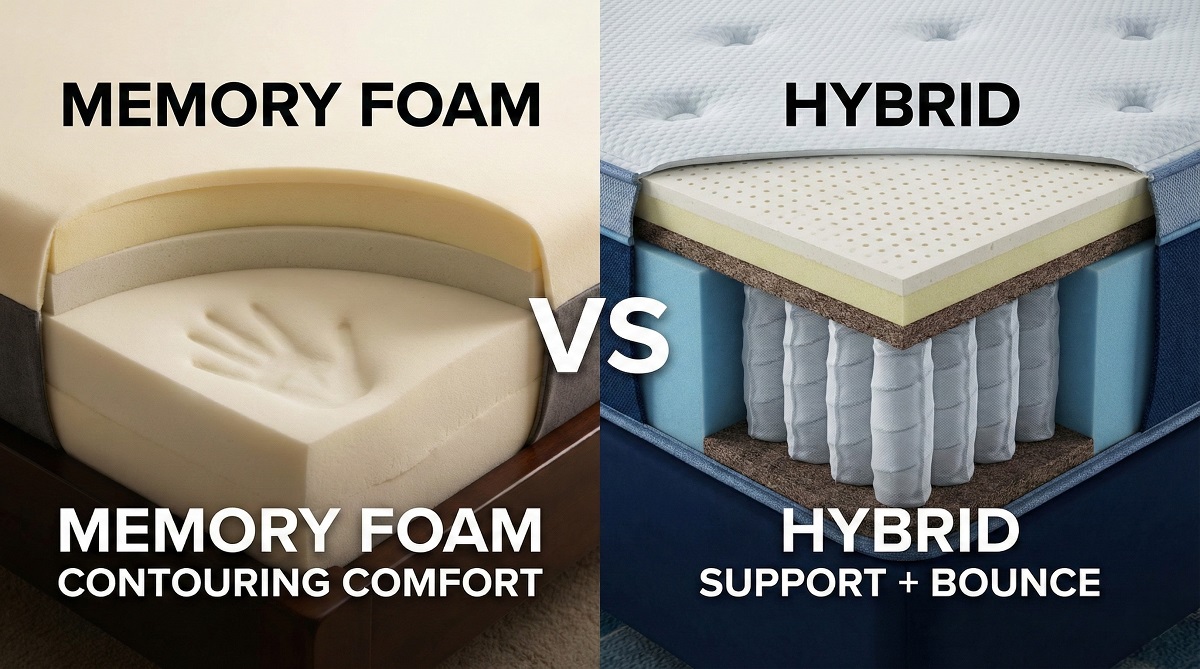
Memory foam and hybrid mattresses dominate the market for good reason—both can deliver excellent sleep if you match them to your needs. The core difference comes down to what’s underneath: memory foam beds use dense polyfoam for support, while hybrids pair foam comfort layers with steel coils. This affects everything from how the mattress feels to how long it lasts.
The quick answer: Choose memory foam if you want deep pressure relief, minimal partner disturbance, and a lower price point (quality queens start around $350-$650). Choose a hybrid if you sleep hot, change positions frequently, or need strong edge support (expect to pay $700-$1,800+ for a queen). Neither type is universally “better”—it depends on your body, sleep style, and priorities.
According to NapLab’s testing data, hybrids outperform memory foam in cooling (8.8 vs 8.2 average score) and edge support, while memory foam wins decisively on motion isolation (4.04 vs 7.40 m/s² motion transfer). If you’re shopping on a budget, check our for current deals.
Who Should Buy Memory Foam vs Hybrid?
Choose Memory Foam If:
- You’re a side sleeper who needs pressure relief for hips and shoulders (see our )
- Your partner tosses and turns (motion isolation is excellent)
- You prefer sinking into your bed rather than sleeping on top of it
- Your budget is under $800 for a queen
- You have allergies (dense foam resists dust mites)
- You want a quieter bed (no springs to squeak)
Choose Hybrid If:
- You sleep hot and need better airflow
- You change positions frequently during the night
- You sit or sleep on the edge of your bed
- You’re a heavier sleeper (over 230 lbs)
- You prefer sleeping “on top” of your mattress with some bounce
- Durability is a top priority
Consider Other Options If:
- Two sleepers need different firmness levels (look at split kings or adjustable beds)
- You want all-natural materials (consider latex mattresses — see our )
- You have severe back pain (consult a sleep specialist for specific recommendations)
What’s Actually Different? Construction Explained
Both mattress types use foam in their comfort layers. The key difference is the support system underneath—and that difference affects almost every aspect of performance.
Memory Foam Mattress Construction
A typical memory foam mattress has three layers:
- Comfort layer: Viscoelastic memory foam (1-3 inches) that conforms to your body using heat and pressure
- Transition layer: Polyfoam (1-2 inches) that prevents you from sinking too deep
- Support core: High-density polyfoam base (5-7 inches) that provides structural support
No springs or coils. According to mattress weight data from Eachnight, a queen-size memory foam mattress typically weighs 70-100 pounds—light enough for one person to maneuver.
Hybrid Mattress Construction
Hybrids combine foam and coils:
- Comfort layer: Memory foam, latex, or polyfoam (2-4 inches)
- Transition layer: Foam or microcoils (1-2 inches)
- Support core: Individually wrapped (pocketed) steel coils (6-8 inches)
- Foundation: Thin polyfoam base (0.5-1 inch)
That coil system adds weight. A queen hybrid typically weighs 100-150 pounds, which can make setup and moving more challenging.
Memory Foam vs Hybrid: Side-by-Side Comparison
| Feature | Memory Foam | Hybrid |
|---|---|---|
| Price Range (Queen) | $350-$2,500 | $700-$3,000+ |
| Feel | Body-hugging, slow response | Balanced, responsive with bounce |
| Cooling Score | 8.2/10 average | 8.8/10 average |
| Motion Isolation | Excellent (4.04 m/s²) | Good (7.40 m/s²) |
| Edge Support | Fair to poor | Good to excellent |
| Bounce/Responsiveness | Low | Moderate to high |
| Weight (Queen) | 70-100 lbs | 100-150 lbs |
| Typical Lifespan | 7-10 years | 7-12 years |
| Best For | Side sleepers, couples, budget shoppers | Hot sleepers, combination sleepers, heavier individuals |
Cooling and motion data from NapLab’s objective testing
The Honest Pros and Cons
Memory Foam Advantages
- Superior motion isolation: Your partner’s movements won’t travel across the bed. Memory foam absorbs energy rather than transferring it.
- Deep pressure relief: The foam conforms to your shoulders, hips, and joints—particularly beneficial for side sleepers.
- Quieter sleep: No springs means no squeaking, even after years of use.
- Hypoallergenic potential: Dense foam structure may resist dust mites and allergens better than coil systems.
- More affordable: Quality options start around $350 for a queen (like the Siena Memory Foam at $359).
Memory Foam Disadvantages
- Heat retention: Traditional memory foam traps body heat. Gel-infused and copper-infused foams help but don’t fully solve the problem.
- “Stuck” feeling: The slow response can make changing positions feel difficult, especially for combination sleepers.
- Weak edges: Sitting or sleeping near the edge may cause noticeable sinking.
- Potential for sagging: Without coil support, impressions can develop over time, particularly with lower-density foams.
- Off-gassing: New foam smell typically lasts 3-7 days. Look for CertiPUR-US certified foams for lower emissions.
Hybrid Mattress Advantages
- Better temperature regulation: Air flows freely through the coil layer, making hybrids noticeably cooler for hot sleepers.
- Stronger edge support: Reinforced coils around the perimeter let you use the entire sleep surface.
- Easier movement: The responsive bounce helps when changing positions or getting in and out of bed.
- More durable: According to Tom’s Guide, hybrids can last 7-12 years compared to 7-10 for memory foam. Steel coils resist sagging better than foam alone.
- Better for heavier sleepers: The coil support system handles higher weights without excessive sinking.
Hybrid Mattress Disadvantages
- Higher price: Expect to pay $200-$500 more than a comparable memory foam model.
- Heavier: At 100-150 lbs for a queen, hybrids are harder to move and set up.
- Potential noise: While modern pocketed coils are much quieter than traditional springs, some squeaking may develop over years of use.
- More motion transfer: The springs can transmit some partner movement, though thick comfort layers help minimize this.
What You’ll Actually Pay in 2026
Mattress prices vary widely, but here’s what to expect based on current market pricing. Most brands run frequent sales, so the prices below reflect typical promotional rates.
Memory Foam Pricing (Queen Size)
| Category | Price Range | Examples |
|---|---|---|
| Budget | $269-$500 | Siena ($359), Linenspa ($299) |
| Mid-Range | $500-$1,000 | Nectar Classic ($649), Nectar Premier ($949) |
| Premium | $1,000-$4,100 | Tempur-Pedic Cloud ($1,699), Tempur-Breeze ($4,099) |
Hybrid Pricing (Queen Size)
| Category | Price Range | Examples |
|---|---|---|
| Budget | $400-$700 | Linenspa Hybrid ($299), Allswell (~$500) |
| Mid-Range | $700-$1,500 | DreamCloud Classic ($699), DreamCloud Premier ($1,099) |
| Premium | $1,500-$3,000+ | Saatva Classic ($1,854), Helix Midnight Luxe |
Note: Prices as of February 2026 and subject to change. Check current pricing at retailer sites. Major sales happen during Presidents’ Day, Memorial Day, Labor Day, and Black Friday. We track the best deals in our .
Trial Periods and Warranties
Most online mattress brands offer generous trial periods. Here’s how the major players compare:
| Brand | Trial Period | Warranty |
|---|---|---|
| Nectar | 365 nights | Forever Warranty |
| DreamCloud | 365 nights | Forever Warranty |
| Saatva | 365 nights | Lifetime Warranty |
| Tempur-Pedic | 90 nights | 10-year Warranty |
| Siena | 180 nights | 10-year Warranty |
A longer trial period gives you more time to adjust. Many sleepers report needing 30-60 days to fully break in a new mattress. If you’re unsure which type suits you, brands with 365-night trials offer the safest way to test at home.
Frequently Asked Questions
Which lasts longer — memory foam or hybrid?
Hybrids typically last 7-12 years compared to 7-10 for memory foam, according to Sleep Foundation. The steel coil support system resists sagging better over time. That said, high-quality memory foam with proper care can last 10-15 years.
Is memory foam or hybrid better for back pain?
Both can help. Memory foam’s deep contouring works well for side sleepers with hip and shoulder pain. Hybrids provide more responsive support that some back sleepers prefer. Firmness level matters more than mattress type—medium-firm tends to work for most back pain sufferers. Learn more in our .
Do hybrid mattresses make noise?
Modern hybrids with individually wrapped (pocketed) coils are much quieter than traditional innersprings. Some noise may develop after years of use, but quality hybrids remain quiet for their usable lifespan.
Which is better for heavy sleepers?
Hybrids. The coil support system handles higher weights without excessive sinking and maintains better spinal alignment for sleepers over 230 lbs. Look for hybrid models specifically designed for plus-size sleepers.
Can I use either type with an adjustable bed frame?
Yes. Both memory foam and hybrid mattresses work with adjustable bases. Check the manufacturer’s recommendations for maximum thickness limits, as some very tall mattresses may not flex properly.
Why does my memory foam mattress sleep hot?
Traditional memory foam traps body heat as it conforms to your shape. Solutions include: choosing gel-infused or copper-infused foam, using breathable cotton sheets, keeping your room cool, or switching to a hybrid if heat is a persistent problem.
How long does the new mattress smell last?
Off-gassing typically takes 3-7 days for both types. Air out the mattress in a well-ventilated room when you first unbox it. CertiPUR-US certified foams have lower VOC emissions and less odor.
What if I don’t like the mattress I buy?
Most online brands offer free returns during the trial period. Nectar and DreamCloud give you a full 365 nights to decide. In-store purchases vary by retailer—always confirm the return policy before buying.
Making Your Decision
Choosing between memory foam and hybrid comes down to three main factors:
- Temperature: If you sleep hot, lean toward a hybrid. The coil airflow makes a real difference.
- Motion sensitivity: If partner disturbance is your biggest issue, memory foam wins here. The motion isolation is measurably better.
- Budget: Quality memory foam starts around $350-$650 for a queen. If you’re willing to spend $700+, hybrids offer better durability and cooling.
Both types can provide excellent sleep when matched to your needs. The best mattress is the one that fits your sleep style, body type, and budget—not the one with the most marketing.
Ready to Shop?
Compare prices from multiple retailers before committing. Take advantage of sleep trials to test at home—if it’s not right, returns are typically free with online purchases. For more help narrowing down your options, browse our on ChubbytIps.
