


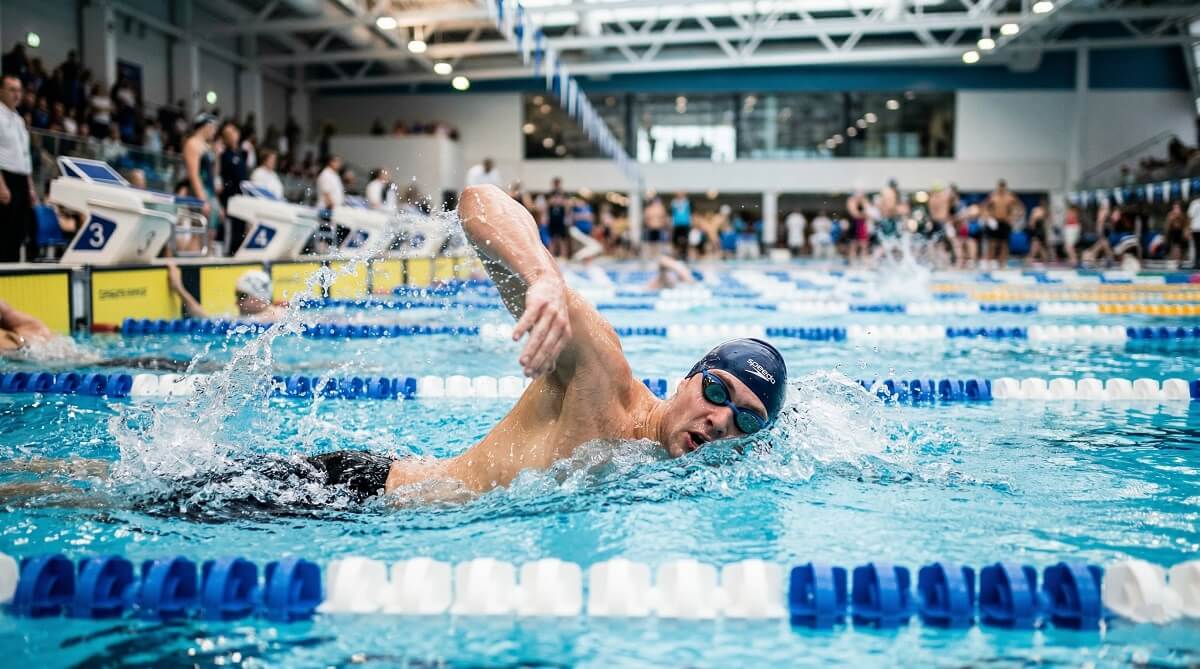
For most competitive swimmers, the Speedo Vanquisher 3.0 is the right starting point. It runs about $28–$32, seals reliably, adjusts easily even with wet hands, and is World Aquatics approved. If you want elite-tier anti-fog with serious race-day performance, the Arena Cobra Ultra Swipe at around $80 is the goggle you’ll see in nearly every A-final at a major meet — and can help you match other swim accessories to your kit once you’ve sorted goggles.
Performance goggles aren’t the same as fitness or lap-swimming goggles. They trade wide-angle comfort lenses for a lower, tighter profile that reduces drag and stays locked in place through flip turns and dive entries. The trade-off: a narrower peripheral view and a firmer seal that some swimmers find uncomfortable in training. Most serious competitors keep one pair for race day and a more comfortable set for practice sets.
If you’ve struggled to find a goggle that doesn’t leak regardless of how you adjust the nose piece, the TheMagic5 custom-fit option (around $65) is worth considering — the 3D face scan creates a gasket shaped to your actual face geometry, solving the fit problem at the source. Below, we break down the top options across price points and use cases.
Who Should (and Shouldn’t) Use Competition Goggles
Best For
- High school, club, college, and Masters swimmers who race regularly
- Triathletes doing pool-based speed work and open-water racing
- Lap swimmers who want a tight, reliable seal without foam cushioning
- Swimmers who need a World Aquatics-approved goggle for sanctioned meets
Skip If
- You swim casually once or twice a week and have no plans to race
- You have sensitive skin around the eyes (wider comfort goggles apply less direct pressure)
- You’ve tried several racing goggles and none seal — a custom-fit option may serve you better than another standard pair
- You’re still building basic water confidence as a newer swimmer
What Makes a Goggle “Competition Grade”
Racing goggles are built around a specific set of priorities that differ meaningfully from recreational designs. Understanding those priorities helps you pick the right pair — and avoid paying a premium for specs that don’t matter for your race distance or environment. typically miss this distinction, so it’s worth spending a minute on the fundamentals.
Low Profile Means Less Drag
The defining characteristic of a racing goggle is its narrow, close-fitting design. The lens sits flush against the eye socket rather than protruding forward, reducing the surface area pushing against the water. For sprint events where hydrodynamics matter most, this translates to a slight speed edge — and more importantly, a goggle that stays put through a dive start and doesn’t shift during underwater kicks.
The cost of that low profile is viewing angle. A racing goggle gives you a narrower sightline than an Aquasphere Kayenne or similar comfort model. Experienced racers adapt quickly; newer competitors sometimes find it disorienting through the first few sessions.
Seal Quality Is the Real Performance Metric
A goggle that leaks mid-race, regardless of how aerodynamic it is, is a failed goggle. Racing designs achieve their seal through a firm silicone or TPE (thermoplastic elastomer) gasket rather than the foam padding common in recreational models. Foam feels softer initially, but it compresses unevenly over time and doesn’t produce as repeatable a suction as silicone.
A solid seal shouldn’t require cranking the strap tight. If you’re tightening the band to stop leaking, the nose piece is likely the wrong size for your face — not a strap problem. That’s why adjustable nose bridges, offered on the Vanquisher 3.0, the Arena Cobra, and most serious racing goggles, matter as much as gasket material. for tips on fitting and caring for swim gear.
Nose Piece Adjustability
The nose bridge is the most under-appreciated fit element in a racing goggle. A nose piece that sits slightly off-center will allow water to seep in on one side regardless of strap tension. Most race-grade goggles come with 3–5 interchangeable bridges in small, medium, and large. Arena’s Cobra Ultra Swipe ships with five; the Vanquisher 3.0 comes with four slide-and-lock options. Take 10 minutes before your first pool session finding the right fit — that small investment pays off every race day after.
Top Competition Goggles Reviewed
Speedo Vanquisher 3.0 — Best All-Around Racing Goggle
Price: ~$28–$30 (clear) / $32.00 (mirrored) — check current pricing at Amazon or Dick’s Sporting Goods
In Wirecutter’s independent testing of more than 50 goggle pairs, the Vanquisher 3.0 earned the “best for competitive lap swimming” call — and the reasoning holds up. The slide-and-lock nose bridge adjusts cleanly across four sizes. Unlike the 2.0 predecessor (where Wirecutter testers worried about snapping the nose pieces), reviewers consistently report the 3.0’s bridge swaps easily even with wet hands. Speedo’s Ocular 360 mirrored lenses claim a 14% wider field of view compared to standard racing lenses, which partially offsets the narrow-profile trade-off.
The strap has a stretchy, secure feel that doesn’t drift down the back of the head during turns. “Even when my hands were wet, it was easy,” one Wirecutter tester noted. Fogging happens — anti-fog coatings degrade with use — but the standard fix (dunk and wipe with your thumb between sets) keeps it manageable through a full session. World Aquatics approved for sanctioned competition.
Trade-off: Narrower viewing angle than comfort goggles; some fogging reported with extended use.
Best for: Most competitive swimmers at high school, club, and Masters level. A solid, affordable race-day goggle.
Arena Cobra Ultra Swipe — Best Premium Racing Goggle
Price: ~$72–$80 — see current options on Amazon
According to SwimSwam’s competition goggle rankings, the Cobra Ultra Swipe is “perhaps the most balanced goggle on the market” and a fixture at elite-level A-finals. Its standout feature is the Swipe anti-fog system: when the inner lens clouds over, you swipe your fingertip across it five times while submerged to reactivate the coating. Arena’s official specs put effective anti-fog life at 10 times longer than conventional coatings — no chemicals, no spit, no removing the goggles from your face.
The build quality justifies the price: 70% polycarbonate lens, 20% silicone gaskets, 10% TPE, manufactured in Japan. Five interchangeable nose bridges accommodate a wider range of face widths than most competitors. Semi-rigid temples keep the frame stable through dive entries and quick turns. The 4.6-star average across 242 reviews on SwimOutlet reflects consistent satisfaction with both fit and anti-fog longevity.
Trade-off: At $80, it’s nearly three times the cost of the Vanquisher 3.0. Unless you race regularly at a serious level, it may be more goggle than you need.
Best for: Dedicated club, college, and elite swimmers who compete frequently and want anti-fog that holds up through an entire race session.
Speedo Fastskin Hyper Elite — Best High-End Speedo for Elite Competition
Price: $58.50–$88.00 depending on colorway — check Amazon or Speedo’s official site
Speedo’s Fastskin Hyper Elite is the brand’s top-tier race-day goggle, developed alongside world-class athletes and approved by World Aquatics for sanctioned competition. Caeleb Dressel — multiple international gold medalist — wore Speedo Speed Sockets at major meets and now also has a Fastskin signature variant. The Hyper Elite’s IQfit seal is engineered to reduce the deep pressure marks that signal too much suction, a real concern for swimmers wearing tight-fitting goggles across a warm-up session and several race heats in a single day.
The hybrid nose bridge delivers a more precise fit than the slide-and-lock systems on mid-tier models. Mirror hydroscopic lenses reduce glare in both indoor and outdoor settings. Stock rotates by color — some colorways sell out ahead of major competition seasons, so ordering early pays off. on ChubbytIps for other Speedo and Arena performance accessories.
Trade-off: Expensive. Less forgiving on atypical face shapes than a custom-fit option.
Best for: High school varsity, collegiate, and competitive Masters swimmers who train and race at high volume.
Speedo Vanquisher 2.0 Mirrored — Best Budget Competition Pick
Price: $28–$34 depending on color — available on Amazon
Swimmers who want mirrored lenses without paying the 3.0’s price will find the Vanquisher 2.0 Mirrored still performs at race level. It predates the improved nose piece design on the 3.0 — the interchangeable bridges require more care to swap without breaking — but once properly fitted, it seals reliably and holds position through turns. The 13+ color options are useful for clubs with specific team color requirements.
Trade-off: The nose piece swap is less smooth than the 3.0. The strap has marginally less stretch.
Best for: Swimmers who want a lower-cost entry into mirrored racing goggles and don’t mind a bit more time on the initial fit.
TheMagic5 Custom — Best for Non-Standard Fit
Price: Approximately $65 — order at themagic5.com (verify current USD pricing at checkout)
TheMagic5 approaches goggle fitting from a completely different direction. Download their app, scan your face with your smartphone camera, and receive custom-built goggles with a gasket shaped to your exact facial geometry. The scan takes around three minutes; standard US shipping from their New York facility runs six days, with an express option at three. They back the fit with a 100% guarantee — if the seal isn’t right, they’ll review your scan data and either correct it or issue a full refund.
Olympic triathlete Jan Frodeno and competitive swimmer Matt Grevers have endorsed TheMagic5, and GearJunkie’s 2026 independent review gave it an 8.0/10, noting the custom fit and low profile as standout qualities. Wirecutter tested an earlier non-custom version and found more leakage than their other picks, though they attributed part of this to the nose piece adjustment system on that particular variant.
Trade-off: Lead time — not available same-day; requires smartphone for ordering; premium price.
Best for: Swimmers who’ve cycled through multiple pairs trying to solve a persistent leaking problem and need a gasket fitted to their specific face geometry.
Competition Goggles Comparison Table
| Model | Price (USD) | Profile | Nose Bridges | Anti-Fog | World Aquatics | Best For |
|---|---|---|---|---|---|---|
| Speedo Vanquisher 3.0 Mirrored | $32 | Low | 4 (slide-lock) | Standard coating | Yes | Best all-around value |
| Arena Cobra Ultra Swipe Mirror | ~$80 | Ultra-low | 5 interchangeable | Swipe tech (10x longer) | Yes | Elite racing, anti-fog priority |
| Speedo Fastskin Hyper Elite | $58–$88 | Ultra-low | Hybrid bridge | Mirror hydroscopic | Yes | High-level competition |
| Speedo Vanquisher 2.0 Mirrored | $28–$34 | Low | Interchangeable | Standard coating | Yes | Budget mirrored option |
| TheMagic5 Custom | ~$65 | Low-medium | Custom 3D scan | Premium coating | Check site | Fit-first / non-standard faces |
Prices sourced from SwimOutlet.com and major retailers, March 2026. Check current pricing before buying — competition goggle prices shift around major meet seasons.
Choosing the Right Lens for Your Racing Environment
Lens color affects how clearly you see lane lines, the wall, and the pace clock during competition — it’s not purely cosmetic. Wirecutter’s testing across indoor and outdoor settings produced consistent findings on which tints work where.
Indoor Competition Pools
Clear or light-blue lenses perform best under overhead LED or fluorescent lighting. They pass more light through to the eye, improving contrast and making it easier to track the black-line lane markers at the bottom. Darker mirrored lenses that look sharp outdoors can leave you squinting at the wall in a dim natatorium. For indoor meets, clear or lightly tinted is the dependable call.
Outdoor and Open-Water Competition
Mirrored or gray-tinted lenses cut glare significantly in direct sunlight. For triathletes racing in open water, a mirrored or blue-tinted lens also softens the reflection off the water’s surface, making navigation easier without straining your eyes. on ChubbytIps cover open-water training accessories and triathlon-specific equipment.
Early Morning and Low-Light Training
Yellow and amber lenses raise contrast when ambient light is poor, making them useful for pre-dawn practice or overcast outdoor sessions. They’re rarely the right lens for competition itself, but worth keeping in your bag if your training schedule starts before sunrise.
How Long Do Competition Goggles Last?
Shorter than most athletes expect. Kevin Long, general manager of Physique Swimming in New York City, told Wirecutter: “If you are a regular swimmer, you might need to replace your goggles every four to six months. Chlorine tends to wear down the soft materials, which can lead to an improper seal.” Swimmers training twice daily during a competition season hit the low end of that range.
Clear warning signs: the gasket stops creating suction even after nose piece adjustments, the band has gone slack and doesn’t hold position, or the lenses have developed a permanent haze that doesn’t clear between sessions. Replace at that point rather than racing in compromised equipment.
To push lifespan further, rinse with fresh water after every swim to clear out chlorine before it degrades the silicone. Store in a hard case — the Arena Cobra Ultra Swipe and most Fastskin models ship with one. Skip the fabric wipe on the inner lens surface; it strips the anti-fog coating faster than anything else. on ChubbytIps cover maintenance routines that extend the life of goggles, caps, and training suits.
Anti-Fog: What Actually Works
Factory anti-fog coatings degrade with use, water exposure, and age — there’s no avoiding it. NYU head swim coach Trevor Miele, speaking to Wirecutter, sums it up directly: “Just take them off between sets and use your thumbs to get rid of the fog.” Briefly dunking the goggles in the water before putting them on also helps. Running a cloth or towel across the inner lens accelerates coating loss — avoid it.
Arena’s Swipe technology offers a more durable fix. Swiping the inner lens with your fingertip five times while submerged mechanically reactivates the coating rather than waiting for it to clear. Arena’s data puts effective anti-fog life at 10 times longer than standard coatings — which holds up through a full training session or multi-heat competition day. For swimmers who consistently battle fogging during warm-up, the Cobra Ultra Swipe is the most direct solution short of keeping a fresh backup pair.
Dedicated anti-fog spray — TheMagic5 sells one, and several third-party options are available — extends coating life on standard models. Home remedies like saliva or diluted baby shampoo are unreliable and can damage the coating over time.
Frequently Asked Questions
What’s the difference between competition goggles and regular swim goggles?
Racing goggles use a low-profile, narrow-frame design that sits flush against the eye socket to reduce drag. Recreational goggles have wider, cushioned lenses with more padding for comfort during long casual swims. The trade-off with race-day goggles is a narrower sightline and a firmer seal that takes some adjustment — but they stay put through dive starts and flip turns far better than comfort models.
Do I need different goggles for practice versus race day?
Many competitive swimmers keep a more comfortable pair for long training sets and save their racing goggles for meets. Two benefits: the meet pair keeps a fresher anti-fog coating, and you avoid eye fatigue that a tight-fitting goggle can cause over hours of practice. It’s not mandatory, but coaches at the club and college level commonly recommend it. for training gear that pairs well with competition equipment.
What goggles do Olympic swimmers use?
Goggle selection at the elite level is largely tied to brand sponsorship. Caeleb Dressel competed in Speedo Speed Socket 2.0 goggles at major international meets; Speedo’s Fastskin Hyper Elite is worn by multiple world-record holders. The Arena Cobra Ultra series appears in the majority of elite A-finals globally, according to SwimSwam’s competition reporting. The podium isn’t wearing a single brand — sponsorships spread across Speedo, Arena, TYR, and others.
How do I stop my goggles from fogging during a race?
The most dependable fix before your heat: dunk the goggles in the water and wipe the inner lens with your thumb — not a towel, which removes the coating. Minimize touching the inside lens surface otherwise, since skin oils accelerate degradation. If fogging is a recurring problem, the Arena Cobra Ultra Swipe handles it mechanically with its reactivatable coating. Anti-fog spray applied before the session helps extend the coating on standard models.
What lens color is best for indoor competition pools?
Clear or light-blue lenses are the standard pick for indoor natatoriums. Overhead LED and fluorescent lighting reduces ambient light compared to outdoor conditions, and darker mirrored lenses cut visibility further. Save the mirrored pair for outdoor swims where sun glare is the primary challenge.
Are custom-fit goggles worth it for competition?
If you’ve tried several pairs and can’t eliminate leaking regardless of nose piece adjustment, yes. TheMagic5’s 3D face scan creates a gasket matched to your specific facial geometry, solving the fit problem at the source. For most swimmers with typical face proportions, a properly sized standard goggle works well and costs considerably less.
How tight should competition goggles be?
Tight enough to hold a seal, not tight enough to cause pain. A well-fitted goggle stays in place when you press it lightly against your eyes and release — that suction is the seal. If you’re tightening the strap hard to stop leaking, the nose bridge is probably the wrong size. Change the nose piece first before adjusting strap tension.
Can competition goggles be used for open-water triathlon swims?
Yes, with one practical caveat. Low-profile racing goggles provide a strong seal and minimize drag, both useful in open water. Their narrower viewing angle does make sighting buoys harder — open-water racing requires frequent head lifts, and a tight racing field of view adds difficulty. Many triathletes opt for a slightly larger-frame goggle for open-water legs and reserve the true racing model for pool time.
When should I replace my competition goggles?
Every 4–6 months for regular swimmers (four-plus sessions per week). Key signals: persistent leaking that nose piece swaps don’t fix, permanent fogging between sessions, cracked gaskets, or a strap that’s lost its spring. Rinsing with fresh water after every swim is the single most effective step for extending that window.
Competition goggle prices shift around major meet seasons, so verify current pricing before buying. The Speedo Vanquisher 3.0 is available on Amazon and Dick’s Sporting Goods. The Arena Cobra Ultra Swipe can be found on Amazon and at specialty retailers like SwimOutlet.com. For the Speedo Fastskin Hyper Elite, Speedo’s official site has the full colorway selection and current stock status. on ChubbytIps for swim training gear, fitness accessories, and equipment comparisons.
