


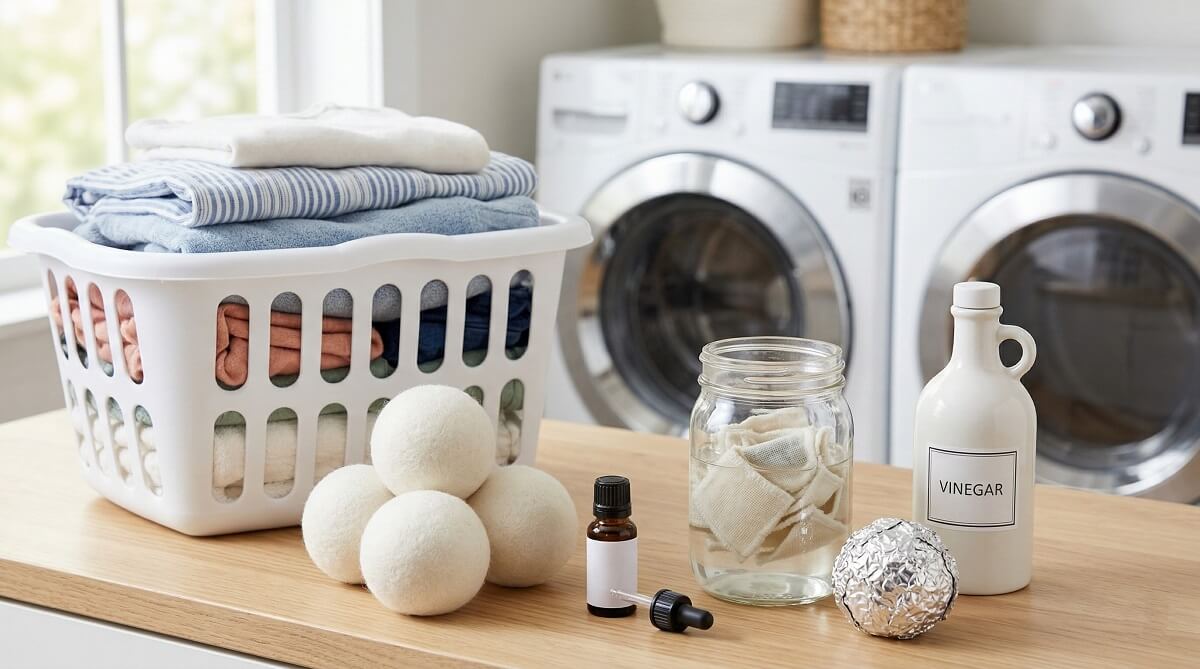
If you’re looking for a straight answer: wool dryer balls are the best all-around replacement. They soften clothes, cut drying time by 14–25% according to independent testing, and a 6-pack costs around $22 and lasts up to 1,000 loads. If static is your only concern and you want zero cost, a ball of aluminum foil handles it just fine. For scent, a few drops of essential oil on a damp cloth—tossed in for the last 10 minutes of the cycle—does the job for about a penny per use. If you’re new to reducing your laundry product footprint, our cover a range of home product swaps worth considering.
Most people start looking for substitutes because dryer sheets leave a waxy residue on clothes, reduce towel absorbency over time, and clog the lint filter. There’s also growing concern about what they emit: a University of Washington study found that scented laundry products release more than 25 volatile organic compounds (VOCs) from dryer vents, including acetaldehyde and benzene, which the EPA classifies as carcinogens with no established safe exposure level.
One thing worth knowing upfront: no single swap does everything a dryer sheet does. Some handle static, some add softness, some add scent—and a few do more than one. The breakdown below matches each option to what it actually delivers, so you can pick what fits your laundry routine.
Who Should (and Shouldn’t) Switch Away From Dryer Sheets
✅ A Good Fit If You:
- Have sensitive skin or allergies to fragrance or fabric softener chemicals
- Wash a lot of athletic or moisture-wicking clothing (dryer sheet residue clogs synthetic fibers)
- Want to reduce single-use waste or cut recurring laundry costs
- Prefer unscented laundry or want to choose your own scent
- Care about what’s going into the air through your dryer vent
❌ Stick With Dryer Sheets If You:
- Love a specific branded scent and essential oils haven’t scratched that itch
- Dry heavy loads of synthetic fabrics with severe static problems (may still benefit from occasional sheets)
- Want the simplest possible laundry routine with zero setup
Why People Stop Using Dryer Sheets
What’s Actually in a Dryer Sheet?
Dryer sheets work by releasing a coating of stearic (fatty) acid and chemical fragrances as they heat up. That coating gives garments a temporary smoothness that feels like softness—but it isn’t actually conditioning the fibers. According to the Environmental Working Group, dryer sheets contain quaternary ammonium compounds (QACs), which have been shown to cause or worsen asthma and skin irritation in some people.
More concerning: a peer-reviewed study from the University of Washington found that dryer vents release more than 25 VOCs during a single cycle when scented laundry products are used. Seven of those compounds are classified as hazardous air pollutants by the EPA, and two—acetaldehyde and benzene—are listed as carcinogens with no established safe exposure level. These emissions are largely unregulated.
The Residue Problem
That fatty coating doesn’t just stay on your clothes. Over repeated cycles, it builds up inside the dryer drum and clogs the mesh of your lint filter. A clogged lint screen reduces airflow, extends drying time, and—because the residue is flammable—raises fire risk. The same residue makes towels less absorbent over time, since it coats the terry fibers that are supposed to soak up water. If you’ve ever noticed your workout clothes starting to smell even when freshly washed, dryer sheet buildup on synthetic fabrics is a common cause.
The 7 Best Dryer Sheet Alternatives
1. Wool Dryer Balls — Best All-Around Replacement
Wool dryer balls are the most practical swap for most households. They work by physically separating your laundry as the drum spins, which allows warm air to circulate more evenly. That separation cuts drying time: independent testing by Prudent Reviews showed a 14% reduction in a controlled 10-load experiment, while the David Suzuki Foundation cites up to 25% in some conditions. The physical tumbling also gently beats fibers soft without any chemical coating. Browse our for more tested home essentials.
Use 3 balls for small and medium loads, and 5–6 for large ones, according to Smart Sheep’s usage guidelines. A 6-pack from Smart Sheep runs $21.95 direct from their site and is rated to last up to 1,000 loads—roughly three years of daily use. To add a scent, drop 2–3 drops of essential oil directly onto a ball before starting the cycle. Good choices: lavender, lemon, eucalyptus. Stay away from dryer balls with raised spikes—they can snag knits and delicate fabrics.
Handles: Static ✅ | Softening ✅ | Scent (with oils) ✅ | Reusable ✅
Best for: Cotton, towels, bedding, everyday laundry
2. Aluminum Foil Balls — Best Free Option
Tearing off 3–4 square feet of aluminum foil and compressing it into a tight 2–3 inch ball is genuinely useful—specifically for static cling. As clothes tumble, they exchange electrons and build up opposite electrical charges. Aluminum acts as a conductor that keeps the negatively and positively charged items from clinging together. The result: no static, at no cost.
Tuck in any sharp edges before tossing it in. The ball smooths out after a few loads as it gets compacted from bouncing around—that’s normal, and it won’t snag clothes. You can reuse it for around a year before replacing it (then recycle it). One downside: it does nothing for softening or scent, so if those matter, pair it with vinegar in the wash.
Handles: Static ✅ | Softening ❌ | Scent ❌ | Reusable ✅ (~1 year)
Best for: Static-heavy loads, budget-conscious households, quick fix when you’re out of everything else
3. White Vinegar in the Wash — Best for Softening
White distilled vinegar softens laundry by breaking down mineral deposits and soap residue that stiffen fibers. Pour 1/4 cup into the fabric softener dispenser and run your normal cycle—it goes in during the rinse, so the smell rinses out completely before your clothes go in the dryer. You won’t smell it on your clothes.
Vinegar also brightens whites, neutralizes odors, and dissolves detergent buildup. One thing it won’t do is reduce static in the dryer—that’s a separate problem. If static is an issue, combine vinegar in the wash with a wool dryer ball or aluminum foil ball in the dryer. Avoid using vinegar with bleach (the combination produces chlorine gas).
Handles: Static ❌ | Softening ✅ | Scent (neutral/deodorizing) ✅ | Reusable N/A
Best for: Towels, cotton sheets, removing detergent buildup, sensitive skin
Cost: About $0.05 per load
4. Baking Soda in the Wash — Best for Odors and Stiffness
Add 1/2 cup of baking soda directly to your washing machine’s drum along with your regular detergent. It works as a natural suspension agent, keeping detergent and water minerals from redepositing onto fabric—which is what makes clothes feel stiff and cardboard-like after drying. It’s also an effective deodorizer, which makes it useful for gym clothes, kids’ laundry, or anything that picks up persistent smells.
Baking soda won’t significantly reduce static in the dryer, and it’s not a substitute for a fabric softener in terms of feel. Think of it as a wash booster that gets clothes cleaner and less stiff, rather than a direct replacement for what dryer sheets do. Cost: pennies per load.
Handles: Static ❌ | Softening (partial) ✅ | Scent (deodorizing) ✅ | Reusable N/A
Best for: Odor-heavy loads, stiff fabrics, gym clothes, kids’ laundry
Cost: About $0.04 per load
5. Essential Oil on a Damp Cloth — Best for Adding Scent
This is one of the cheapest and most customizable options on the list. Dampen a clean cotton cloth or dish towel with water, add 3–5 drops of your preferred essential oil, and toss it into the dryer with your laundry during the last 10–15 minutes of the drying cycle. Adding it toward the end prevents the heat from evaporating the oil too quickly. Make sure the cloth is damp, not dripping—excess moisture can leave oil spots on clothes.
The cloth is reusable: rinse it and re-soak before each use. According to Homes and Gardens, a cleaning expert at Spekless recommends this method and notes it can scent clothes with lasting notes for about a penny per use. Good scent choices: lavender, geranium, lemon, bergamot, or eucalyptus.
Handles: Static ❌ | Softening ❌ | Scent ✅ | Reusable ✅
Best for: Anyone who switches to wool dryer balls but misses the fresh-laundry smell
Cost: ~$0.01 per use
6. DIY Reusable Dryer Sheets — Best Tactile Substitute
Cut any old cotton fabric (worn-out t-shirts work well) into roughly 5×5 inch squares. Place them in a jar with enough white vinegar to make them damp but not soaked. Add a few drops of essential oil if you want scent. Before each load, wring one out and toss it in the dryer with your laundry. The result: a reusable sheet that releases a little vinegar (softening effect) and scent as it tumbles.
These won’t dramatically reduce static on their own, but they’re an easy way to avoid buying disposable products while keeping a familiar habit. Store the unused squares in the sealed jar and re-wet them as needed.
Handles: Static (partial) ✅ | Softening (partial) ✅ | Scent ✅ | Reusable ✅
Best for: People who want a familiar sheet format without the chemicals
Cost: ~$0.02 per use (vinegar + oil only)
7. Hang Drying / Air Drying — Best for Delicates and the Environment
Static cling is a dryer problem—it happens when dry air and tumbling build up electrical charge in fabric. Air-dried clothes don’t go through that process, so there’s no static to deal with. This is especially valuable for synthetic fabrics like polyester and nylon, which generate more static than cotton and don’t tolerate high heat well anyway. Air drying also extends garment life significantly, since heat and tumbling break down fibers over time.
You don’t need to air dry everything. Hanging synthetics and delicates while machine-drying towels and cotton is a common approach. A drying rack or a length of paracord strung in a utility room is enough to get started. No cost, no chemicals, and clothes tend to maintain their shape longer.
Handles: Static ✅ (avoids it entirely) | Softening N/A | Scent N/A | Reusable N/A
Best for: Activewear, delicates, knits, anyone reducing dryer use
Cost: Free
Side-by-Side Comparison
| Alternative | Reduces Static | Softens Clothes | Adds Scent | Reusable | Estimated Cost |
|---|---|---|---|---|---|
| Wool dryer balls | ✅ Yes | ✅ Yes | With oils | ✅ ~1,000 loads | ~$22 for 6-pack |
| Aluminum foil ball | ✅ Yes | ❌ No | ❌ No | ✅ ~1 year | Free |
| White vinegar | Partial | ✅ Yes | Neutral/deodorizes | N/A | ~$0.05/load |
| Baking soda | ❌ No | Partial | Deodorizes | N/A | ~$0.04/load |
| Essential oil + damp cloth | ❌ No | ❌ No | ✅ Yes | ✅ Yes | ~$0.01/use |
| DIY reusable sheets | Partial | Partial | ✅ Yes | ✅ Yes | ~$0.02/use |
| Air drying | ✅ Avoids it | N/A | N/A | N/A | Free |
Which One Should You Use?
The right swap depends on what you’re actually trying to solve:
- Static cling is your main problem: Start with a wool dryer ball (3 for regular loads). If the static is still bad, add an aluminum foil ball to the same load and make sure you’re not over-drying—static gets worse when clothes are bone dry.
- Towels feel rough: Add 1/4 cup white vinegar to the fabric softener dispenser in the wash cycle. Do this consistently and you’ll notice a difference within a few loads.
- Gym clothes smell even when clean: Stop using dryer sheets on activewear immediately—residue clogs the moisture-wicking fibers and traps odor. Switch to wool balls and add baking soda to the wash.
- You want that fresh-laundry scent: Try the essential oil cloth method. A damp cloth with 3–5 drops of lavender or lemon, added in the last 10 minutes, gives a subtle, lasting scent without synthetic fragrance chemicals.
- Sensitive skin: Unscented wool dryer balls are your best option. No fragrance, no QACs, no residue on skin-contact fabrics.
If you’re also looking to rethink your full laundry routine, our cover more practical home tips on everything from cleaning to organization.
Tips for Keeping Static Under Control
Static builds up when synthetic fibers rub together in a dry environment. A few habits help reduce it regardless of which dryer alternative you use:
- Don’t over-dry. Pull clothes out while they’re still slightly damp. The more bone-dry the load, the more static you’ll get. With wool dryer balls reducing your cycle time, this is easier to manage.
- Keep the lint filter clean. A clogged filter reduces airflow and extends drying time, which worsens static. If you’ve been using dryer sheets for years, the filter screen may have a coating—rinse it with warm water and a soft brush to remove the film.
- Separate natural and synthetic fabrics. Synthetics generate more charge. Drying them separately from cotton reduces how much static transfers.
- Try a safety pin on a wool ball. An old hack: pin a metal safety pin to one of your wool dryer balls. The metal grounds some of the static charge. It sounds odd, but it works.
- Low-heat setting. High heat increases static. Dropping to medium heat—especially for synthetic loads—can help.
Frequently Asked Questions
What is the best replacement for dryer sheets?
Wool dryer balls are the most versatile replacement. They reduce drying time, soften clothes naturally, and last for hundreds of loads. If you also want scent, add 2–3 drops of essential oil to each ball before the cycle. For static-only issues with no budget, an aluminum foil ball works well.
Do wool dryer balls really reduce static?
They help, but results vary. In independent testing by Prudent Reviews, static went from an average of 4 instances per load to 3—a modest improvement. They’re more effective at softening and reducing drying time than eliminating static. For heavy static loads (lots of synthetics in dry weather), an aluminum foil ball may work better for that specific problem.
How do aluminum foil balls work in the dryer?
As clothes tumble, they exchange electrons and build up opposite electrical charges. Aluminum conducts electricity, which helps equalize those charges and reduces the attraction between positively and negatively charged pieces of fabric. The result is less cling. To make one: pull off 3–4 square feet of foil, compress it tightly into a 2–3 inch ball, and tuck in any sharp edges.
Can I use vinegar in the dryer instead of a dryer sheet?
Don’t add vinegar directly to the dryer—it goes in the wash. Pour 1/4 cup of white distilled vinegar into the fabric softener dispenser before starting your wash cycle. It rinses out during the cycle, so there’s no vinegar smell on your dry clothes. Vinegar softens fabrics and removes residue but doesn’t address static in the dryer.
Are dryer sheets actually harmful?
Research suggests some genuine concern. A University of Washington study found dryer vents emit more than 25 VOCs from scented laundry products during a cycle; seven are classified as hazardous air pollutants by the EPA, and two—acetaldehyde and benzene—are carcinogens with no established safe exposure level. The Environmental Working Group also flags quaternary ammonium compounds (QACs) in dryer sheets as potential asthma and skin irritation triggers. Whether that rises to “harmful” in typical household use is debated, but the residue effects on towels, lint filters, and activewear are real and well-documented.
How many wool dryer balls do I need per load?
Use 3 for small and medium loads, and 5–6 for large loads. More balls means better separation of laundry and more contact with fabric. With fewer than 3, you lose most of the benefit. Smart Sheep, one of the leading brands, recommends this range on their official packaging.
Can I make my own dryer sheets at home?
Yes—cut old cotton fabric (t-shirt scraps work great) into roughly 5×5 inch squares. Soak them in white vinegar with a few drops of essential oil. Before each load, wring one out and toss it in. They’re reusable indefinitely and cost almost nothing per use. They provide a mild softening and scent effect, but won’t eliminate static on their own. For more DIY home solutions, check out our .
Do any dryer sheet alternatives work on synthetic fabrics?
Wool dryer balls work on all fabrics, including synthetics, and produce no chemical residue. Air drying is the top approach for synthetics prone to static, since the problem happens in the dryer drum. Avoid dryer sheets and DIY sheets with vinegar on moisture-wicking activewear—both can leave residue that traps odor over time.
Ready to make the switch? Check the current price of Smart Sheep Wool Dryer Balls on Amazon or visit Smart Sheep’s official site directly. If you prefer to start with zero investment, grab a sheet of aluminum foil from your kitchen drawer and give it one load—you might be surprised.
