


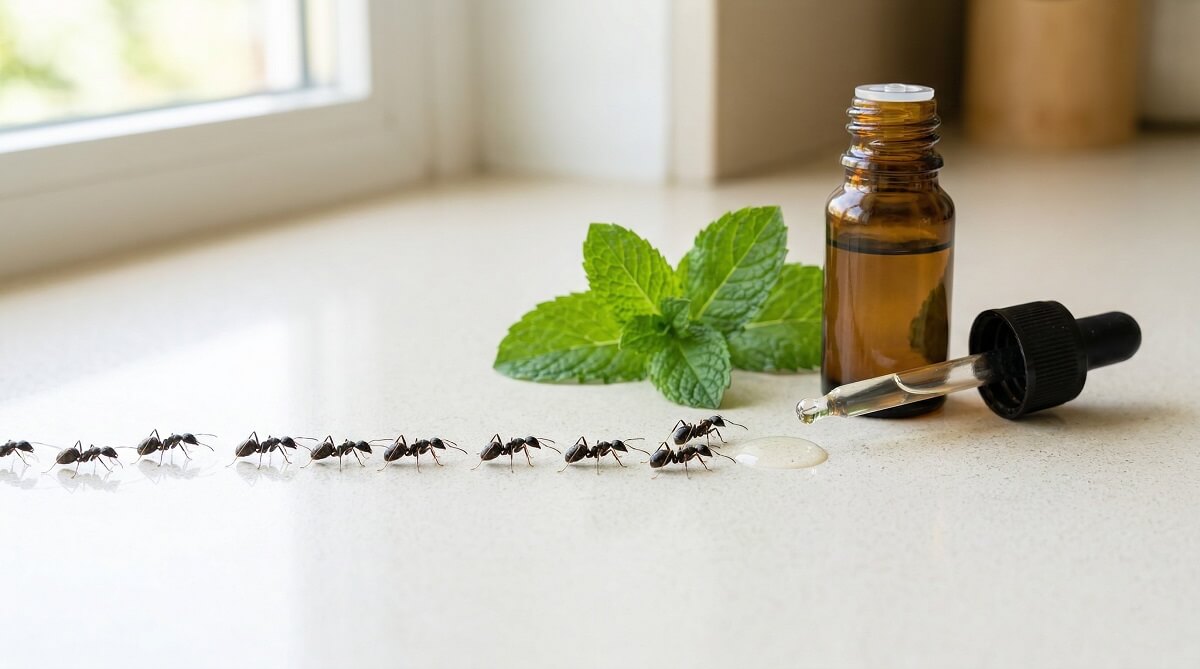
Yes — peppermint oil repels many common ant species. The strong, volatile scent of menthol overwhelms the pheromone trails ants use to navigate, leaving foragers disoriented and unable to follow each other back to food. For small ant incursions — a trail crossing the kitchen counter, a handful of scouts around the window frame — peppermint spray or cotton balls at entry points can clear the problem quickly without reaching for chemical sprays.
The catch: peppermint is a deterrent, not a colony eliminator. It doesn’t kill ants underground, and the scent fades within a few days, so you’ll need to reapply consistently. Think of it as a “keep out” sign rather than an exterminator. If the infestation has been building for weeks, or if you’re dealing with carpenter ants in structural wood or fire ants in the yard, .
The species also matters. Peer-reviewed studies confirm strong repellency against Argentine ants, European red ants, and pavement ants. Evidence against fire ants exists but requires high concentrations that DIY sprays rarely hit. Carpenter ants? Peppermint has minimal documented effect. We’ll cover all of this — including a pet safety note most articles skip over.
Should You Use Peppermint for Your Ant Problem?
✅ Good Fit If:
- You have a minor ant trail — not a full-blown infestation
- You’re dealing with odorous house ants, Argentine ants, or pavement ants
- You want a non-toxic, plant-based first response
- You don’t have cats (see pet safety section below)
- You’re open to reapplying every 2–4 days to maintain effectiveness
❌ Skip Peppermint and Try Something Stronger If:
- Carpenter ants are chewing through wood in your walls or deck
- You have a fire ant mound in the yard
- The trail has been active for more than a week despite treatment
- You have cats — peppermint essential oil is genuinely toxic to them
- Ants are coming from multiple entry points or inside walls
Why Peppermint Messes with Ants
Ants are almost entirely dependent on chemical communication. Scout ants leave invisible pheromone trails on surfaces — tiny scent roads that foragers follow back to food. Remove or mask those trails, and the whole operation breaks down.
Menthol, peppermint oil’s primary active compound, is both highly volatile and intensely aromatic. When applied to surfaces, it floods the area with a scent so overpowering it effectively drowns out the ants’ pheromone messages. Foragers can’t follow their own routes, scouts can’t lead others back to the colony, and the trail collapses.
It’s Temporary by Design
Here’s the honest part: menthol evaporates fast. That same volatility that makes it so effective at disruption also means the effect fades within days. The colony is still alive underground. Ants will reroute, reestablish trails, and test entry points again — which is why consistent reapplication matters as much as the initial spray.
Which Ant Species Does Peppermint Work On?
Not all ants respond the same way. Here’s a quick reference based on current research:
| Ant Species | Common Locations | Peppermint Effectiveness | Notes |
|---|---|---|---|
| Odorous House Ant | Kitchen, bathrooms, under sinks | ✅ Good deterrent | Most common indoor ant; responds well to trail disruption |
| Argentine Ant | Southern and Pacific Coast US, warm climates | ✅ Effective (lab-confirmed) | 1% peppermint solution was the top performer in a 2024 PMC study |
| Pavement Ant | Driveways, sidewalk cracks, baseboard perimeter | ✅ Solid option | Responds to scent barriers at entry points |
| European Red Ant (Myrmica rubra) | Gardens, nurseries, outdoor planters | ✅ Strong (field-confirmed) | Repelled for full 15-week field trial per 2020 Journal of Economic Entomology study |
| Pharaoh Ant | Apartments, heated buildings, hospitals | ⚠️ Use caution | Pharaoh ants can “bud” — split the colony when stressed; repellents may worsen the problem |
| Carpenter Ant | Moist wood, walls, decks, outdoor lumber | ❌ Minimal effect | If carpenter ants are present, seek professional inspection — structural damage risk is real |
| Fire Ant (Red Imported) | Outdoor mounds, lawns, pastures | ⚠️ High concentration only | 100% mound abandonment seen in field with commercial mint oil granules (2004 study), but DIY sprays rarely hit those concentrations |
Three Ways to Use Peppermint Oil for Ants
The method you choose depends on where the problem is and how persistent you want the barrier to be. All three approaches use 100% pure peppermint essential oil — not grocery-store extract (more on that distinction in a moment).
Method 1: DIY Spray (Best for Active Trails)
Mix 15 drops of peppermint essential oil with 2 cups of water in a spray bottle. Shake before each use — the oil and water separate quickly.
Before spraying: Wipe existing ant trails with a vinegar-water solution (equal parts). This removes the pheromone residue first. Then mist the peppermint spray along baseboards, windowsills, door frames, and any crack or gap ants are using to get in. Reapply every 2–4 days, or after cleaning those surfaces.
Method 2: Cotton Balls at Entry Points (Best for Targeted Blocking)
Soak cotton balls in undiluted peppermint essential oil — about 3–5 drops per ball. Tuck them into corners, cabinet gaps, spaces around plumbing pipes, and any visible crack near ant access points. Replace them every 5–7 days as the scent dissipates.
This method delivers higher menthol concentration at specific weak spots without spraying your entire floor. Good for kitchens where you don’t want residue on cooking surfaces.
Method 3: Peppermint Plant at the Perimeter (Passive Prevention)
Growing peppermint or spearmint near foundation entry points, garden borders, or along the base of the house provides a milder, ongoing deterrent. The plant releases menthol continuously but at lower concentration than oil. Better as a long-term prevention measure once an active infestation is under control.
One practical note: mint spreads aggressively. Plant it in containers rather than directly in garden beds unless you want it taking over.
One ready-made option to consider: Mighty Mint Peppermint Oil Ant Killer Spray — a pre-mixed plant-based formula with peppermint oil and geraniol, available in a 16 oz trigger bottle for $19.99 (price as of March 2026, check current pricing). The manufacturer recommends applying it directly to ants on contact and spraying entry points twice per week as a repellent. Check current pricing at Amazon or directly at Mighty Mint’s website.
The Real Limitations of Peppermint as Ant Control
Being straight with you here — most articles oversell peppermint. Here’s what it actually can’t do:
- It doesn’t kill the colony. Underground workers, the queen, and eggs are completely untouched. Peppermint keeps ants from entering treated zones; it doesn’t eliminate the source. The colony adapts and finds another route.
- The scent fades fast. Menthol is highly volatile — that’s why it hits so hard initially. But within 2–4 days, the concentration drops below the threshold that disrupts pheromone trails. Without consistent reapplication, ants return.
- It redirects, it doesn’t stop. Block the front door, and they’ll test the kitchen window. Block enough entry points simultaneously and you may win the battle for a few weeks, but a large enough colony will find a gap.
- Peppermint extract ≠ essential oil. The McCormick peppermint extract in your spice cabinet is water and alcohol with a small amount of peppermint flavoring — it doesn’t contain meaningful menthol concentration. For this to work, you need 100% pure peppermint essential oil from a health food store or online.
Pet Safety: Don’t Skip This If You Have Cats
Peppermint oil is toxic to cats — and this isn’t a minor inconvenience, it’s a real health risk. Cats lack a liver enzyme called glucuronyl transferase, which is essential for metabolizing phenols. Peppermint oil is rich in phenolic compounds, and without that enzyme, cats can’t safely process even small amounts.
According to the Pet Poison Helpline, exposure to peppermint oil in cats can cause drooling, vomiting, tremors, unsteady walking (ataxia), respiratory distress, low heart rate, and in severe cases, liver failure. Skin contact and diffuser inhalation both carry risk — active ultrasonic and nebulizing diffusers emit oil microdroplets that settle on fur and get ingested during grooming.
If you have cats: Keep them out of rooms where peppermint oil was applied until surfaces are completely dry. Avoid cotton balls in spots cats frequent. Don’t run a peppermint oil diffuser in spaces your cat occupies. If you suspect exposure, call the ASPCA Animal Poison Control at (888) 426-4435 or your vet immediately.
Dogs are generally less sensitive to peppermint, but high concentrations or direct ingestion can cause GI upset. If you have dogs, keep treated surfaces out of their licking range.
When Peppermint Isn’t the Right Tool
If peppermint hasn’t reduced activity after a week of consistent treatment, the infestation is likely too established for surface deterrents alone. Here are the tools that actually eliminate colonies:
Boric Acid Bait Stations
Forager ants carry boric acid back to the colony and feed it to workers and the queen. It’s a slow poison — which is exactly what makes it effective. A quick-kill poison that foragers avoid won’t reach the colony. Boric acid bait stations are available at most hardware stores and are one of the most reliable non-professional options for persistent infestations.
Diatomaceous Earth
Food-grade diatomaceous earth (DE) is a physical barrier made from fossilized algae. It damages insects’ exoskeletons and kills by dehydration. Apply it along baseboards, around the perimeter of the foundation, and at confirmed ant gaps and cracks. It’s pet- and kid-safe when dry, and it doesn’t lose effectiveness over time the way essential oils do.
Professional Pest Control
For carpenter ants in structural wood, fire ant mounds, or any infestation that’s been active for more than a couple of weeks, a licensed exterminator is the practical choice. They can identify the species precisely, locate the colony source, and apply targeted treatment that surface repellents can’t reach.
Check current prices on boric acid bait stations at Amazon or at your local Home Depot or Lowe’s.
Frequently Asked Questions
Does peppermint repel ants permanently?
No. Peppermint deters ants temporarily by masking pheromone trails — the effect fades within a few days as the menthol evaporates. You need to reapply consistently (every 2–4 days) and address the underlying colony to get lasting results. Peppermint works best as an ongoing deterrent alongside other methods, not as a one-time fix.
How many drops of peppermint oil should I use for ants?
For a spray: 15 drops of pure peppermint essential oil per 2 cups of water. For cotton balls: 3–5 drops of undiluted oil per cotton ball. These ratios are consistent across multiple pest control sources and provide sufficient menthol concentration for trail disruption.
Does peppermint oil kill ants or just repel them?
Repel only, at typical DIY concentrations. Peppermint scrambles ant navigation but doesn’t kill them. The colony remains active underground. If you need to eliminate the colony, boric acid bait stations are a far more effective approach — foragers carry the poison back to the nest.
Is peppermint oil safe for pets?
Not for cats. Peppermint contains phenols that cats can’t metabolize, and even diffuser exposure can cause symptoms ranging from drooling and vomiting to liver failure. Dogs tolerate it better but can be irritated by concentrated exposure. Keep treated areas off-limits to cats, and call a vet or the ASPCA Poison Control at (888) 426-4435 if you suspect exposure.
Can I use peppermint extract from the grocery store instead of essential oil?
Grocery-store peppermint extract — the kind used in baking — is mostly water and alcohol with a small amount of peppermint flavoring. It doesn’t contain the menthol concentration found in pure peppermint essential oil, and it won’t work effectively as an ant repellent. Use 100% pure peppermint essential oil, available at health food stores, pharmacies, and online.
Does peppermint repel carpenter ants?
Minimally. There’s little documented evidence that peppermint has meaningful impact on carpenter ants. More importantly, if you have carpenter ants active in structural wood — walls, decks, window frames — the structural damage risk is real and requires professional inspection, not essential oil.
Does peppermint work on fire ants?
Research suggests it can. In a controlled field study, commercial mint oil granules achieved 100% abandonment of fire ant mounds within five days at high concentration. However, a DIY diluted spray is unlikely to reach those concentration levels in an outdoor yard setting. For established fire ant mounds, commercial bait products or professional treatment are more practical and reliable.
How quickly does peppermint oil work on ants?
You may notice ants avoiding treated surfaces within a few hours of application. A meaningful reduction in trail activity usually takes 1–3 days. If a large or well-established colony is involved, the trail may reroute rather than disappear — which means you need to locate and treat all active entry points, not just one.
For a quick first response, check current pricing on Mighty Mint Peppermint Oil Ant Spray on Amazon. For more stubborn ant problems, browse boric acid bait stations on Amazon or consult a licensed pest control company to locate the colony source.
