


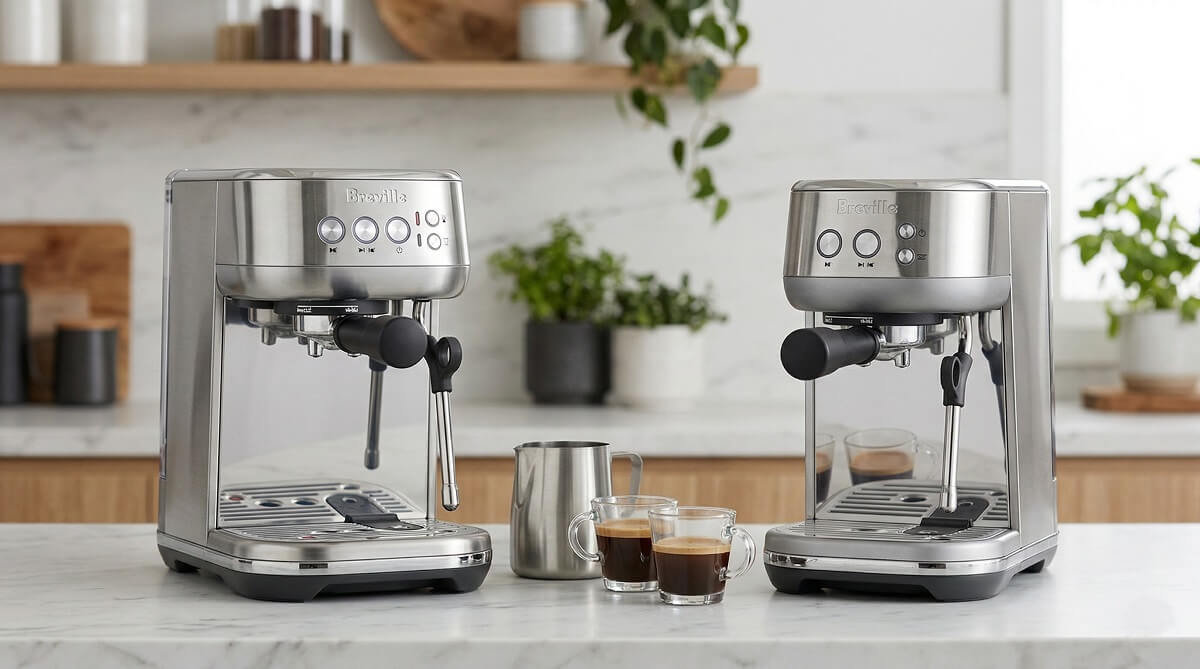
Here’s the short version: if lattes and cappuccinos are your daily drink and you’d rather not fuss with a steam wand, the Bambino Plus is the one to get. If you pull straight espressos, make Americanos, or plan to develop your own frothing technique, the base Bambino saves you money and actually gives you a feature the Plus is missing.
Both machines pull identical shots. They share the same ThermoJet heating system (ready in 3 seconds), the same 54mm portafilter, the same 9-bar extraction pressure, and the same PID-controlled temperature. A blind taste test between a Bambino espresso and a Bambino Plus espresso would stump even an experienced palate. The divide between these two machines lives entirely in how they handle milk.
There’s also a detail that doesn’t get enough attention: the standard Bambino has a hot water spout built into the steam wand — handy for Americanos and tea. The Bambino Plus removed that function when Breville added the automated frothing system. Small thing, but if you regularly add hot water to your espresso, it’s worth knowing before you buy.
Current prices (as of March 2026 via Breville.com): Bambino is $299.95 (on sale for $249.95); Bambino Plus is $499.95 (on sale for $399.95). Check Amazon for the latest deal pricing — it often dips below the official site.
Who Should Buy the Bambino vs the Bambino Plus?
✅ Get the Breville Bambino if you…
- Drink espresso straight, with a splash of something, or as Americanos
- Want to learn to froth milk by hand — a genuinely useful skill once you have it
- Regularly use oat, almond, or other non-dairy milks (the auto-presets on the Plus struggle here)
- Need a hot water spout for Americanos or tea
- Have limited counter space — the Bambino is about 1.25 inches narrower
- Want to put that extra $100–$150 toward a better burr grinder instead
✅ Get the Breville Bambino Plus if you…
- Drink lattes, flat whites, and cappuccinos made with dairy milk every day
- Want hands-free milk frothing — push a button and walk away
- Are a complete beginner who’d rather not learn steaming technique right now
- Want color options (the Plus comes in 8+ finishes; the base is stainless only)
- Prefer a metal tamper and a razor dosing tool included out of the box
❌ Neither machine is right if you…
- Need a built-in grinder — look at the Breville Barista Express instead
- Want to manually adjust brew temperature or see real-time pressure data (look at the Breville Infuser)
- Make back-to-back rounds for a large household — the drip trays on both fill up quickly
Breville Bambino vs Bambino Plus: Specs Side by Side
On paper, these machines are nearly twins. The practical differences are concentrated in four areas: milk frothing, hot water access, color options, and what’s in the box.
| Spec | Breville Bambino | Breville Bambino Plus |
|---|---|---|
| Regular price | $299.95 | $499.95 |
| Sale price (March 2026) | $249.95 | $399.95 |
| Dimensions (W × D × H) | 6.25″ × 13.5″ × 12″ | 7.5″ × 13.5″ × 12″ |
| Heating system | ThermoJet — 3 sec warmup | ThermoJet — 3 sec warmup |
| Extraction pressure | 9 bar (15 bar pump) | 9 bar (15 bar pump) |
| PID temperature control | Yes | Yes |
| Pre-infusion | Yes | Yes |
| Portafilter | 54mm | 54mm |
| Milk frothing | Manual 360° steam wand | Auto (3 temps × 3 textures) + manual |
| Max steam temp | Not specified | 266°F |
| Hot water spout | Yes (via steam wand) | No |
| Color options | Stainless steel only | 9 finishes |
| Tamper included | Plastic | Metal 54mm |
| Razor dosing tool | No | Yes |
| Pressure gauge | No | No |
| Google rating | 4.3★ (1,100+ reviews) | 4.5★ (2,300+ reviews) |
Pricing sourced from Breville.com, verified March 16, 2026. Google ratings sourced via Homes & Gardens’ barista-tested comparison. For current deals, both machines go on sale regularly during Prime Day, Memorial Day, and Black Friday — worth checking before you pull the trigger.
The Espresso Is the Same — and That’s a Good Thing
Breville built both machines on the same espresso platform, so you’re not trading shot quality when you choose one over the other. A few things make this setup genuinely impressive for the price range:
ThermoJet Heating: 3 Seconds to Ready
Traditional espresso machines use a boiler that takes anywhere from 5 to 30 minutes to reach temperature. Breville’s ThermoJet technology coats metal with a glass-ceramic enamel that heats to brewing temperature in about 3 seconds. For daily home use, this changes everything — no planning ahead, no wasted water while you wait for a machine to warm up. According to , ThermoJet also uses 32% less energy annually than traditional thermoblock systems.
PID Temperature Control and Pre-Infusion
A PID controller holds brewing temperature at a steady 200°F — the industry-standard mark for espresso extraction. Pre-infusion — where water gently saturates the puck at low pressure before the full 9-bar push kicks in — reduces channeling and produces more even shots. These are capabilities you’d typically find on setups costing twice as much. consistently note that both machines deliver reliably smooth espresso with less fuss than traditional single boilers like the Gaggia Classic Pro.
The One Thing Missing: No Pressure Gauge
Neither the Bambino nor the Bambino Plus has a pressure gauge. You can’t watch the needle in real time to know if your grind is dialed in. If that kind of feedback matters to you, the ($599) adds that feature while keeping the same brewing fundamentals.
A Note on Filter Baskets
US versions of both machines ship with pressurized (double-wall) filter baskets. These are forgiving — they produce decent crema even with a less precise grind — but they mask grind inconsistencies and cap your shot quality ceiling. To push either machine further, swapping to a single-wall basket is worth doing once you have a reliable burr grinder dialed in. (Note: Sage-branded European versions include single-wall baskets; US buyers need to purchase them separately.)
Milk Frothing Is Where They Go Different Ways
This is the only real split between the two machines. Everything else — the espresso, the heating, the footprint — is nearly identical. Milk is where you make your call.
Breville Bambino: Manual 360° Steam Wand
The Bambino’s wand rotates fully — you can angle it wherever you need it for a proper vortex. It has a single-hole tip, which slows down the steam flow and gives you more time to work the milk. That extra control is actually helpful for beginners: the milk heats more gradually, so mistakes are easier to catch. Once you develop a feel for it, the manual wand produces excellent microfoam — the glossy, wet-paint texture baristas use for latte art.
The wand also doubles as a hot water dispenser when turned the other direction. Pull a double shot, add hot water through the same wand, and you have an Americano without any extra steps. The Bambino Plus gave up this function to make room for the automated frothing hardware.
Non-dairy milks also fare better with the manual wand. Oat milk, almond milk, and soy milk are more heat-sensitive than dairy — they need longer, more controlled aeration that the Plus’s fixed presets can’t deliver. Multiple independent reviewers found that oat and soy milk would fail to froth properly — or scorch — under the automatic settings. Testing by Nook Coffee Bar (2025) confirmed it plainly: “the automatic steam wand was clearly designed for dairy milk.” If plant-based milks are your daily choice, the manual wand on the base Bambino is the better tool. See for technique guidance that applies to either setup.
Breville Bambino Plus: Automated Milk Texturing
The Plus gives you nine combinations to work with: three temperature levels (low, medium, high) and three texture settings (silky, smooth, frothy). You position the steam wand in the pitcher, press a button, and step away. The machine does the rest and auto-purges the wand afterward to keep it clean.
For dairy milk, the results are genuinely good. As noted in Bon Appétit’s full Breville guide, the Bambino Plus’s auto-froth “produces a thick blanket without any large bubbles and enough texture to try your hand at latte art.” For someone who wants a reliable cappuccino every morning without a learning curve, that’s exactly what it promises.
The wand doesn’t rotate like the base model’s does, but for automatic use, that’s not a concern — the machine positions the steam itself. The auto-purge is a useful touch: it vents a short burst of steam after each use, which keeps milk residue out of the wand tip without you having to remember to wipe it manually.
Size, Colors, and What You Get in the Box
Footprint and Counter Space
Both machines are compact. The Bambino comes in at 6.25″ wide × 13.5″ deep × 12″ tall, according to Breville’s official specs. The Bambino Plus is 7.5″ wide — about 1.25 inches wider — at the same depth and height. The height is identical, so neither has an advantage if you’re fitting one under a low cabinet. The extra inch-plus on the Plus is minor but worth measuring if your counter space is genuinely tight.
Both drip trays fill up fast. Reviewers consistently flag this: the Bambino Plus in particular may need emptying every day with regular use. takes care of this quickly.
Color Options
The standard Bambino comes in brushed stainless steel only. The Bambino Plus is available in nine finishes: Stainless Steel, Black Truffle, Sea Salt, Damson Blue, Oyster Shell, Royal Champagne, Red Velvet Cake, Black Stainless Steel, and Smoked Hickory. If you want the machine to match a kitchen aesthetic or just prefer a splash of something different, this matters.
What’s in the Box
Both machines include a portafilter, single and double-wall filter baskets, and a 16 oz stainless steel milk pitcher. The differences are small but real: the Bambino ships with a plastic tamper; the Bambino Plus includes a metal 54mm tamper that feels more substantial and is more consistent in use. The Plus also includes Breville’s Razor Precision Dosing Tool, which lets you level your coffee dose to the exact capacity of the basket — useful for repeatable shot quality without a scale.
The Feature the Bambino Plus Gave Up
One thing gets buried in most comparisons: the base Bambino has a hot water spout. Turn the steam dial the other direction on the Bambino, and it dispenses hot water — perfect for Americanos, Americano-style long blacks, or a cup of tea. It’s a simple feature that adds real utility to the machine as a daily kitchen appliance.
The Bambino Plus removed it. As Bon Appétit’s Noah Kaufman noted, the Bambino’s steam wand “doubles as a hot water dispenser to make Americanos or tea, a feature the Bambino Plus lacks.” If Americanos are a regular part of your morning routine, this is a real tradeoff worth weighing against the convenience of automated frothing.
You’ll Need a Grinder — Here’s What to Pair With Either Machine
Neither the Bambino nor the Bambino Plus includes a grinder. This is one area where both models look the same, but the decision you make here has a bigger effect on your espresso than the machine choice itself. A blade/spice grinder produces uneven particle sizes that lead to inconsistent extraction — use a burr grinder instead.
For a pairing that doesn’t break the bank, a few options work well at the $100–$200 range: the (around $170) is purpose-built for espresso and is widely recommended at this price. The Breville Smart Grinder Pro (~$200) integrates cleanly with Breville’s ecosystem. If you’re willing to go manual, the Comandante C40 or 1Zpresso JE-Plus produce grind quality that rivals grinders twice their price.
Breville also sells a on Amazon that packages both together at a slight discount if you’re starting from scratch.
Frequently Asked Questions
What’s the main difference between the Breville Bambino and Bambino Plus?
The core difference is in milk frothing. The Bambino Plus has an automatic steam system with nine preset combinations (three temperatures, three textures) — you press a button and it handles the milk. The base Bambino has a manual 360°-rotation steam wand that you operate by hand. Both machines pull identical espresso using the same heating technology, pressure, and portafilter setup.
Is the Breville Bambino Plus worth the extra cost?
For regular latte and cappuccino drinkers who use dairy milk, yes. The auto-froth is reliable, low-effort, and saves real time every morning. For black coffee drinkers, Americano drinkers, or anyone who uses non-dairy milk regularly, the premium is hard to justify — the base Bambino does everything you need and gives you a hot water spout in the bargain.
Can you make latte art with the Bambino Plus?
Yes. The auto-froth system on the Plus produces microfoam with enough texture for basic latte art patterns. The milk won’t have quite the precision of a trained barista using a manual wand, but it gets close enough for hearts and simple tulips at home, especially after a little practice pouring.
Does the Bambino Plus have a hot water dispenser?
No. The base Bambino does — its steam wand also dispenses hot water when turned in the other direction, useful for Americanos and tea. Breville removed this function on the Plus when they added the automated milk system. If hot water access matters to you, the base Bambino is the better pick.
Which is better for oat milk or non-dairy milk?
The base Bambino, by a clear margin. The automated presets on the Bambino Plus were built around dairy milk’s specific protein and fat content. Oat milk, soy milk, and almond milk are more heat-sensitive and need longer, more controlled aeration that the fixed presets don’t provide well. Multiple reviewers found that non-dairy milks scorched or failed to foam properly with the auto-froth setting. With the manual wand on the base Bambino, you can adjust your technique to match the milk you’re using.
Do both machines need a separate grinder?
Yes. Neither the Bambino nor the Bambino Plus has a built-in grinder. You’ll need a dedicated burr grinder — not a blade grinder — to produce the fine, consistent grind espresso requires. A quality entry-level option in the $150–$200 range (like the Baratza Encore ESP) pairs well with either machine.
How fast does the Bambino heat up?
Both models use Breville’s ThermoJet heating system and reach brewing temperature in approximately 3 seconds, according to Breville’s official product page. That’s meaningfully faster than most machines in this price range, which typically take 20–30 seconds or more.
What colors does the Breville Bambino Plus come in?
Nine finishes as of 2026: Stainless Steel, Black Truffle, Sea Salt, Damson Blue, Oyster Shell, Royal Champagne, Red Velvet Cake, Black Stainless Steel, and Smoked Hickory. The base Bambino only comes in brushed stainless steel.
Ready to pick one? Check the current sale price on the Breville Bambino on Amazon or the Breville Bambino Plus on Amazon — pricing fluctuates and both machines go on sale regularly. You can also compare them side by side on Breville’s official site.
