


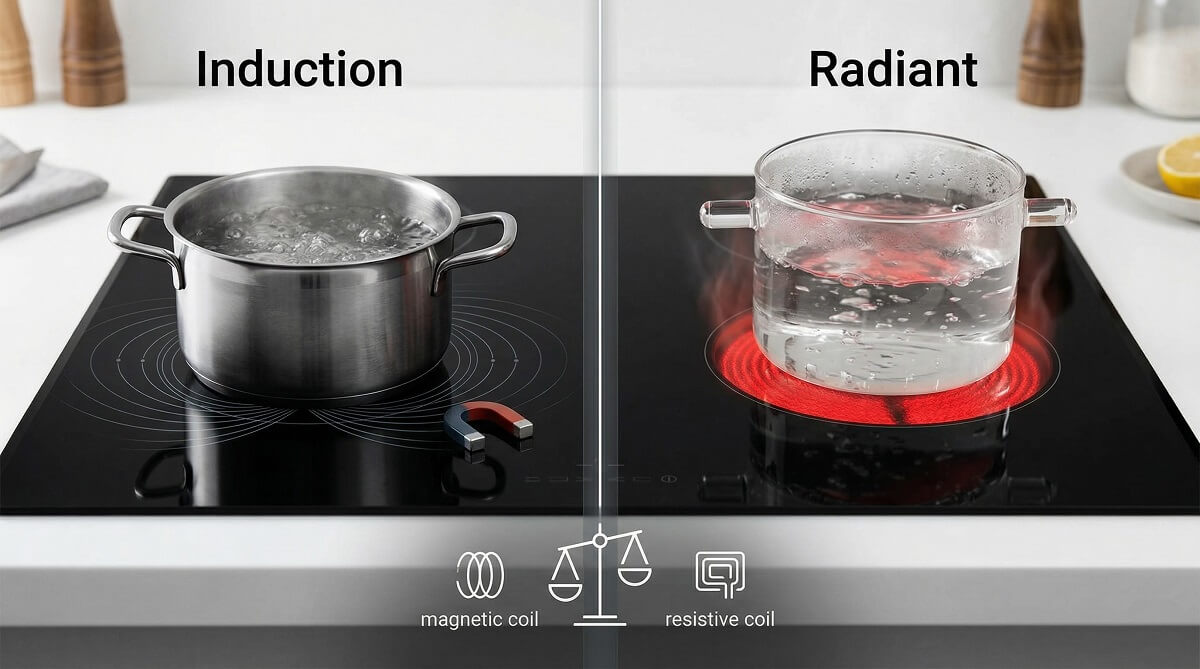
Short version: induction is the better cooktop. Radiant is the cheaper one. Those are different things, and which one matters more depends on your kitchen, your cookware, and your budget.
Induction heats 25 to 50 percent faster than standard electric, responds instantly when you adjust the heat, and leaves the glass surface cool enough to touch — because the cooktop itself doesn’t heat up, only the pan does. The trade-offs are real: you need ferromagnetic cookware (cast iron, magnetic stainless steel), you may need to upgrade your kitchen’s electrical circuit, and you’ll pay $400 to $600 more upfront for a comparable model. Radiant electric works with every pot and pan you own, costs less to buy, and requires nothing special from your kitchen’s wiring.
Below, we break down the five factors that actually decide this — cookware, electrical setup, cooking performance, energy costs, and price — so you can make a clear call without wading through the usual back-and-forth. If you’re also looking at specific models, our buying guides cover a range of kitchen appliance options.
Induction vs. Radiant: Pick One in 60 Seconds
✅ Get induction if you:
- Are buying new cookware anyway, or already own cast iron or magnetic stainless steel
- Want the fastest possible boil times and precise, instant temperature control
- Cook frequently and care about long-term energy bills
- Have — or can add — a dedicated 240V circuit in your kitchen
- Cook a lot of sauces, candy, or anything that needs careful low-heat control
❌ Skip induction if you:
- Cook with copper, aluminum, or ceramic pots you won’t replace
- Are working with a tight budget and don’t want to risk electrical upgrade costs
- Rely heavily on a round-bottom wok for stir-fry cooking
- Strongly dislike touch controls and haven’t found a knob-equipped induction model that fits your budget
✅ Get radiant if you:
- Need a reliable cooktop that works with every pot and pan you already own
- Are replacing an old smooth-top electric with minimal installation hassle
- Want a lower upfront cost — especially under $600
- Are outfitting a rental unit or a second kitchen where flexibility matters
❌ Skip radiant if you:
- Want precise, instant temperature control — particularly for low-heat cooking
- Want the fastest possible boil times on a busy weeknight
- Are doing a full kitchen remodel and have flexibility in the budget
The Technology Difference (It Matters More Than You Think)
Radiant: Heated Coils Under Glass
A radiant cooktop hides heating coils beneath a smooth ceramic-glass surface. When you turn a burner on, the coils heat up and radiate that heat through the glass to whatever pan is sitting on top. The glass surface itself gets hot — sometimes very hot — and it stays warm for several minutes after you turn the burner off.
That’s the core behavior: heat transfers indirectly, through the glass, to the pan. It works with any cookware material because it’s just heat radiating upward. It heats up gradually, cools down gradually. No electrical interaction with the pan required.
Induction: The Electromagnetic Field Heats the Pan Directly
Induction is different at a fundamental level. Beneath the glass sits a copper coil that generates an electromagnetic field when energized. That field doesn’t heat the glass — it passes through it. When a ferromagnetic pan sits on the surface, the field induces electrical currents inside the pan’s base, and those currents generate heat directly in the metal.
Turn on an induction burner with no pan on it and nothing heats up. Set a piece of paper between an induction cooktop and a cast iron skillet, and the pan will heat while the paper stays cool. The glass surface gets warm only from residual heat conducted back from a hot pan — not from the cooktop itself.
That difference in mechanism is what drives every other advantage induction has: the instant response, the lower burn risk, the easy cleanup, the faster boiling. It’s also what creates the one major requirement — the pan must contain iron or magnetic steel to interact with the field.
The Magnet Test
Testing your existing cookware takes 30 seconds. Hold a refrigerator magnet to the bottom of a pot or pan. If it sticks firmly, the pan will work on induction. If it slides off or barely holds, it won’t. Cast iron always works. Enameled cast iron (Le Creuset, Lodge) always works. Stainless steel pans are a mixed result — some magnetic grades work, some high-nickel grades don’t. Copper, pure aluminum, glass, and ceramic cookware won’t work on induction regardless of how much you paid for them.
Induction vs. Radiant Cooktop — Side by Side
| Feature | Induction | Radiant Electric |
|---|---|---|
| Heating speed | 25–50% faster (Consumer Reports) | Slower; gradual warm-up |
| Temperature precision | Instant response to adjustments | Gradual; slight lag on changes |
| Cookware compatibility | Ferromagnetic only (cast iron, magnetic stainless) | All types — aluminum, copper, ceramic, glass |
| Surface temperature | Stays mostly cool; residual heat from pan only | Gets hot; stays hot after use |
| Energy efficiency | ~84% (DOE estimate) | ~74–80% |
| Annual energy cost (avg USA) | ~$42–$47/year | ~$52/year |
| Cleanup | Easy — spills don’t bake on cool surface | Easy — smooth glass; spills can bake if surface is hot |
| Upfront cost (30-inch, name brand) | $936–$1,899 (mid-range) | $450–$700 (name brand) |
| Electrical requirement | 240V dedicated circuit (40–50A) | Standard 240V outlet (30–40A) |
| Wok cooking | Limited — flat-bottom woks only | Better for round-bottom woks |
| Noise | Slight fan hum; possible pan buzz at high heat | Silent |
| Control type options | Mostly touch; some knob models available | Touch or knob (both common) |
Pricing based on retailer listings as of March 2026. Annual cost figures from Reviewed.com and DOE data.
Five Factors That Settle the Induction vs. Radiant Question
1. Your Cookware — Check Before You Buy Anything
This is the first question, not the last. Before comparing prices or reading a single spec sheet, do the magnet test on every pot and pan you actually cook with. If most of them stick, you’re already set for induction. If your go-to pans are copper, aluminum, or ceramic-clad, induction requires a cookware change — and that has a cost.
A solid induction-compatible cookware set doesn’t require a major budget. Sets with a range of compatible pots and pans are available from $100 to $300 at major retailers, and individual pieces of cast iron start under $30. Our how-to section has guidance on evaluating cookware for compatibility. If you already own cast iron or a decent set of magnetic stainless steel pans, the cookware issue is already solved.
One common trap: “18/10 stainless steel” (high nickel content) is often non-magnetic and won’t work on induction. The only reliable test is the magnet — not the label, not the brand, not the price point of the pan.
2. Your Electrical Setup — One Question That Changes the Math
Both induction and radiant cooktops require a 240V circuit. The difference is in the amperage. Most radiant cooktops run on a standard 30–40A circuit — the same type used for older electric ranges. Most induction cooktops require a dedicated 40–50A circuit.
If your kitchen already has a 240V outlet from an old electric range or smooth-top cooktop, there’s a good chance you’re already wired for induction. Call an electrician to confirm before you buy. If you’re converting from gas, or if your existing circuit is undersized, you’ll need new wiring. Based on 2026 data from Angi and HomeGuide, installing a new dedicated 240V circuit costs approximately $250 to $900 for labor and materials, with electrical permits adding another $50 to $350 depending on your municipality.
That’s a real cost to factor in. If your kitchen isn’t already wired for it, add $300–$600 to the effective price of your induction cooktop before comparing it to radiant.
3. Speed and Cooking Performance — Where Induction Earns Its Premium
Consumer Reports found induction heats 25 to 50 percent faster than standard electric — and that gap is noticeable in daily use. A pot of pasta water that takes 12 minutes to boil on a radiant cooktop takes roughly 7 to 9 minutes on induction. Multiply that across a week of cooking and it adds up.
The more significant performance advantage is at the low end. Induction’s response is immediate — dial down from a boil to a simmer and the temperature drops right away. On radiant, the coil and glass retain heat for a minute or two after you reduce the setting, which means overshooting is easy. For sauces, candy-making, chocolate tempering, or anything that needs a precise low heat, induction is genuinely superior.
The exception is wok cooking. Traditional round-bottom woks need a curved heat source — like a gas grate — to work properly. On any flat cooktop (induction or radiant), a round-bottom wok wobbles and makes uneven contact. Flat-bottom woks work on both, but induction adds another limitation: wok materials. Most traditional steel woks are magnetic and will work on induction, but the flat-bottom constraint limits the high-heat tossing technique. For serious stir-fry cooking, this is a real trade-off, not a marketing footnote.
4. Energy Costs — The Math Is Real But Modest
Induction’s efficiency advantage is well-established. The U.S. Department of Energy puts induction efficiency at approximately 84%, compared to 74–77% for electric coil. Radiant smooth-top electric falls in a similar 74–80% range. The practical result: induction wastes less heat to the surrounding air and heats your food faster using less electricity.
According to Reviewed.com’s 2026 appliance running-cost analysis, the average U.S. electric range uses about 292 kWh per year, costing around $52 annually at the national average rate of $0.18 per kWh. Induction saves 10 to 20 percent on average — meaning an annual savings of roughly $5 to $10 per year for a typical household.
That number is honest. It’s real savings, but it’s not the reason to buy induction. The annual saving of $5–$10 means a $500 price premium over a comparable radiant model takes 50 to 100 years to pay back on energy alone. Buy induction for the speed, the precision, and the safety — not to recoup the cost through your electric bill.
5. Price: What You Actually Pay in 2026
As of March 2026, a well-made 30-inch radiant electric cooktop from a name brand costs roughly $450 to $700. The Frigidaire FFEC3025US (4 burners, 3,000W quick-boil element, stainless steel) runs $549.99 at Best Buy — a solid middle-of-the-road option that performs reliably without any frills.
Induction starts higher. The Samsung 30-inch Smart Induction Cooktop (NZ30K7880US, Flex CookZone, 5 elements) is $1,699 at Samsung.com — down from $2,299. The Frigidaire Professional PCCI3080AF (30-inch, 4 burners, physical knob controls) lands at $1,499 at Walmart and $1,899 at other retailers. The KitchenAid KCIT730SBL (5 zones, TempCook precision control) is $1,899. For a GE Profile, expect to pay $936 to $2,499 depending on the model and current promotions.
The honest middle ground for most buyers: a 30-inch induction cooktop from a major brand in the $1,000–$1,500 range does everything most home cooks need. Going above that buys smart home features, wider flex zones, and more precise degree-level temperature control — worth it if you use them, not if you don’t. See our appliance reviews for side-by-side model comparisons.
Three Things Nobody Mentions When You’re Comparing Cooktops
You Can Test Induction Before Spending $1,500
A single-burner portable induction cooktop is one of the smarter $60–$90 purchases you can make before committing to a built-in unit. The Duxtop 9600LS (1,800W, 20 power levels, LCD display) runs about $89 on Amazon. It lets you test your existing cookware for compatibility, get a feel for induction’s responsiveness, and see whether touch controls bother you — all before any installation costs. If you hate it, you’re out $89. If you love it, you’ve confirmed the investment before making it.
This is also the answer for renters or anyone in an apartment where the landlord controls the electrical panel. A portable unit plugs into a standard 120V outlet — no dedicated circuit needed. It’s not a permanent replacement for a built-in cooktop, but it works for everyday cooking and proves out whether induction fits your style.
The Touch Control Problem Has a Solution
The most common real-world complaint about induction cooktops isn’t the cookware — it’s the controls. Touch-panel interfaces are standard on most induction models, and users consistently cite them as frustrating: hard to see when you’re mid-cook, accidentally activated by water or a damp towel, and less intuitive than a physical knob you can reach for without looking.
Two models worth knowing about if this concerns you: the Frigidaire Professional PCCI3080AF has physical knob controls — a genuine rarity in induction at the $1,499–$1,899 price range. The Samsung NZ30K7880UG features removable magnetic knobs that attach over the touch panel, giving you the choice of either interface depending on what you’re cooking.
GE Cafe models are also frequently cited by experienced induction users as having a more intuitive physical-knob layout. If control ergonomics matter to you, these are the models to evaluate first.
The Noise Isn’t a Dealbreaker, But It Exists
Induction cooktops make noise that radiant models don’t. There are two sources: a cooling fan that runs during and after cooking, and a buzzing or humming from the cookware itself as the electromagnetic field interacts with the pan’s metal. The fan noise is consistent and mild — most people stop noticing it within days. The pan buzz depends on the cookware: cast iron is nearly silent, thin stainless steel can hum noticeably at high power settings.
HowStuffWorks described the typical induction cooktop as “about as loud as a whisper.” That’s accurate for low-to-medium heat with quality cookware. At high settings with thinner pans, you’ll hear it. It’s not a problem — it’s just different from what most people expect coming from electric.
Induction vs. Radiant Cooktop — Common Questions
Can I use my existing cookware on an induction cooktop?
Test each pan with a refrigerator magnet: firm stick means it works, weak or no stick means it won’t. Cast iron and enameled cast iron always work. Most stainless steel works, but some high-nickel grades (often labeled 18/10) do not. Copper, aluminum, ceramic, and glass cookware do not work on induction regardless of price or brand. If your core pans fail the test, induction requires a cookware upgrade — budget $100 to $300 for a solid compatible set.
Is induction actually safer than radiant?
In most practical ways, yes. The cooktop surface on an induction unit stays close to room temperature because the electromagnetic field doesn’t heat glass — it only heats the pan. Spills don’t bake onto the surface. A child’s hand touching an unused burner won’t get burned. Residual heat from the pan does warm the glass slightly after cooking, so it’s not completely cold, but it’s a fraction of the surface temperature on a radiant cooktop at full heat. The one safety note worth mentioning: people with pacemakers or implanted cardiac devices should consult their doctor before using induction, as the electromagnetic field can potentially interfere with some older device models.
How much does it cost to install an induction cooktop?
If your kitchen already has a 240V outlet from an existing electric range or radiant cooktop, installation is typically just swapping the appliance — labor cost only. If you need a new dedicated 240V, 40–50A circuit installed, expect to pay $250 to $900 for an electrician, plus $50 to $350 for permits depending on your location. That’s based on 2026 estimates from Angi and HomeGuide. Converting from gas to induction is the most expensive scenario because gas lines may need capping, a new 240V circuit must be run, and ventilation changes may also be needed.
Do induction cooktops make noise?
Yes — two types. A cooling fan runs during and shortly after cooking: consistent, quiet, similar to a laptop fan. And certain cookware produces a buzzing or humming sound from the electromagnetic interaction — more noticeable with thin stainless steel at high settings, almost inaudible with cast iron. Radiant cooktops are silent. The noise isn’t loud enough to be a dealbreaker for most users, but if you’re sensitive to background sound in the kitchen, it’s worth testing a portable unit before committing.
Can I do wok cooking on induction?
With limitations. Round-bottom woks don’t make proper contact with any flat cooktop — induction or radiant. Flat-bottom woks work on both and are the standard recommendation for electric cooking. On induction specifically, the wok must also be magnetic-base (most carbon steel and cast iron woks are). Some experienced wok cooks report that induction’s inability to heat the pan sides adequately limits the high-heat tossing style used in professional stir-fry. For occasional home stir-fry, a flat-bottom carbon steel wok on induction works well. For daily wok-heavy cooking, gas or a commercial setup remains the better fit.
What’s the cheapest decent induction cooktop from a major brand?
The Frigidaire Professional PCCI3080AF at $1,499 (Walmart, as of March 2026) is among the lowest-priced options from a recognized brand with physical knob controls and solid performance specs — including an 11-inch, 5,200W PowerPlus burner. Below that price range, off-brand induction cooktops exist on Amazon in the $200–$500 range, but build quality, support, and long-term reliability vary significantly. If budget is the main constraint, a portable single-burner unit like the Duxtop 9600LS ($89) is worth considering as a complement to a radiant cooktop.
Is radiant electric the same as induction?
No. Both are electric cooktops with a smooth glass surface, but the technology underneath is completely different. Radiant uses resistive heating coils that glow and radiate heat through the glass. Induction uses an electromagnetic field that passes through the glass and heats only ferromagnetic cookware directly. Same appearance from across the kitchen; completely different behavior in use.
Will switching to induction lower my electric bill?
A little. Reviewed.com’s 2026 analysis puts the annual running cost of an average electric range at about $52. Induction saves 10 to 20 percent, meaning roughly $5 to $10 per year in electricity at the national average rate. That’s a real saving, but modest enough that it shouldn’t be the deciding factor. Induction’s financial case rests more on speed and precision than on energy payback.
Ready to Compare Specific Models?
The induction vs. radiant decision narrows down to three questions: does your cookware pass the magnet test, do you have or can you add the right circuit, and does the upfront price fit your budget. If you’ve answered those, the next step is comparing specific models side by side.
Our kitchen appliance buying guides cover cooktops, ranges, and related categories with current pricing and hands-on assessments. If you want to start with a low-commitment test, the Duxtop 9600LS portable induction unit (~$89 on Amazon) is the most practical way to confirm induction fits your cooking style before spending $1,500 on a built-in cooktop.
Browse our appliance reviews for model-level detail on induction and radiant electric cooktops.
