


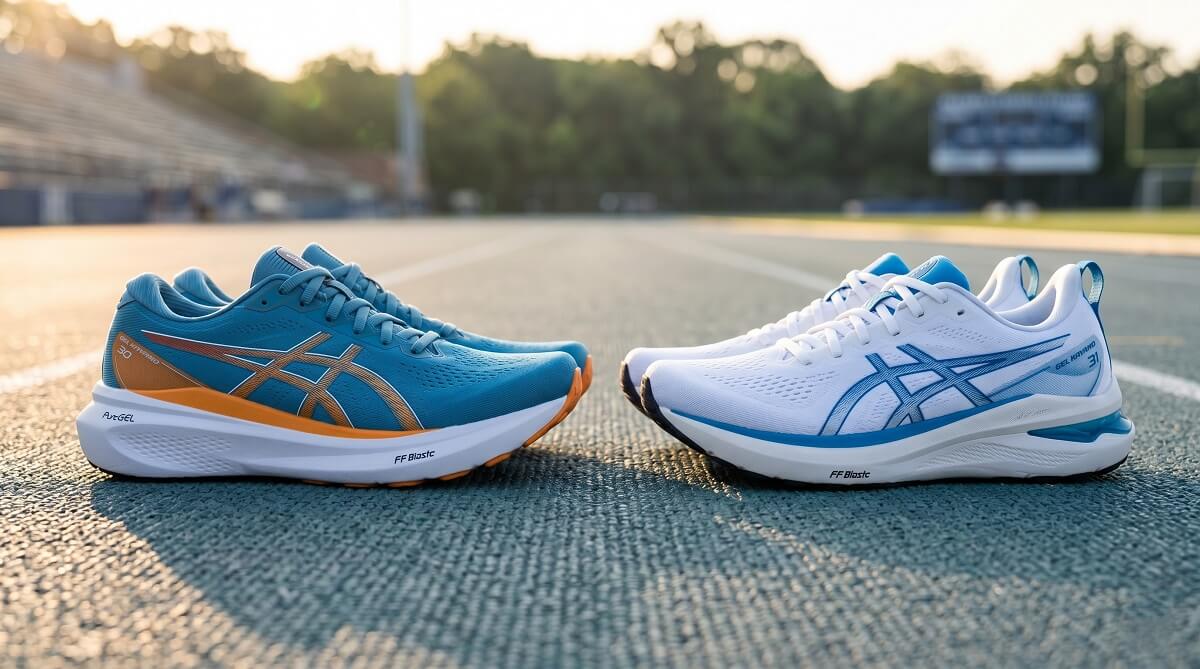
The short version: the Kayano 31 is a better shoe than the 30, but not by a wide margin. If you’re already running in the 30 and it fits well, there’s no need to rush an upgrade. But if you’re shopping for new shoes now, the 31 is the one to get. The improvements are real — particularly in wet-road traction and heel durability — and the $5 price bump from $160 to $165 is negligible. For a broader look at how the Kayano stacks up against other options in this category, see .
ASICS did the heavy lifting with the Kayano 30’s redesign in 2023, which completely overhauled the shoe from a traditional support trainer into something more modern. The 31 builds on that. Four specific things changed: a new upper material, a revised outsole with dramatically better grip, a smoother heel geometry, and a slightly longer 4D Guidance insert in the midfoot. Everything else — the midsole foam, the stack height, the drop, the general fit — stayed the same.
The one honest tradeoff: the new mesh upper is plusher but slightly less breathable than the knit upper from the 30. If you run in warm weather and airflow matters, that’s worth knowing going in. But for most runners in most conditions, the 31 comes out ahead.
Quick Decision Guide: Kayano 30 vs 31
✅ Go With the Kayano 31 If:
- You’re buying new shoes — it’s the current version with meaningful improvements
- You run on wet roads or in rainy conditions (traction is a genuine upgrade)
- You had heel rubbing or premature wear in the Achilles area with the 30
- You want the plushest possible step-in feel (new knit collar + pull tab)
- You have flat feet or overpronate and want the best current support in this line
✅ Stick With the Kayano 30 If:
- You already own a pair and they still have miles left — no need to replace them yet
- You can find the 30 at a significant discount (the 30 dropped to clearance pricing once the 31 launched)
- Breathability is a top priority for you in warm-weather running
- You’ve worn the 30 for years and know its fit works perfectly for your foot
❌ Consider a Different Shoe If:
- You want a lightweight trainer — both are heavy by modern standards (~10.7 oz men’s)
- You need a versatile shoe for speed workouts or tempo runs
- You prefer minimal drop (both have a 10mm heel-to-toe drop)
- You’re a strict forefoot striker — the high stack and drop work best for heel strikers
Kayano 30 vs 31 Specs: Side-by-Side
| Spec | Kayano 30 | Kayano 31 |
|---|---|---|
| Price (MSRP) | $160 | $165 |
| Weight — Men’s (size 9) | 10.6 oz / 300g | 10.7 oz / 305g (brand); 10.4 oz / 295g (lab-tested) |
| Weight — Women’s (size 8) | 9.2 oz / 260g | 9.3 oz / 264g |
| Stack Height — Men’s | 40mm heel / 30mm forefoot | 40mm heel / 30mm forefoot |
| Stack Height — Women’s | 39mm heel / 29mm forefoot | 39mm heel / 29mm forefoot |
| Heel-to-Toe Drop | 10mm | 10mm |
| Upper Material | Engineered knit | Engineered mesh |
| Breathability (lab) | 5/5 | 4/5 |
| Outsole | AHAR LO rubber | HYBRID ASICSGRIP (ASICSGRIP + AHARPLUS) |
| Traction Score (lab) | Near average | 0.83 (vs avg 0.50) — top tier |
| 4D Guidance Insert | Standard length | 5mm longer; positioned higher |
| Heel Collar | Standard padding | Knit collar + finger-loop pull tab |
| Heel Padding Durability (lab) | 1/5 | 4/5 — major improvement |
| Energy Return (lab) | Similar | 49.2% (below avg 58.6%) |
| Midsole Foam | FF Blast+ ECO | FF Blast+ ECO (same; marginally softer feel) |
| PureGEL (heel) | Yes | Yes |
| APMA Seal of Acceptance | Yes | Yes |
| Men’s Widths | Normal, Wide, X-Wide | Narrow (2A), Standard, Wide (2E), X-Wide (4E) |
| Women’s Widths | Normal, Wide | Narrow (2A), Standard, Wide (D) |
| Best For | Easy paces, daily training, walking | Easy paces, daily training, walking, wet conditions |
Check current pricing on Kayano 31 on Amazon or find the Kayano 30 at clearance pricing on Amazon. Prices change regularly.
The 4 Real Updates Between the Kayano 30 and 31
that only say “minor update” aren’t very useful. Here’s exactly what ASICS changed and why it matters.
1. Outsole: HYBRID ASICSGRIP — A Significant Grip Upgrade
This is the most meaningful improvement in the 31. The Kayano 30 used AHAR LO rubber, which gave average wet-road grip. The 31 switched to HYBRID ASICSGRIP — a combination of ASICSGRIP and AHARPLUS rubber compounds.
In RunRepeat’s lab traction test, the Kayano 31 scored 0.83 versus an average of 0.50 across 321 running shoes. Their words: “The ASICS Gel Kayano 31 blew us away in the lab… a grip-loaded, rain-ready performance.” The Kayano 30 “hovered closer to the average in this exact same test.” If you run in wet weather or on slick roads, this alone is worth noting.
2. New Engineered Mesh Upper — Plusher but Warmer
The Kayano 30’s engineered knit upper was rated 5/5 for breathability by RunRepeat. The 31’s engineered mesh dropped to 4/5. The mesh is plusher and more structured, but under microscopy, a secondary backing layer restricts full airflow through the ventilation holes.
Multiple Fleet Feet testers noted warmer feet in the 31. Spencer, who runs exclusively in stability shoes, said: “My feet were noticeably heated by the end of runs.” The tradeoff is a more cocooning feel — if you’ve ever wished your shoes felt more premium and padded, you’ll appreciate the mesh. If you run in summer heat, the 30’s knit was more forgiving.
3. Heel Geometry + Knit Collar — Less Clunky, Easier to Put On
The 30 had a somewhat blocky, angular heel that Sam Winebaum at Road Trail Run described as feeling “blocky and somewhat awkward.” The 31 reshapes the rear heel to be more curved and flared, creating a smoother initial ground contact.
The new knit collar and finger-loop pull tab also make the 31 easier to slip into — a small quality-of-life improvement. More practically: heel padding durability jumped from 1/5 to 4/5 in RunRepeat’s Dremel durability test. If you wear through the Achilles area of your shoes, the 31 is a clear improvement.
4. Refined 4D Guidance System — More Effective Midfoot Support
The 4D Guidance System is what makes the Kayano different from traditional stability shoes. Instead of a firmer medial post that blocks pronation, ASICS uses a softer, more resilient foam that bounces the foot back through the natural pronation-to-supination transition.
In the 31, the insert is 5mm longer (Road Trail Run measured this directly) and positioned slightly higher. The result is a more noticeable “spring” out of midfoot pronation. Matt Klein, DPT at Doctors of Running, noted: “The midfoot bounce especially brings to life what I mostly missed and misunderstood in version 30.” The effect is subtle but real — multiple testers confirmed better responsiveness through the midfoot.
What Didn’t Change Between the Kayano 30 and 31
The changes above are the full list. Everything else carried over from the 30:
- Midsole foam: FF Blast+ ECO with 24% bio-based content — identical in both
- Stack height: 40mm heel / 30mm forefoot (men’s) — unchanged
- Heel-to-toe drop: 10mm in both versions
- PureGEL cushioning: Embedded in the heel of both models
- Ride character: Both are easy-pace, daily trainer shoes — not fast, not light, very comfortable
- Fit: True to size in both; the wider upper options are essentially the same range
- APMA Seal of Acceptance: Both models carry this podiatrist-evaluated credential
Practically speaking: if you pull on a 30 and a 31 side by side, you’d be hard-pressed to identify which is which without looking. According to Road Trail Run, editor Sam Winebaum ran an A/B comparison with one shoe on each foot and found the differences “subtle” but directionally positive.
Who the Kayano 31 Is Actually For
The Kayano sits in a specific lane. You’ll get the most out of it if you fit one of these profiles:
Overpronators and Flat-Foot Runners
This is the Kayano’s home turf. The 4D Guidance System offers support that doesn’t feel intrusive — no hard plastic plate, no aggressive medial posting. According to Matt Klein, DPT at Doctors of Running, the 4D system replicates “the true function of the arch far more than traditional medial posts.” If you’ve tried structured trainers in the past and found them restrictive or uncomfortable, the Kayano’s guidance approach is worth a try. for more options in this category.
Daily Trainers and Long-Distance Easy Runners
The Kayano is not a shoe for speed. It’s heavy (~10.7 oz), not particularly bouncy (energy return of 49.2% versus the 58.6% average per RunRepeat’s lab), and its 40mm stack makes it feel more like a couch than a trampoline. What it does well is soak up mileage on easy days — marathon runners who use it for recovery runs, commuters who run to work, and anyone logging slow-and-steady base miles will find it excellent for the purpose.
Walkers and People on Their Feet All Day
Doctors of Running explicitly rates the Kayano 31 for walking and all-day standing. The wide platform, flexible-enough sole, and deep cushioning make it comfortable for prolonged non-running use. The APMA Seal of Acceptance — awarded after evaluation by a committee of podiatrists — reinforces this for people with foot health concerns.
Heavier Runners
The wide midsole base (122.1mm forefoot width, per RunRepeat’s lab measurements) and substantial cushioning provide more joint protection for runners above average weight. The inherent stability from the wide platform works without requiring runners to pronate heavily.
If the Kayano Isn’t the Right Fit — Alternatives to Consider
The stability trainer market has solid options at different points on the price-weight-cushioning spectrum. cover these in more depth, but here’s a quick orientation:
| Shoe | Price | Weight (Men’s) | Drop | Key Difference vs Kayano |
|---|---|---|---|---|
| HOKA Arahi 7 | $145 | 9.9 oz | 5mm | Lighter, lower drop, less plush, $20 cheaper |
| Brooks Glycerin GTS 21 | $165 | ~10.8 oz | 10mm | GuideRails system, denser feel, same price |
| New Balance Vongo v6 | $165 | 10.6 oz | 8mm | Similar plush ride, slightly lighter, same price |
| New Balance 860 v14 | $140 | 10.5 oz | 8mm | Quicker ride, lower stack, $25 cheaper |
The Arahi 7 deserves serious consideration if weight is a priority — it’s nearly a full ounce lighter, $20 less, and uses HOKA’s J-Frame structured system. The tradeoff is less cushioning depth and a lower drop that not everyone adjusts to easily. For a full comparison of these competitors, on ChubbytIps.
Frequently Asked Questions
Is the Kayano 31 worth upgrading from the Kayano 30?
Only if your Kayano 30s are worn out and due for replacement. The improvements are genuine — better wet-road grip, a smoother heel, more durable heel padding — but not dramatic enough to justify buying new shoes before the old ones wear out. When you do need to replace them, get the 31.
What did ASICS change in the Kayano 31 vs 30?
Four things: (1) new engineered mesh upper replacing the knit upper; (2) HYBRID ASICSGRIP outsole replacing AHAR LO rubber, with dramatically better traction; (3) smoother heel geometry with a new knit collar and pull tab; (4) a 5mm longer, higher-positioned 4D Guidance insert. Everything else — midsole foam, stack height, drop, PureGEL — stayed the same.
Is the Kayano 31 heavier than the 30?
Marginally. The brand specifies 10.7 oz (men’s size 9) for the 31 vs 10.6 oz for the 30. RunRepeat’s lab weighed the 31 at 10.4 oz — actually lighter than the brand spec. Real-world, the difference is imperceptible on foot.
Is the Kayano 31 good for overpronation and flat feet?
Yes. The 4D Guidance System is specifically designed for overpronators. Unlike traditional stability shoes that use a harder medial post to block pronation, ASICS uses a softer, more resilient foam to guide the foot through the natural pronation-to-supination movement. The Kayano 31 also carries the APMA Seal of Acceptance, evaluated by a committee of podiatrists.
Is the Kayano 31 good for walking?
Yes — it’s one of the better road-based walking shoes available. The deep cushioning, wide platform, and minimal flexibility make it comfortable for long periods on hard surfaces. Doctors of Running explicitly recommends it for walking and all-day standing.
How does the Kayano 31 compare to the HOKA Arahi 7?
Both are stability maximalist shoes, but they feel different. The Kayano is softer, heavier (~10.7 oz vs ~9.9 oz men’s), and has a higher heel drop (10mm vs 5mm). The Arahi is lighter, lower-profile, and $20 cheaper at $145. If weight and agility matter, go Arahi. If you want maximum underfoot softness and plushness, the Kayano is the pick.
Does the Kayano 31 run true to size?
Yes. Reviewers at Doctors of Running, RunRepeat, Find My Footwear, and Road Trail Run all confirm a true-to-size fit. If you’re between sizes, some testers noted the upper feels slightly snugger volume-wise in the 31 than the 30. Narrow-footed runners may find the 31 excellent; higher-volume feet should look into or try the 2E sizing in store.
What wide size options does the Kayano 31 come in?
Men’s: Narrow (2A), Standard (D), Wide (2E), and Extra-Wide (4E). Women’s: Narrow (2A), Standard (B), and Wide (D). The 4E extra-wide option is a notable addition that wasn’t as well-promoted in the 30.
Where to Buy the ASICS Gel Kayano 30 and 31
The Kayano 31 is widely available at full retail. The 30 has dropped to clearance pricing at many retailers now that the newer version is out — worth checking if you’re comfortable with an older model at a better price.
Check current prices for the Kayano 31 on Amazon or browse on ChubbytIps to compare your options.
