


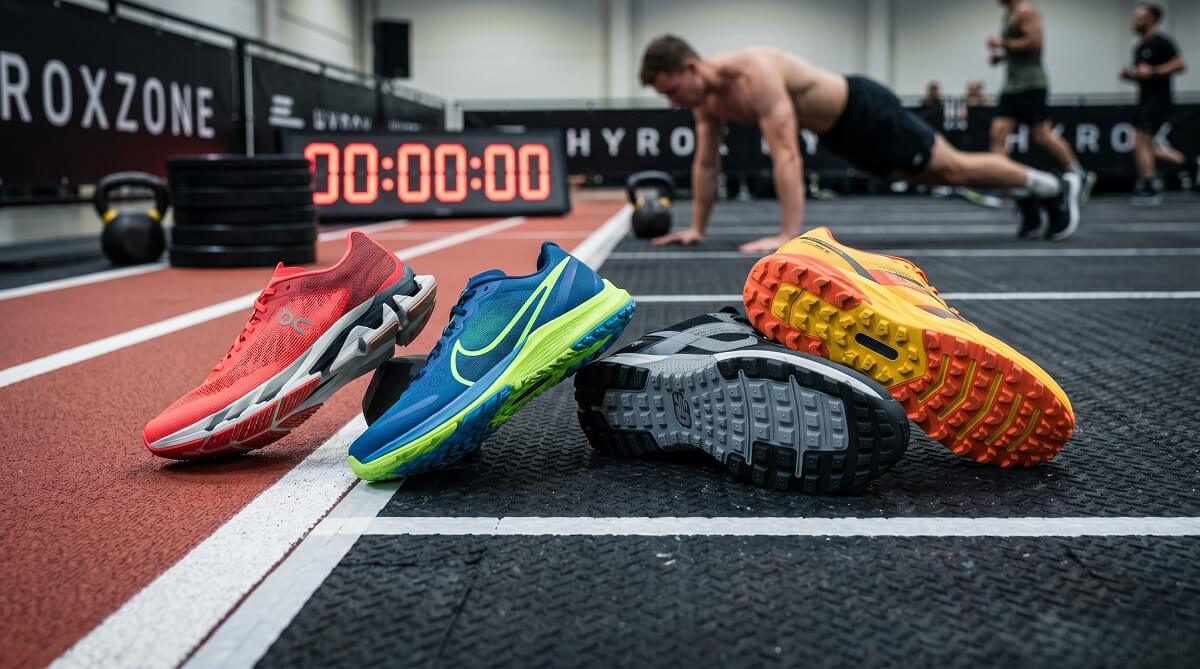
HYROX is not a running race with some gym work bolted on. The 8km of running happens 1km at a time — between eight functional workout stations that include sled pushes, sandbag lunges, burpee broad jumps, and wall balls. That hybrid format means the shoes that feel incredible on a road race will often fail you in the RoxZone. And nothing derails a race faster than slipping on a 335-pound sled because your outsole has no traction on turf.
For most athletes, the right shoe is a performance running trainer with a grippy outsole, moderate stack height (30–38mm), and a rounded heel that fits the Concept2 rower. The Puma Deviate Nitro 3 hits every one of those marks and is the most consistently recommended shoe across elite and amateur athletes. On a budget? The Nike Pegasus 41 at $145 is hard to argue with. Chasing a podium? The Saucony Endorphin Pro 4 or the new Puma x HYROX Deviate Elite 4 — the first shoe purpose-built for HYROX — is worth the investment.
One important caveat before diving into the picks: the right shoe for you depends on your goals, your foot type, and how much you value speed versus sled-push security. Read the buying criteria first if you’re new to HYROX. If you’ve done a few races, jump straight to the shoe reviews.
Who Should (and Shouldn’t) Wear What
✅ Best For
- Athletes competing HYROX solo or doubles who want a competitive finish time
- Anyone who’s had their race wrecked by slipping on the sled push
- Runners who want one shoe that handles both weekly training and race day
- Athletes comfortable running in performance trainers for distances up to 10km
❌ Skip If
- You’re planning to race in dedicated super shoes like Nike AlphaFlys — too unstable for stations, especially lunges and wall balls
- CrossFit shoes are tempting — they’re solid for stations but not cushioned enough for 8km cumulative running
- You have wide feet and haven’t tried the shoe in person — most top HYROX picks run narrow
Why HYROX Demands More Than a Standard Running Shoe
The 8km Problem — and Why It’s More Complicated Than You Think
On paper, HYROX involves 8km of running. In practice, you run 1km at a time, stop to complete a station, then run another lap. Repeat eight times. That means you’re never in sustained running mode — you’re constantly transitioning between speed, load, and lateral movement. Your legs are tired from the station when you hit the next run, which is what HYROX athletes call “compromised running.” See our fitness gear buying guides for more on training for hybrid events.
Most road running shoes are designed for sustained forward motion on pavement. They’re not optimized for pushing a loaded sled backwards across turf, dropping into a lunge, or fitting snugly into a Concept2 rower’s heel cup. That’s the design gap that makes HYROX shoe selection genuinely tricky.
The Sled Push Is Where Races Are Won or Lost
Ask any experienced HYROX athlete what ruined their race, and “slipping on the sleds” comes up more than any other answer. The sled push and sled pull are performed on artificial turf — not the rubber or asphalt your shoes are designed for. Without sufficient forefoot grip on that surface, your feet spin out instead of driving forward.
The weights involved aren’t trivial. According to the official HYROX 25/26 season rules, the sled push in the Open Men’s division is 152 kg (335 lbs) total including the sled over 50 meters. Pro Men push 202 kg (445 lbs). Open Women push 102 kg (225 lbs). At those loads, even a small footing deficit costs 30–60 seconds per sled station — enough to drop several places in your division.
The Other Seven Stations Have Their Own Demands
Each station tests your footwear in a different way. Sandbag lunges require heel stability and a low enough stack that your knee can make contact with the ground (HYROX rules require this for reps to count). Wall balls need enough heel drop for squat depth. The rowing station requires a traditional rounded heel — pointed or flared heel designs won’t sit in the Concept2’s heel cup, making it harder to generate power on each pull. Burpee broad jumps need forefoot traction for push-off and landing. Farmer’s carries with fatigue-heavy legs demand a stable, wide base underfoot.
No shoe handles all of this perfectly. The goal is to find the best compromise for your specific race goals — which is exactly what the section below is designed to help you do.
What to Look for in HYROX Shoes
Outsole Grip — the Non-Negotiable
HYROX stations are covered in a purpose-built turf surface (Centr x HYROX Perform Turf) that behaves differently from road or track rubber. Most running shoes have minimal rubber coverage — enough for road grip, not enough for a loaded sled push on turf.
What to look for: good rubber coverage across the forefoot (ball of foot area), a defined tread or lug pattern, and a high-friction rubber compound. Puma’s PUMAGRIP technology is the most cited by athletes for multi-surface traction. In RunRepeat’s independent lab testing, the Puma Deviate Nitro Elite 3 scored a 0.67 coefficient of friction on wet surfaces — 42.6% grippier than the average running shoe tested.
If you’re unsure whether your shoes have enough grip, test them on a sled before race day — ideally with more weight than you’ll face in your division. Better to find out in training than at kilometer 3 of your race.
Stack Height — Find the Sweet Spot
Stack height refers to how much foam sits between your foot and the ground. More foam generally means more cushioning and running comfort, but it also means less stability and a higher center of gravity during functional movements.
The recommended range for HYROX is 30–38mm heel stack. Shoes below 30mm can feel under-cushioned across the cumulative 8km of running. Shoes above 38mm — and especially the 40mm+ super shoes popular in road racing — create real problems in the RoxZone. At 40mm+, it’s physically harder to get your knee to the floor during sandbag lunges, your ankle is at greater risk of rolling during farmer’s carries, and some heel designs won’t fit properly in a Concept2 rower.
The Saucony Endorphin Pro 4 sits at approximately 38mm heel stack — just inside the recommended range — while delivering carbon-plate speed.
Heel Drop — Matters More Than Most People Expect
Heel-to-toe drop is the height difference between your heel and forefoot inside the shoe. Standard running shoes are 8–10mm, low-drop options are 4mm or under, zero-drop exists but is rare in racing shoes.
For HYROX: an 8–10mm drop works for most athletes, particularly heel strikers. A higher drop also helps athletes with limited ankle mobility hit parallel depth in wall balls, which is required for reps to count. Lower drop (5mm, like the HOKA Mach 6) suits forefoot strikers and athletes with good mobility — but be aware that calf fatigue can increase over a 60–90 minute event if you’re not adapted to it.
Heel Shape — the Rower Test
Some running shoes — particularly high-end racing shoes — feature unconventional heel shapes: pointed, flared, or protruding crash pads. These designs can prevent the shoe from sitting properly in the Concept2 rower’s heel cup. In independent testing by GQ, certain popular racing shoes made rowing “downright impossible.” When evaluating shoes, look for a traditional rounded heel. If in doubt, test the rowing position before race day.
Weight — Helpful, but Don’t Sacrifice Grip for It
A lighter shoe reduces leg fatigue across 8km of cumulative running. Shoes under 9 oz (255g) are solid for HYROX. The tradeoff: manufacturers often reduce rubber coverage (and therefore grip) to save weight. For most athletes below the elite level, a few extra grams is a much smaller problem than spinning your wheels on a 335-pound sled. Prioritize grip, then optimize for weight within that constraint.
Best HYROX Shoes in 2026: Our Top Picks
Browse all our gear reviews for more tested fitness equipment picks. Below are the top HYROX shoes tested and recommended by athletes and independent reviewers.
| Shoe | Price (USD) | Drop | Stack (Heel) | Carbon Plate | Weight | Best For |
|---|---|---|---|---|---|---|
| Puma Deviate Nitro 3 | ~$160–$170 | 10mm | 39mm | Yes (PWRPLATE) | 9.7 oz | Best Overall |
| Saucony Endorphin Pro 4 | ~$189–$225 | 9.5mm | ~38mm | Yes (Carbon) | 7.4 oz | Best for Speed |
| Nike Pegasus 41 | $145 | 10mm | 34mm | No | 10.4 oz | Best Value |
| HOKA Mach 6 | $140 | 5mm | 37mm | No | 8.2 oz | Best Stability |
| Brooks Hyperion | $140 | 8mm | 30mm | No | 7.6 oz | Best Lightweight |
| Puma x HYROX Deviate Elite 4 | $260 | ~8mm | ~40mm | Yes (PWRPLATE) | ~7.0 oz | Elite Race Day |
Prices as of March 2026. Check current pricing on Amazon or manufacturer sites — these fluctuate regularly.
Best Overall — Puma Deviate Nitro 3
The Deviate Nitro 3 is the most widely recommended HYROX shoe across elite and amateur athletes, and the reason is straightforward: it balances speed, grip, and station performance better than anything else at its price point. The carbon PWRPLATE and NITROFOAM midsole deliver a quick, responsive ride for the running laps. The PUMAGRIP rubber outsole handles the turf on sled stations. And the 39mm heel stack with 10mm drop is aggressive enough to feel fast without crossing into the instability zone.
Puma became the official HYROX apparel and footwear partner in 2024, and it shows in the shoe design. 2023 Men’s World Champion Hunter McIntyre and 2024 Women’s World Champion Meg Jacoby have both raced in Puma’s Deviate line. The shoe runs narrow — if you have wide feet, size up or try on before buying.
See current pricing and availability: Puma Deviate Nitro 3 HYROX on Amazon.
Best for Speed — Saucony Endorphin Pro 4
For athletes willing to accept a slightly higher price and a stiffer feel underfoot, the Endorphin Pro 4 is the fastest HYROX-appropriate shoe you can buy. RunRepeat’s lab testing measured a 71.7% energy return rate — 23.4% above average — thanks to Saucony’s PWRRUN HG foam and S-shaped carbon plate. It weighs just 7.8 oz, 17% below the average running shoe.
What separates the EP4 from most super shoes in a HYROX context is the forefoot rubber coverage and broader platform. It gives enough traction on sleds and enough lateral support for lunges. The main limitation: its longitudinal stiffness can make foot-bending movements (burpees, lunges) feel a bit mechanical. Athletes with flexible training backgrounds adapt to this faster than others.
Prices vary by retailer — compare current deals: Saucony Endorphin Pro 4 on Amazon.
Best Value — Nike Pegasus 41
The Pegasus 41 shouldn’t work this well for HYROX. It’s a mainstream daily trainer, not a racing shoe. But its deep waffle-pattern outsole delivers what GQ’s independent tester called “cheat code-level traction” on the sled push — better than several carbon-plated alternatives that cost twice as much. The ReactX foam and dual AirZoom units make the running sections comfortable. The 34mm heel stack keeps you grounded enough for stations.
No carbon plate means you’re leaving some run speed on the table compared to the Deviate Nitro 3 or Endorphin Pro 4. But for first-time HYROX athletes, athletes on a budget, or anyone who trains and races in the same pair, the Pegasus 41 is the clearest value on this list. At $145, it’s also regularly discounted on Amazon.
Pick it up on Amazon (Nike Pegasus 41) — it’s regularly discounted below the $145 retail price.
Best Stability — HOKA Mach 6
If you overpronate, have flat feet, or just prefer a more planted feel during functional movements, the Mach 6 is worth serious consideration. Despite HOKA’s reputation for marshmallow-thick midsoles, the Mach 6 is on the firmer, lower-profile end of the brand’s lineup — 37mm heel stack with a 5mm drop. RunRepeat rated its torsional rigidity at 4/5, making it more resistant to twisting than you’d expect from a HOKA.
The 5mm drop is the thing to watch. It’s ideal for forefoot strikers and athletes with strong mobility. If you’re a heel striker or have tight calves, the lower drop can cause fatigue over a 60–90 minute HYROX event. Try it in a longer training session before committing to it on race day. At $140 from hoka.com, it’s one of the better values on this list.
Find current pricing on Amazon (HOKA Mach 6) or directly at hoka.com.
Best Lightweight Option — Brooks Hyperion
Brooks builds the Hyperion as its lightest trainer — 7.6 oz — and the low 30mm heel stack makes it one of the most sure-footed options during loaded movements. The wide base and grippy forefoot outsole handle the sled push well, and the traditional heel shape fits the Concept2 rower without issue. Brooks categorizes it as a training shoe, which works in its favor for HYROX — the minimal cushioning is less of an issue when you’re only running 1km at a time.
The downside is straightforward: no carbon plate, modest energy return. You won’t be setting any personal bests in the running sections. But if your goal is a clean, stable race where you don’t blow up on the stations, the Hyperion at $140 delivers exactly that. It also holds up well across a full training cycle.
See current pricing on Amazon (Brooks Hyperion) — it frequently goes on sale below the $140 MSRP.
Elite Pick — Puma x HYROX Deviate Elite 4
Released February 19, 2026, the Puma x HYROX Deviate Elite 4 is the first shoe built from the ground up for HYROX competition — not just adapted from a road racer. It combines Puma’s carbon PWRPLATE and NITROFOAM Elite cushioning with a full-coverage PUMAGRIP outsole and a slightly wider platform than the Deviate Nitro Elite 3. The result is a shoe that’s fast enough to compete with the best carbon racers on the running sections while still being secure on the sleds and stations.
2025 Women’s World Champion Linda Meier, Hunter McIntyre, and Joanna Wietrzyk all competed in this shoe. At $260, it’s a significant investment — and it’s one to reserve for race day rather than wear through an 8-week training block. But if you’re chasing a time or a podium and want the shoe that top athletes are actually using, this is it.
Check availability and current pricing at Fleet Feet or .
Should You Wear Super Shoes for HYROX?
Super shoes — carbon-plated racing shoes with PEBA foam and 40mm+ stacks, like the Nike Vaporfly or AlphaFly — are the fastest running shoes ever made. They’re also, for most HYROX athletes, the wrong choice.
The problems stack up quickly. At 40mm+ heel stack, lunges require you to drop even further to get your knee to the floor — harder on tired legs. The minimal rubber outsole coverage that keeps them light translates to poor grip on turf; some athletes slip repeatedly on sled pushes. The aggressive rocker geometry makes sharp cornering on the HYROX course feel unstable. And several super shoe designs have heel shapes that won’t seat properly in a Concept2 rower.
That said, elite athletes do wear them — with full awareness of the trade-offs. Most heavier athletes (who can move the sled more easily) can get away with more grip-limited shoes than lighter athletes. If you’re a fast runner competing in the Pro division where every second counts, and you’ve trained extensively in high-stack shoes, the calculus changes. For everyone else, the Deviate Nitro 3 or Endorphin Pro 4 offer the best balance of running speed and functional stability.
Check our how-to guides for more on HYROX training and race strategy.
A Practical Framework for Choosing Your HYROX Shoe
With the criteria laid out, here’s a quick checklist to help narrow down the right pick:
- What’s your goal? Just finish → Nike Pegasus 41 or HOKA Mach 6. Competitive time → Puma Deviate Nitro 3. Podium → Saucony EP4 or Puma x HYROX Deviate Elite 4.
- Do you have wide feet? Puma runs narrow; HOKA and Nike tend to be more accommodating. Try on in person if possible.
- Are you a heel striker or forefoot striker? Heel striker: go with 8–10mm drop (Deviate Nitro 3, Pegasus 41, EP4). Forefoot striker: HOKA Mach 6’s 5mm drop may suit you.
- How important is the sled push to you relative to running? If your running is strong and sleds are your weakness — prioritize grip. That means Puma Deviate Nitro 3 or Deviate Elite 4 above all.
- Budget? Under $150 → Nike Pegasus 41 or HOKA Mach 6. Mid-range → Puma Deviate Nitro 3. Race-day elite → Puma x HYROX Deviate Elite 4 at $260.
- Test before race day. Whatever shoe you choose, try the sled push in training — loaded heavier than your race division. Also use heel-lock lacing to prevent the shoe slipping during the sled pull.
Frequently Asked Questions
Can I wear regular running shoes for HYROX?
Yes — but with conditions. A standard daily trainer works fine if it has sufficient grip on the outsole and a moderate stack height. The problem with most regular running shoes isn’t the running; it’s the sled push. Check the outsole tread before race day and test it on a loaded sled in training. Shoes with worn outsoles or minimal rubber coverage will let you down on the carpet.
Do I need a carbon plate shoe for HYROX?
No. Carbon plates deliver faster running, but they’re not required to compete well. The Puma Deviate Nitro 3 has a carbon plate and strikes a good balance. The Nike Pegasus 41 has none and still performs well across all stations. If you’re trying to finish rather than podium, a quality non-plated shoe is perfectly adequate.
Why do so many HYROX athletes wear Puma?
Partly sponsorship — Puma became the official HYROX apparel and footwear partner in 2024, and many top athletes are sponsored. But the Deviate Nitro line also genuinely solves the HYROX shoe problem: it’s fast enough for serious running splits and grippy enough for the sleds. The new Puma x HYROX Deviate Elite 4, released in February 2026, is the first shoe actually engineered for HYROX from the ground up.
What’s the best shoe for the sled push specifically?
For raw sled push grip, the Puma Deviate Nitro 3 and Deviate Elite 4 are the top picks — both use PUMAGRIP rubber. The Nike Pegasus 41 also performs very well on the sled push due to its deep waffle tread, and GQ’s testing rated it above several more expensive options for this specific station. Avoid shoes with minimal forefoot rubber or very smooth outsoles.
Does heel drop matter for HYROX?
More than most people expect. A higher drop (8–10mm) helps heel strikers and athletes with limited ankle mobility hit depth on wall balls. A lower drop (5mm like the HOKA Mach 6) suits forefoot strikers and athletes with strong mobility. If you’re not sure, 8–10mm is the safer default for HYROX.
Does shoe choice affect my time as a beginner?
The difference between a good shoe and a great shoe is small — probably 20–30 seconds total. The difference between a good shoe and a bad one can be much larger, especially if you’re slipping on the sleds. For beginners, a solid daily trainer with decent outsole traction (Nike Pegasus 41, Brooks Hyperion) is more than enough. Don’t overthink it until you’re competing at a level where those marginal seconds matter. Focus on training first — check our how-to section for HYROX prep tips.
Can I train and race in the same shoe?
Yes — most athletes do, particularly with the Puma Deviate Nitro 3 or Nike Pegasus 41. The exception is the Puma x HYROX Deviate Elite 4 ($260) and other premium race-day shoes, which can wear down quickly under repeated sled and burpee work. For those, a separate training shoe makes sense. The Puma Velocity Nitro is often used as a training counterpart.
What does PUMAGRIP mean, and why does it matter?
PUMAGRIP is Puma’s proprietary rubber compound for the outsole, designed for multi-surface traction. In HYROX terms, it’s specifically effective on indoor turf — the surface used for sled stations. RunRepeat’s lab testing found the Puma Deviate Nitro Elite 3’s PUMAGRIP outsole scored a 0.67 coefficient of friction on wet surfaces, which is 42.6% grippier than the average running shoe tested. That measurable difference is what makes Puma stand out for the sled push and pull.
Ready to pick your pair? Check current prices and availability on Amazon or visit your local running store to try them on. Whichever shoe you choose, get it on a loaded sled before race day. That’s the one test that matters most.
