


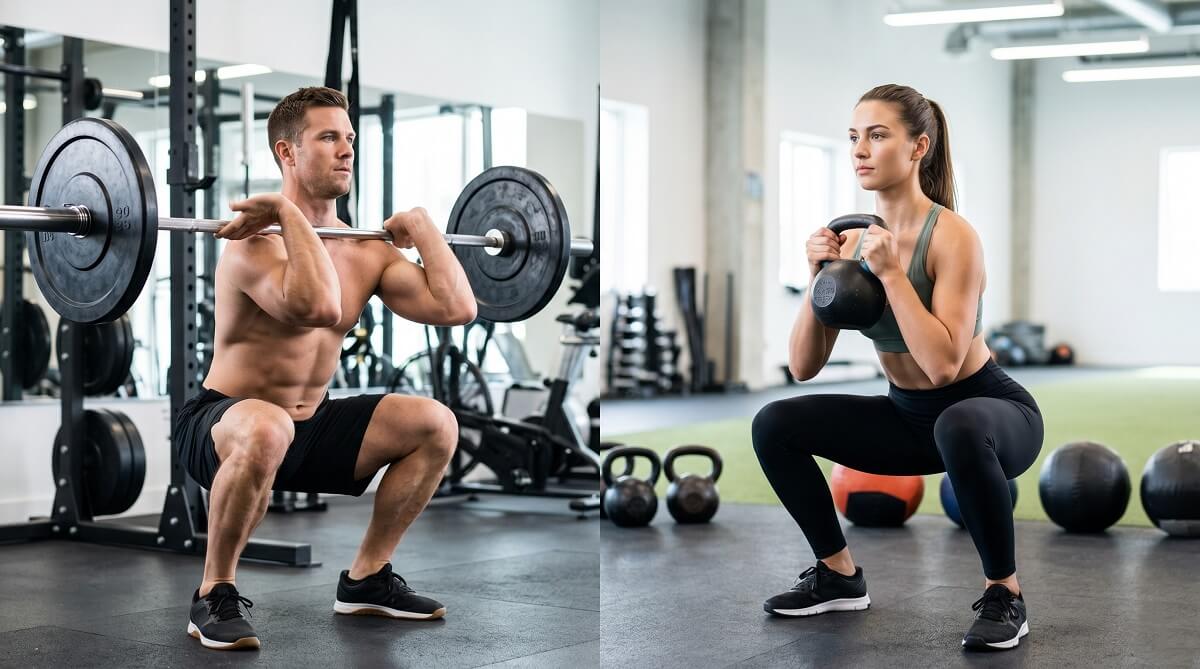
Both movements front-load your body and use the same basic squat pattern, but they’re not interchangeable. The goblet squat is simpler, more forgiving on mobility, and the better starting point for most people. The front squat takes over once you need to actually load your legs heavy — because the goblet variation has a ceiling that barbell front squats don’t.
If you’re new to lifting or returning after time off, start with goblet squats. They’re easier to learn, safer to self-coach, and require nothing more than a dumbbell or kettlebell. If you’ve been training for a while and your arms give out before your legs during goblet squats, that’s your cue to move to the barbell.
Most serious lifters end up using both — goblet squats for warm-up, mobility, and form work; front squats for the heavier leg-building sets. That’s not a bad place to land.
Quick Guide: Which Squat Fits Your Situation?
✅ Goblet Squat Is the Right Move If:
- You’re learning the squat pattern and want a self-correcting movement
- You train at home with dumbbells or kettlebells
- You have limited wrist or shoulder mobility
- You’re rehabbing an injury or coming back to training after a long break
- You want a low-risk warm-up before barbell work
❌ Add Front Squats (or Switch Entirely) If:
- Your arms fatigue before your legs on every goblet squat set
- You’ve maxed out the heaviest dumbbell or kettlebell your gym has
- You’re training for Olympic weightlifting or a barbell sport
- You want to build serious quad size and strength over months and years
What Makes These Two Squats Different?
The Goblet Squat
A goblet squat uses a single dumbbell or kettlebell held at chest height, cupped in both hands with palms facing up. The weight acts as a counterbalance that naturally pulls your torso upright as you descend. That’s what makes it so beginner-friendly — the exercise essentially self-corrects your position.
Setup is minimal. No barbell, no rack, no spotter. Pick up a weight, hold it at your chest, and squat. The bottom position feels natural for most people, with hips able to drop below the knees without a lot of coaching. for kettlebell and dumbbell recommendations if you’re building a home gym.
One thing worth knowing: kettlebells and dumbbells are both valid for goblet squats, but they feel slightly different. A kettlebell’s shape keeps the load close to your body; a dumbbell held vertically works just as well and is often what beginners have access to first. Either works — the mechanics are the same.
The Barbell Front Squat
A barbell front squat places the bar across the front of your shoulders, with your elbows raised high to keep it in place. The bar rests on the “shelf” created by your deltoids and clavicles — not in your hands. This shifts the upper body demand from grip strength (as in goblet squats) to rack position stability.
The front squat requires a squat rack or power cage for safe use. You can’t unrack a loaded barbell for a front squat without one. if you’re evaluating rack options. Entry-level power racks start around $200–$400 on Amazon (prices as of March 2026 — check current pricing).
Wrist and thoracic spine mobility are genuine prerequisites. Stiff wrists or tight shoulders will make the clean-grip front squat uncomfortable or impossible. Many lifters use a crossed-arm grip or wrist straps to get around mobility limitations early on.
Side-by-Side Comparison
| Attribute | Goblet Squat | Front Squat |
|---|---|---|
| Equipment needed | Dumbbell or kettlebell | Barbell + squat rack |
| Skill level | Beginner | Intermediate–Advanced |
| Loading ceiling | Limited by grip/arms | Essentially unlimited |
| Wrist mobility required | Minimal | Moderate–High |
| Core demand | Moderate | High |
| Quad emphasis | Moderate–High | High |
| Beginner-friendly | ✅ Yes | ❌ Not ideal |
| Used in strength sports | Rarely | Weightlifting, powerlifting |
Muscles Worked: Where Each Exercise Hits
Goblet Squat
According to NASM’s exercise guide, goblet squats work the quadriceps, hamstrings, glutes, core, upper back, and shoulders. The front-loaded position “shifts more emphasis to your glutes and quads” compared to back squats. Your core braces throughout the movement; your upper back holds the weight steady.
For depth, ACE Fitness specifies that the goal is hips dropping below the knees — deeper than parallel. That deeper position is where glute development really kicks in. Most beginners who struggle to hit depth on back squats find goblet squats much easier to get there.
Front Squat
Front squats hit the same primary muscles — quads, glutes, hamstrings, and core — but the heavier loading means the quads get taxed harder over time. According to ACE Fitness, the primary muscles are the quadriceps, back, and gluteus maximus.
NASM’s sports performance research also found that EMG activity in the quadriceps, hamstrings, and glutes is “nearly identical” between front squats and back squats. The front-loaded mechanics don’t dramatically change which muscles fire — but the upright torso does shift emphasis toward the quads and away from the posterior chain compared to a back squat.
The Bottom Line on Muscles
These two exercises target the same muscle groups. Both hit the anterior chain harder than back squats, as Healthline notes — the front of your body (quads, core) does most of the work in both variations. The difference isn’t what you’re training; it’s how much you can load it.
The Loading Problem: Why Goblet Squats Hit a Wall
Most commercial gyms top out at 100–120 lbs on their dumbbells. If you’re strong enough, you’ll reach a point where a goblet squat with the heaviest dumbbell doesn’t feel like a leg exercise anymore — it feels like a forearm and grip test. The upper body becomes the limiting factor, and your quads never get the challenge they need.
This is the central argument for front squats. When the bar rests on your shoulders, your grip is irrelevant. You can load 135, 185, 225 lbs or more, and the legs are always the weakest link in the chain. for barbell and rack options if you’re setting up at home.
When Should You Make the Switch?
The coaching framework used at Mike Boyle Strength & Conditioning (one of the more respected strength facilities in the country) lays it out clearly: goblet squat first, then double kettlebell front squat, then barbell front squat. The move happens when the upper body — not the legs — is what gives out first.
As a rough guideline, if you can goblet squat 60–80 lbs for 10 clean reps and your arms are still the limiting factor, it’s time to progress. The typical working range for goblet squats is 25–70 lbs for most lifters; once you’ve outgrown what you can hold, the barbell solves the problem.
Technical Demands: How Hard Are These to Learn?
Goblet Squat Setup
Hold a dumbbell or kettlebell at chest height with both hands. Feet are about shoulder-width apart, toes angled slightly out. Drop into the squat keeping your elbows inside your knees at the bottom. Keep your chest up throughout.
The most common mistake is rounding the upper back — usually a sign the weight is too heavy or the core isn’t braced. A second common error is letting the knees cave inward as you stand up. Fix that by actively pushing your knees out over your toes on the way down and up.
Front Squat Rack Position
Three options exist for the rack position: clean grip (fingertips hooked under the bar, elbows high), crossed-arm grip (arms crossed, hands on opposite shoulders), and wrist straps looped around the bar. The clean grip is more stable and what Olympic lifters use, but it demands solid wrist and thoracic spine flexibility.
The non-negotiable cue for front squats is elbows up. The moment your elbows drop, the bar rolls forward and you’re fighting to stay upright. Keep that in mind before loading up heavy.
Per ACE Fitness, a common technique error is holding the tibia too vertical — this pushes the torso forward. The fix: let the tibia angle forward as you descend while keeping the heels planted. This allows you to maintain an upright chest without collapsing.
Which Is Better for Teaching Squat Mechanics?
Goblet squats are the better teaching tool. The counterbalance naturally fixes torso angle and depth issues. Most coaches introduce goblet squats first precisely because learners improve faster — feedback is immediate and errors are self-correcting.
Think of the goblet squat as the on-ramp. Front squats are the highway. You need the on-ramp to get up to speed safely, but you won’t stay on it forever.
Who Should Use Each — Practical Use Cases
Goblet Squats Work Best For:
- Beginners and new lifters — the fastest path to a solid squat pattern
- Home gym lifters — no rack or barbell required; a single adjustable kettlebell (starting around $40–$150 on Amazon) covers a wide range of training
- Warm-up before barbell work — many experienced coaches program goblet squats as a mobility warm-up even for advanced athletes
- Rehab and return-to-training — the light load and self-correcting mechanics make goblet squats a preferred movement in physical therapy progressions, especially for anterior chain reactivation
- Lifters with wrist or shoulder issues — zero wrist demand compared to a clean-grip front squat
Front Squats Work Best For:
- Intermediate and advanced lifters who have outgrown goblet loading
- Olympic weightlifters — the front squat is required for the clean & jerk and is a primary training movement in that sport
- Anyone targeting quad hypertrophy — heavier loads mean more mechanical tension over time, which drives muscle growth
- Lifters who want upper back and posture benefits — maintaining the front rack position trains the upper back under load in a way goblet squats can’t match at higher weights
Can You (and Should You) Do Both?
Yes, and many programs do exactly this. A common setup: goblet squats as a warm-up set or accessory movement; barbell front squats as the main quad work. Using both isn’t redundant — they serve different purposes within the same session. The goblet squat primes your mobility and reinforces your pattern; the front squat is where the real loading happens. if you’re deciding between kettlebells, dumbbells, or a full barbell setup.
Frequently Asked Questions
Is a goblet squat the same as a front squat?
They share the same front-loading principle and similar muscle targets, but they’re not the same exercise. The goblet squat uses a single dumbbell or kettlebell held at chest height; the front squat uses a barbell resting on the front of the shoulders. The biggest practical difference is the loading ceiling — goblet squats plateau when grip becomes the limiting factor; front squats don’t have that ceiling.
Which is harder: goblet squat or front squat?
It depends on what you mean by harder. Goblet squats can feel deceptively demanding because the upper body fatigues quickly at heavier weights, making the legs feel less challenged. Front squats are technically more difficult to set up and require more mobility, but they allow your legs to work harder because the load can be much higher.
Can goblet squats replace front squats?
At light to moderate loads, they train similar patterns. But once you’re chasing real quad strength and hypertrophy, goblet squats can’t fully replace front squats — the loading ceiling is too low. If your gym has dumbbells up to 100 lbs and you can goblet squat them for clean reps without your legs being the first to go, you’ve already outgrown the goblet squat as your primary leg-strength tool.
How heavy should my goblet squat be before switching to front squats?
There’s no universal pound number, but the signal is clear: when your grip and arm position are failing before your legs, it’s time to move on. For most people, that happens somewhere in the 60–80 lb range. Once you’re working with quality technique at those loads for 10+ reps and still don’t feel the legs adequately challenged, a barbell front squat will take you further.
Do front squats hurt your wrists?
Wrist discomfort with a clean grip is common at first, especially for people with limited wrist flexibility. It usually improves with consistent practice and mobility work. If it’s a barrier, a crossed-arm grip or wrist straps are legitimate alternatives that remove the wrist demand entirely while keeping the movement benefits.
Are goblet squats good for bad knees?
Generally yes — the upright torso and front-loaded position reduce posterior shear force on the knee compared to a back squat. Both goblet squats and front squats are considered easier on the lower back and knees than back squats for many people. That said, knee problems vary; check with a physical therapist for your specific situation before loading up.
Which is better for building quad size?
Front squats win in the long run because they allow progressive overload without the grip bottleneck. More load over time means more mechanical tension on the quads, which is the primary driver of muscle growth. Goblet squats will build your quads when you’re starting out, but they’ll plateau once you’ve maxed out available weight.
Do I need a power rack for front squats?
Yes — you can’t safely unrack a loaded barbell for a front squat without a rack or power cage. Entry-level squat racks start around $200–$400 on Amazon (check current pricing). If that’s not in the budget, double kettlebell front squats are a solid middle step — they load the front rack position much more than a goblet squat without requiring a full barbell setup.
If you’re ready to add front squats to your program, you’ll need a barbell and a rack. Check current power rack prices on Amazon, or start with an adjustable kettlebell for goblet squats — see current options and pricing on Amazon.
