


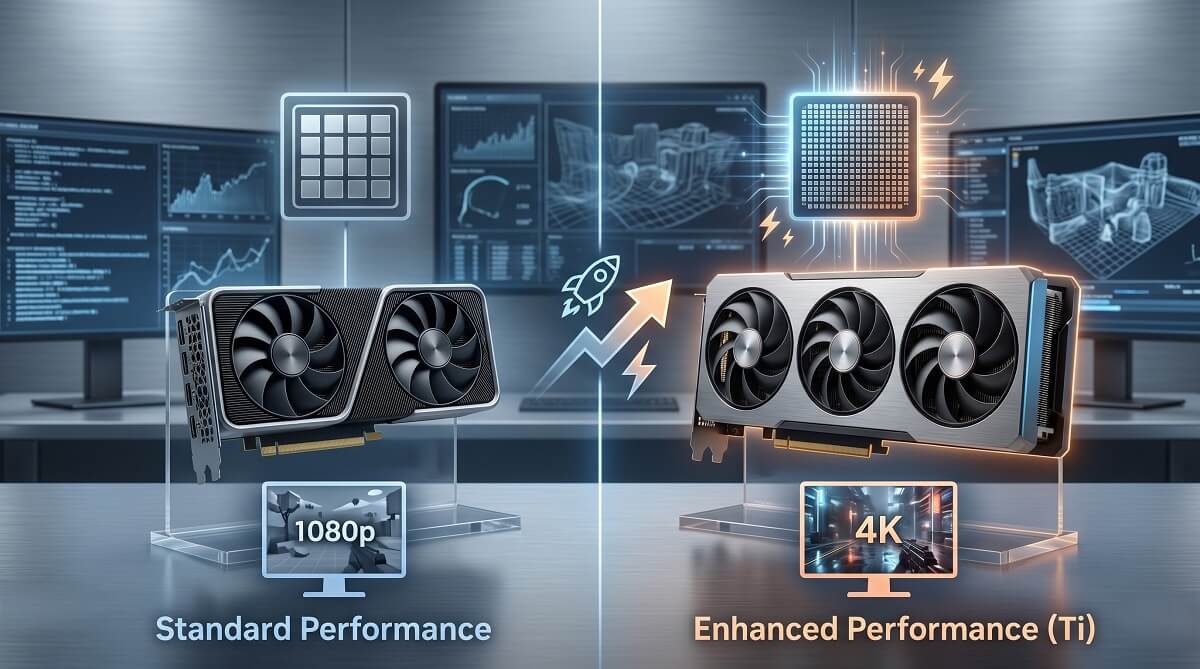
Ti stands for Titanium. It’s NVIDIA’s way of labeling a more powerful version of a graphics card within the same generation. Think of it as the Pro model — same GPU family, better specs, higher price.
That’s the short answer. But if you’re staring at an RTX 5070 vs an RTX 5070 Ti and trying to figure out whether to spend the extra $200, you need more than a two-sentence definition. You need to know what actually changes under the hood, what the performance difference looks like in real games, and whether the bump in performance is worth the bump in price for your setup.
This article breaks all of that down using current GPU data and real street prices as of March 2026.
What Does Ti Actually Stand For?
Ti is short for Titanium — borrowed from the periodic table symbol for the element. NVIDIA has never officially published a definition, but “Titanium” is the community-accepted explanation and it fits the intent: titanium suggests strength and a step above the baseline.
To be clear, there’s no actual titanium in the card. It’s a branding choice, not a materials decision. NVIDIA uses the Ti suffix to signal that a particular model is an upgraded version of the base GPU with the same number.
An RTX 5070 Ti is not a different product line from the RTX 5070. It’s a step up within the same generation — more capable hardware, same architecture, more money.
A Brief History of the Ti Name
The Ti label is older than most people realize. NVIDIA first used it on the GeForce 2 Ti back in 2001. During the 200–400 series era, Ti was just one of several tier designations alongside GT, GTS, and GTX — more of a product-line label than a performance promise.
Starting with the 500-series, Ti shifted into what it is today: a marketing label for a meaningfully upgraded version of a base GPU. The GTX 560 Ti in 2011 is often cited as the card that set this convention. From that point on, buying the Ti meant buying noticeably better hardware — not just a different SKU.
Here are the Ti cards most PC builders remember:
- GTX 560 Ti (2011) — Defined the modern Ti formula: better chip, same model number
- GTX 980 Ti (2015) — Near-flagship performance at a more accessible price than the Titan X
- GTX 1080 Ti (2017) — Widely considered one of the best-value flagship GPUs ever made
- RTX 2080 Ti (2018) — Flagship-tier pricing and performance; the first real-time ray tracing powerhouse
- RTX 3060 Ti (2020) — The sweet-spot card of the 30-series generation
- RTX 4070 Ti (2023) — High-end 40-series offering
- RTX 5070 Ti (2025) — Current high-end Blackwell card
One more thing worth mentioning: NVIDIA also added SUPER variants in the 40-series (e.g., RTX 4070 Ti SUPER). SUPER cards are a mid-cycle refresh that sits between the base and Ti in most cases — more on that in a moment.
What’s Actually Different in a Ti GPU?
Every Ti card has the same fundamental relationship to its non-Ti counterpart:
- More CUDA cores — the parallel processing units that handle graphics, gaming, and compute workloads
- Often more VRAM (video memory) — particularly important for high-resolution gaming and content creation
- Different (sometimes higher, sometimes slightly lower) boost clock speeds
- Higher TDP (thermal design power — how much power the card draws under load)
- Same GPU architecture generation — Ti is not a newer or fundamentally different chip family
Let’s look at two current-gen examples with actual numbers.
RTX 4070 vs RTX 4070 Ti
Both cards are built on NVIDIA’s Ada Lovelace architecture using the AD104 chip. The Ti version unlocks more of the chip’s potential.
| Spec | RTX 4070 | RTX 4070 Ti |
|---|---|---|
| CUDA Cores | 5,888 | 7,680 |
| Memory | 12 GB GDDR6X | 12 GB GDDR6X |
| Boost Clock | 2,475 MHz | 2,610 MHz |
| TDP | 200W | 285W |
| Launch MSRP | $599 | $799 |
| Street Price (Mar 2026) | ~$703 (Amazon) | ~$716–$849 (Amazon) |
The RTX 4070 Ti has about 30% more CUDA cores and draws 85W more power. In real games at 1440p, that translates to roughly a 25–30% frame rate advantage in GPU-limited scenarios. Interestingly, as of March 2026, the street price gap has narrowed significantly from launch — the Ti is sometimes only $13–$146 more depending on which specific card you’re looking at. That’s worth checking before you buy.
You can compare current prices for the RTX 4070 on Amazon and the RTX 4070 Ti on Amazon.
RTX 5070 vs RTX 5070 Ti
The 50-series (Blackwell architecture) tells a slightly different story. Here the VRAM difference is significant — 4 GB more on the Ti — which matters for 4K gaming and AI workloads.
| Spec | RTX 5070 | RTX 5070 Ti |
|---|---|---|
| CUDA Cores | 6,144 | 8,960 |
| Memory | 12 GB GDDR7 | 16 GB GDDR7 |
| Boost Clock | 2,512 MHz | 2,450 MHz |
| TDP | 250W | 300W |
| MSRP | $549 | $749 |
| Street Price (Mar 2026) | $549–$740 | $749–$1,300+ |
Specs sourced from NVIDIA’s official GPU compare page.
The 5070 Ti has about 46% more CUDA cores and 4 GB more GDDR7 memory. In gaming benchmarks, that’s roughly an 18% advantage at 1440p and closer to 25% at 4K. The VRAM bump from 12 GB to 16 GB also matters if you’re running texture-heavy games at 4K or using the card for video editing.
One caveat: as of March 2026, RTX 5070 Ti street prices are all over the place due to supply constraints. MSRP is $749, but many listings sit above $1,000. A PNY model recently appeared at $749 on Amazon — if you see the Ti at or near MSRP, that changes the value math considerably.
Current prices: RTX 5070 on Amazon | RTX 5070 Ti on Amazon.
Ti vs. SUPER vs. OC Edition — What’s the Difference?
NVIDIA’s naming has gotten more complicated with the 40-series, so here’s a plain-language breakdown:
- Ti: A different, more capable chip from NVIDIA. More CUDA cores, often more VRAM. A real hardware upgrade over the base model.
- SUPER: NVIDIA’s mid-cycle refresh naming (introduced in the 40-series). SUPER cards generally land between the base model and the Ti in performance — more CUDA cores than the base, fewer than the Ti. The RTX 4080 SUPER, for example, has 10,240 CUDA cores, compared to 7,680 in the 4070 Ti and 16,384 in the 4090.
- OC Edition: Same chip and tier as the standard card — just factory-overclocked by the board partner (ASUS, MSI, Gigabyte, etc.). You might gain 1–3% performance. You can often achieve the same result by manually overclocking a non-OC card yourself.
The key point: you cannot overclock a non-Ti into Ti performance. Ti vs. non-Ti is a hardware difference, not a settings difference. OC Edition is cosmetic in comparison.
Should You Buy the Ti Version?
Here’s the honest breakdown by situation.
Buy the Ti if…
- You’re gaming at 1440p and want noticeably higher frame rates — the Ti’s extra CUDA cores make a meaningful difference at this resolution
- You’re targeting 4K gaming — the Ti’s performance advantage grows at 4K, and the extra VRAM in cards like the 5070 Ti handles 4K textures better
- You do video editing, 3D rendering, or AI workloads — extra VRAM matters here more than in casual gaming
- The price gap is under 20% between Ti and non-Ti when you’re shopping — this happens occasionally when discounts hit the Ti before the base model
Skip the Ti if…
- You’re gaming at 1080p — the base model is almost always enough, and you’re leaving money on the table with a Ti at this resolution
- Your budget is tight — the non-Ti delivers roughly 75–85% of the Ti’s performance for significantly less money in most cases
- The Ti costs more than 30–35% extra vs. the base model — at that point, look at the next tier up rather than paying a Ti premium
- You’re buying used — the Ti/non-Ti pricing gap on the secondary market is inconsistent; sometimes the base model is the better deal, sometimes the Ti is underpriced
The Honest Math on the RTX 5070 vs 5070 Ti
At MSRP: the RTX 5070 Ti costs $200 more than the RTX 5070 ($749 vs $549). For that extra $200, you get approximately 18% more performance at 1440p and 25% more at 4K, plus 4 GB more VRAM.
In practical terms, if you’re playing at 1440p and the 5070 hits 124 FPS average in your games, the 5070 Ti might hit around 146 FPS. Whether 22 extra frames is worth $200 is a personal call — but for most people who are happy at high-refresh 1440p, the 5070 does the job.
Where the Ti case gets stronger is if you’re doing creative work. The jump from 12 GB to 16 GB GDDR7 VRAM isn’t just a gaming metric — it determines whether large video projects, AI models, or complex 3D scenes run cleanly or start paging to system RAM. For that workload, the extra $200 is easier to justify.
For more help building your GPU budget, check out the ChubbTips buying guides and the gaming section for GPU-specific recommendations.
Final Verdict
Ti means Titanium — a step-up version of the base GPU with more CUDA cores, sometimes more VRAM, higher power draw, and a higher price tag.
For most gamers at 1080p, the base model is the smarter buy. For 1440p and 4K gaming, or for content creation work where VRAM is the bottleneck, the Ti earns its premium. And if you catch the Ti at a sale where the price gap has narrowed, it becomes even easier to recommend.
The most important thing to check before you buy: actual street prices, not launch MSRPs. In March 2026, you can find the RTX 4070 Ti on Amazon for close to the 4070’s street price — which completely changes the equation. Always check current listings before committing.
Frequently Asked Questions
- Does Ti actually mean titanium?
- Yes — Ti is short for Titanium, borrowed from the element’s periodic table symbol. NVIDIA has never officially confirmed this, but it’s the accepted explanation. There’s no actual titanium in the card.
- Is a Ti GPU always better than the non-Ti version?
- Better specs, yes. Better value, not always. If the Ti costs 40% more than the base model and you’re gaming at 1080p, you’re overpaying for performance you won’t use.
- What’s the difference between Ti and SUPER?
- Both are hardware upgrades over the base model, but they’re different product tiers. SUPER is NVIDIA’s mid-cycle refresh (added in the 40-series). Ti typically sits above SUPER in the stack — though this varies by generation. OC Edition is a sub-variant of any of these: same hardware, just factory-overclocked by the board partner.
- Can I overclock a non-Ti card to Ti performance?
- No. Ti and non-Ti cards have different hardware — different numbers of active CUDA cores. Overclocking only increases clock speeds on the cores that are already active. You can’t unlock disabled hardware.
- Does AMD have a Ti equivalent?
- AMD uses different suffixes for the same concept. XT and XTX on their RX cards indicate a more capable version of the same architecture — same idea as Ti, different letters. The RX 7900 XTX, for example, is AMD’s top-of-line version of the RX 7900 family.
- Is the RTX 5070 Ti worth buying right now (March 2026)?
- At MSRP ($749), yes — if you’re gaming at 1440p or 4K, or doing creative work. But street prices above $1,000 make it a much harder sell when you can buy a base RTX 5070 at or near its $549 MSRP. Watch for price drops and buy when the gap is reasonable.
