


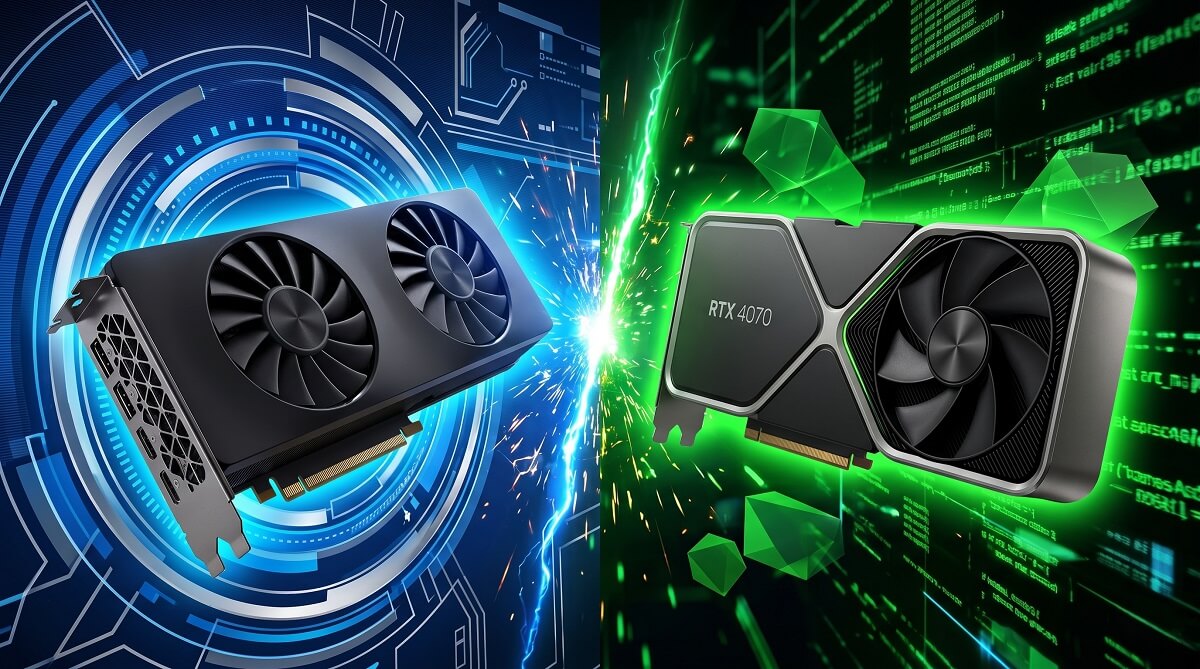
The RTX 4070 is faster — by a lot. In aggregate benchmarks, NVIDIA’s card holds roughly a 70% performance lead over the Arc B580. But here’s the catch: finding an RTX 4070 at a sane price in 2026 is genuinely difficult. New units on Amazon are running around $703 — nearly $300 above the original $599 MSRP, thanks to supply tightening after the RTX 5000 series launch. Used RTX 4070 cards on eBay are more reasonable at around $490, but you’re still looking at a $200+ premium over the B580’s current $299 street price. For most people building a new gaming PC right now, that math matters.
The Arc B580 is Intel’s Battlemage architecture card, and it’s a genuine step up from the rough Alchemist debut. It’s a 12 GB card that competes directly with the RTX 4060 — not the RTX 4070. Comparing it to the 4070 is mostly useful for understanding the performance ceiling you give up in exchange for a lower budget. If you’re eyeing the 4070 for its raw power, that’s legitimate. But if you’re stretching the budget to buy a 4070 over a B580, the extra dollar-per-frame math starts to look shaky.
One thing to know before you buy: the Arc B580 benefits significantly from Resizable BAR (ReBAR). Intel officially calls it mandatory for optimal performance, and some sources report a 20–40% drop without it. Most systems built in the last three to four years support it, but if you’re running older hardware, verify before purchasing. The RTX 4070, by contrast, runs fine on PCIe 3.0 with negligible performance loss.
Who Should Buy Which GPU?
✅ Buy the Arc B580 if:
- You’re on a budget and want a solid 1440p gaming card around $250–$300
- You want 12 GB VRAM without paying mid-range premium prices
- Your monitor supports DisplayPort 2.1 — the B580 includes three DP 2.1 outputs capable of 4K@240Hz, while the RTX 4070 tops out with DP 1.4a
- You’re pairing it with a modern system that supports PCIe 4.0 and Resizable BAR
- You mostly play titles where Arc drivers perform well (Cyberpunk 2077, Dying Light 2, newer DX12 games)
❌ Skip the Arc B580 if:
- Your system lacks PCIe 4.0 or Resizable BAR support — performance takes a serious hit without ReBAR enabled
- You play a heavy rotation of older DX9 titles or competitive shooters where frametime consistency matters most
- You rely on CUDA-dependent software: AI tools, DaVinci Resolve with RAW codecs, or ML workloads
- You game exclusively at 1080p — the RTX 4060 is a more refined choice at that resolution
✅ Buy the RTX 4070 if:
- You find a used card around $400–$490 on eBay or a clearance deal — at that price it’s a strong value
- You want maximum driver maturity and near-universal game compatibility
- You use DLSS 3 Frame Generation — it’s in 150+ supported games vs. XeSS frame gen’s handful of titles
- Your workflow involves NVENC video encoding, CUDA-accelerated software, or AI-assisted creative tools
- You want a GPU with strong resale value and a proven track record
❌ Skip the RTX 4070 if:
- You’d be paying $600+ new — at that price, a used RTX 4070 Ti or a newer RTX 5000 series card makes far more sense
- Budget is your main constraint — you’re paying for a brand premium that doesn’t translate to a proportional performance gain over the B580
Specs Side by Side
Shared DNA: both chips carry 12 GB of VRAM on a 192-bit memory bus. That’s where the similarity ends. The RTX 4070 packs more than twice the shader units and nearly 2.5× the floating-point throughput — all for a launch price that’s $350 higher than the B580’s MSRP.
| Spec | Intel Arc B580 | NVIDIA RTX 4070 |
|---|---|---|
| Launch Price (MSRP) | $249 | $599 |
| Current Street Price (Mar 2026) | ~$299 new / ~$234 used | ~$703 new / ~$490 used |
| Architecture | Xe2 (Battlemage) | Ada Lovelace |
| Shader Units | 2,560 | 5,888 |
| VRAM | 12 GB GDDR6 | 12 GB GDDR6X |
| Memory Bandwidth | 456 GB/s | 504 GB/s |
| TDP | 190W | 200W |
| PCIe Interface | PCIe 4.0 x8 | PCIe 4.0 x16 |
| Display Outputs | 1x HDMI 2.1a, 3x DisplayPort 2.1 | 1x HDMI 2.1, 3x DisplayPort 1.4a |
| Ray Tracing Cores | 20 | 46 |
| Upscaling Tech | XeSS (+ XeSS 3 MFG rolling out) | DLSS 3 (Frame Gen in 150+ games) |
| Floating Point | 13.67 TFLOPS | 29.15 TFLOPS |
| Release Date | December 2024 | April 2023 |
A note on the display outputs: the B580’s three DisplayPort 2.1 connections are genuinely useful if you run a high-refresh 4K monitor. DP 2.1 supports 4K at up to 240Hz or 8K at 60Hz. The RTX 4070’s DP 1.4a tops out at 4K@120Hz without compression. For most 1440p setups, neither matters — but it’s a quiet advantage for the B580 if you’re eyeing a next-gen display.
Gaming Performance: What the Numbers Show
Based on GamersNexus benchmarks from December 2024 using an AMD 9800X3D platform, here’s how these cards actually play out in real games.
1080p — The B580’s Weak Spot
At 1080p, the performance gap between the B580 and RTX 4060 (its actual price competitor) shrinks to near nothing — or reverses entirely in some titles. The RTX 4070 meanwhile runs roughly 64% faster on average across popular games. In Starfield at 1080p, the RTX 4060 had a 10 FPS average lead over the B580, and the frametime pacing on the B580 was noticeably erratic — frame delivery ranged from 13ms to 53ms with no pattern to it. If you’re gaming on a 1080p monitor and care about smooth frame delivery in competitive or CPU-heavy games, the B580 doesn’t make a strong case here.
That said, in Cyberpunk 2077 at 1080p, the B580 led the RTX 4060 by 18% in average framerate — one of its better showings. The card is game-dependent at this resolution.
1440p — Where the B580 Earns Its Money
This is the sweet spot. At 1440p, the B580 consistently beats the RTX 4060 by 19–28% depending on the title. In Final Fantasy XIV at 1440p, the B580 ran 86 FPS average — solid and playable. In Cyberpunk 2077 at 1440p Ultra, it hit 53 FPS and led the RTX 4060 by 36%. The 12 GB VRAM matters here, giving the B580 headroom that the 8 GB RTX 4060 lacks in some VRAM-hungry titles.
The RTX 4070 still leads the B580 by about 60% at 1440p, but given the ~$200 price gap between a used 4070 and a new B580, you’re paying roughly $3–$4 per additional frame. Whether that’s worth it depends entirely on your budget and how much that performance delta matters to your specific game library.
4K — Mostly Academic, But Interesting
Neither card is designed as a 4K gaming GPU. The RTX 4070 handles 4K better — it’s genuinely capable at medium-high settings in most titles. The B580 can push 4K in less demanding games like Final Fantasy XIV (47 FPS average at 4K), but struggles in more demanding titles.
One useful data point: the B580 scales surprisingly well as resolution climbs. In Final Fantasy XIV, it led the RTX 4060 by 28.6% at 4K — compared to just 10% at 1080p. If you ever do try 4K with the B580, it punches harder than its specs suggest at that resolution.
Ray Tracing
The RTX 4070 holds a larger lead in RT workloads — it has 46 ray tracing cores vs. the B580’s 20. In most RT benchmarks, the 4070 leads by 40–60% over the B580. But here’s the surprise: the B580’s RT performance relative to its price is competitive. In GamersNexus testing, it outperformed the AMD RX 7600 in Dying Light 2 RT by 44%, and in Cyberpunk RT Medium mode, it ran 62% ahead of the 7600 while maintaining stable frametimes. One hard caveat: the B580 hard-locked when attempting Cyberpunk RT Ultra — a driver-level issue that may have since been patched but warrants verification before relying on extreme RT settings.
On the upscaling side, DLSS 3 Frame Generation on the RTX 4070 is a real, meaningful advantage in supported games. It’s available in 150+ titles and works well. Intel’s XeSS 3 with Multi-Frame Generation is rolling out to the B580, but game support remains limited — a handful of titles compared to DLSS 3’s broad library. This gap will close over time, but right now, DLSS 3 is the better upscaling ecosystem.
Content Creation: A Complicated Picture
If you edit video or work in creative apps, the story gets more nuanced. According to Puget Systems’ December 2024 review, the B580 matched the RTX 4070 in GPU effects benchmarks within After Effects and DaVinci Resolve — impressive for a $250 card. In DaVinci Resolve Fusion tests, it outperformed the previous-gen A770 by 7%. For GPU-accelerated effects work, it’s a legitimate budget option.
The weak spots are real, though. In DaVinci Resolve RAW codec processing, the B580 ran 16% behind the RTX 4060. NVIDIA’s NVENC encoder and CUDA acceleration still have no real equivalent on Intel hardware for professional workflows. For users who rely on AI-assisted tools (Topaz Video AI, DaVinci Resolve AI features), the RTX 4070 leads the B580 by 43% in Puget’s testing — NVIDIA’s tensor core advantage is significant here.
Bottom line for creators: the B580 works well for GPU effects and basic editing. For RAW codecs, AI-assisted tools, or anything CUDA-dependent, the RTX 4070 — or any NVIDIA card — is the safer choice.
Power Draw, Driver Maturity, and System Compatibility
Power Consumption
Gaming TDPs are close: B580 at 190W, RTX 4070 at 200W. Idle power draw is a different story. The B580 pulls around 35W at desktop idle — over three times the RTX 4060’s 11W idle, according to GamersNexus’s isolated power testing. For a gaming rig that spends most of its time browsing the web or running background tasks, this translates to a few watts of extra electricity cost per hour. Not a dealbreaker, but worth knowing if energy efficiency matters to you.
Driver Maturity
The RTX 4070 runs on NVIDIA’s well-established driver stack. Game compatibility is about as close to universal as you’ll find. The B580 is a different story — improved, but still a work in progress. Intel’s Battlemage launch was far cleaner than the Alchemist debut, with GamersNexus reporting only one game-breaking bug across their entire test suite (the Cyberpunk RT Ultra hard lock). Most modern DX12 games work well. Intel has implemented driver-level DXVK for older DX9 title support, which has improved compatibility considerably.
Where you’ll still notice Intel’s growing pains: some DX11 games (Baldur’s Gate 3 showed occasional frametime spikes), Starfield (poor frametime consistency at launch), and any game or app that relies on CUDA. Check reviews for your specific game list before committing. The B580 is ready for general gaming — it’s not ready for every use case without verification.
System Compatibility Requirements
The B580 officially requires a PCIe 3.0 x16 slot at minimum, but Intel’s own documentation labels Resizable BAR (ReBAR) as mandatory for optimal performance. Without ReBAR, expect throughput to drop by 20–40% depending on the workload. Most platforms from 2020 onward — Intel 10th Gen, AMD Ryzen 3000 series, and newer — support ReBAR. Verify in your BIOS before installing. The RTX 4070 runs well on PCIe 3.0 with negligible real-world performance loss, and doesn’t require any special BIOS settings for full performance.
Power connectors also differ: the B580 uses a standard 8-pin PCIe connector, while the RTX 4070 uses a 16-pin (12VHPWR) connector — an adapter is typically included, but check your power supply cables. Both cards require at least a 600W PSU.
The Real Value Equation in March 2026
Here’s the honest price-per-frame comparison. At current market prices (as of March 2026, via bestvaluegpu.com), the Arc B580 at $299 new delivers around 121 FPS average at 1080p across popular games. The RTX 4070 at $703 new delivers roughly 198 FPS — a 64% output advantage for a 135% price premium. The cost-per-frame math strongly favors the B580 at current new pricing.
The better deal on the RTX 4070 side is the used market. At $490 on eBay, you’re paying about 63% more than a new B580 for 60–70% more average performance. That’s closer to even, and if you value driver maturity, DLSS 3, and CUDA, the used RTX 4070 becomes genuinely competitive.
One more consideration: before buying a used RTX 4070, check whether the RTX 4070 Super makes more sense. It’s about 11% faster than the base 4070, and used 4070 Super cards have come down in price significantly. In a market where new RTX 4000 series inventory is drying up, used card prices fluctuate — do a quick price check before committing.
Frequently Asked Questions
Is the Intel Arc B580 a good alternative to the RTX 4070?
Not as a direct substitute — the RTX 4070 is roughly 60–70% faster in gaming benchmarks. But the B580 is a legitimate option if you’re building a mid-range PC and can’t justify the 4070’s price tag. At $299, it competes more directly with the RTX 4060 than the 4070, and it typically beats the 4060 at 1440p.
What resolution is the Arc B580 best at?
1440p is where the B580 delivers the best value. Its 12 GB VRAM and 456 GB/s bandwidth give it a real edge over 8 GB cards at this resolution, and it consistently outperforms the RTX 4060 by 19–28% in modern titles. At 1080p, the gap over the 4060 shrinks and frametime consistency becomes more of a concern in some games.
Does the Arc B580 support DLSS?
No. DLSS is NVIDIA-exclusive. The B580 supports Intel’s XeSS upscaling, which works across all hardware (not just Intel). Intel is rolling out XeSS 3 with Multi-Frame Generation to the B580, but DLSS 3 remains well ahead in game library support with 150+ supported titles.
Is the RTX 4070 still worth buying in 2026?
At its original $599 MSRP, yes — it was an excellent card. At current new prices of $700+, it’s hard to recommend. A used RTX 4070 in the $400–$500 range on eBay is a much better deal. But check whether the RTX 4070 Super or an entry-level RTX 5000 series card offers better value at similar used prices first.
How does the Arc B580 compare to the RTX 4060?
At 1440p, the B580 leads the RTX 4060 by 19–28% in most titles while costing about the same or less. It also offers 12 GB of VRAM vs. the 4060’s 8 GB. The tradeoff is NVIDIA’s more mature driver stack and DLSS 3 support. For most gamers on a tight budget targeting 1440p, the B580 is the stronger technical choice — but the 4060 is the safer, less-troubleshooting-required option.
Can the Arc B580 run ray tracing?
Yes, and it does so better than AMD’s competing cards at a similar price. In GamersNexus testing, the B580 ran 44–62% ahead of the AMD RX 7600 in RT-heavy tests. It can’t match the RTX 4070’s 46 RT cores, but it’s a capable RT card for its price class. Note: Cyberpunk RT Ultra caused a hard lock at launch — check for driver updates before relying on extreme RT settings.
Does the Arc B580 need PCIe 4.0?
Technically, it runs on PCIe 3.0. But Intel officially recommends PCIe 4.0 and requires Resizable BAR to be enabled for full performance. Without ReBAR, performance can drop by 20–40%. Most systems from 2020 onward support this, but verify in your BIOS before buying.
Which GPU is better for video editing — Arc B580 or RTX 4070?
For GPU effects acceleration in Premiere Pro and DaVinci Resolve, the B580 actually matches the RTX 4070. For RAW codec workflows, AI-assisted tasks, and anything CUDA-dependent, the RTX 4070 is significantly better — up to 43% faster in AI workloads. If you edit with CUDA-dependent tools, don’t buy Intel. For general editing on a budget, the B580 is more capable than most expect.
Check current prices before you decide — the gap between new and used pricing on both cards is significant in March 2026. See the Arc B580 on Amazon or Best Buy, and the RTX 4070 on Amazon. For used cards, compare eBay listings against current new pricing to make sure the deal actually makes sense.
