


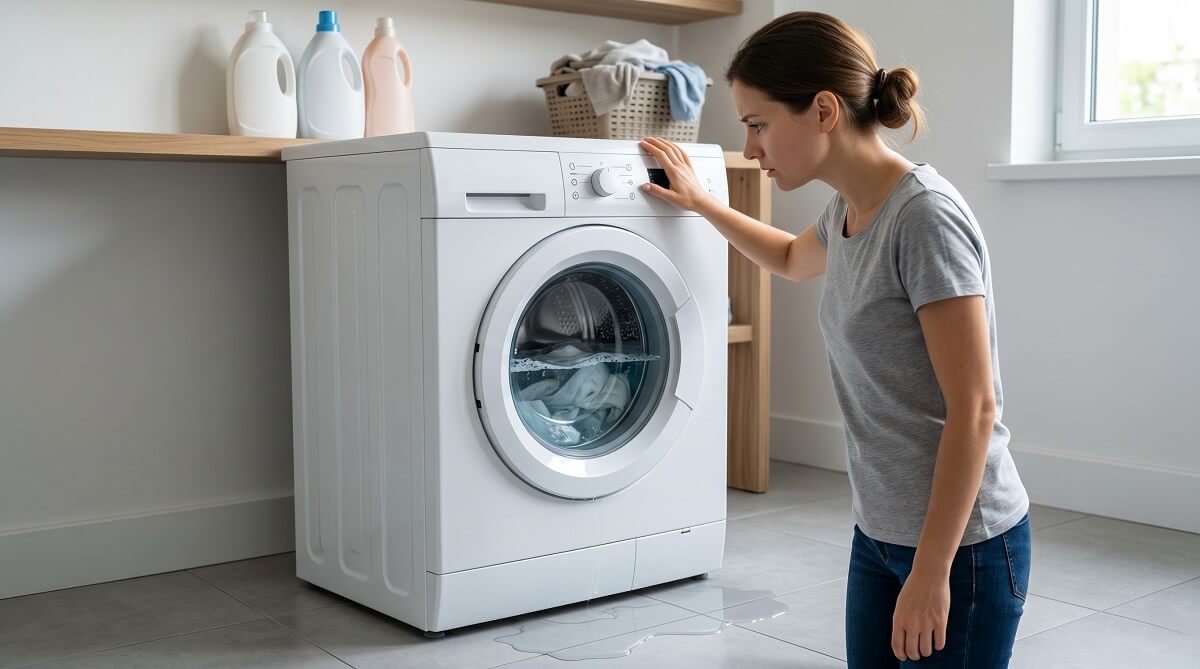
Your washer fills and agitates just fine, then stops dead — clothes sitting in a tub full of water. Before you call a repair tech or start pricing new machines, know this: the vast majority of these failures come down to three things — a failed lid switch, a clogged drain pump, or a broken motor coupling. All three are fixable in under an hour for well under $30 in parts, if you’re comfortable turning a screwdriver.
Work through the checks below from easiest to hardest. Start with the no-tool quick checks before touching any internal parts. You’ll find the culprit faster than you’d expect, and you might save yourself a $150 service call in the process.
Should You Fix It or Replace It?
✅ Try fixing it yourself if:
- Your machine fills and agitates normally (the motor is running)
- The washer is under 10 years old and otherwise works well
- You’re comfortable with basic hand tools and removing a few screws
- The likely repair (lid switch, pump, coupling) costs under $60 in parts
❌ Consider replacing if:
- The machine is 12+ years old with multiple failing parts
- The motor or control board has failed — repairs can run $150–$350 for parts alone
- Total repair cost (parts + labor) would exceed 50% of what a comparable new washer costs
- You’re hearing grinding or burning smells along with the drain/spin failure
Start Here — Quick Checks Before Touching Anything
Run through these four checks first. They cost nothing and take two minutes. You’d be surprised how often the fix is this simple.
1. Verify Your Spin Speed Setting
According to Whirlpool’s official troubleshooting guide, gentle and delicate cycles deliberately use slow spin speeds to protect fabrics. That slow spin leaves significantly more water in your clothes — enough that they feel like the machine didn’t spin at all. If you ran a delicate or handwash cycle, switch to a heavy duty or normal cycle and run again before assuming there’s a mechanical fault.
2. Look for an Unbalanced or Overloaded Drum
Washers have a built-in out-of-balance detection system. If heavy items like jeans, towels, or a comforter shift to one side during spin, the machine will slow down or abort the spin cycle to avoid damage. Open the lid, redistribute the load evenly, reduce the amount in the drum if it’s packed full, and restart the spin cycle.
3. Too Much Detergent
Excess suds create a foam layer that blocks the drain pump’s ability to move water. Whirlpool’s official guidance specifically states that “high amounts of detergent can create too many suds” that prevent the washer from pumping and spinning. If you’ve been eyeballing detergent, start measuring. If you have a high-efficiency (HE) machine, make sure you’re using HE-rated detergent — regular detergent produces far more suds than HE tolerates.
4. Examine the Drain Hose
Pull the machine away from the wall and trace the drain hose from the back of the washer to wherever it empties. Look for kinks, sharp bends, or obvious obstructions. Also verify the standpipe height: according to Whirlpool, the drain standpipe must sit between 30 inches (76 cm) and 96 inches (244 cm) from the floor. A standpipe that’s too tall prevents the pump from pushing water out — it can even siphon back into the tub.
Gravity drain test: If you suspect a pump issue but want to confirm, lower the drain hose below the water level of the tub and let gravity drain it into a bucket. If water flows freely by gravity but not when the machine is running, the pump itself is likely the problem (not a clog in the hose).
The #1 Culprit — Lid Switch Failure
If the quick checks don’t solve it, the lid switch is your most likely suspect. On top-load washers, this switch tells the machine whether the lid is open or closed. If it fails in the “open” position, the washer will agitate (which doesn’t require a closed lid on many models) but refuse to drain or spin — because it thinks you’ve got your hand in there.
How to Test the Lid Switch
There are three ways to test it, from simplest to most thorough:
- Listen test: Turn the dial to “Spin” and start the machine. After about 10 seconds, open the lid quickly. If there’s absolutely no motor sound or movement, the lid switch is a strong suspect — the machine never got the “closed” signal.
- Screwdriver bypass: With the machine off, press the lid switch actuator (the tab the lid presses when closed) with a screwdriver while turning on the spin cycle. If the machine starts spinning, you’ve confirmed the switch is the problem.
- Multimeter test: Disconnect power. Access the switch (usually 2 screws on the control panel). Test for continuity across the switch terminals with the lid plunger depressed. No continuity = bad switch, replace it.
Note on bypassing: Permanently jumpering the lid switch is a safety hazard — the drum won’t stop when you open the lid. Use bypass only for temporary diagnosis, not as a long-term fix.
Replacing the Lid Switch
Lid switch replacements are one of the easiest washer repairs you can do. The part typically runs $10–$45, with most common Whirlpool, Kenmore, GE, and Maytag switches falling in the $15–$40 range on Amazon (as of March 2026 — verify current pricing). The repair itself involves removing 2 screws from the control panel, disconnecting the wiring harness, and snapping in the new switch. Most people finish in 10–15 minutes. Search your model number on YouTube and you’ll find a step-by-step video for your exact machine.
- Part cost: $10–$45
- Time: 10–20 minutes
- DIY difficulty: ⭐ Easy
Second Most Common — Drain Pump Problems
If the lid switch checks out, look at the drain pump. The pump is what physically pushes water out of the tub. Two things go wrong with pumps: they get clogged, or they fail outright.
Signs the Pump Is the Issue
- The machine hums during the drain cycle, but no water moves
- The gravity drain test worked (water flows freely), but the pump doesn’t engage
- You hear rattling or a grinding noise during the drain cycle — often a foreign object lodged in the impeller
- Water drains very slowly instead of completely stopping
Checking for a Clogged Pump
Socks, coins, hair ties, and small articles of clothing are the usual suspects. On front-load washers, there’s often an accessible filter panel at the bottom front — clean it regularly. On top-load machines, you’ll need to tilt the machine forward (lay it on its front carefully) and access the pump from the bottom.
Once you can see the pump, spin the impeller by hand. It should turn freely. If it’s stuck, something is lodged in it. Disassemble the pump housing (usually 3–4 screws), clear the debris, and reassemble. Many “bad pumps” are actually just clogged ones.
- Part cost: $0 (if just clearing a clog)
- Time: 20–45 minutes
- DIY difficulty: ⭐⭐ Moderate
Replacing a Faulty Drain Pump
If the impeller spins freely but the pump still won’t run — or if it was humming but dead — the pump motor has likely failed. Replacement drain pumps for common brands run $20–$60 for aftermarket parts and $35–$60+ for genuine OEM parts, available on Amazon or RepairClinic (prices as of March 2026). If you’re going to pay a technician, expect to pay $150–$350 total for pump replacement, parts included, according to data from Angi.
- Part cost: $20–$60
- Time: 30–60 minutes
- DIY difficulty: ⭐⭐ Moderate
Other Mechanical Causes Worth Checking
If the lid switch and drain pump are both fine, one of these less common faults is likely responsible.
Broken Motor Coupling (Direct-Drive Top-Loaders)
Older Whirlpool and Kenmore top-loaders use a direct-drive system where the motor connects to the transmission through a plastic coupler with a rubber buffer. When the machine is overloaded — or after years of normal use — this coupler breaks to protect both the motor and transmission from damage.
The giveaway is a klacking or rattling noise during what should be the wash or spin cycle, combined with no agitation or spin. The part itself is cheap: the Whirlpool 285753A motor coupling runs about $18 at major retailers. The repair takes about 30–45 minutes and involves removing the washer cabinet — there are good YouTube guides for this one.
- Part cost: $10–$20
- Time: 30–45 minutes
- DIY difficulty: ⭐⭐ Moderate
Worn or Broken Drive Belt
Belt-drive machines (common in older and some budget models) use a rubber belt to transfer power from the motor to the drum. A cracked, loose, or snapped belt means no spin. This is easy to diagnose — tilt the machine and look. If the belt is visibly cracked, off the pulley, or broken, replace it. Belts typically cost $10–$20.
- Part cost: $10–$20
- DIY difficulty: ⭐⭐ Moderate
Shift Actuator (Newer Whirlpool/Kenmore Top-Loaders)
On newer direct-drive Whirlpool and Kenmore models, a component called the shift actuator manages the transition between the agitate and spin modes. It also houses a speed sensor. If the speed sensor fails, the machine will drain fine but refuse to shift into high-speed spin — often accompanied by a flashing lid lock light. Replacing the shift actuator typically fixes both symptoms. It’s a moderately involved repair but well-documented, and the part runs $20–$50.
- Part cost: $20–$50
- DIY difficulty: ⭐⭐ Moderate
Motor Control Board (Last Resort)
If the machine makes no sound at all during the spin or drain cycle — no hum, no click, nothing — and all the above checks out, the motor control board may have failed. Inspect it visually for burned or scorched components. Replacement boards vary widely in cost depending on brand and model; verify current pricing for your model number before committing, as this repair can easily push into the range where buying new makes more financial sense. Run the 50% math before approving any control board repair.
- Part cost: $150–$350
- DIY difficulty: ⭐⭐⭐ Advanced
Repair vs. Replace — Running the Numbers
Here’s how to make this call quickly. According to repair cost data from Angi and HomeGuide, the average appliance technician charges a $50–$130 service/diagnosis fee, plus $50–$125 per hour in labor. The average total washing machine repair runs about $180, though the range is wide ($100–$400+).
The standard repair-vs-replace guideline used in the appliance industry: if the total repair cost exceeds 50% of what a comparable new washer costs, replacing makes more financial sense. Entry-level top-load washers start around $400–$600. So if a repair quote comes in over $250, you’re getting into territory where a new machine is worth considering.
| Problem | DIY Part Cost | Pro Repair Est. (total) | DIY Difficulty |
|---|---|---|---|
| Lid switch | $10–$45 | $100–$200 | ⭐ Easy |
| Drain pump (clog clearance) | $0 | $100–$175 | ⭐⭐ Moderate |
| Drain pump (full replacement) | $20–$60 | $150–$350 | ⭐⭐ Moderate |
| Motor coupling | $10–$20 | $100–$200 | ⭐⭐ Moderate |
| Drive belt | $10–$20 | $100–$200 | ⭐⭐ Moderate |
| Shift actuator | $20–$50 | $120–$225 | ⭐⭐ Moderate |
| Motor control board | $150–$350 | $275–$500+ | ⭐⭐⭐ Advanced |
Pro repair estimates include national average service/diagnosis fee + labor. Costs vary by region. Verify current part prices before ordering — these reflect March 2026 pricing. if you’re weighing a full replacement.
Frequently Asked Questions
Why does my washer agitate but not drain or spin?
The most common cause is a failed lid switch. The motor runs fine for agitation, but the lid switch tells the machine the lid is “open” — so it refuses to drain or spin as a safety measure. Test the switch by pressing the actuator with a screwdriver while running the spin cycle. If the machine responds, replace the switch.
Can I use my washer with the lid switch bypassed?
Only temporarily, for diagnosis. Bypassing the switch means the drum won’t stop spinning when you open the lid — a real injury risk. Once you’ve confirmed the switch is the problem, replace it rather than leaving the bypass in place.
My washer hums during the drain cycle but water won’t move — what’s happening?
That hum is the pump motor running but unable to turn the impeller. Either something is lodged in the impeller (a coin, sock, or small item of clothing), or the impeller itself has broken off the motor shaft. Remove and disassemble the pump to check. Clear any blockage, or replace the pump if the impeller is damaged.
How do I drain a washer that won’t pump?
Lower the drain hose below the water level of the tub — gravity will do the work. Place it in a bucket or utility sink. Alternatively, a wet-dry vacuum can pull water out through the drain hose. Don’t try to tip the machine with a full tub of water.
Is it worth repairing a 10-year-old washer?
It depends on the repair cost. A lid switch or motor coupling — under $50 in parts, easy DIY — is almost always worth doing. If you’re looking at a control board replacement where parts alone push past $250, plus a service call on top of that, the math often favors a new machine. A unit in solid overall condition with one failed part is worth fixing; one that’s been showing multiple issues over the past year is not. can help if you decide to shop for a replacement.
What’s the difference between a direct-drive and a belt-drive washer?
A direct-drive washer connects the motor directly to the transmission via a motor coupling — no belt involved. Most older Whirlpool and Kenmore top-loaders are direct-drive. A belt-drive machine uses a rubber belt to transfer motor power to the drum, similar to how a dryer works. Belt-drive machines are common on some budget models and older brands. Knowing which type you have matters because the motor coupling fix only applies to direct-drive machines.
Why does my washer spin fine on “Drain and Spin” but not during a normal wash cycle?
This usually points to a shift actuator or timer issue rather than a mechanical failure. The machine can spin, but something in the control sequence is interrupting the spin command during the normal wash cycle. On Whirlpool and Kenmore models from the last 10–15 years, a defective shift actuator is the most common culprit.
How do I reset my washing machine?
Unplug the machine for 60 seconds, then plug back in. Some models require a specific reset sequence — typically turning the dial a set number of positions in a specific pattern. Check your owner’s manual or look up your model number on the manufacturer’s support site for model-specific instructions. On front-load machines, a reset can sometimes clear a stuck error code.
Ready to Order Your Parts?
Find your model number on the sticker inside the lid (top-loaders) or on the door frame (front-loaders), then search for compatible parts on Amazon or RepairClinic. Both carry parts for Whirlpool, Kenmore, GE, Maytag, Samsung, and LG. RepairClinic also offers step-by-step repair videos specific to your model.
