


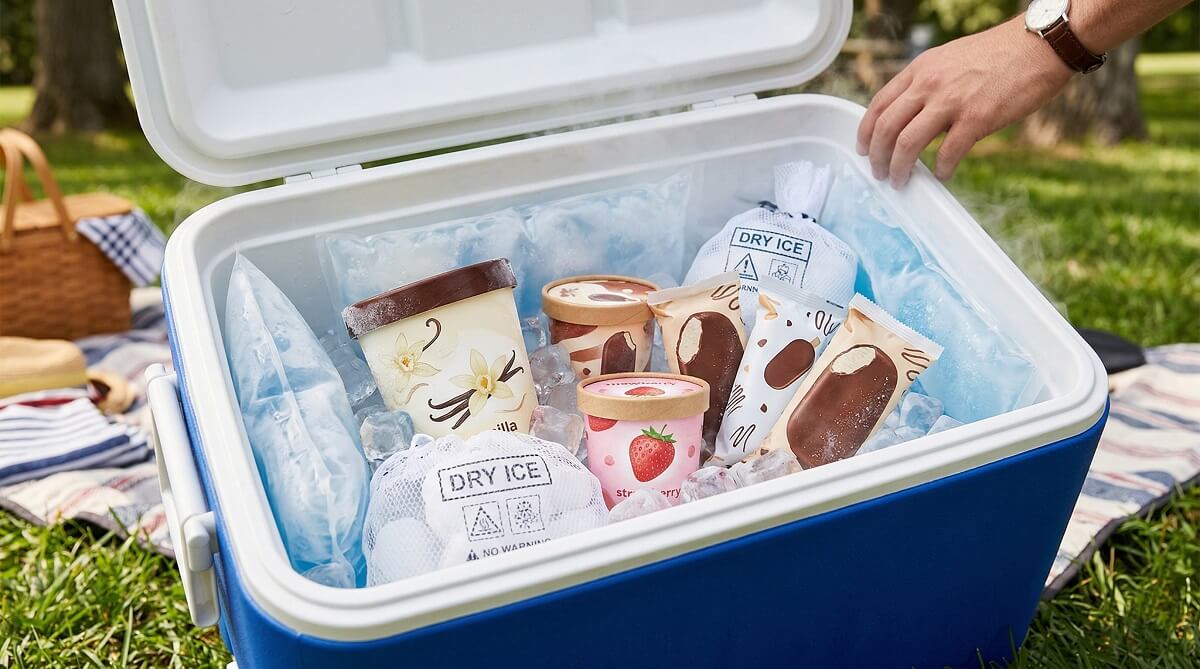
The short answer: start with a fully frozen product in a pre-chilled cooler, and choose the right ice method for your trip length. Dry ice can hold ice cream solid for 18 to 48 hours. Salt mixed with regular ice gets you about 2 to 4 hours. An on its own buys you up to 4 hours — or up to 8 hours when placed inside a cooler with ice. Regular ice alone is not enough for any trip longer than 60 to 90 minutes on a warm day.
Packing technique matters almost as much as what you use. Ice cream goes on the bottom, ice (or dry ice) goes on top, and every air gap in the cooler gets filled with a towel or crumpled newspaper. The less dead space inside, the slower things warm up. Keep the lid shut as much as possible, and keep the cooler out of direct sunlight. You’ll find more on ChubbytIps if you want to go deeper on trip prep.
Which Method Is Right for Your Trip?
✅ Use Dry Ice If:
- Your trip is 8 hours or longer (cookouts, beach days, road trips)
- You’re transporting a large quantity of ice cream
- You want the most reliable, hands-off solution
- You have a quality hard-shell cooler (Yeti, Coleman, or similar)
✅ Use Salt + Regular Ice If:
- Your trip is under 3 hours
- Dry ice isn’t available locally
- You’re packing a mixed cooler (drinks, food, and ice cream together)
- Budget is a consideration and you already have ice on hand
✅ Use an Insulated Pint Container If:
- You only need to protect 1 or 2 pints
- You’re heading to a cookout or dinner party under 8 hours away
- You want a clean, mess-free solution without loose ice
❌ Skip Regular Ice Alone If:
- Outside temps are above 85°F
- Your trip exceeds 90 minutes to 2 hours
- You plan to open the cooler more than a few times
The Three Methods: Dry Ice, Salt + Ice, and Insulated Containers
Method 1 — Dry Ice (Best for Long Trips)
Dry ice is solidified carbon dioxide, sitting at -109°F (-78°C) — that’s more than 140 degrees colder than regular ice. Ice cream needs to stay at around 5°F or below to hold its shape, and dry ice delivers that margin with room to spare. According to wikiHow’s expert-reviewed guide, dry ice evaporates at roughly 5 to 10 pounds per 24 hours in an insulated container.
For quantities, Whitey’s Ice Cream — an ice cream shop with direct dry ice shipping experience — recommends the following for a container up to 15 quarts:
- 1 lb of dry ice = about 2 hours of preservation
- 7–10 lbs = 24 hours
- 10–12 lbs = 48 hours
Salt & Straw, the Portland-based ice cream company, offers similar guidance: a 5-pound block typically lasts 24 hours, a 10-pound block around 48 hours.
How to pack it:
- Place your ice cream on the bottom of the cooler — it stays coldest there
- Fill air gaps with crumpled newspaper or a towel
- Wear gloves and wrap the dry ice block in a towel or newspaper
- Set the dry ice on top — cold sinks downward, cooling everything below it
- Close the lid, keeping a small gap (or use a cooler with a pressure-relief vent)
Safety rules to follow:
- Always use gloves — contact with bare skin causes frostbite
- Never seal dry ice in a completely airtight container; the CO2 pressure buildup can rupture it
- In a car, crack the windows about an inch; CO2 is heavier than air and can accumulate at floor level, causing light-headedness or worse
- Store the cooler in the trunk when driving if at all possible
- Dispose of unused dry ice by leaving it in a well-ventilated area — it will sublimate (convert directly to gas) on its own; never put it down a drain or sink
Method 2 — Salt + Regular Ice (The Chemistry Approach)
You may have heard that salt is used to melt ice on winter roads. The same principle works in your cooler — just in your favor. Salt disrupts ice’s ability to maintain its crystalline structure, which lowers the temperature at which water can remain frozen. According to Wikipedia’s entry on freezing-point depression, sodium chloride can bring a water-ice mixture down to as low as -6°F (-21°C) at the eutectic concentration. That’s cold enough to slow ice cream melting considerably.
The meltwater does get slushy faster than regular ice, but that slushy brine is colder than plain ice — so leave it in the cooler rather than draining it.
How to use salt + ice:
- Line the bottom of your cooler with a layer of ice cubes or crushed ice
- Sprinkle a generous amount of rock salt, kosher salt, or table salt across the ice
- Set your ice cream cartons on top
- Pour more ice around and over the cartons to surround them completely
- Add another round of salt on top
- Optional: wrap cartons in bubble wrap or foam sheeting before placing them in for extra insulation
- Fill any remaining space with a rolled towel
Aim for a 2:1 ratio of ice to ice cream by volume. The more ice you have surrounding each carton, the longer it stays solid.
Check if you’re looking for a recommendation on which cooler brand holds temperature best for frozen foods.
Method 3 — Insulated Pint Container (Clean and Simple for Short Outings)
If you only need to protect one or two pints — say, you’re bringing a special flavor to a dinner party two hours away — a vacuum-insulated stainless steel pint holder is worth considering. These are designed specifically for standard ice cream pints.
The Ice Cream Canteen on Amazon (originally featured on Shark Tank) currently sells for $34.99 (down from $39.99 typical price). It holds a rating of 4.5 out of 5 stars from 406 reviewers. The triple-wall vacuum insulation keeps a pint frozen for up to 4 hours on its own, or up to 8 hours when the container is placed inside a cooler with ice. It fits any standard paper pint shape, includes a silicone leak-proof gasket, and comes in stainless steel or a few color options.
This isn’t a replacement for a full cooler setup on a long trip, but for short runs or protecting a single pint at a party, it does exactly what it promises.
How to Pack Your Cooler So the Ice Cream Actually Survives
Pre-Chill the Cooler the Night Before
A warm cooler burns through your ice supply fast — sometimes within the first hour. The fix is to pre-chill it by filling it with regular ice the night before and closing the lid. In the morning, dump that ice out and replace it with fresh ice (or dry ice) just before you pack your ice cream. If you have a small portable cooler, stick the whole thing in your freezer overnight.
Pack Ice Cream That’s Frozen Rock Solid
Don’t temper your ice cream before the trip. Keep it in the freezer until the last possible moment before departure. According to the FDA’s food storage guidance, your freezer should be at 0°F (-18°C) — that’s the baseline for safe frozen storage. The colder your ice cream is when it goes into the cooler, the more time you have before it softens.
Fill Every Air Gap
Empty space in the cooler acts as a heat reservoir. Stuff any remaining gaps with folded towels, crumpled newspaper, or a blanket. Some tailgaters wrap the entire outside of the cooler in a sleeping bag — it sounds extreme, but it works.
Keep the Lid Closed and the Cooler in the Shade
Every time you open the lid, warm air rushes in. If you’re bringing drinks and snacks alongside ice cream, put them in a separate cooler so you can access them freely without opening the ice cream cooler more than necessary. Keep it out of direct sunlight — even 20 minutes in the sun can meaningfully reduce the life of your ice. Our can help you choose a model with superior insulation if you do a lot of outdoor entertaining.
Method Comparison: Duration, Cost, and Best Use
| Method | Duration | Approx. Cost | Best For | Main Limitation |
|---|---|---|---|---|
| Dry ice | 18–48 hours | $1.50–$3.00/lb | Overnight trips, bulk ice cream, long drives | Safety precautions required; not always easy to find |
| Salt + regular ice | 2–4 hours | $1–$5 (salt + bag of ice) | Short trips, mixed coolers, last-minute solution | Ice melts faster; limited duration |
| Insulated pint container (in cooler) | Up to 8 hours | ~$34.99 one-time (Ice Cream Canteen) | 1–2 pints, cookouts, dinner parties | Only fits pint-sized containers; upfront cost |
| Regular ice only | 60–90 minutes | $1–$3 (bag of ice) | Not recommended for ice cream | Meltwater warms ice cream from 32°F upward |
Where to Buy Dry Ice (and What It Costs)
Most large grocery stores carry dry ice — check near the checkout lanes, the freezer section, or ask at the customer service desk. Major retailers that typically stock it include Walmart ($1.50–$2.50/lb), Kroger ($1.50–$2.75/lb), Safeway, H-E-B, Publix, and Albertsons. Prices generally range from $1.00 to $3.00 per pound across retailers.
Call ahead before making a special trip — availability varies by location and season. Some stores only stock it during summer or around Halloween when demand spikes. You can also check specialty suppliers if grocery chains near you don’t carry it.
A practical tip from Salt & Straw: buy your dry ice as close to departure time as possible. It starts sublimating (converting to gas) the moment you buy it, at a rate of about 5 to 10 pounds per 24 hours. If you need it for an early morning departure, pick it up the afternoon or evening before — not two days in advance.
When you buy it, bring your cooler to the store and pack the dry ice directly — this minimizes the time it spends losing mass in transit. Most stores sell it in 10-by-2-inch blocks weighing about 10 pounds each.
For help picking the right cooler for long-haul trips, browse covering outdoor gear and kitchen essentials.
Frequently Asked Questions
How long will ice cream stay frozen in a cooler?
With dry ice properly packed, expect 18 to 48 hours. With the salt + regular ice method, about 2 to 4 hours. An insulated vacuum pint container inside a cooler with ice can hold for up to 8 hours. Regular ice alone — without salt — typically keeps ice cream solid for 60 to 90 minutes on a warm day before softening begins.
Can regular ice (without salt) keep ice cream frozen?
Not well, and not for long. Regular ice melts at 32°F, but ice cream must stay at or below 5°F to hold its texture, according to Salt & Straw. As regular ice melts, the water warms up past 32°F fairly quickly. Adding salt to the ice drops the mixture’s temperature to as low as -6°F (-21°C), which is why the salt method extends your window considerably.
Is dry ice safe to use in a regular cooler?
Yes, as long as the cooler isn’t completely airtight. Dry ice produces CO2 gas as it sublimates, and in a sealed container, that pressure can build and cause damage. Hard-shell plastic or styrofoam coolers work fine — just leave the lid slightly ajar or use a cooler with a pressure-release vent. Never use a completely sealed, airtight container for dry ice.
Is it safe to have dry ice in the car?
Yes, with a couple of precautions. Crack your car windows about an inch — CO2 is heavier than air and can pool at floor level in an enclosed space, causing light-headedness or worse if it accumulates. Ideally, keep the cooler in the trunk. If you’re driving with the cooler inside the cabin, run the air conditioner set to draw fresh air from outside rather than recirculate.
What temperature does ice cream need to stay frozen?
The FDA recommends 0°F (-18°C) as the standard freezer temperature for safe frozen food storage. Ice cream starts softening noticeably above about 10°F (-12°C) and loses its shape entirely above 20°F (-7°C). For transport, the goal is to keep it as close to 0°F as possible throughout your trip.
Can I refreeze ice cream that partially melted?
Technically yes, but the quality takes a hit. Melting and refreezing causes larger ice crystals to form, giving the ice cream a gritty, icy texture instead of the smooth, creamy one you started with. From a food safety standpoint, if ice cream has been above 40°F for more than 2 hours, standard food safety guidance advises discarding it rather than refreezing. If it softened slightly but stayed cold throughout, refreezing is fine for texture — just expect a slight quality drop.
For more gear that makes outdoor entertaining easier, see on ChubbytIps.
Check current dry ice prices and availability at your nearest Walmart or Kroger before your next outdoor outing. For pint-sized protection, the Ice Cream Canteen on Amazon is a solid one-time investment if you regularly bring ice cream to gatherings.
