


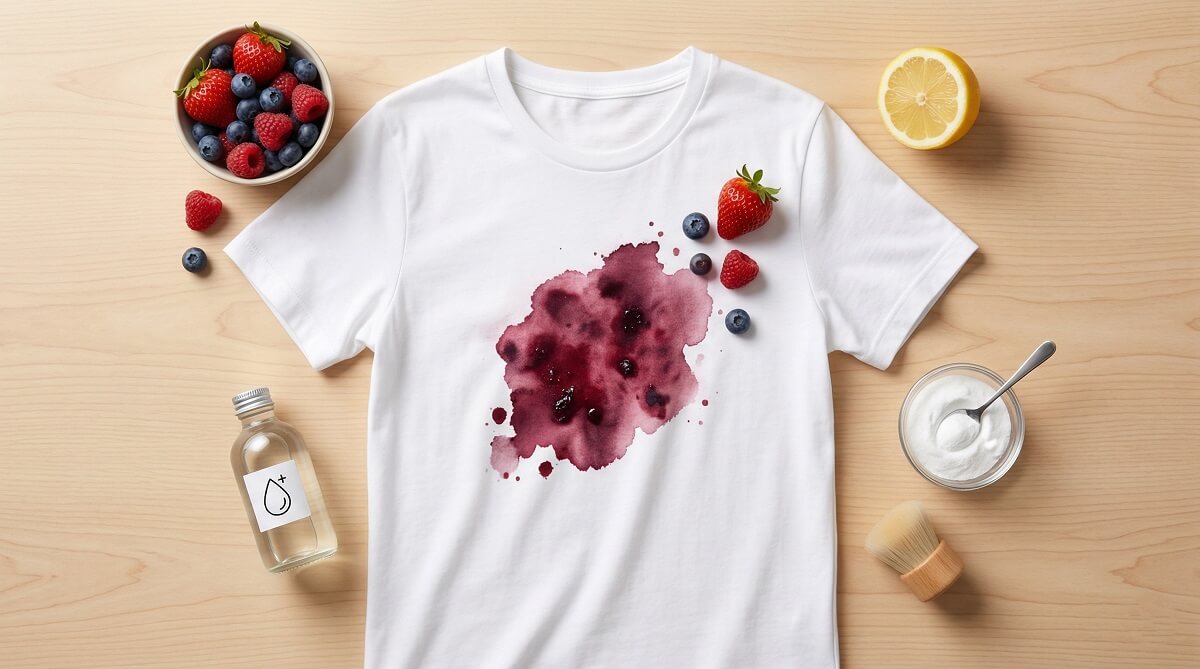
Berry stains are not permanent — but they’re unforgiving if you wait too long. The pigments in blueberries, blackberries, and raspberries (called anthocyanins) bond tightly to fabric fibers when exposed to heat or left untreated. Catch the stain while it’s fresh, and most methods work quickly. Let it dry — especially through a dryer — and you’re fighting a much harder battle.
There are five approaches that reliably work: boiling water, lemon juice, white vinegar, enzyme-based detergent, and hydrogen peroxide. Each has different strengths depending on fabric type and how long the stain has been sitting. The one rule that applies to all of them: never put a berry-stained garment in the dryer until the mark is completely gone. Heat sets stains permanently. Browse more laundry how-tos on ChubbytIps.
Below you’ll find step-by-step instructions for each method, a quick fabric compatibility table, guidance for dried or set-in stains, and answers to the most common questions people have when they’re standing in the kitchen with a blueberry catastrophe on their shirt.
Quick Guide: Should You Try This at Home?
✅ Home Treatment Works Well If:
- The stain is fresh — treated within a few hours is ideal
- The fabric is machine-washable (cotton, polyester, most blended fabrics)
- You caught it before putting the item through the dryer
- The garment is colorfast (dye won’t run when wet)
❌ Skip Home Treatment If:
- The care label says dry-clean only
- The fabric is delicate silk or structured wool (professional cleaning is safer)
- The stain has already been dried in a dryer — permanent setting is likely
- You’re unsure whether the dye is stable (test on a hidden seam first)
Why Berry Stains Are So Hard to Shift
The color in berries — blueberries especially — comes from plant pigments called anthocyanins. These are water-soluble right after the spill, which is why speed matters. Once heat or time gets involved, anthocyanins bond with fabric fibers at a molecular level, and that bond becomes increasingly difficult to reverse.
Berry stains are actually a triple threat. Alongside anthocyanins, you’re dealing with tannins (plant compounds that cause brownish discoloration and react with fabric proteins) and natural sugars that leave a sticky residue behind. This combination is why berry stains can still feel tacky or look yellowed even after a wash cycle, particularly if the stain wasn’t pre-treated.
The key chemistry insight: acid breaks anthocyanin bonds. That’s why lemon juice and vinegar work — citric acid and acetic acid both disrupt the pigment’s grip on fiber. Enzyme detergents take a different route: specific enzymes (particularly pectinase and pectate lyase) break down the berry’s pectin and plant sugars, letting water carry the residue away. Both techniques are effective; the right pick depends on what you have available and what your garment can handle.
Three Rules Before You Start
Regardless of which method you use, these three principles apply every time:
- Act within the first few hours. Fresh stains are significantly easier to lift. The longer anthocyanins sit — especially in a warm room — the stronger the bond to the fiber.
- Always rinse with cold water first. Run cold water through the back of the stain (not the front) to push pigment out rather than deeper in. Hot or warm water at this stage will set the stain — cold only.
- Never rub. Blot, dab, or press with a clean cloth. Rubbing spreads the stain laterally and drives it deeper into the fabric weave. Work from the outer edge of the stain inward to keep it contained.
5 Methods to Get Berry Stains Out of Clothes
Method 1: Boiling Water
Best for: Fresh stains on cotton, linen, and other durable natural fibers.
This is one of the oldest and most effective tricks for berry stains on sturdy fabrics. The force and heat of boiling water poured from height drives the stain out of the weave rather than setting it. It works particularly well for blueberry and blackberry stains on cotton T-shirts, tablecloths, and napkins.
Steps:
- Rinse the stain briefly with cold water.
- Stretch the stained area over a heat-proof bowl and secure with a rubber band, or lay it flat in the bottom of the bathtub.
- Boil water using a kettle. From about two to three feet above the bowl (or standing over the bathtub), pour a steady stream of boiling water directly onto the stain.
- The height matters — the impact force is what physically dislodges the pigment. Pour in a firm, continuous stream.
- Repeat if any discoloration remains, then wash as usual in cold or warm water per the care label.
Fabric warning: Boiling water is only appropriate for cotton and linen. Do not use this on wool (it will shrink and felt), silk (it will damage the fiber structure), or synthetic fabrics like polyester or spandex (heat can cause warping or melting). Check the care label first.
Method 2: Lemon Juice
Best for: Most colorfast fabrics; particularly effective on white and light-colored items.
Fresh lemon juice is a natural acid treatment. The citric acid breaks down the anthocyanin bonds, and direct sunlight after application enhances the lightening effect — making this a surprisingly powerful combo for stubborn spots. The bottled lemon juice from those little yellow squeeze bottles works fine if you’re out of fresh lemons. More home cleaning guides on ChubbytIps.
Steps:
- Blot the stain gently with a clean cloth to absorb as much surface berry juice as possible.
- Run cold water through the back of the stain.
- Squeeze fresh lemon juice directly onto the stain until the area is saturated. For small stains, a squeeze bottle works well for precision.
- Leave it for 5–30 minutes. The longer the better for stubborn spots, as long as the fabric can tolerate it.
- Blot with a clean cloth, moving to fresh sections of the cloth as the stain transfers.
- Apply a small amount of dish soap mixed with cool water to the area, let sit 5 minutes, then blot again.
- If the garment is machine-washable, wash now as usual. If not (sheepskin, wool), rinse thoroughly with cold water and air dry — ideally in sunlight.
Method 3: White Vinegar (+ Optional Dish Soap)
Best for: Most machine-washable fabrics including polyester and spandex blends.
White vinegar works on the same principle as lemon juice — acetic acid disrupts the anthocyanin structure. It’s a solid option when you don’t have lemons handy, and it’s safe on a wider range of fabric dyes. The vinegar smell washes out completely during the machine wash cycle. Hanging the item in sun after a vinegar treatment (before washing) can help lift the stain further.
For fresh stains:
- Rinse with cold water.
- Soak the stained area in undiluted white vinegar for 30–60 minutes.
- Rinse with cool water, then wash as usual.
For stubborn stains — vinegar + dish soap solution:
- Mix 1 tablespoon of white vinegar + ½ teaspoon of liquid laundry detergent + 1 quart of cool water.
- Soak the stained area in the solution for 15 minutes.
- Rinse with cool water.
- Wash as usual.
Important: Do not mix vinegar with hydrogen peroxide in the same treatment — the combination creates a potentially harmful compound (peracetic acid). If you want to use both, rinse thoroughly between applications.
Method 4: Enzyme Detergent Soak
Best for: All machine-washable fabrics, including polyester, spandex/Lycra, and synthetic blends.
This approach targets the underlying chemistry of berry discoloration most directly. Berries contain pectin, a complex polysaccharide, along with proteins and sugars. Enzyme detergents carry specific enzymes — pectinase and pectate lyase — that break down pectin, while protease handles the protein component. The result is that the stain’s structural components are disassembled and can be rinsed away. See more cleaning how-tos on ChubbytIps.
Warm water (not hot) is the right temperature for enzyme detergents — warm activates the enzymes; hot water above roughly 140°F degrades them and reduces effectiveness.
Steps:
- Blot the stain gently, then rinse from the back with cold water.
- Fill a clean sink or basin with warm water and add a pump or scoop of enzyme-based laundry detergent. Good options include Tide Ultra Stain Release, Persil ProClean, or OxiClean Versatile Stain Remover (mix to Line 2–4 per gallon).
- Submerge the stained item and soak for 5–10 minutes for fresh stains, or up to 1–6 hours for stubborn ones (per OxiClean’s official instructions).
- Check the stain — you should see it fading. Repeat soak if needed.
- Wash the garment on the warmest setting the care label allows. Add an oxi-booster or extra enzyme detergent to the wash cycle for extra stain-fighting power on white or light-colored clothing.
- Check the stain before drying. If any discoloration remains, treat again before putting in the dryer.
OxiClean Versatile Stain Remover is a solid pick for this technique — it’s chlorine-free, color-safe, and listed by the manufacturer as America’s #1 versatile stain remover by units sold. As of March 2026, the 3 lb size runs approximately $7.99–$8.99 on Amazon — check current pricing before buying.
Method 5: Hydrogen Peroxide + Dish Soap
Best for: White cotton and very light-colored fabrics only.
Hydrogen peroxide is an oxidizing agent — it bleaches the stain by breaking down the pigment’s chemical bonds. It works well on white fabric, but it cannot distinguish between stain molecules and fabric dye, which means it can bleach colored clothing. The spot test is not optional with this method.
Steps:
- Spot test first: Apply 1–2 drops of 3% hydrogen peroxide to a hidden seam or interior hem. Wait 5 minutes. If the fabric color changes, do not proceed on visible areas.
- Apply 3% hydrogen peroxide (standard pharmacy-grade) directly to the stain.
- Mix 1 tablespoon of dish soap with a small amount of cool water and apply to the same area.
- Let sit for no more than 10 minutes. Longer contact increases the risk of fading on any fabric.
- Blot with a clean cloth — do not rub.
- Rinse thoroughly with cold water.
- Wash as usual, checking the stain before drying.
Critical: Never mix hydrogen peroxide with vinegar, bleach, or ammonia — these combinations produce toxic compounds (peracetic acid or chlorine gas). Always rinse the garment thoroughly if you’ve already applied vinegar before switching to hydrogen peroxide. When in doubt about fabric safety, Branch Basics has a thorough guide on hydrogen peroxide for stain removal.
Fabric and Method Compatibility: Quick Reference
Not every method is safe on every fabric. Use this table as a starting guide — and always check the care label on your garment.
| Fabric | Boiling Water | Lemon Juice | White Vinegar | Enzyme Detergent | Hydrogen Peroxide |
|---|---|---|---|---|---|
| Cotton | ✅ Yes | ✅ Yes | ✅ Yes | ✅ Yes | ✅ Whites only |
| Linen | ✅ Yes | ✅ Yes | ✅ Yes | ✅ Yes | ✅ Whites only |
| Polyester | ⚠️ Lower temp only | ✅ Yes | ✅ Yes | ✅ Yes | ⚠️ Spot test first |
| Spandex/Lycra | ❌ No | ✅ Yes | ✅ Yes | ✅ Yes | ⚠️ Spot test first |
| Wool | ❌ No | ⚠️ Diluted, cool only | ⚠️ Diluted, cool only | ✅ Cool water only | ❌ No |
| Silk | ❌ No | ❌ No | ❌ No | ⚠️ Gentle enzyme, cold water | ❌ No |
For dry-clean-only garments: skip home treatment entirely. Take the item to a professional cleaner as soon as possible and tell them what caused the stain.
How to Treat Dried or Set-In Berry Stains
Set-in stains take more effort — but they’re not automatically lost causes. If the garment has been through a dryer, the heat has likely made the stain permanent, and a professional cleaner is your best remaining option. If the item has simply air-dried or sat untreated for a day or two, try this approach:
Pre-soak method for dried stains:
- Moisten the stained area with cool water to rehydrate the dried pigment.
- Mix: 1 quart warm water + ½ teaspoon liquid dish soap + 1 tablespoon white vinegar.
- Soak the stained garment in this solution for 15–30 minutes.
- Drain, then add an enzyme-based detergent (Tide Ultra Stain Release, Persil ProClean, or OxiClean) and soak for an additional 15–30 minutes in fresh warm water.
- Wash on the warmest cycle the care label allows.
- Check the stain before drying — if it’s still visible, repeat the entire process. It may take two or three rounds for stubborn set stains.
Patience matters here. Older stains didn’t happen overnight, and they don’t always come out in a single wash. Repeat treatment is normal and often successful. For more laundry troubleshooting, see the ChubbytIps how-to guides.
Stain Removers Worth Keeping on Hand
You don’t need much. Most of these methods use pantry staples. But if you want a commercial stain fighter ready to go:
- OxiClean Versatile Stain Remover (Powder): Oxygen-based, chlorine-free, color-safe. Works as both a pre-soak and a laundry booster. Around $7.99–$8.99 for 3 lb as of March 2026. Check current price on Amazon.
- Tide Ultra Stain Release or Persil ProClean: Both contain strong enzyme blends (including pectinase/protease) well-suited for fruit stains. Available at most grocery stores and big-box retailers.
- Oxi-booster pods (Dropps, Tide, etc.): Good add-on for the wash cycle when treating light-colored or white clothing. Adds brightening power on top of your regular detergent.
Frequently Asked Questions
Do berry stains come out of clothes?
Yes — if you treat them before they dry and before the item goes through a dryer. Fresh berry stains respond quickly to cold water, lemon juice, vinegar, or enzyme detergent. The longer a stain sits untreated (especially with heat exposure), the more permanently it bonds to fabric fibers.
How do you get blueberry stains out of clothes after drying?
If the item has only air-dried, try the vinegar pre-soak method (1 tbsp white vinegar + ½ tsp dish soap + 1 qt warm water, soak 15–30 minutes) followed by an enzyme detergent treatment. If the stain went through a hot dryer, the heat may have set it permanently — professional cleaning is worth trying at that point.
Should I use hot or cold water on a berry stain?
Cold water always, for the initial rinse. Hot water accelerates anthocyanin bonding to fabric, which is exactly what you want to avoid. Once the mark has been pre-treated and is lifting, you can launder on the warmest setting the care label allows — warm water helps enzyme detergents work faster.
Does lemon juice work on all berry types?
Yes — the citric acid in lemon juice breaks down the anthocyanin pigments present in blueberries, blackberries, raspberries, and strawberries. Blueberries and blackberries tend to have higher anthocyanin concentration and may need longer treatment time (up to 30 minutes instead of 5).
Is vinegar or hydrogen peroxide better for berry stains?
For colored clothing, vinegar is the safer choice — it won’t bleach fabric dye. Hydrogen peroxide is more powerful on the stain itself, but it can strip color from fabrics if left on too long. On white cotton, hydrogen peroxide is often the faster option. On anything with color, default to vinegar and only try hydrogen peroxide after a careful spot test.
Can you remove berry stains from dry-clean-only clothing at home?
The risk is high. Delicate fabrics like silk and some wools can be permanently damaged by home treatment — water itself can leave marks on certain silks. Take dry-clean-only items to a professional cleaner as soon as possible, and let them know what caused the stain. The sooner they see it, the better the outcome.
How do you get berry stains out of white clothes?
White cotton responds well to the boiling water trick, enzyme detergent soaks, and hydrogen peroxide. You can also add a color-safe oxi-booster to the wash cycle for extra brightening. Avoid regular chlorine bleach unless the care label specifically says the material is bleach-safe — even then, pre-treating with an enzyme soak is usually more effective for berry discoloration.
What is the fastest method to treat a fresh berry stain?
The fastest effective first response is a cold water rinse from the back of the stain, followed by the boiling water method (for cotton) or an enzyme detergent pre-soak. Both can show results in under 10 minutes. If you’re away from home, blot the stain with cold water and a little dish soap from the restaurant or bathroom, and treat properly when you get back — just don’t let it go through a dryer first.
Got the stain out? Keep a small container of enzyme detergent or an oxi-booster on hand for next berry season — the best stain treatment is the one you actually have ready when you need it. Check current prices on OxiClean on Amazon or pick up any enzyme-based detergent at your local grocery store.
