


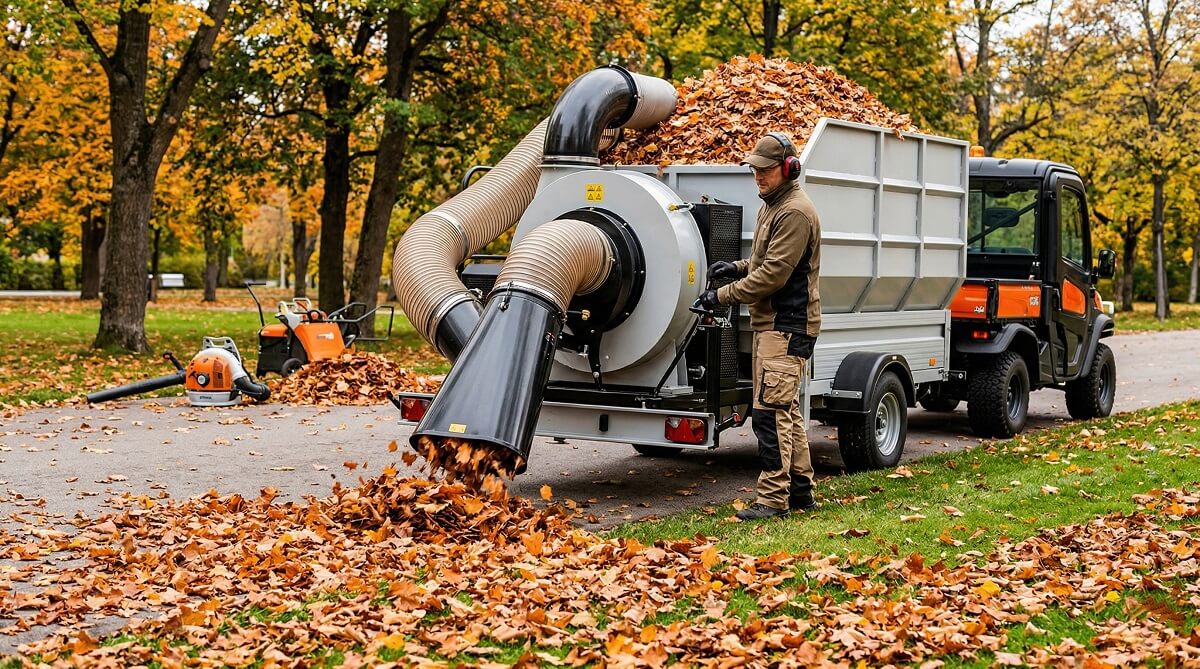
A commercial leaf vacuum is a different animal from the bagging attachment on a homeowner’s riding mower. These machines run for hours at a time, handle wet and dry debris across multiple properties, and need to hold up season after season. If you’re managing five or more accounts a day — or running leaf removal as a core service — the right unit can cut cleanup time by half while reducing the physical strain on your crew.
The three main categories are walk-behind vacuums, tow-behind units that hitch to a mower or tractor, and debris loaders that mount to a truck or trailer. Walk-behinds work well on parking lots and hard surfaces. Tow-behinds handle large turf areas efficiently. Debris loaders are the heavy-hitters for high-volume routes. for additional equipment comparisons.
For most landscaping contractors, Billy Goat and Cyclone Rake are the two names you’ll encounter most. Trac-Vac offers solid tow-behind value, and Titan (through MacQueen Equipment) serves municipalities that need diesel-powered, city-scale systems. Pricing runs from around $3,145 for the Cyclone Rake XL to $9,925 for a 37HP Billy Goat debris loader — so there’s a lot of ground to cover before you commit.
Who Should (and Shouldn’t) Use a Commercial Leaf Vacuum
✅ Best For
- Landscaping contractors handling 5 or more residential or commercial accounts per day
- Property managers overseeing schools, parks, HOAs, or large estates
- Municipalities running seasonal leaf collection programs
- Lawn care businesses looking to reduce manual labor and dumping trips
❌ Skip If
- You’re maintaining one or two residential properties — a mower bagger handles that fine
- Your typical lot is under a quarter acre
- You only need equipment for one or two weeks per season (local rental may make more sense)
- Your budget is under $1,000 — consumer-grade units won’t survive daily commercial use
What Separates a Commercial Leaf Vacuum from a Residential One
Build Quality and Duty Cycle
The most obvious difference is materials. Commercial units use steel housings — often 12-gauge stainless — and armor-plate impellers with multiple cutting points. Residential units rely heavily on plastic. That distinction matters when you’re running a machine for four to six hours a day, five days a week during peak fall season.
Engine quality is the other dividing line. Commercial machines run Briggs & Stratton Vanguard, Honda GX, and Kubota diesel engines — the same powerplants used in professional turf equipment. The no-name engines on cheaper walk-behinds tend to fade fast under sustained commercial loads. for real-world durability data.
Three Main Types at a Glance
| Type | Typical HP | Capacity | Price Range | Best Use Case |
|---|---|---|---|---|
| Walk-Behind Vacuum | 9–13 HP | 36–40 gallons | $1,500–$3,500 | Parking lots, sidewalks, hard surfaces, tight spaces |
| Tow-Behind Vacuum | 8–13 HP | 200–415+ gallons | $3,145–$4,995 | Large turf areas, mower-attached cleanup |
| Debris Loader | 18–37 HP (gas); 74–99 HP (diesel) | Loads directly to truck/trailer | $5,150–$9,925+ | High-volume routes, municipal contracts, multi-property crews |
Walk-Behind Commercial Leaf Vacuums
When a Walk-Behind Makes Sense
Walk-behinds are the right call for properties where a tractor can’t go — tight parking lots, narrow sidewalks, around cars, between shrubs and benches in public parks. They’re also the practical choice for hard-surface cleanup where a tow-behind would be overkill.
Billy Goat dominates this segment with its KV, TKV, QV, and MV series. The KV handles residential through light commercial. The MV is the heavy-duty option for larger turf properties. The TKV adds a built-in 2-inch chipper for branches. Billy Goat has been setting the standard for outdoor power cleanup for more than 50 years, and this line reflects that experience. can help your crew get up to speed faster.
Key Specs to Prioritize
- HP: 9 HP minimum for commercial use; 13 HP or more for larger properties
- CFM (cubic feet per minute): Higher CFM = more suction power. Look for 2,000+ CFM for commercial walk-behinds
- Bag capacity: 36–40 gallons is typical; look for easy-open fasteners (zipperless is better for repeated daily use)
- Self-propelled options: Worth the premium for crew members covering large areas on foot
According to Family Handyman’s hands-on testing, the Billy Goat walk-behind cleared roughly 30 gallons of leaves in two passes at full power — and testers rated it above competing walk-behinds for maneuverability and ease of starting. Pricing for the walk-behind KV series runs approximately $1,795–$1,799.
Noise Levels — A Real Consideration for Urban Properties
If you’re servicing schools, hospitals, or noise-sensitive neighborhoods, noise output matters. Standard commercial walk-behinds typically run 85–95 dBa. Billy Goat’s QUIETVAC line changes that equation significantly.
According to Billy Goat’s official product specs, the QUIETVAC runs as low as 77 dBa at full RPM and 76 dBa at 2,800 RPM — the lowest noise level in its class. That’s a meaningful difference compared to backpack blowers or standard steel-housing vacuums when you’re working near residences or medical facilities.
Tow-Behind Leaf Vacuums — High Capacity for Large Turf Areas
How They Work
Tow-behinds hitch to the rear of a riding mower or garden tractor and trail behind while the operator drives. The vacuum intake pulls leaves from the turf into a large collection hopper. Unlike a mower bagger, these units can hold hundreds of gallons before needing to dump — and some models mulch while collecting, reducing the volume of material you haul away.
Two hitch styles are common: dual-pin systems create a rigid connection that won’t jackknife when you’re backing up to dump; newer single-pin systems (like the Cyclone Rake CRS) offer more maneuverability with zero-turn mowers. If you’re running a ZTR, confirm compatibility before buying.
Cyclone Rake XL — Strong Mid-Market Option
The Cyclone Rake XL is currently priced at $3,145.00 (sale from $3,545.00 list price, as of March 2026). It runs an 8HP Briggs & Stratton Vanguard engine, carries 415 gallons of debris, and uses an 8-inch JetPath vacuum system with a 5-blade Super-Flow impeller. It fits tractors 16HP or larger with 42″–60″ deck widths.
Cyclone Rake backs its commercial units with a 6-month peace-of-mind trial — if you’re not satisfied within the first six months, they’ll take it back and cover return shipping. For a contractor investing over $3,000, that’s a meaningful guarantee. for equipment comparison frameworks.
Trac-Vac — American-Made Tow-Behind Value
Trac-Vac has been making lawn care equipment in Thorntown, Indiana since 1955. Their tow-behind commercial line offers three models:
- Leaf Vac 880: $3,295.00
- Leaf Vac 1070: $3,990.00
- Leaf Vac 1080: $4,995.00
Trac-Vac is also the only manufacturer currently offering custom steel chutes. For contractors working in abrasive conditions or dealing with heavy debris, that’s a durability advantage over standard plastic discharge setups.
Debris Loaders — Built for High-Volume Routes
What Makes Debris Loaders Different
Debris loaders mount to trucks or trailers and load leaves directly into the truck bed or a collection body — no bag to empty between stops. The suction comes from a dedicated engine (separate from the vehicle), and HP ratings start at 18 and climb past 37 for gas units, with diesel-powered municipal versions reaching 74–99 HP.
The key advantage is throughput. Billy Goat’s dual-shredding PiranhaTM blade impellers reduce debris by up to 12:1, according to Billy Goat’s official specs. That means a truck that would fill up with 12 bags of leaves at normal volume can carry the equivalent of 144 bags’ worth of shredded material. Fewer dump runs, lower fuel costs, and less crew time waiting at the transfer station.
Billy Goat Debris Loaders — Pricing and Specs
| Model | HP | CFM | Impeller | Hose | Price (approx.) |
|---|---|---|---|---|---|
| DL1802VE | 18HP Vanguard | 3,700 CFM | 16″, 8 cutting points | 10″×10″ clear urethane | $5,151.99 |
| DL3702VE | 37HP Vanguard EFI | Higher (993cc) | 20″, 18 cutting points | 14″ hose | ~$9,925.00 |
Both models include electric start, which matters more than it sounds on a long day. Pull-starting a 37HP engine after lunch is a reliable way to put workers on light duty with shoulder injuries. The DL1802VE weighs 280 lbs and measures 31″L × 27″W × 48″H — verify your truck setup before ordering.
Municipal Scale: Titan Leaf Vac Trailers (MacQueen Equipment)
For city governments and large contractors running municipal contracts, the Titan line from MacQueen Equipment steps up to 74 HP Tier 4 liquid-cooled diesel engines, with optional 99 HP John Deere powerplants. Collection bodies hold 15–30 cubic yards. The Olympian II model includes CANbus joystick controls, a gated operator platform with swivel seat, and a 180-degree swing extended boom — this is specialized equipment for full leaf-removal programs. Contact MacQueen directly for pricing.
Brand Comparison — Finding the Right Fit
| Brand | Best For | Product Types | Price Range | Warranty Highlight |
|---|---|---|---|---|
| Billy Goat | Contractors, municipalities | Walk-behind, debris loaders | $1,795–$9,925+ | Multi-year; sold through dealers |
| Cyclone Rake | Tractor/mower owners | Tow-behind (dual-pin + CRS) | $3,145–$3,545+ | 6-month peace-of-mind trial + 6-month commercial warranty |
| Trac-Vac | Value-focused contractors | Tow-behind | $3,295–$4,995 | Made in USA; dealer support |
| Titan/MacQueen | Municipalities, large contractors | Trailered vac systems | Contact dealer | NATM certified; refurb/inspection on used units |
Billy Goat — Widest Range, Deepest Dealer Network
Billy Goat (a Briggs & Stratton brand) offers the most complete line from walk-behind to truck-mounted loaders. The PiranhaTM blade system and 12-gauge stainless steel housing are genuine differentiators at the commercial level. They’re sold through a national dealer network, which means local service support — important when a machine goes down mid-season.
Cyclone Rake — Best for Owner-Operators with Tractors
Cyclone Rake is direct-to-consumer, which cuts out dealer markup and means you deal directly with the manufacturer for support. The 415-gallon capacity on the XL is among the largest in the tow-behind category, and the company’s 6-month trial period is the most generous return policy in this market segment. Maintenance is designed to be DIY-friendly — most service work can be done without calling a tech.
Trac-Vac — Straightforward American-Made Option
Trac-Vac keeps it simple. Three tow-behind models, clear pricing on the website, made in Indiana. The custom steel chutes are a practical advantage for anyone dealing with abrasive material or rough terrain. Their history stretches back to 1955, which counts for something in terms of parts availability and institutional knowledge.
Key Factors to Evaluate Before You Buy
Matching HP to Your Job Size
Engine horsepower is a reasonable proxy for how much work a machine can handle continuously. Here’s a rough framework based on typical commercial applications:
- 9–13 HP: Smaller commercial lots, sidewalks, around buildings — walk-behind territory
- 18 HP: Mid-size properties, landscaping contractor daily routes, debris loading into trucks
- 25–37 HP: Large estates, multi-property routes, high-volume truck loading
- 74 HP+ diesel: Municipal contracts, city-scale leaf removal, sustained operation
Keep in mind that the tractor or mower pulling a tow-behind needs to be sized appropriately too. The Cyclone Rake XL, for instance, requires a tractor of 16HP or more with a 42″–60″ deck.
Hose Selection — It Matters More Than You Think
The intake hose is the most wear-prone component on a debris loader or tow-behind system. Getting the right diameter and material upfront prevents costly replacements mid-season. for more maintenance tips.
- 8″–10″ hoses: Walk-behinds and smaller loaders (Billy Goat DL1802VE ships with a 10″ hose)
- 12″–14″ hoses: Mid-range debris loaders (DL3702VE uses 14″)
- 16″–18″ hoses: Municipal trailer systems (Titan Olympian II runs a 16″ hose)
On materials: the LCDC polypropylene hose (12″×10′) runs $180.90 and is the economical choice for standard use. The Flx-Thane HD polyurethane version (18″×10′) is $799.00 and handles heavy abrasion, wide temperature swings (−65°F to +200°F), and severe service conditions.
Gas vs. Diesel — A Practical Breakdown
Gas engines (Vanguard, Honda GX) are the right choice for most landscaping contractors. Lower purchase price, easier to find service, parts available locally. Diesel makes sense for municipal-scale operations running equipment continuously — better fuel efficiency under sustained load and longer engine life when properly maintained. For a contractor running leaf removal two months per year, the diesel premium rarely pays off.
Commercial Leaf Vacuum Maintenance — What to Stay On Top Of
Commercial equipment earns its keep through reliability. A few habits extend machine life significantly:
- Inspect and clean the impeller after every use. Debris buildup throws the impeller off balance and accelerates bearing wear.
- Check the intake hose regularly. Look for cracks, thinning walls, or holes — especially at connection points where hose clamps create stress. Clear urethane hoses (like those on the Billy Goat DL1802VE) let you spot blockages visually without disassembly.
- Seasonal storage: Drain the fuel system or add stabilizer, clean the housing interior, and inspect the bearings. The impeller housing takes most of the abuse from debris.
- Keep spares on hand. For commercial operations: a spare impeller, a replacement hose in the right diameter, and hose clamps. Downtime during peak fall season is expensive.
Frequently Asked Questions
What is the best commercial leaf vacuum for a lawn care business?
For most landscaping contractors, Billy Goat’s debris loaders or walk-behind vacuums offer the best combination of power, reliability, and dealer support. The DL1802VE ($5,151.99) is a strong mid-range choice for crews handling multiple properties daily. If you’re attaching to a tractor and need high capacity at lower cost, the Cyclone Rake XL ($3,145–$3,545) is worth a serious look.
How much does a commercial leaf vacuum cost?
Walk-behind commercial units start around $1,795–$1,799 for models like the Billy Goat KV series. Tow-behinds run $3,145–$4,995 (Cyclone Rake XL, Trac-Vac 880/1070/1080). Debris loaders for trucks range from approximately $5,151 (18HP Billy Goat DL1802VE) to $9,925 (37HP DL3702VE). Municipal diesel systems run higher — contact dealers for quotes.
What HP do I need for a commercial leaf vacuum?
9–13HP handles lighter commercial work on smaller properties. 18HP is the practical minimum for a contractor running mid-size accounts. If you’re loading trucks across multiple properties, 25–37HP gives you the throughput to stay productive. Municipal operations typically run diesel engines at 74HP or more.
What is CFM and does it matter for leaf vacuums?
CFM (cubic feet per minute) measures airflow volume — essentially how much air and debris the machine can move per minute. Higher CFM means more suction capacity and the ability to handle denser, wetter debris. The Billy Goat DL1802VE moves 3,700 CFM. For comparison, backpack blowers typically output 400–600 CFM — so a commercial loader is in a completely different class.
Can commercial leaf vacuums mulch leaves?
Yes. Most commercial models use multi-blade impellers that shred leaves as they pass through the system. Billy Goat’s PiranhaTM blade delivers a 12:1 debris reduction ratio — meaning 12 bags’ worth of whole leaves compact to 1 bag’s worth of shredded material. This dramatically reduces dump frequency and disposal costs.
What’s the difference between a debris loader and a leaf vacuum?
A leaf vacuum (walk-behind or tow-behind) collects debris into an onboard bag or hopper. A debris loader mounts to a truck or trailer and feeds leaves directly into the truck bed — no intermediate bag. Loaders are designed for high-volume routes where stopping to empty a bag every 20 minutes would kill productivity. They also run larger, more powerful engines.
How do I attach a leaf vacuum to a zero-turn mower?
Most tow-behind vacuums use either a dual-pin or single-pin hitch. Cyclone Rake’s CRS (Cyclone Rake Single) system is specifically designed for single-pin setups common on zero-turn mowers. Not all tow-behinds are compatible with ZTRs — confirm hitch compatibility with the manufacturer before purchasing.
Are commercial leaf vacuums worth it for small landscaping businesses?
It depends on your service mix. If leaf cleanup is a regular part of your fall schedule and you’re handling 5+ accounts per day, the equipment typically pays for itself within a season or two through labor savings and faster job completion. If you only do occasional cleanups, equipment rental may be a better financial fit until your volume justifies the purchase.
Check current pricing and availability on the Billy Goat and Cyclone Rake lineup on Amazon, or contact your local power equipment dealer for a hands-on demo. For Trac-Vac, call them directly at 765-436-2496. For municipal systems through MacQueen, reach their team at (800) 832-6417.
