


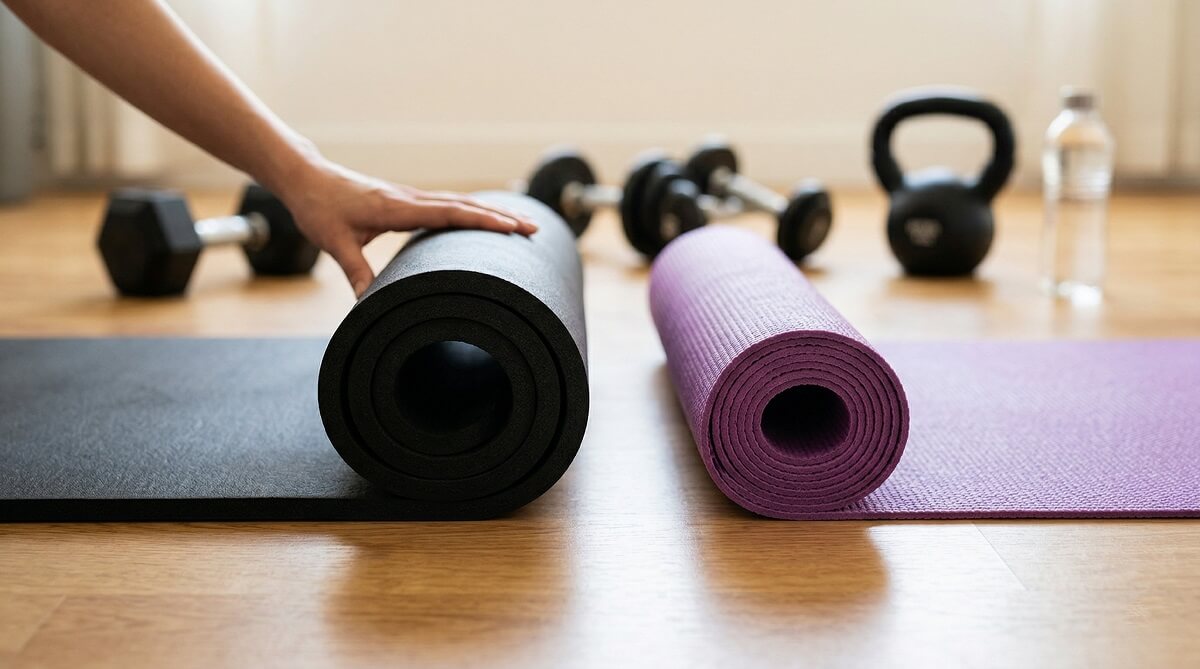
The short answer: if you practice yoga, pilates, or any floor work barefoot, go with a yoga mat. If you do HIIT, ab circuits, floor-based strength training, or exercises in shoes, a fitness mat (also called an exercise mat) serves you better. Both look similar from across the room, but they’re engineered for different demands — and using the wrong one does make a difference.
The three things that actually separate these mats are thickness, surface texture, and material. Yoga mats run 3mm to 6mm thin — that closeness to the floor is intentional, helping you stay stable and grounded during poses. Fitness mats start around 10mm and often go up to 15mm or thicker, cushioning your knees and elbows during planks, crunches, and push-ups. Surface-wise, yoga mats have a sticky, tacky top designed for bare hands and feet; fitness mats have a firmer, less tacky surface that holds up better to sweat and shoe traffic.
If you do both yoga and general workouts, you’re not stuck buying two mats. A handful of dual-purpose mats are designed for exactly that situation, and we cover those below. But for most people, one mat matched to your main activity is the cleaner answer.
The Short Answer: Match Your Mat to Your Workout
Choose a Yoga Mat If You…
- Practice yoga, pilates, barre, tai chi, or stretching sessions barefoot
- Need your hands and feet to grip the surface during poses and transitions
- Want something lightweight enough to roll up and carry to a studio
- Do balance work where feeling the floor beneath you actually helps
- Prefer a mat that starts around $25 and scales up to professional-grade options
Choose a Fitness Mat If You…
- Do floor-based workouts like HIIT, bodyweight circuits, or ab training
- Sometimes exercise in shoes or socks
- Want thicker padding to protect your knees and elbows during planks and push-ups
- Need a surface that cleans up easily after a hard sweat session
- Want a larger mat that gives you more room to move than a standard yoga mat
Consider a Dual-Use Mat If You…
- Mix yoga with general workouts and don’t want two separate mats cluttering your space
- Want something thicker than a yoga mat but still suitable for floor poses
- Are open to spending a bit more for versatility — options like the Stakt Mat run around $94 and fold into a yoga block
Fitness Mat vs Yoga Mat: Feature Comparison
| Feature | Yoga Mat | Fitness / Exercise Mat |
|---|---|---|
| Typical thickness | 3mm–6mm (some up to 8mm) | 10mm–15mm+ (some up to 25mm) |
| Top surface | Sticky/textured — grips bare skin | Firmer, smoother — easier to clean |
| Bottom surface | Non-slip (grips the floor) | Non-slip (grips the floor) |
| Shoe-friendly? | No — designed for barefoot use | Yes — works with shoes or socks |
| Best for | Yoga, pilates, barre, stretching, meditation | HIIT, floor exercises, ab work, strength training |
| Standard dimensions | 68″–72″ long × 24″–26″ wide | Varies widely; often 71″+ long, sometimes wider |
| Common materials | PVC, natural rubber, TPE, cork | NBR foam, EVA foam, rubber, neoprene |
| Typical weight | 2–7 lbs depending on thickness | 2–5 lbs for standard sizes |
| Price range | ~$25 budget → $129+ premium | ~$15 budget → $60+ mid-range |
| Portability | Rolls up easily; carry strap common | Rolls up; heavier, less travel-friendly |
Prices as of March 2026; check current pricing at retailers for the latest figures.
What Actually Separates These Two Mats
Thickness — The Biggest Factor
Thickness is where yoga mats and fitness mats diverge most clearly. A standard yoga mat runs between 4mm and 6mm — the Manduka PRO, one of the most recommended mats for serious practitioners, is exactly 6mm and weighs 7.5 lbs. That thinner profile keeps you in direct contact with the floor, which matters for balance poses — you can feel where your weight is distributing.
Fitness mats are noticeably thicker, typically 10mm to 15mm. That extra material absorbs the impact of dropped knees, grinding elbows, and repeated movement patterns. If you’ve ever done a long plank session on a thin yoga mat and felt your elbows the next day, a thicker fitness mat would have helped.
One trade-off worth knowing: the thicker the mat, the less stable balance poses become. A 15mm foam surface compresses under your foot unevenly, which is fine for push-ups but makes standing yoga poses noticeably harder. This is why yoga mats stay thin on purpose.
Surface Texture and Grip
The top surface is the other major distinction. Yoga mats have a tacky, textured finish designed so bare hands and feet stay planted — even when you’re sweating during a flow. Fitness mats use a smoother or lightly textured surface that prioritizes easy cleaning over barefoot grip. The bottoms of both mats are non-slip to grip your floor, whether that’s hardwood, tile, or carpet.
For hot yoga specifically, standard PVC yoga mats can get slippery once sweat builds up. That’s why some practitioners use a microfiber towel overlay, or opt for mats with moisture-wicking surfaces. The Manduka GRP Adapt (around $78 as of early 2026) is designed specifically for sweaty hot yoga practices.
Materials and What They Mean for You
Most yoga mats are made from one of three materials:
- PVC — The most common choice. Grippy, durable, affordable, and easy to wipe clean. Not eco-friendly, but it lasts for years with proper care.
- Natural rubber — Better grip and more durable than PVC, heavier (typically), and biodegradable. Lululemon’s The Mat 5mm (~$118) uses FSC-certified natural rubber. Not suitable if you have a latex allergy.
- TPE (thermoplastic elastomer) — A lightweight, closed-cell foam that doesn’t absorb sweat. A popular eco-conscious alternative to PVC.
Fitness mats lean toward different materials:
- NBR (nitrile butadiene rubber) foam — The most common fitness mat material. Dense, cushioned, and comfortable for floor exercises. Most budget-friendly fitness mats use this.
- EVA foam — Lighter than NBR, used in puzzle-piece interlocking mats and portable exercise mats.
- Neoprene — Water-resistant and durable, often used in gym-quality fitness mats.
Size — Yoga Mats vs Fitness Mats
Standard yoga mats measure approximately 68″ long by 24″ wide — just under 5’8″ in length. That covers most people for a yoga practice, though taller users often look for 72″–84″ options. Retrospec, for example, offers all its yoga mats at 72″ long. Lululemon’s The Mat 5mm comes in at 71″x26″, slightly wider for added elbow room during flows.
Fitness mats vary more in size. Some roll out at the same 71″x24″ footprint as a yoga mat. Others come in large puzzle-tile systems that let you cover an entire home gym floor. If you’re doing side-to-side movements, jumping, or working with equipment, a larger mat makes a real difference.
Can a Yoga Mat Sub for a Fitness Mat (and Vice Versa)?
Using a Yoga Mat for General Workouts
A yoga mat works fine for low-impact floor exercises — bodyweight movements, stretching, pilates, and similar work done barefoot. Where it falls short is high-impact training. The thin surface doesn’t offer enough cushioning for repeated knee drops or intense floor work, and it won’t appreciate being worn down by shoe soles.
For lighter sessions, the swap is workable. For HIIT or anything that involves a lot of contact force, you’ll notice the mat isn’t doing its job well.
Using a Fitness Mat for Yoga
You can practice yoga on a fitness mat without any safety issues. The problem shows up in balance poses — the thicker, softer surface compresses unevenly under your feet, making standing poses like Warrior III or tree pose noticeably harder to hold. The surface texture also tends to be less grippy for bare hands and feet, which can cause slipping during dynamic sequences.
If yoga is a regular part of your routine rather than occasional, the right tool genuinely helps. For occasional stretching or a beginner trying things out, a fitness mat gets the job done.
What to Spend: Yoga Mats and Fitness Mats by Price
Yoga Mat Price Ranges
Yoga mats span a wide price range, and the differences between tiers are real:
- Budget (~$15–$30): Basic PVC mats like the Gaiam Premium 5mm (~$25) work for beginners and occasional practitioners. Grip is adequate; lifespan is 1–3 years with regular use.
- Mid-range ($40–$80): Better materials, longer lifespan, improved grip. This is where most regular yogis land. The Manduka GRP Adapt (~$78) sits here and offers genuine hot-yoga grip.
- Premium ($100–$150+): Professional-grade options for daily practice. The Manduka PRO ($129) and Lululemon The Mat 5mm (~$118) fall here — both come with multi-year or lifetime warranties and are built to outlast cheaper alternatives by years.
Check current yoga mat prices on Amazon.
Fitness Mat Price Ranges
Fitness mats tend to cost less than premium yoga mats, and the budget tier is quite capable:
- Budget (~$15–$30): NBR foam mats in the 10–12mm range. BalanceFrom’s GoYoga 1/2″ line lands here — it won’t last forever, but it’s solid for home workouts.
- Mid-range ($30–$60): Denser foam, larger surface area, better durability. The OPTP Pro Fitness Mat (~$49.95) is a well-regarded option in this range.
- Pro/Specialty ($60+): Large gym-quality rubber mats, specialty foam, or foldable options. The Stakt Mat ($94) bridges yoga and fitness at 12mm — twice the thickness of a standard yoga mat — with a foldable design that doubles as a yoga block.
Check current exercise mat prices on Amazon.
Solid Options Worth Looking At
Yoga Mats
- Gaiam Premium 5mm (~$25): A reliable entry point. Standard 68″x24″ dimensions, PVC construction, non-slip. Good for beginners and occasional practice. See on Amazon
- Manduka PRO 6mm ($129): The long-term investment mat. Dense, stable, closed-cell surface that doesn’t absorb sweat. Lifetime guarantee. Made in Germany. Best for daily practitioners who want a mat that lasts indefinitely. See on Amazon
- Lululemon The Mat 5mm (~$118): Natural rubber, FSC-certified, 71″x26″ — slightly wider than standard, which gives you more working room. Good grip and solid durability. See at Lululemon
Fitness / Exercise Mats
- BalanceFrom GoYoga 1/2″ (~$20–$30): Budget NBR foam, 12mm thickness, 71″x24″. Non-slip both sides, carries a 2-year warranty for the price range. Works well for home floor workouts. See on Amazon
- OPTP Pro Fitness Mat (~$49.95): A well-regarded mid-range option used in physical therapy and fitness settings. Durable, supportive surface for Pilates and floor exercise. See at OPTP
All prices as of March 2026. Check retailers directly for current availability and pricing.
Frequently Asked Questions
Is a fitness mat the same as a yoga mat?
No, though the terms get used interchangeably. Yoga mats are thinner (3–6mm) with a sticky surface for barefoot grip. Fitness mats are thicker (10–15mm+) with a firmer surface designed for cushioning during floor exercises and shoe-friendly workouts. They serve overlapping but distinct purposes.
Can I use my yoga mat for HIIT workouts?
For low-impact HIIT done barefoot, a yoga mat handles the job reasonably well. For high-impact moves — jump squats, burpees, repeated knee drops — the thin surface provides limited cushioning, and the mat wears out faster under shoe traffic. A fitness mat is a better fit for that intensity level.
What thickness mat is best for floor exercises?
For general floor exercises (planks, push-ups, crunches, core work), a mat in the 10mm–15mm range offers a good balance of cushioning and stability. Thicker than 15mm and the surface gets too soft for controlled movements; thinner and your joints feel the floor more than you’d like.
Are yoga mats good for Pilates?
Yes — yoga mats work well for Pilates, especially mat Pilates done barefoot. Some practitioners prefer a slightly thicker mat (8mm+) for extra knee and hip support during supine exercises. A fitness mat also works for Pilates, though the less grippy surface can cause slipping in certain exercises.
What is a TPE mat?
TPE stands for thermoplastic elastomer — a synthetic material used as an eco-friendlier alternative to PVC in yoga and fitness mats. TPE mats are lightweight, closed-cell (they don’t absorb sweat), and typically recyclable. Grip and durability fall between foam and natural rubber in most comparisons.
How often should I replace my workout mat?
A high-quality yoga mat used daily can last several years. Signs it’s time to replace: noticeable thinning in high-wear spots, grip that no longer holds even after cleaning, or a persistent odor that won’t wash out. Budget mats used frequently may show wear within a year or two.
What’s the best mat for joint pain?
For joint pain, prioritize thickness and density. A mat in the 12mm–15mm NBR foam range gives meaningful cushioning for knees, hips, and wrists during floor work. Retrospec’s 1″ (25mm) Solana mat is an option if joint comfort is the top priority, though very thick mats can feel unstable for balance movements.
Can I use a fitness mat for yoga?
Yes, safely. The main drawbacks are less grip on the top surface (which can cause slipping in flowing sequences) and more surface instability in standing balance poses. For occasional or beginner yoga practice, a fitness mat works fine. For regular dedicated practice, a yoga mat’s design is worth the difference.
Which mat is easier to clean?
Fitness mats tend to be easier to clean — their smoother, less porous surface wipes down quickly. Most yoga mats should be wiped after each session and deep cleaned monthly. Closed-cell yoga mats (like the Manduka PRO) don’t absorb sweat, which makes them considerably easier to maintain than open-cell foam mats.
Do I need a mat if I work out on carpet?
Carpet provides some cushioning and grip on its own, but a mat still helps. It creates a defined, clean workout surface, adds consistent traction regardless of carpet pile, and protects the carpet from sweat. For yoga on carpet, a mat actually becomes more important — the non-slip bottom keeps the mat from sliding across carpet fibers.
The Bottom Line
For most people, the right call is to match the mat to the workout you do most often. Yoga and pilates practitioners get more out of a proper practice mat — the thin profile and sticky surface are there for good reason. For floor workouts and general fitness, a workout mat’s added cushioning protects your joints without much compromise.
If budget is the deciding factor, start with whatever option is closest to your primary activity. A $25 yoga mat beats a $60 gym mat for a daily yoga practice. And vice versa — a $20 NBR exercise mat outperforms a premium yoga mat for ab circuits every time.
Check current prices and options for yoga mats on Amazon and exercise mats on Amazon.
