


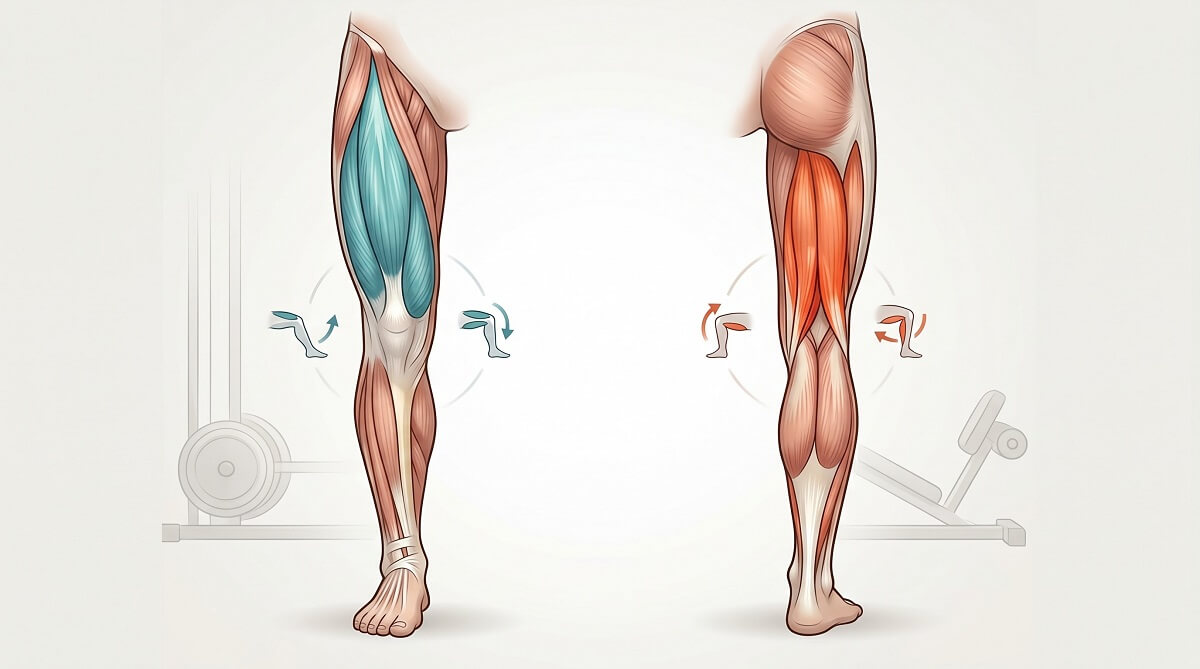
Your quads (front of thigh) and hamstrings (back of thigh) are opposing muscle groups. The quads extend your knee; the hamstrings bend it and extend your hip. For healthy movement, your hamstrings should be roughly 60–75% as strong as your quads — most people fall well short of that. Research consistently puts the acceptable range at 50–80%, with 60% as the conventional benchmark, according to a review published in PMC on hamstring/quadriceps ratio assessment.
The gap happens for a predictable reason: most gym routines pile on quad work through squats, leg presses, and lunges, while hamstring training gets an afterthought — a few sets of leg curls if there’s time. That imbalance quietly sets you up for knee pain, hamstring strains, and lower back issues. Studies show that 37% of soccer players and 44% of basketball players already have a meaningful H:Q ratio deficit. And if you’re not a competitive athlete, the numbers are likely worse.
This guide covers what each muscle group actually does, why the strength ratio matters, which exercises hit each one most effectively, and how to close the gap without rebuilding your entire training schedule.
Is This Guide Right for You?
✅ Read This If You:
- Train regularly but skip dedicated hamstring work
- Have knee pain, tight hamstrings, or unexplained lower back soreness
- Run, cycle, play soccer, or do any sport involving sprinting or cutting
- Want to know which exercises actually target quads vs hamstrings
❌ Less Relevant If You:
- Are researching ACL reconstruction graft options (that’s a surgical decision — see an orthopedic surgeon)
- Have an acute hamstring or knee injury — start with a sports medicine doctor or physical therapist
What Are the Quads and Hamstrings?
of how these muscle groups function makes it much easier to train them intelligently.
The Quadriceps (Front of Thigh)
The quadriceps is actually four separate muscles working together: the rectus femoris, vastus lateralis, vastus medialis, and vastus intermedius. Their primary job is knee extension — straightening the leg from a bent position. The rectus femoris also assists with hip flexion, pulling the knee toward the chest.
You recruit your quads heavily in squats, lunges, step-ups, cycling, and running uphill. They’re also constantly engaged in everyday activities like standing up from a chair or climbing stairs. Because they see so much daily use, they tend to develop more strength and size than the hamstrings in most people.
The Hamstrings (Back of Thigh)
Three muscles make up the hamstring group: the biceps femoris (which has a long and short head), semitendinosus, and semimembranosus. They handle two distinct functions: bending the knee (knee flexion) and extending the hip by driving it backward. That hip extension role makes hamstrings essential for sprinting, jumping, and any movement requiring power from behind.
Critically, hamstrings serve as the brakes during deceleration. When you’re sprinting and need to slow down, your hamstrings absorb that force eccentrically — which is exactly why hamstring strains happen most often at high speeds during the late swing phase of running.
How They Work Together
These two groups are classic antagonists. As the quads contract to extend the knee, the hamstrings lengthen and act as stabilizers. In the walking and running cycle, one hip moves into flexion while the other extends — a reciprocal pattern that depends on both groups working in coordinated opposition. When one is significantly stronger or tighter than the other, that coordination breaks down.
The Strength Ratio: How Strong Should Each Be?
The hamstring-to-quadriceps (H:Q) strength ratio is one of the most studied metrics in sports medicine. The conventional normative value is 0.6 — meaning hamstrings should be at least 60% as strong as the quads. A broader acceptable range runs from 50–80%, but anything below 60% is a yellow flag. This benchmark comes from isokinetic dynamometer testing, where forces are measured at controlled speeds.
In practical terms: if your leg extension (quad) machine maxes out at 100 lbs for a set, your leg curl (hamstring) should handle around 60–75 lbs. Most gym-goers, especially those who prioritize squats and skip dedicated hamstring work, find a much bigger gap than that.
A 2022 systematic review in Sports Medicine and Health Science found that athletes with an H:Q ratio below 60% face a noticeably higher risk of lower limb injuries, particularly hamstring strains and ACL tears. The prevalence of this deficit is striking: 37% of soccer players and 44% of basketball players show a meaningful H:Q imbalance. For recreational gym-goers who don’t include structured hamstring work, the numbers are likely higher.
One important nuance: the conventional ratio measures concentric strength (muscles shortening). Researchers also use a “functional ratio” comparing eccentric hamstring strength to concentric quad strength — since hamstrings primarily work eccentrically during deceleration. That functional ratio has a target closer to 1.0. For most fitness purposes, the 60–75% conventional benchmark is the practical starting point.
Why Most People Have Stronger Quads Than Hamstrings
Quad dominance isn’t a gym error — it’s a structural outcome of how most people move and train.
Sitting 8–12 hours a day tightens the hip flexors and puts hamstrings in a chronically lengthened, passive position. Over time, those hamstrings become neurologically inhibited — the nervous system stops calling on them as a primary mover. Meanwhile, the quads and hip flexors stay active from standing, walking, and daily activity.
Common training choices make it worse. Squats, leg presses, lunges, and step-ups are the default lower body exercises in most programs. All of these are quad-heavy movements. The hamstrings assist but are not the primary driver. Without deliberate programming — Romanian deadlifts, Nordic curls, leg curls, hip hinges — the back-side muscle group gets undertrained.
Running mechanics can also contribute. Runners who over-stride (landing with the foot too far in front of the body) shift load toward the quads and reduce hamstring recruitment. This is one reason hamstring strains are disproportionately common among sprinters who lack back-of-body muscle strength.
Quad vs Hamstring Exercises: Which Is Which?
Knowing where each exercise falls helps you balance your training. The goal isn’t to pick one group over the other — it’s to make sure both get adequate attention each week.
Exercises That Load the Quads Most
| Exercise | Primary Target | Notes |
|---|---|---|
| Back squat (high bar) | Quads | Upright torso shifts load toward quads; low bar shifts more to posterior chain |
| Leg press | Quads | Foot position matters — lower foot placement = more quad; higher = more glute/hamstring |
| Forward lunge | Quads | Reverse lunge shifts more load to glutes and hamstrings |
| Step-up | Quads | Effective quad isolation, easy to load progressively |
| Leg extension (machine) | Quads (isolation) | Open-chain exercise; useful for rehab but not a primary strength builder |
Exercises That Load the Hamstrings Most
can help you find the right gear for these movements at home or in the gym.
| Exercise | Primary Target | Notes |
|---|---|---|
| Romanian deadlift (RDL) | Hamstrings + glutes | Best overall hamstring builder; hip hinge pattern, high eccentric load. ACE research confirms activation comparable to or exceeding leg curl machine. |
| Nordic curl (Nordic hamstring exercise) | Hamstrings (eccentric) | Strongest evidence for injury prevention. A meta-analysis of 8,459 athletes found programs including Nordic curls cut hamstring injury rates by up to 51%. |
| Lying / seated leg curl (machine) | Hamstrings (isolation) | Good for isolation; less functional than hip-hinge patterns but useful for volume |
| Glute-ham raise | Hamstrings + glutes | High hamstring activation across full range; requires specialized equipment |
| Good morning | Hamstrings + lower back | Hip hinge variation; requires attention to lumbar positioning |
Exercises That Work Both
- Conventional deadlift — More balanced load; shifts hamstring-dominant when performed with a strong hip-hinge
- Hex bar (trap bar) deadlift — More balanced between quads and posterior chain than conventional; great for beginners
- Hip thrust — Primarily glutes but significant hamstring co-activation, especially at the top
Research in the Journal of Strength and Conditioning Research found that the Romanian deadlift produced nearly 3.5x greater eccentric biceps femoris activation compared to the prone leg curl (305 mV vs 93 mV). That eccentric loading is exactly what protects hamstrings during high-speed movements.
What Happens If You Ignore the Imbalance
Hamstring strains are one of the most common sports injuries across all levels of competition. A systematic review and meta-analysis tracking 5,952 hamstring injuries across 7 million exposure hours found an incidence of 0.81 per 1,000 hours in field-based sports — roughly 10% of all injuries. In men’s professional soccer, a 21-year UEFA study found hamstring injuries rose from 12% to 24% of all reported injuries by 2021/22.
Beyond strains, a weak posterior chain shows up in other ways:
- Patellofemoral pain (“runner’s knee”) — Overactive quads pull the kneecap out of optimal tracking
- ACL injury risk — Hamstrings co-stabilize the knee; weak hamstrings reduce that protection during cutting movements
- Lower back pain — Tight quads tilt the pelvis forward (anterior pelvic tilt), pulling on lumbar muscles
- Hip flexor issues — When quads are chronically tight, the hip flexors compensate, restricting hip extension
These aren’t worst-case scenarios. They’re the predictable downstream effects of an imbalance that many people have been building for years without realizing it. If you’re looking for specific equipment to help with recovery or strengthening, our cover resistance bands, foam rollers, and home gym options.
A Practical Plan to Balance Your Quads and Hamstrings
are a good complement if you want structured workout breakdowns beyond this intro plan.
You don’t need to rebuild your program. Three targeted adjustments make a real difference:
Step 1: Loosen Up the Front Side
Foam roll your quads and hip flexors for 2–3 minutes each before training. Follow with a couch stretch (rear foot elevated on a bench or wall, front knee on the floor) to specifically address the rectus femoris. This reduces the neurological inhibition that tight quads place on the hamstrings — your hamstrings will recruit better once the quads stop dominating.
Step 2: Add Targeted Hamstring Work
Two to three sets of Romanian deadlifts per session is the most efficient starting point. Begin with a weight you can control through a full range of motion — the stretch at the bottom is what builds the hip extensor muscle group. If you’re new to Nordic curls, start with an eccentric-only version: kneel with feet anchored, lower your torso forward as slowly as possible (3–5 seconds), then use your hands to push back up. Aim for 48 reps per week at a high-volume phase per the 2024 umbrella review on Nordic hamstring exercises — but build up gradually to avoid soreness.
Step 3: Rebalance Your Weekly Training
For every quad-dominant session, include at least one dedicated hamstring exercise. A simple rule: if you did squats today, add RDLs or leg curls. Over time, target a 1:1 ratio of quad-to-hamstring exercises per week. Track it for four weeks and you’ll likely notice a meaningful difference in both strength and how your knees feel.
Timeline: Most people notice measurable strength gains in hamstrings within 4–8 weeks of consistent training. Closing a significant gap — where hamstrings were at 40–50% of quad strength — typically takes 3–6 months of sustained effort.
Quads vs Hamstrings: Quick Reference
| Feature | Quadriceps | Hamstrings |
|---|---|---|
| Location | Front of thigh | Back of thigh |
| Muscles in group | 4 (rectus femoris, vastus lateralis, medialis, intermedius) | 3 (biceps femoris, semitendinosus, semimembranosus) |
| Primary actions | Knee extension, hip flexion | Knee flexion, hip extension |
| Typically stronger? | Yes | No — target 60–75% of quad strength |
| Best exercises | Squat, leg press, lunge | RDL, Nordic curl, leg curl, glute-ham raise |
| Injury risk if underdeveloped | Patellofemoral pain | Hamstring strain, ACL injury, lower back pain |
| Training frequency | 2–3x per week | 2–3x per week (often neglected) |
Frequently Asked Questions
Are quads naturally stronger than hamstrings?
Yes, in most people. The quads have greater muscle mass and are more active in everyday movements like walking and climbing stairs. The hamstrings aren’t designed to match quad strength — they’re designed to complement it. The goal is a healthy ratio (60–75%), not equal strength.
What is the ideal hamstring-to-quadriceps strength ratio?
The conventional benchmark is 0.6 (60%), meaning your hamstrings should produce at least 60% of the force your quads do under controlled testing. A range of 60–75% is generally considered healthy. Below 50% is a meaningful deficit that increases injury risk, especially for athletes who sprint or change direction frequently.
Do squats work quads or hamstrings more?
Squats are primarily quad-dominant. The hamstrings assist with stability and hip extension, but they’re not the primary driver. Back squats with a high bar and upright torso emphasize quads most. A low-bar squat with more forward lean shifts some load toward the posterior chain, but squats are still classified as a quad-primary exercise.
Do deadlifts work quads or hamstrings more?
It depends on the variation. Romanian deadlifts are the most hamstring-focused — the hip-hinge pattern keeps tension on the hamstrings through most of the range of motion. Conventional deadlifts are more balanced. Sumo deadlifts engage more quad due to the wider stance and upright torso. Hex bar deadlifts split the load more evenly.
Can quad dominance cause knee pain?
Yes. Overactive quads can alter kneecap tracking, contributing to patellofemoral pain (sometimes called runner’s knee). Weak hamstrings also reduce the stability they normally provide to the knee joint, increasing stress during activities like running and cutting. Both mechanisms can be addressed with dedicated hamstring work and quad flexibility.
How long does it take to fix a quad-hamstring imbalance?
With consistent training — two to three sessions per week targeting the hamstrings — most people see measurable strength gains within 4–8 weeks. Correcting a significant imbalance where hamstrings are at 40–50% of quad strength typically takes 3–6 months of deliberate programming.
What’s the best hamstring exercise for someone starting out?
Romanian deadlifts with a light dumbbell or barbell are the most accessible and effective starting point. Focus on the hip hinge — sending your hips back while keeping a neutral spine — until you feel a deep stretch in the back of the thigh. Start with 3 sets of 10–12 reps. Once you’re comfortable with the movement, progress the weight gradually.
Should I stretch quads or strengthen hamstrings first?
Both are part of the solution, but the order matters. Foam rolling and stretching tight quads and hip flexors first reduces neurological inhibition, making it easier for the hamstrings to recruit properly during strengthening exercises. Think of it as clearing the lane before trying to drive through it. For more structured guidance, check our on building lower body training programs.
Building a balanced lower body takes the right equipment and the right plan. Browse on ChubbytIps for recommendations on resistance bands, dumbbells, and home gym gear that support posterior chain training.
