


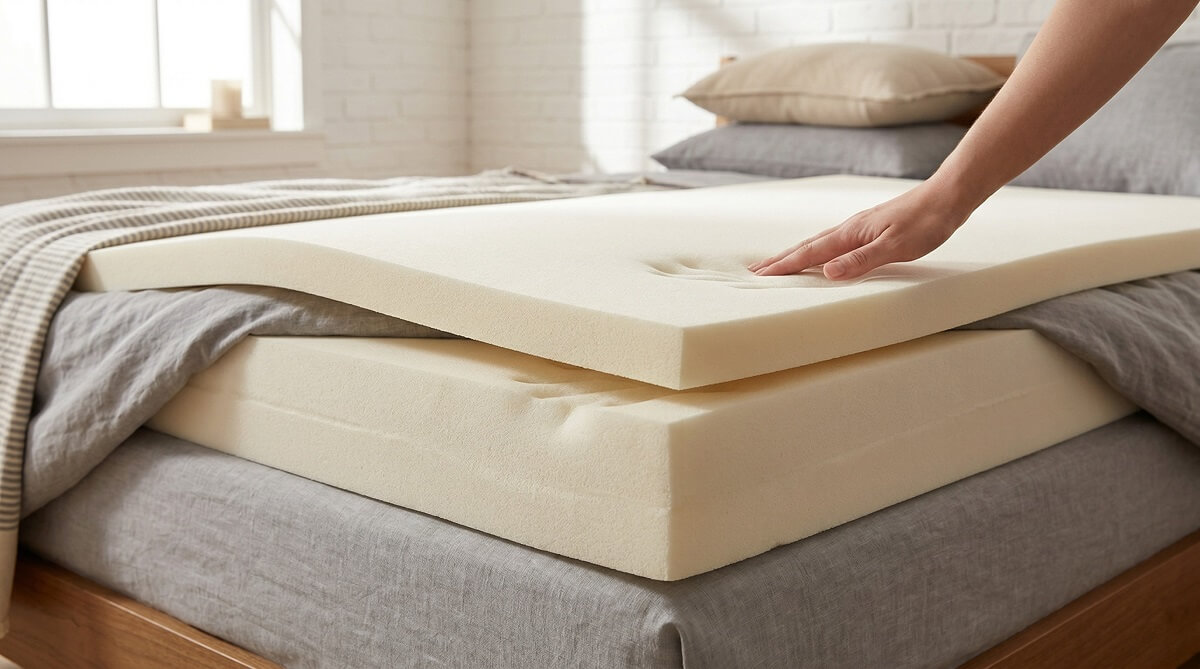
Short answer: yes, you can put a memory foam topper on a memory foam mattress. But you shouldn’t just grab any foam pad and stack it on top. The type of topper you choose makes a real difference — especially when heat is already a concern with your current bed.
Standard memory foam on top of memory foam is the combination most likely to leave you sleeping hot and sinking too deep. What actually works: gel-infused memory foam toppers, which run 2–5°F cooler than traditional memory foam according to Sleep Foundation. Latex is another solid option if you want a more responsive feel. The goal is adding a layer that improves your sleep — not one that compounds the existing drawbacks of foam.
This guide covers who should add a topper (and who shouldn’t), how to pick the right thickness, and a comparison of the best options on the market right now, including picks under $100.
Should You Add a Topper to Your Memory Foam Mattress?
✅ Add a Topper If:
- Your mattress is too firm and causing shoulder or hip discomfort
- Your bed is 5–8 years old and has lost some of its original feel
- You sleep hot and want a cooling gel layer between you and the base foam
- You want to extend the mattress life without buying a new bed
- You’re a side sleeper needing more cushioning at pressure points
❌ Skip the Topper If:
- Your mattress has visible sagging or body impressions deeper than 2 inches — a topper can’t fix structural issues; at that point, replace the bed
- You already sleep hot and your base is standard memory foam — adding a plain memory foam topper makes the heat problem worse
- You want a firmer feel — most toppers soften things further
- Your mattress is newer (under 2 years) and in good condition — give it time to break in first
Does a Topper Change How Your Memory Foam Mattress Feels?
Adding a 2-inch topper preserves most of your mattress’s existing character — you’ll feel the difference, but the base foam still does its job. A 3-inch topper changes things more substantially. As Brentwood Home puts it on their product page, with a 3-inch topper “you may no longer even feel the mattress underneath.” That can be exactly what you want if your mattress is the problem, or it can be frustrating if you paid good money for a specific feel.
The concern about “defeating the purpose”
If you drop a latex or down-alternative topper on top of memory foam, the body-contouring properties of the base foam become less relevant — you’re sleeping on the top layer instead. That’s fine if that’s what you want. If you add a matching memory foam topper, the layers work together and you still get contouring; you just get more of it. The issue isn’t the concept — it’s picking the wrong material for your situation.
The heat problem with foam-on-foam
Memory foam traps body heat by design. Stack two layers of it and you’re retaining more warmth than either layer would alone. Sleep experts at Tom’s Guide note that plain memory foam on a foam base creates “stuffy, warm” conditions because there are no springs or coils to boost airflow. The fix: choose a gel-infused topper or a latex topper, both of which manage heat better.
Picking the Right Thickness
Thickness is the most practical decision you’ll make. The difference between a 2-inch and a 4-inch topper isn’t just comfort — it affects heat, weight, and how much the topper masks your mattress’s original support.
2-inch toppers — light adjustment
A 2-inch layer adds cushioning without dramatically changing what’s underneath. This works well for stomach sleepers (who typically need less give), lighter people under 130 lbs, and anyone who wants a subtle improvement rather than an overhaul. It’s also the easiest to handle — a queen-size 2-inch gel topper from Brentwood Home weighs just 13 lbs, manageable alone.
3-inch toppers — the most popular choice
Three inches is where most side sleepers and average-weight individuals (130–230 lbs) land. You get meaningful pressure relief at the hips and shoulders, and the topper does enough work that your mattress’s exact firmness matters less. The Novaform SoFresh Plus 3″ is a strong example at $99.99 for a queen — it’s widely available and CertiPUR-US certified.
4-inch toppers — significant transformation
For heavier sleepers over 230 lbs, or anyone dealing with a badly worn mattress, a 4-inch topper essentially creates a new sleeping surface. The catch: 4-inch queen toppers can weigh 30–40 lbs and some lighter-weight sleepers find themselves sinking uncomfortably. One Foam Factory customer described the 4-inch 5LB topper as a “dead weight” when it landed on the mattress — in a good way, because it didn’t compress under them overnight. But if you weigh under 130 lbs, 4 inches of memory foam may have you sleeping in a groove by morning.
When to Add a Topper vs. When to Replace the Mattress
A topper extends a mattress’s useful life, but it can’t fix a broken foundation. Here’s how to tell which situation you’re in.
Add a topper when: Your mattress is structurally sound — no sagging, no visible deformations — but the firmness or feel isn’t right for you anymore. This is common with mattresses in the 5–8 year range that have lost some initial feel but haven’t structurally failed yet.
Replace when: Body impressions in your mattress are deeper than 2 inches, according to guidance from Amerisleep and Casper. A topper placed over a sagging mattress will mirror that sag — you’re just adding a softer surface to an uneven base. Sleep Foundation puts average mattress lifespan at 7–10 years; past that range, most foam mattresses have compacted enough that no topper adequately compensates.
Middle ground: Using a topper as a temporary fix while saving for a new mattress is entirely reasonable. Just don’t buy an expensive topper for a mattress that needs replacing — the money is better saved toward the replacement.
Top Memory Foam Toppers to Pair With a Memory Foam Mattress (2026)
All pricing is as of March 2026 and subject to change. Check current listings for promotions.
| Topper | Type | Thickness | Queen Price | Trial Period | Certification |
|---|---|---|---|---|---|
| Novaform SoFresh Plus | Gel Memory Foam | 3″ | $99.99 | — | CertiPUR-US |
| Lucid 3″ Gel Memory Foam | Gel Memory Foam | 2″ / 3″ / 4″ | ~$99.99 | 30-night | CertiPUR-US |
| GhostBed Memory Foam Topper | Zoned Gel Memory Foam | 3″ | $269 | 101-night | CertiPUR-US |
| Brentwood Home BioFoam | Gel + Plant-Based Foam | 2″ or 3″ | $251 (sale) | 1-year trial | CertiPUR-US + GREENGUARD Gold |
| Foam Factory 5LB ViscoMAX | High-Density Memory Foam | 2″ / 3″ / 4″ | Check current price | 60-day | CertiPUR-US |
Best for hot sleepers
Go with the Novaform SoFresh Plus or Lucid 3″ Gel Memory Foam. Both use gel infusions and open-cell construction to offset the heat-trapping nature of the foam below. At $99.99 for a queen, both sit under the $100 threshold that makes a topper genuinely cost-effective compared to a new mattress.
Best for pressure relief and back pain
Higher-density foam holds up better under sustained pressure. The Foam Factory 5LB ViscoMAX (ILD 12) is the densest option listed here — customers with fibromyalgia and spinal conditions consistently report waking without pain after switching to it. GhostBed’s zoned design also targets pressure points at the head, shoulders, torso, and legs, which can help with targeted discomfort.
Best overall value
The Novaform SoFresh Plus at $99.99 (queen) ticks the most boxes for most people: gel cooling, CertiPUR-US certification, 10-year warranty, and widely available at Costco and online. The Lucid 3″ is a close second at a similar price point with a 30-night trial attached.
What to Know Before You Buy
What CertiPUR-US actually means
Most of the toppers above carry CertiPUR-US certification. This matters because it means the foam has been independently tested to contain no phthalates, no heavy metals (lead must meet the CPSC toy standard), formaldehyde under 0.1 parts per million, and total VOCs under 0.5 parts per million, according to certipur.us. For something you sleep on every night for years, that third-party verification is worth looking for. GREENGUARD Gold (carried by Brentwood Home) is a stricter standard, particularly relevant if you have chemical sensitivities or are buying for a child’s room.
Off-gassing: expect a brief smell period
New memory foam has a distinct odor when first unpacked — polyurethane VOCs off-gassing as the foam expands. Adding a new topper to a foam mattress doubles that effect temporarily. Air the topper out for 24–48 hours before sleeping on it. Most off-gassing dissipates within a few days; CertiPUR-US certification means the amounts are within safe limits, but the smell itself is unavoidable initially.
Will the topper slide around?
Toppers without fitted covers tend to migrate, especially on smooth mattress surfaces. Most quality toppers now include a fitted-sheet-style cover with elastic or non-slip backing. Novaform’s cover “stretches like a fitted sheet over mattresses up to 17 inches deep,” and Brentwood Home includes a non-woven non-slip bottom. If your topper doesn’t come with a cover, a non-slip mat between layers works fine.
Adjustable bed compatibility
Foam toppers generally flex enough to work with adjustable bases. The exception is thick (4″+) high-density toppers, which resist bending at higher adjustments. If you use an adjustable base, stick with a 2- or 3-inch topper and confirm the product is adjustable-base compatible before ordering.
Frequently Asked Questions
Can you put a memory foam topper on a memory foam mattress?
Yes. A memory foam topper on a memory foam mattress is a common and effective way to adjust firmness, add pressure relief, or extend a mattress’s usable life. The key is choosing a gel-infused option rather than standard memory foam, which compounds the heat-retention issue most foam mattresses already have.
Will a memory foam topper on a memory foam mattress make me sleep hotter?
Possibly, if you choose plain memory foam. Gel-infused memory foam toppers run 2–5°F cooler than traditional memory foam, according to Sleep Foundation, and open-cell construction adds airflow. If you already sleep hot, prioritize gel, graphite-infused, or latex toppers instead of standard memory foam.
What thickness memory foam topper should I get for my memory foam mattress?
For minor adjustments, start with 2 inches — it’s enough to notice but preserves your mattress’s original feel. Side sleepers and average-weight people (130–230 lbs) generally get the best results with 3 inches. Heavy sleepers over 230 lbs or those dealing with significantly worn mattresses may need 4 inches. When in doubt, go with 3 inches and take advantage of a sleep trial.
Does a memory foam topper help with back pain?
It can, especially if your current mattress is too firm and causing pressure at your hips, shoulders, or lower back. High-density foam toppers (4–5 LB per cubic foot) tend to hold up better for pain relief than lower-density options, which compress under sustained weight and lose their benefit. Several Foam Factory customers with spinal stenosis, arthritis, and fibromyalgia report significant improvement.
How long do memory foam toppers last?
Expect 3–5 years from most memory foam toppers, according to Sleep Foundation. Higher-density foam (5LB) lasts longer than 3LB. A 3LB topper used on an active, heavy-use bed may compress and lose support in 2 years. Signs it’s time to replace: visible impressions that don’t recover, consistent morning aches that weren’t there initially.
What is the difference between gel memory foam and regular memory foam toppers?
Gel memory foam incorporates beads or swirls of gel material that absorb and disperse body heat. Standard memory foam has no temperature management beyond its open-cell structure, which helps somewhat but not enough for hot sleepers. Gel toppers typically cost a bit more but are worth it when adding a layer to an already-warm foam bed.
Do memory foam toppers work on adjustable beds?
Most do, as long as the topper is 3 inches or thinner. Very thick or rigid high-density toppers may resist bending at steeper incline and head-rest angles. Check the product specs or manufacturer FAQ if you use an adjustable base regularly.
Should I replace my mattress or add a topper?
Replace the mattress if body impressions or sagging are deeper than 2 inches, if your mattress is over 8–10 years old, or if you’re waking up with pain that wasn’t there initially and a comfort layer hasn’t helped. Add a topper if the bed is structurally sound but the firmness level isn’t working for you. A topper is a legitimate fix for comfort issues; it’s not a fix for structural failure.
Check current prices on gel memory foam toppers on Amazon or find the Novaform SoFresh Plus at Novaform (also available at Costco).
