


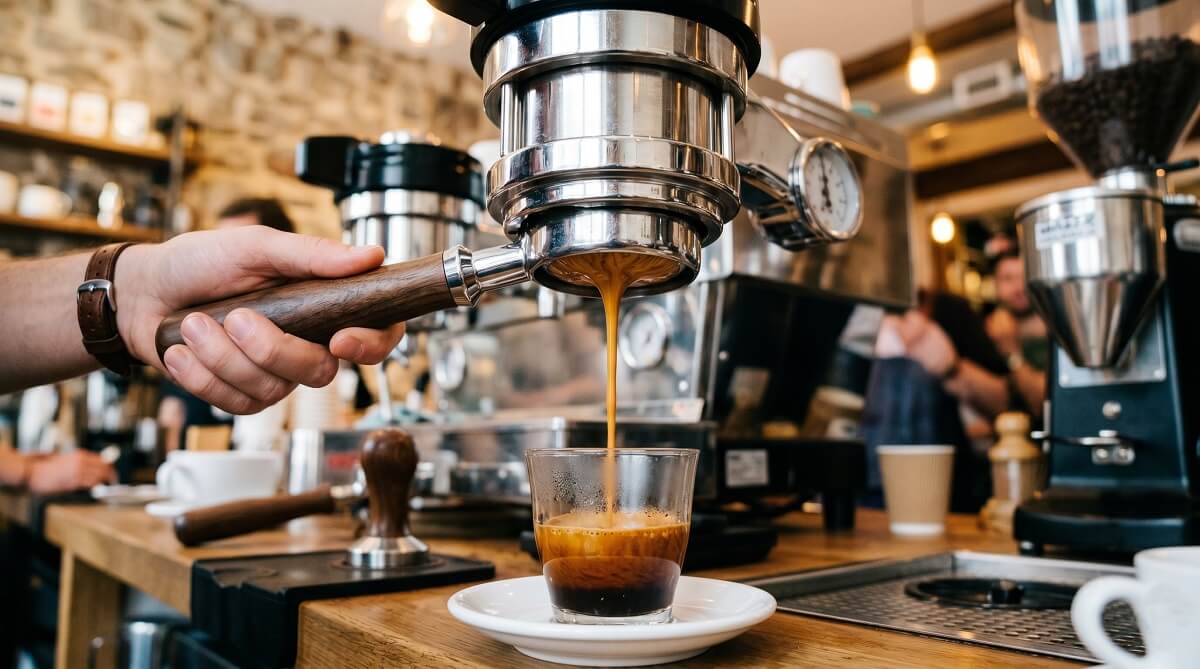
A bottomless portafilter — also called a naked portafilter — is a standard espresso portafilter with the spouts removed. That’s it. The bottom of the filter basket is fully exposed, so you can watch the espresso flow directly out of the puck as it extracts. It’s a diagnostic tool first and a coffee accessory second.
The reason baristas use one is simple: it shows you what’s actually happening inside your basket. If your tamping is uneven, your grind is inconsistent, or your grounds are distributed poorly, you’ll see the shot spray everywhere instead of flowing smoothly. With a spouted portafilter, those same problems stay hidden. With a bottomless portafilter, they’re impossible to ignore — which means you fix them faster. For a broader look at , that’s a good place to start before adding new tools.
One thing worth being clear about upfront: a bottomless portafilter won’t make your espresso taste better by itself. What it does is force you to refine your approach, and that’s what improves the shot. If you’re the kind of home barista who actually wants to understand what’s going wrong with your pulls, this tool is worth having. If you’re still dialing in your grind and just want a clean shot on a busy morning, stick with the spouted portafilter a bit longer.
Should You Get a Bottomless Portafilter?
✅ Get one if you:
- Pull espresso at home and want to understand why your shots taste off
- Are learning espresso technique and want real-time visual feedback on your tamping and distribution
- Have a semi-automatic machine with a 54mm or 58mm group head
- Want a cleaner portafilter to maintain — no hidden spout channels to scrub
- Use a scale to weigh your shots (extra drip-tray clearance makes this easier)
❌ Skip it for now if you:
- Are brand new to espresso and still figuring out grind size basics
- Regularly make drinks for two people at the same time (a dual-spout portafilter splits shots more easily)
- Use a fully automatic or super-automatic machine
- Have a pressurized portafilter machine — most entry-level pod-compatible setups won’t work with non-pressurized bottomless portafilters
- Zero mess tolerance before work in the morning (a shot that’s off will spray)
What Exactly Is a Bottomless Portafilter?
The Basic Parts (and What’s Missing)
A standard portafilter has a handle, a metal body, a filter basket held in place by a spring clip, and one or two spouts at the bottom that direct espresso into your cup. A bottomless portafilter has all of those same components except the spouts. The bottom of the basket is open — exposed — so espresso drips directly out of the holes in the basket rather than being channeled through any additional metalwork.
Some people call it a “naked portafilter” — the terms are used interchangeably in the espresso community. According to Breville’s portafilter guide, “bottomless portafilters don’t have a spout or second wall, so the filter basket is visible when you look up toward the group head.” If you’re shopping for espresso gear beyond just the portafilter, cover machines, grinders, and accessories together.
Bottomless vs. Spouted Portafilter — Side by Side
| Feature | Bottomless (Naked) | Spouted (Single or Double) |
|---|---|---|
| Spouts | None | 1 or 2 |
| Extraction visible | Yes — full, unobstructed view | No — hidden behind spout housing |
| Good for training | Yes | No |
| Splits into 2 cups | No (needs shot glass or mug) | Yes (dual spout) |
| Mess risk | Higher when technique is off | Lower |
| Cleaning | Easier — no hidden channels | More involved |
| Cup clearance | More vertical space | Standard |
Why Baristas Actually Use a Bottomless Portafilter
It Tells You What’s Wrong — In Real Time
The whole point of removing the spouts is visibility. When you pull a shot through a spouted portafilter and something tastes off, you’re guessing: is it the grind? The tamp? The dose? With a bottomless portafilter, the extraction itself gives you the answer.
According to Coffee Chronicler’s guide (written by Asser Christensen, a licensed Q Arabica Grader), five distinct extraction problems become visible through a naked basket:
| What You See | What It Means | What to Fix |
|---|---|---|
| Spray in multiple directions | Channeling — water forcing through weak spots | Even distribution + level tamp |
| Extraction starts as a ring (donut shape) | Side-channeling — grounds thin near basket edge | Better grind distribution; use a WDT tool |
| Two streams that never merge | Uneven puck density | Distribution tool or WDT stirring |
| One side flows faster than the other | Off-angle tamp | Use a leveling tamper or practice flat tamp |
| Dry patches visible in the basket | Dry pockets — water bypassing sections of puck | Better grind distribution |
| Smooth, steady, centered flow | Good extraction | Keep doing what you’re doing |
As Clive Coffee describes it, a well-pulled shot “pours like warm honey — smooth, silky, and delicious.” The visual feedback you get from a bottomless portafilter is what guides you toward that result.
It Pushes You to Nail Your Puck Prep
There’s a psychological element to this tool that competitors rarely mention. When spraying is visible — when your espresso is going sideways instead of down — you feel it and fix it. You adjust your distribution, your tamp angle, your dose. With a spouted portafilter, those same flaws are hidden, and you stay stuck longer.
covers three main variables: dose, distribution, and tamping. For most home machines, a double shot runs 16–22g of ground coffee depending on the basket. confirm 18g for their 54mm machines (Barista Express, Bambino Plus) and 22g for their 58mm professional models (Dual Boiler, Oracle). Getting those numbers consistent is the foundation — the bottomless portafilter shows you whether the rest of your prep holds up.
Cleaning Is Genuinely Easier
Standard spouted portafilters develop a buildup of coffee oils and old grounds in the spout channels and the area between the basket and the body. Getting into those spots requires removing the basket, which can be stiff on many machines. A bottomless portafilter has no hidden geometry — old grounds knock out cleanly, and rinsing the basket takes seconds since there’s nothing blocking access from below.
More Clearance for a Scale or Tall Mug
Removing the spouts adds vertical clearance under the portafilter — useful if you’re weighing shots on a small scale or pulling into a taller glass. This is especially practical on machines like the Gaggia Classic Pro (starting at $549.00, per Gaggia North America), where the drip tray clearance is tight with standard cups. for a closer look at popular home espresso setups.
What a Good Extraction Looks Like Through a Bottomless Portafilter
The first few seconds of a pull start dark — almost black. As the shot progresses, the color lightens toward a warm amber or honey tone. The flow should emerge from the center of the basket and stay relatively steady, neither rushing nor stopping.
You’ll often see what’s called “tiger striping” — alternating darker and lighter streaks in the flow, like reddish-brown stripes, that merge into a single column. That pattern is a sign of even, well-distributed extraction. When things go wrong, the stripes become erratic, shoot off to one side, or break into separate streams that never meet in the middle.
Clive Coffee sums it up well: “When you get it right, the shot pours beautifully like warm honey.” That’s the visual you’re working toward.
One honest note: visual imperfections don’t automatically mean bad espresso. As Clive Coffee puts it, “If it tastes great, it is great.” The diagnostic value of the bottomless portafilter comes into play when something tastes off and you’re trying to figure out why.
How to Use a Bottomless Portafilter
The process is the same as using any portafilter — with one key addition: you watch the extraction and learn from it.
- Purge the group head. Run water through briefly before locking in the portafilter. This clears old grounds and stabilizes temperature.
- Grind and dose. Single basket: approximately 7–9g. Double basket: 16–22g depending on your machine. For most Breville 54mm machines, 18g is the factory recommendation.
- Distribute evenly. Tap the portafilter, use a WDT (Weiss Distribution Technique) tool to break up clumps, or use a distribution tool to level the surface before tamping.
- Tamp level. Apply firm, even pressure straight down. An angled tamp creates uneven density — which a bottomless portafilter will show you immediately.
- Lock in and extract. Start the shot and watch the flow from below.
- Diagnose. Smooth and centered: good. Spraying sideways: channeling. Ring-shaped start: side-channeling. Two separate streams: uneven distribution.
- Knock out and rinse. Remove spent grounds, rinse the basket under hot water immediately. Bottomless portafilters clean quickly.
Finding the Right Bottomless Portafilter for Your Machine
Why Size Matters (54mm vs. 58mm)
The diameter of your machine’s group head determines what portafilter you need. Per Breville’s official guide, home machines typically use 54mm or 49mm group heads, while 58mm is the standard for commercial-grade equipment. Getting the right diameter isn’t enough on its own — the locking lugs (the fins that lock the portafilter into the group head) also need to match your machine’s design. A portafilter that looks correct but has slightly different lug dimensions can cause a poor seal and inconsistent pressure.
Machine Compatibility Guide
Check current compatibility and pricing at your retailer before purchasing, as new machine models are released regularly (as of March 2026):
| Machine | Group Head Size | Compatible Bottomless PF |
|---|---|---|
| Breville Barista Express, Bambino Plus, Barista Pro, Barista Touch, Infuser, Duo-Temp | 54mm | 54mm bottomless portafilter |
| Breville Dual Boiler (BES900/BES920), Oracle (BES980), Oracle Jet (BES985), Oracle Touch (BES990) | 58mm | 58mm Breville-specific bottomless PF |
| Gaggia Classic Pro | 58mm | 58mm (confirm lug style with retailer) |
| Rancilio Silvia | 58mm | 58mm Rancilio-compatible |
| DeLonghi Dedica | 51mm | 51mm (limited availability) |
| E61 machines (Rocket, ECM, Lelit, La Marzocco, Expobar, Quick Mill) | 58mm | 58mm E61 bottomless portafilter |
Source: Breville product pages and Seattle Coffee Gear compatibility listings, March 2026.
What to Expect to Pay
Pricing varies by brand and handle material. As of March 2026:
- Crema Coffee Products — $89.00 (54mm or 58mm; wood and matte finishes available; 161 customer reviews)
- Seattle Coffee Gear 58mm options — $49.99 (black) to $74.99 (wood handles)
- Official Breville 58mm bottomless portafilter (for Dual Boiler/Oracle) — $79.95 via Seattle Coffee Gear
- Gaggia-compatible bottomless (via Whole Latte Love) — $64.99 (Bakelite handle) to $84.99 (wood options)
- Rancilio-compatible (via Whole Latte Love) — $59.95
- Breville Craft Series Naked Portafilter (via Whole Latte Love) — $89.95
Prices fetched March 2026 — check current availability and pricing at each retailer, as stock changes.
When a Spouted Portafilter Is the Better Choice
A bottomless portafilter isn’t always the right tool for the job, and being honest about that matters.
- Making drinks for two people at once: A dual-spout portafilter splits one double shot into two cups simultaneously. A bottomless portafilter outputs into a single container, so you’d need to split manually. Not a dealbreaker, but slower.
- High-volume commercial settings: The mess risk from an off shot isn’t acceptable when you’re running a busy bar. Bottomless portafilters are better suited for training sessions and calibration, not continuous service.
- Zero-tolerance mornings: If grind alignment isn’t dialed in and you’re in a rush, a rogue spray of espresso across the counter is a real possibility. Keep the spouted portafilter handy for those days.
- Pressurized machines: Entry-level machines with pressurized baskets (most under $200) rely on the pressurized filter to compensate for imprecise grinding. A non-pressurized bottomless portafilter used with a pressurized machine often produces weak, inconsistent results.
Frequently Asked Questions
What is a bottomless portafilter?
A bottomless portafilter is a standard espresso portafilter with the spouts removed, leaving the filter basket fully exposed at the bottom. This lets you see the espresso flowing directly from the puck during extraction, which reveals technique flaws like channeling, uneven distribution, or poor tamping in real time.
Is a naked portafilter the same as a bottomless portafilter?
Yes — same tool, two names. “Naked” refers to the exposed basket. Both terms are used interchangeably in the home espresso community.
Why is my bottomless portafilter spraying everywhere?
Spraying is almost always caused by channeling — water finding a weak path through the coffee puck instead of flowing evenly. The most common causes are uneven distribution of grounds in the basket before tamping, an off-angle tamp, or a dose that’s too low. Try distributing more carefully (a WDT tool helps), tamping level, and checking your dose. The spray will calm down as your technique improves. Per Breville’s portafilter guide, channeling is “uneven extraction in areas where there’s less pressure from an improperly packed puck.”
What size bottomless portafilter do I need?
It depends on your machine’s group head. Breville’s Barista Express, Bambino Plus, Barista Pro, and similar mid-range models use 54mm. Breville’s Dual Boiler and Oracle use 58mm. Gaggia Classic Pro, Rancilio Silvia, and most E61 machines are 58mm. DeLonghi Dedica uses 51mm. Always confirm lug compatibility with your specific model before buying — diameter alone isn’t enough.
Does espresso taste better from a bottomless portafilter?
Not automatically. The portafilter itself doesn’t change the taste — your technique does. What a bottomless portafilter does is force you to improve your puck prep, which can lead to better-tasting shots over time. As Clive Coffee puts it: “If it tastes great, it is great.” The tool is a means to an end, not a shortcut.
Can beginners use a bottomless portafilter?
You can, but it helps to have the grind basics down first. If your grinder is too coarse or too fine, shots will spray regardless of your tamping — and it’s hard to diagnose puck prep when grind is the actual problem. Get comfortable with grind adjustment first, then add the naked portafilter to start .
How do I clean a bottomless portafilter?
Knock out the spent puck, then rinse the basket under hot water immediately after pulling. Because there are no hidden spout channels, cleaning is straightforward — most of the residue goes straight out. For a deeper clean, remove the basket (much easier on a bottomless portafilter than a spouted one) and scrub with a portafilter brush and a little espresso machine cleaner.
Can I use a bottomless portafilter on a pressurized machine?
Generally not recommended. Pressurized portafilters use an internal mechanism to regulate pressure, compensating for inconsistent grinding. A non-pressurized bottomless portafilter bypasses that mechanism and requires precise grinding to extract correctly. On a machine designed for pressurized baskets, you’ll likely get thin, under-extracted espresso. Check your machine’s specs before purchasing.
Ready to see what your extractions actually look like? Check current prices and availability at Crema Coffee Products. For more espresso gear that pairs well with a naked portafilter — including tampers, WDT tools, and dosing funnels — . Always confirm your machine’s group head size and lug style before ordering.
