


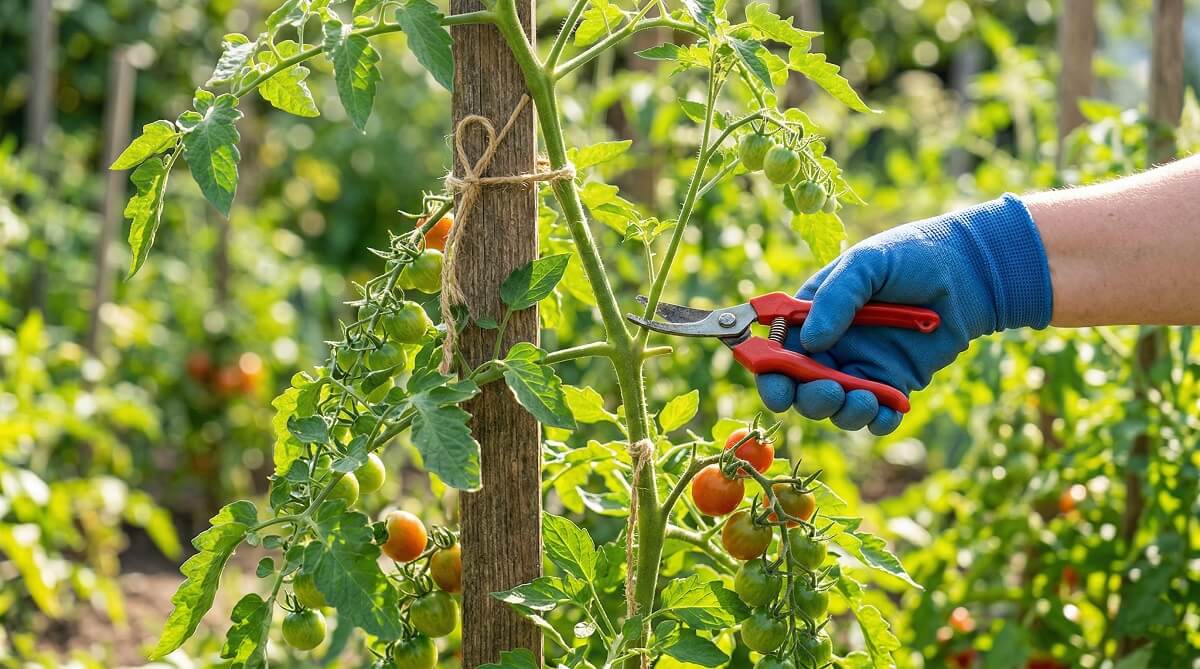
Pruning tomato plants takes less than ten minutes a week once you know what to look for. The core technique: remove the small shoots — called suckers — that grow between the main stem and each leaf branch, strip any foliage touching the ground, and cut the top of the plant four weeks before your first fall frost. Do those three things consistently and you’ll have a healthier, more manageable plant that produces larger fruit.
There’s one rule that comes before anything else: only prune indeterminate (vining) tomato varieties. Cut suckers off a determinate (bush) plant and you’ll trim away a significant portion of your harvest. If you’re not sure which type you have, check the seed packet or plant tag — “bush,” “dwarf,” or “compact” usually means determinate; everything else is almost certainly indeterminate. For more practical vegetable garden guides, browse the ChubbytIps how-to section.
One honest note before we dive in: pruning doesn’t automatically mean more tomatoes. Research cited by Purdue Extension shows pruned plants produce fruit roughly 25% larger, but unpruned plants yield around 38% more by weight. So the right approach depends on what you’re after — bigger individual tomatoes or more of them. This guide covers both, so you can decide what makes sense in your garden.
Should You Prune Your Tomato Plants? A Quick Guide
✅ Pruning makes sense if you:
- Grow indeterminate varieties — Beefsteak, Brandywine, Cherokee Purple, Sun Gold, most heirlooms
- Want larger individual fruits rather than maximum fruit count
- Garden in a hot, humid climate where fungal disease is a recurring problem
- Have limited garden space and need compact, manageable plants
- Use a single stake or string-and-clip trellis, which works best with one or two main stems
❌ You can skip pruning if you:
- Grow determinate varieties — Roma, Celebrity, Bush Early Girl, Glacier, Patio
- Prefer maximum yield by weight over fruit size
- Use a large, sturdy cage that handles natural sprawl
- Garden in a dry, low-humidity climate with plenty of sun (less disease pressure)
Determinate vs. Indeterminate Tomatoes: Why It Matters Before You Prune
Tomatoes fall into two categories based on how they grow, and getting this wrong is the most common pruning mistake home gardeners make.
Indeterminate varieties keep growing throughout the season, pushing out new stems, leaves, flowers, and fruit until frost kills them. They can reach 5 to 8 feet tall — or taller — and will keep producing if you support and prune them. Most heirlooms, beefsteaks, cherry tomatoes, and vine tomatoes fall in this category. Common indeterminate varieties include Brandywine, Cherokee Purple, Sungold, Early Girl, and Big Boy.
Determinate varieties grow to a set height, produce fruit all at once in a concentrated burst over two to three weeks, and then stop. They’re naturally compact and bushy. Pruning them removes the very branches that carry your fruit. Common determinate varieties include Roma, Celebrity, Rutgers, and Patio.
How to check: look at the seed packet or plant tag. Words like “bush,” “dwarf,” “compact,” or “patio” typically signal determinate. If none of those appear, look up the variety name online — seed company websites list the growth habit for every variety. When in doubt, don’t prune until you’re certain.
According to the University of Wisconsin Extension, pruning indeterminate tomatoes improves fruit production by redirecting energy away from extra vegetative growth and back toward developing fruit. Pruning also opens the canopy, which improves airflow and speeds drying — two things that slow the spread of fungal disease.
What Is a Tomato Sucker?
A sucker is the shoot that emerges at a 45-degree angle from the “elbow” — the junction between the main stem and a leaf branch. It looks like a tiny stem at first, easy to miss when it’s the size of your pinky nail. Left alone, a sucker grows into a full secondary stem with its own leaves, flowers, suckers, and fruit. That sounds like a good thing, but each sucker pulls resources away from the rest of the plant.
The one sucker you don’t remove: the one directly below the plant’s lowest flower or fruit cluster. According to the UW-Extension Tomato Pruning guide, this is “the strongest sucker on the plant” and can be kept to grow as a second productive stem. Remove everything else.
Once you’ve done it a few times, spotting suckers becomes second nature. They always appear at leaf axils — the V-shaped junctions where a branch meets the main stem. A leaf comes from the stem at an angle; a sucker emerges from the space between that leaf and the stem itself, pointing roughly upward.
When to Start Pruning Tomato Plants
Wait until your transplants have been in the ground for about four weeks and have put on solid new growth. Starting too early — while plants are still getting established — adds stress when they’re least equipped to handle it.
The University of New Hampshire Extension recommends beginning sucker removal once plants have set their first flower clusters. By that point, you can clearly identify the main stem, the leaf branches, and the suckers in between — before that, it can be hard to tell one from another.
From there, check plants every five to seven days. New suckers appear constantly on indeterminate types, and the smaller they are when you catch them, the better. Small wounds heal fast; large ones leave bigger openings for pathogens.
The UW-Extension guide adds a useful end-point: “Stop pruning one to two weeks before your expected first harvest to allow time for tomato plants to produce canopies that will protect fruits from sunscald.” In practice, that means active sucker removal happens from late spring through mid-summer, with a shift to topping (removing the growing tip) as fall approaches.
Best time of day to prune: morning, after leaves have dried from dew or overnight humidity. The Alabama Cooperative Extension specifically recommends early morning pruning to let any cuts dry out before the higher humidity of the evening. Never prune when leaves are wet — moisture makes it easy to transfer disease from plant to plant through your hands or tools.
What You’ll Need
You don’t need much. Here’s the short list:
- Your fingers — for suckers under about an inch, pinching cleanly with your thumb and index finger works fine.
- Bypass pruning shears — for suckers over 2 inches, scissors, or a small garden knife. Bypass-style shears make cleaner cuts than anvil-style. Budget options like Fiskars bypass pruners run $15–$30 on Amazon and hold up fine for home garden use. Felco models ($60–$90) are built to last decades and worth it if you have a large garden.
- Sanitizing solution — rubbing alcohol or a 10% bleach solution (one part bleach, nine parts water). Wipe blades between plants, or at minimum between any plant that looks diseased and the next healthy one. Food52 garden writer Nadia Hassani recommends keeping a small bottle and clean rag nearby during pruning sessions.
- Gloves — optional, but tomato stems and leaves can cause skin irritation or a mild rash in sensitive people. If you’ve noticed redness or itching after working with tomatoes before, wear them.
- Twine or tomato clips — to secure vines to stakes after pruning, especially if you’re training to one or two leaders.
How to Prune Tomato Plants: Step by Step
Step 1: Find the Main Stem
Stand back from the plant and trace the thickest stem from the soil up to the growing tip at the top. That’s your leader — the plant’s central column. Do not cut this. If your plant has two roughly equal stems branching from the base, decide now: use one leader if you’re staking with a single stake or string; keep two if you’re using a large cage or basket weave.
Step 2: Remove Leaves and Stems Touching the Ground
Strip all foliage within 12 inches of the soil, working your way up. Leaves that rest on or near the soil make direct contact with fungal spores that live there. According to the University of Minnesota Extension, early blight — one of the most common tomato diseases — spreads primarily when raindrops or irrigation water splash soil-borne spores onto lower leaves. Remove those leaves and you break that pathway. Add a 2–3 inch layer of mulch around the plant base for an extra layer of protection.
One limit to keep in mind: the UMN Extension advises removing no more than one-third of the plant’s total leaves in any single pruning session. Stripping too much at once weakens the plant’s ability to photosynthesize and support its fruit load.
Step 3: Locate the Lowest Flower or Fruit Cluster
This is the anchor for everything else. Find the flower cluster closest to the ground — the cluster where you can see yellow flowers or tiny developing fruit. Now look directly below it. The sucker growing there is the one you keep. Hold it with one hand while you work, so you don’t accidentally remove it.
Step 4: Remove All Other Suckers
Remove every sucker above and below the one you’re keeping. For small suckers (under an inch), pinch cleanly at the base with your thumb and index finger. For anything larger, use sanitized pruning shears and cut as close to the main stem as possible without cutting into it. Make clean cuts — torn stems create larger wounds and heal more slowly.
Dispose of the removed material away from the plant. If it looks healthy with no spots or discoloration, compost it. If there’s any sign of disease — yellowing with brown spots, white powder, unusual patches — put it in the trash. Don’t compost diseased plant material.
Step 5: Repeat Every 5–7 Days
New suckers emerge constantly throughout the season. A five-minute check once a week keeps them small and easy to remove. Let them go for two or three weeks and you’re dealing with large secondary stems that leave significant wounds when cut. For more vegetable garden maintenance tips, see the ChubbytIps how-to guides.
Step 6 (Late Season): Top the Plant
About three to four weeks before your area’s average first fall frost, cut off the tip of the main stem just above the topmost flower cluster that has fruit actively developing. Also pinch off any flowers or very small developing fruit that clearly won’t have time to reach maturity before frost.
Topping stops the plant from putting energy into new growth and redirects it into ripening fruit that’s already on the vine. To find your average first frost date, the Old Farmer’s Almanac frost date calculator lets you look up dates by ZIP code.
Pruning vs. Not Pruning: What the Data Actually Shows
Most gardening articles treat sucker removal as non-negotiable. The real picture is more nuanced.
Research cited by Purdue Extension found that pruned plants produced fruit approximately 25% larger than unpruned plants. The catch: unpruned plants produced roughly 38% more yield by weight. More tomatoes, smaller size vs. fewer tomatoes, bigger size — pick your priority.
A similar finding appears in a two-year heirloom tomato study (published on ResearchGate, examining ‘Mortgage Lifter’ and ‘Prudens Purple’ varieties): mid-season marketable yields were higher for the no-sucker-removal group, but fruit size was reduced compared to pruned plants.
Gardener Jill McSheehy ran a side-by-side experiment in her own garden and found the unpruned row produced 37% more yield by weight than the pruned row, with no difference in individual fruit size — results that closely match the extension research.
The climate variable matters a lot here. In humid regions like the Southeast or Pacific Northwest, pruning reduces the dense foliage that holds moisture and fuels fungal disease — that’s a practical benefit beyond just fruit size. In drier climates, unpruned plants can do just fine, since disease pressure is lower and the extra foliage actually shades fruit from sunscald.
The short answer: prune if you want larger fruit, are dealing with disease pressure, or need compact plants. Leave more suckers if you want maximum total yield and your climate allows it.
Pruning Method Comparison
| Method | Stems Kept | Best Support | Fruit Size | Total Yield | Disease Resistance |
|---|---|---|---|---|---|
| 1-Stem (full sucker removal) | 1 leader | Single stake or string | Largest | Lowest count | Best airflow |
| 2-Stem (keep lowest sucker) | 2 leaders | Large cage, basket weave | Large | Moderate | Good airflow |
| Selective (remove non-producers) | Multiple | Large cage or trellis | Medium | Higher | Moderate airflow |
| No pruning | All | Very large cage | Smaller | Highest by weight | Poorest (dense foliage) |
Common Pruning Mistakes
- Pruning determinate varieties. Removing suckers from bush tomatoes cuts into the branches that carry your harvest. Don’t do it.
- Removing the sucker below the first flower cluster. This is the one to keep. It’s often the biggest sucker on the plant, which is why new pruners accidentally take it off. Hold it with one hand while you work nearby.
- Pruning with wet leaves. Moisture on plant surfaces makes it easy to spread disease from one plant to the next. Wait for dry conditions, and preferably prune in the morning.
- Skipping tool sanitation. If one plant is diseased and you move to the next with the same unwashed hands or dirty pruners, you’re spreading the problem. Wipe blades with alcohol or bleach solution between plants.
- Over-pruning in hot climates. Heavy sucker removal reduces canopy cover. In regions with intense sun, exposed fruit gets sunscald — pale, leathery patches on the skin. Leave more foliage overhead to shade developing fruit.
- Waiting too long between sessions. Suckers left for two or three weeks grow into large secondary stems. Removing them creates big wounds that heal slowly and invite pathogens. A weekly five-minute check prevents this.
- Leaving pruned material on the ground. Diseased stems and leaves left near the plant can re-infect it. Clean up trimmings after each session.
Pruning for Your Trellis Setup
How you support your tomatoes affects how aggressively you should prune.
Standard Cage
Most store-bought tomato cages are too short for indeterminate varieties — anything under 5 feet will be outgrown. If you’re using a cage, keep 2–3 leaders and remove suckers that point inward toward the center of the cage (they block airflow and make harvesting difficult). Always work from the bottom of the plant upward.
Single Stake or String-and-Clip
This method works best with one leader, sometimes two. Remove all suckers. Clip the main stem to the string or stake every 10–12 inches as the plant grows. This setup gives you the most control and the best airflow.
Basket Weave (Florida Weave)
With posts and horizontal strings supporting a row of plants, you can maintain 6–8 leaders per plant. Prune more aggressively at the bottom and selectively thin growth that extends too far outward. Weave string up the row as the plants grow, about once a week.
Need help choosing the right cage or stake height? Check out the ChubbytIps buying guides for garden tools and supports.
What to Do With the Suckers You Remove
Most removed suckers can go straight to the compost pile — they break down quickly and add organic matter. If any show signs of disease (spots, unusual discoloration, powdery residue), bag them and put them in the trash. Don’t compost diseased plant material.
If you’re growing heirlooms or a variety you’d like more of, small healthy suckers can be rooted. Place them in a glass of water — change the water every two days — and watch for roots to develop in one to two weeks. Once roots reach about an inch long, transplant into potting mix. This works best early in the season when there’s enough growing time left for the new plant to produce.
Frequently Asked Questions
Do I have to prune tomato plants?
No, pruning isn’t required. Unpruned indeterminate plants still produce fruit — often more of it by weight, according to research cited by Purdue Extension. But pruning does help control plant size, improve airflow, and reduce fungal disease in humid conditions. At minimum, removing lower leaves that touch the soil is worth doing regardless of your pruning philosophy.
How do I know if my tomato is determinate or indeterminate?
Check the seed packet or plant tag. Words like “bush,” “dwarf,” “patio,” or “compact” usually mean determinate. If none of those appear, look up the variety name on a seed company’s website — they list the growth habit for every cultivar. When uncertain, don’t prune suckers until you’ve confirmed the type.
What happens if I accidentally cut the main stem?
The plant will be stressed but not finished. A lateral shoot near the cut will take over as the new growing point. Keep the plant watered and supported, and it will typically recover. The harvest may be reduced, but the plant won’t die from one pruning mistake.
Can I prune tomatoes in a container or raised bed?
Yes, and for containers it’s especially helpful. A limited root zone can only support so much plant. In a 5-gallon container, keep to one stem; in a 10-gallon or fabric pot, two stems is reasonable. Prune more conservatively in containers than you would in-ground — stressed container plants don’t bounce back as quickly.
How do I keep from spreading disease when pruning?
Sanitize tools with rubbing alcohol or a 10% bleach solution between plants. Don’t touch your face or other plants after working near a diseased one. Start your pruning session with the healthiest plants and leave any that look sick for last. Never work with wet foliage.
When should I stop pruning for the season?
Stop removing suckers three to four weeks before your average first fall frost. At that point, top the main stem instead. To find your frost date, use the Old Farmer’s Almanac frost date calculator — enter your ZIP code for your local average dates.
Will pruning prevent blight?
Pruning reduces the conditions that favor fungal disease — particularly dense foliage that traps moisture. But it’s not a cure. According to the University of Minnesota Extension, lower leaf removal disrupts the main spread pathway (soil-splash onto leaves), but once blight has a foothold, you’ll need to remove affected leaves and consider a copper-based fungicide to slow it.
Can I grow new plants from removed suckers?
Yes. Place healthy suckers in a glass of water, change the water every couple of days, and you’ll see roots form within one to two weeks. Transplant into potting mix when roots are about an inch long. Larger cuttings (over 6 inches) are harder to root successfully — stick to smaller, fresher suckers for best results. Browse more vegetable garden how-to guides at ChubbytIps for companion topics like staking, watering, and fertilizing.
Tools to Get You Started
For pruning shears, Fiskars Bypass Pruning Shears on Amazon are a solid budget pick at around $15–$30 (check current price). If you want a tool that’ll last decades, Felco pruners are the go-to for serious gardeners. For trellis options and support gear, browse the ChubbytIps buying guides to find the right setup for your space.
