


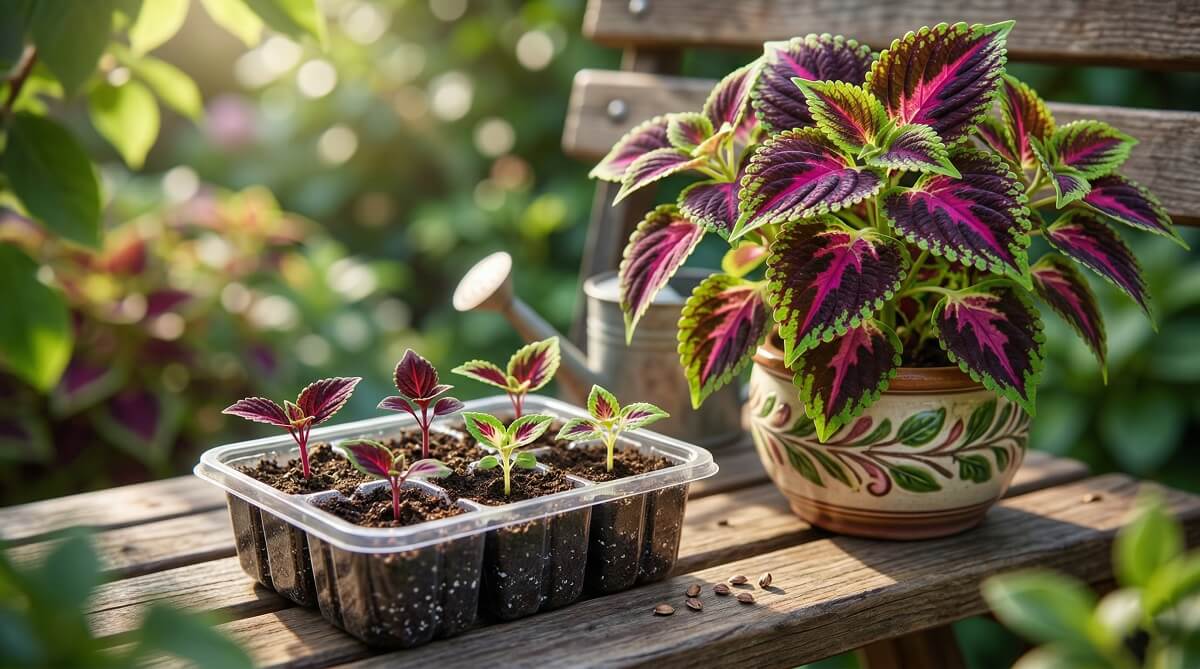
Coleus seeds are deceptively fragile — tiny as specks of dust, slow to sprout, and initially pokey growers. But start them right and you’ll have some of the most colorful foliage plants available for containers and shade beds by summer, for a fraction of what nursery transplants cost.
The short version: surface-sow on moist seed starting mix 8 weeks before your last frost date, keep soil at 70–75°F, and expose the seeds to light — don’t bury them. Germination takes 10–20 days. Seedlings grow slowly for the first few weeks, which catches beginners off guard. Plan for 8–10 total weeks indoors before they’re ready for the garden.
One honest note: growing coleus from seed isn’t always suitable for beginners. The seeds are tiny, germination can be spotty, and open-pollinated varieties produce unpredictable color mixes. If you want exact named varieties with guaranteed foliage patterns, propagate from cuttings or buy transplants. If you want dozens of colorful plants at low cost and enjoy a bit of gardening experimentation — seed is your best option.
Who Should (and Shouldn’t) Grow Coleus from Seed
✅ Best For
- Gardeners who want large quantities without spending $5–8 per transplant
- Container gardeners with an indoor seed starting setup
- Anyone who enjoys the process of starting plants from scratch
- Gardeners interested in saving seed and selecting their best plants year to year
❌ Skip If
- You need specific named varieties with consistent foliage colors (use cuttings instead)
- You’re a complete beginner with no indoor setup — coleus seeds are demanding
- You’re starting after April in colder zones and don’t have time for the 8-week lead
- You have pets: coleus is toxic to cats, dogs, and horses (more on this below)
What You’ll Need Before You Start
Equipment List
- Shallow seed trays or 72-cell plug trays — small cells prevent overwatering
- Seed starting mix — not regular potting soil; you need a finer, lighter medium
- Clear humidity dome — maintains moisture during germination
- Heat mat (optional but helpful) — keeps soil at 70–75°F for faster germination
- Grow lights — 16 hours on, 8 hours off, positioned 3–4 inches above seedlings
- Spray bottle — mist the surface without disturbing tiny seeds
Seeds vs. Cuttings vs. Store-Bought Transplants
| Method | Typical Cost | Effort Level | Color Accuracy | Lead Time | Best For |
|---|---|---|---|---|---|
| From seed | $5–10 per packet (yields 20–550 seeds) | High | Variable (mixed results) | 8–10 weeks | Bulk color, budget growing |
| From cuttings | Free (from existing plants) | Low | Exact match to parent | 2–3 weeks to root | Specific varieties, overwintering |
| Store-bought transplants | $3–8 per plant | None | Exact named variety | Ready immediately | Beginners, late starters |
For reference: a single packet of Burpee Rainbow Mixed Colors (550 seeds) runs about $7.69 on Amazon as of March 2026 — that’s the cost of one transplant for potentially hundreds of plants. Check current pricing, as it fluctuates by season.
When to Start Coleus Seeds (Timing by USDA Zone)
According to the University of Minnesota Extension, start coleus seeds indoors about 8 weeks before your anticipated outdoor planting date. Don’t set them out until soil temperatures reach at least 60°F and nighttime temps stay reliably above 50°F.
| USDA Zone | Avg Last Frost | Outdoor Planting | Start Seeds Indoors |
|---|---|---|---|
| Zone 4 (MN, WI, northern MI) | May 10–20 | Late May | Late March |
| Zone 5 (Chicago, Columbus) | April 15–30 | Mid May | Mid-late February |
| Zone 6 (Kansas City, Richmond) | April 1–15 | Late April – early May | Early-mid February |
| Zone 7 (Nashville, Charlotte) | March 15–30 | Mid April | Mid January |
| Zone 8 (Dallas, Atlanta) | February 15–28 | Mid March | Late December – January |
| Zone 9 (Houston, Phoenix) | January 30 – Feb 15 | Late February | Late November – December |
Use the Old Farmer’s Almanac frost date calculator to find your specific last frost date by zip code.
How to Sow Coleus Seeds — 5 Steps
Step 1 — Prepare Your Tray
Fill cells or your seed tray to within ½ inch of the rim with pre-moistened seed starting mix. Press lightly to remove air pockets. The mix should feel like a wrung-out sponge — damp but not dripping.
Step 2 — Surface Sow (Do Not Bury the Seeds)
Sprinkle seeds onto the surface. Leave them right there — do not cover with more soil. Per the University of Minnesota Extension, coleus seeds require light to trigger germination. Burying them is the single most common reason seeds fail. If you want minimal cover, a very light dusting of fine vermiculite is acceptable — it’s transparent enough to let some light through.
Step 3 — Create Humidity and Warmth
Cover with a clear humidity dome or stretch plastic wrap over the tray. Place on a heat mat or in a reliably warm spot. Target soil temperature: 70–75°F. Bottom heat consistently produces faster, more even germination. A cool basement or drafty windowsill will slow things down significantly.
Step 4 — Monitor for Germination (10–20 Days)
Check moisture daily. The surface should stay uniformly damp — mist lightly with a spray bottle if it dries out. Expect first sprouts around day 10–14; some seeds take up to 20 days to emerge. According to UMN Extension, sprouting occurs in 10–20 days at 70–75°F. Don’t abandon the tray at day 14 if nothing has appeared yet.
Step 5 — Remove Dome and Provide Light
Once sprouts appear, take the dome off. Now give them plenty of light immediately — coleus seedlings stretch aggressively toward dim light and become leggy within days. If you’re using grow lights, position them 3–4 inches above the seedlings and run them 16 hours per day, off 8 hours at night. A bright south-facing window works, but grow lights produce better, stockier plants.
Caring for Coleus Seedlings Indoors (Weeks 3–8)
Thinning
Once seedlings develop their first true leaves (the second set — noticeably different from the initial seed leaves), thin to one plant per cell. Use scissors to snip extras at the base. Don’t pull — you’ll disturb roots of neighboring plants. Leaving multiple seedlings per cell stunts all of them.
Potting Up
When each seedling has 2–3 sets of true leaves, move it from the plug cell into its own 2–3 inch pot with a light, well-draining potting mix. Handle by the leaves, not the stem — the stem is fragile at this stage. This is also the point where foliage coloring starts to show clearly.
Fertilizing
Begin feeding with a diluted liquid fertilizer — half-strength — every two weeks once seedlings have 2 sets of true leaves. Resist the urge to over-fertilize: rich soil dulls coleus foliage coloring. The vivid variegation you’re after comes from moderate, not heavy, feeding.
Watering
Keep the medium consistently moist but never waterlogged. Young plants in small cells dry out fast — check daily. Bottom watering works best: pour into the tray and let the cells wick it up. This keeps foliage dry and cuts damping-off risk significantly.
Hardening Off and Transplanting Outdoors
Hardening Off (1–2 Weeks Before Move)
Indoor seedlings haven’t dealt with wind, temperature swings, or direct sun. Move them outside to a sheltered, shaded spot — a covered porch works well — for increasing time each day. Start with 1 hour, add an hour daily, building toward full days outside over 7–10 days. Bring them in if nighttime temps drop below 55°F. Skipping hardening off is how you lose plants that took 8 weeks to grow.
Choosing a Spot
Coleus performs best in partial shade — 3 to 4 hours of morning sun with afternoon shade produces the most vivid coloring. Full shade works but can make some varieties look duller. Newer sun-tolerant hybrids (like the “Premium Sun” series) handle more light, but even they can scorch in intense afternoon sun in the South.
Soil and Spacing
Plant in well-draining soil amended with compost. Target pH of 6.0–7.0. Space standard varieties 12–18 inches apart; trailing types benefit from 18–24 inches. Coleus spreads quickly once established and can crowd neighbors in containers if you underestimate their size.
Maintaining Coleus Through Summer
Pinching for Bushiness
Once a plant reaches 6 inches tall, pinch off the growing tip just above a set of leaves. This redirects energy to the side buds along the stem, encouraging branching rather than upward extension. The payoff: a fuller, denser plant. Repeat every 3–4 weeks through summer. Skip it and you’ll have tall, sparse stems by August.
Removing Flower Spikes
When coleus sends up flower spikes — upright stems with small lavender or purple whorls — pinch them off immediately. Flowering diverts energy from foliage production and signals the plant to begin its end-of-season decline. Remove spikes as soon as you spot them unless you’re intentionally collecting seed.
Watering in Heat
Coleus wilts dramatically in heat but recovers quickly once hydrated. In containers, daily moisture checks are normal during hot spells — they can dry out fast. In garden beds, consistent soil moisture matters more than a strict schedule — check if the top inch has dried out before adding water. Keep foliage dry when possible, especially in humid climates, to limit disease pressure.
Saving Seeds and Overwintering Coleus
How to Collect Coleus Seeds
Let a few flower spikes mature through late summer. When the seed capsules turn brown and papery, snip the stalks and let them dry for another week over a sheet of paper. Shake or rub the capsules to release seeds. Store in a cool, dry, dark spot in a paper envelope — not plastic, which traps moisture. Coleus seeds remain viable for about 2 years under good storage conditions.
Important: If you grew F1 hybrid varieties (most named commercial varieties with “F1” on the label), seeds saved from them will not grow true to the parent plant. The seedlings will look different — often more plain green. Open-pollinated varieties come reasonably true from saved seed and are better choices for seed saving.
Overwintering via Cuttings
Before your first fall frost, take 3–4 inch cuttings from your favorites. Strip lower leaves, place the stem in a jar of water in a bright window at 60°F or warmer. Roots form in 1–2 weeks. Pot up in potting mix and keep as houseplants over winter. This is the most reliable way to preserve a specific coleus you love.
Common Problems and How to Fix Them
| Problem | Likely Cause | Fix |
|---|---|---|
| Seeds didn’t germinate | Buried too deep, soil too cold, or seeds too old | Surface sow, add heat mat, use fresh seed (viable up to 2 years) |
| Seedlings leggy and stretched | Insufficient light | Add grow lights, position 3–4 inches above seedlings, 16 hours/day |
| Seedlings wilting or rotting at base (damping off) | Overwatering combined with poor airflow | Reduce watering, remove dome sooner, improve air circulation |
| Leaf colors fading after transplant | Too much direct sun, or root stress | Move to partial shade; wait 2 weeks for color to stabilize |
| Fuzzy gray growth on leaf undersides | Downy mildew (Peronospora belbahrii) | See warning below |
Downy Mildew Warning
Coleus is susceptible to downy mildew, a fungal-like pathogen (Peronospora belbahrii) that thrives in cool, humid conditions between 59–68°F. Signs include irregular yellow patches on upper leaf surfaces and fuzzy gray or purplish sporulation on the undersides of leaves. Per the UMass Amherst Extension, prevention beats treatment: avoid overhead watering, water in the morning so foliage dries quickly, space plants to allow airflow, and select resistant varieties when available. If you see symptoms, remove affected leaves and improve ventilation immediately.
Is Coleus Safe Around Pets?
No. According to the ASPCA Poison Control Center, coleus is toxic to cats, dogs, and horses. The toxic principle is the essential oils present in the plant. Clinical signs of ingestion include vomiting, diarrhea, depression, loss of appetite, and occasionally bloody vomiting or diarrhea. If you suspect your pet ingested any part of a coleus plant, contact your veterinarian or the ASPCA Poison Control hotline at (888) 426-4435. Keep coleus out of reach of pets, or choose container placements that animals can’t access.
Frequently Asked Questions
Do coleus seeds need light to germinate?
Yes. Coleus seeds are light-dependent germinators — they need exposure to light to trigger sprouting. Press them onto the surface of moist seed starting mix and do not cover with soil. A very thin layer of fine vermiculite is acceptable but heavy soil coverage will prevent germination entirely.
How long does it take to grow coleus from seed?
Germination takes 10–20 days at 70–75°F. Seedlings take another 3–4 weeks to develop enough to pot up. From sowing to transplant-ready seedlings, plan on 8–10 weeks total. This is why timing matters — start too late and your plants won’t be ready before the season warms up enough to go outside.
Can I direct sow coleus seeds outdoors?
Technically yes, but results are poor in most US climates. Coleus needs warm soil, consistent moisture, and light — all conditions that are hard to control outdoors. Indoor seed starting under controlled conditions produces far better germination and stronger seedlings. Direct sowing only makes practical sense in Zone 9–10 gardens with mild spring temperatures.
Is coleus toxic to cats and dogs?
Yes. The ASPCA classifies coleus as toxic to cats, dogs, and horses. Signs of ingestion include vomiting, diarrhea, depression, and anorexia. Contact a veterinarian or the ASPCA Poison Control at (888) 426-4435 if your pet has eaten any coleus.
Why are my coleus seedlings growing so slowly?
This is normal. Coleus seedlings are notoriously slow in the first 2–3 weeks after germination. Growth accelerates noticeably once they develop their second or third set of true leaves. If growth seems completely stalled, check that temperatures aren’t too cool (below 65°F will slow them) and that light levels are adequate.
How do I know when to transplant coleus seedlings outdoors?
Seedlings are ready to go outside when they have 3–4 sets of true leaves, outdoor nighttime temperatures consistently exceed 50°F, and soil temperatures are above 60°F. Run through a 7–10 day hardening-off process before transplanting.
Can I save seeds from F1 hybrid coleus varieties?
You can collect them, but the plants grown from those seeds won’t look like the parent. F1 hybrids don’t come true from saved seed — the offspring tend to revert toward more generic green forms. For reliable seed saving, grow open-pollinated (non-hybrid) coleus varieties.
What’s the difference between sun coleus and regular coleus?
Standard coleus varieties prefer partial to full shade — direct midday sun can fade colors or scorch leaves. Sun coleus varieties (such as the “Premium Sun” series) have been bred to tolerate more direct sunlight, up to full sun in some climates. Even sun-tolerant types benefit from afternoon shade in hot southern states. Check the seed packet description for sun tolerance.
Ready to Start Growing?
A single coleus seed packet can yield dozens of plants for the price of one nursery transplant. Check current prices on Amazon coleus seeds, or browse named varieties directly at Burpee. For the widest variety selection, Swallowtail Garden Seeds carries over 39 coleus varieties.
