


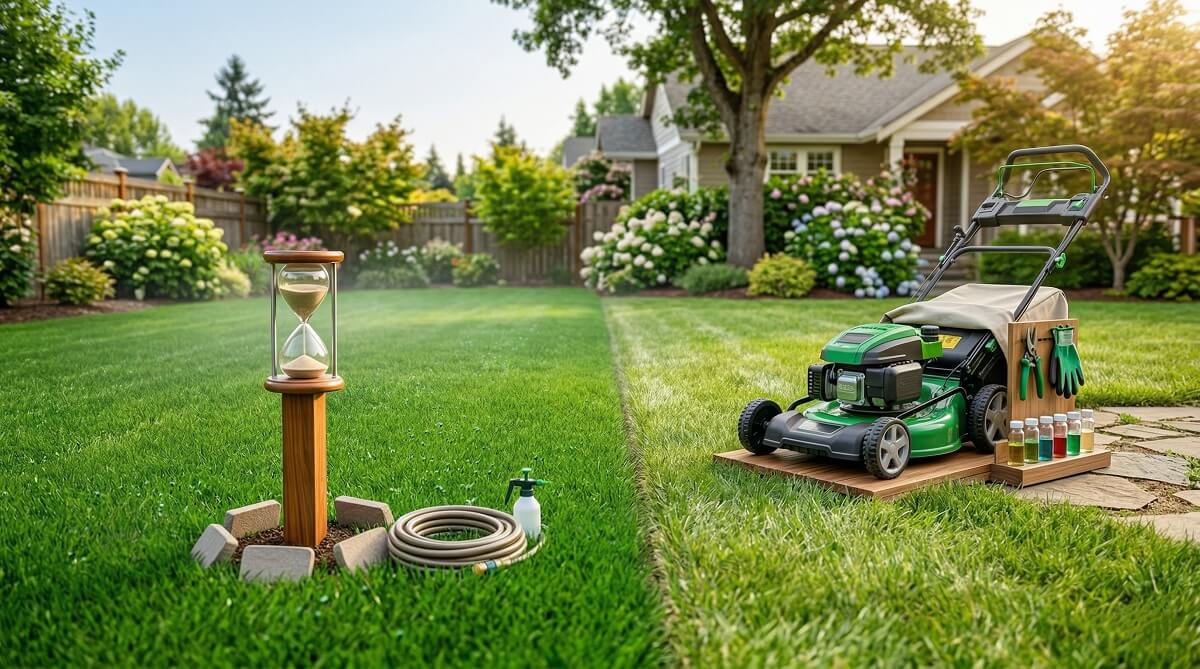
The standard answer is 24 to 48 hours — but that’s really just the rule for granular fertilizer. What you actually need to wait depends on the type of product you applied. Herbicides, pre-emergents, liquid fertilizers, and overseeding situations all have different timelines, and confusing them is one of the more common ways homeowners accidentally undo a perfectly good lawn treatment.
Mowing too soon after a treatment can strip granular fertilizer off grass blades before it works its way into the soil, cut away the leaf surface a post-emergent weed killer needs to absorb through, or shear off new grass seedlings before they’ve had a chance to take root. A little patience here avoids a lot of wasted product and effort.
Below is a quick-reference table followed by a treatment-by-treatment breakdown with the reasoning behind each wait time. are on ChubbytIps if you’re working through a full seasonal routine.
Quick Guide: Should You Wait to Mow?
✅ You Need to Wait If You:
- Applied granular fertilizer within the last 48 hours
- Sprayed a post-emergent weed killer in the last 2 days
- Put down a pre-emergent or weed-and-feed product recently
- Overseeded and the new grass is under 3 inches tall
- Just hired a lawn service and they treated your yard
❌ You Can Mow as Usual If You:
- Mowed right before your treatment (you’re already set for the week)
- Applied liquid fertilizer and it dried fully 4+ hours ago
- Only aerated without any chemical treatment
- Your lawn is dormant and hasn’t had any product applied
Wait Times by Treatment Type — Quick Reference
This table gives you the short answer. The sections below explain why each rule exists and what happens if you skip the wait.
| Treatment Type | Wait Time Before Mowing | Key Notes |
|---|---|---|
| Granular fertilizer | 24–48 hours | Water in first; mowing before this risks uneven absorption |
| Liquid fertilizer | ~2–4 hours (after fully dry) | Must be completely dry; faster window but higher burn risk |
| Weed-and-feed (granular) | 48 hours | Don’t mow 2 days before or after; the herbicide needs leaf contact |
| Post-emergent weed killer | 48 hours minimum | Also wait 2–3 days before applying (weeds need leaf surface) |
| Pre-emergent (crabgrass preventer) | 48 hours | Allow it to settle and activate in soil before disrupting |
| Fungicide / Insecticide | 24–48 hours (or per label) | Check re-entry interval (REI) on the product label |
| Overseeding + starter fertilizer | 2–4 weeks | Wait until new grass reaches 3–4 inches; use one-third rule on first mow |
Fertilizer: The 24–48 Hour Rule
Granular fertilizer — the kind you spread with a broadcast spreader — needs to do two things before you mow: land on the soil and get watered in. The granules carry nitrogen, phosphorus, and potassium that absorb into the root zone through moisture. If you run the mower before that happens, the blades physically knock and scatter the granules, leaving you with patchy application across your lawn.
Granular Fertilizer: Start the Clock After Watering
The 24–48 hour wait begins once the fertilizer is watered in — either by rain or by you running the sprinklers. Here’s the sequence that works best:
- Mow your lawn one to two days before you plan to fertilize
- Apply the granular product to dry grass with a spreader
- Water the lawn (or let rain do it) to activate the granules
- Wait 24–48 hours before mowing again
According to Hunker’s lawn care editorial, the risk of skipping this wait is spotty nutrient coverage — some areas of your yard get a full dose while others get almost none. can help you choose the right spreader type for your yard size.
Liquid Fertilizer: A Shorter Window
Liquid fertilizer behaves differently. Once it dries on the grass — typically within two to four hours — you can mow. The product has already bonded to the leaf surface and begun absorbing into the plant. There’s no loose granule to scatter.
That said, liquid fertilizer comes with trade-offs. It has a higher risk of burning grass if applied too heavily or in hot weather, it costs more per application than granular, and it needs to be reapplied more often since it’s typically quick-release. For most homeowners doing routine lawn feeding, granular remains the easier and more cost-effective choice — just plan the mowing schedule around it.
Weed-and-Feed Combinations
Weed-and-feed products combine a granular fertilizer with an herbicide in one application. Because the herbicide component needs to stick to weed leaves to work, the timing rules are stricter. Scotts Turf Builder Weed and Feed guidance recommends not mowing within two days before or 48 hours after application.
The two-day pre-application window matters just as much as the post-application wait. If you mow right before putting down weed-and-feed, you cut the weeds short and reduce the leaf surface the herbicide has to absorb through. Let the weeds grow for a couple of days first so the product has something to grab onto.
Herbicides: Timing Matters More Than You’d Think
Herbicide timing has a quirk that fertilizer doesn’t: you need to think about mowing both before and after the application, not just after.
Post-Emergent Weed Killers (Broadleaf, Spot Treatments)
Post-emergent products like 2,4-D and triclopyr work by absorbing through the weed’s leaf tissue and moving into the root system. For that to happen, the weed needs enough leaf area exposed. Mowing the day before you spray cuts that surface area down significantly, reducing how much herbicide can enter the plant.
The practical rule: wait 2–3 days after mowing before applying post-emergent herbicide so weeds have had a chance to put out fresh growth. Then, after applying, hold off on mowing for at least 48 hours to let the product travel through the plant’s vascular system. According to SodLawn’s analysis, mowing too soon can cut away treated leaf material and reduce herbicide effectiveness by 30–40%.
Pre-Emergent Herbicides (Crabgrass Preventers)
Pre-emergent products create a chemical barrier in the top layer of soil that stops weed seeds from germinating. They don’t need leaf contact — they work in the ground. But they do need time to settle and activate after application before you run heavy mower wheels across the lawn.
Give a pre-emergent product at least 48 hours after application before mowing. Once it’s been watered in and has had time to settle, normal lawn maintenance can resume. One important note: don’t overseed or aerate right after applying a pre-emergent — the product will prevent your grass seed from germinating too.
Fungicides and Insecticides
Fungicides and insecticides each carry what’s called a re-entry interval (REI) — the minimum time that must pass before people, pets, and lawn equipment should be on the treated area. This is a label requirement, not just a suggestion.
For most residential fungicide and insecticide products, the REI is 24–48 hours, but check your specific label. Products registered with the EPA are required to list the re-entry interval clearly. If you hired a lawn care service to apply a treatment, they’re required to inform you of the re-entry interval as part of the application notice.
Beyond the safety angle, waiting the REI window also protects treatment effectiveness — mowing over a freshly applied insecticide can disrupt contact coverage on grass blades where insects feed.
Universal Mowing Rules After Any Treatment
Mow Before You Treat — The Simplest Approach
Cutting your lawn one to two days before any treatment is the easiest way to sidestep all of this timing complexity. Scotts recommends mowing and raking before fertilizing so debris is cleared and the product can reach the soil more easily. When you mow first, you remove the question of “how long do I wait?” — your lawn is already at the right length, and you won’t need to mow again for another 5–7 days. That’s usually enough time for any treatment to fully absorb or activate.
Don’t Mow Wet Grass After Treatment
Most granular treatments require watering in, which leaves the lawn wet. Most spray treatments need to dry. Both situations mean your grass will be in a wet or damp state right after application — and mowing wet grass creates problems regardless of treatment timing: uneven cuts, clumped clippings that can block soil contact, and potential redistribution of product across the yard. Wait until the lawn has dried out after watering before you mow.
The One-Third Rule Still Applies
After waiting 24–48+ hours for a treatment, your grass may have grown noticeably. The temptation is to cut it down to size in one pass. Resist that. Removing more than one-third of the grass blade in a single mowing session stresses the plant — and post-treatment turf is already in an absorptive state where adding stress can trigger yellowing or disease susceptibility. If your grass has gotten long during the wait, take it down gradually over two or three mowing sessions a few days apart.
What If It Rains Before You Can Mow?
A little rain after applying granular fertilizer is actually helpful — it’s exactly what the product needs to activate. Light rainfall shortly after application can serve as the “water in” step and start the absorption clock. You still want to wait 24–48 hours after the rain before mowing, but you haven’t lost anything.
Heavy rain is a different story. A significant downpour within the first few hours of application can wash granular products off your lawn before they’ve had a chance to settle. If you’ve had an inch or more of rain shortly after applying, check your lawn for product runoff. You may need to reapply. The same applies to spray herbicides that haven’t had time to become rain-fast — most products specify a rain-free window of 1–4 hours on the label, which is why checking the weather forecast before any lawn treatment is a step worth taking seriously.
After heavy rain resets the treatment clock, your mowing timing resets too. Wait out the appropriate interval for your product type from the new application date.
Overseeding: The Longest Wait of All
If you’ve overseeded your lawn — spreading new grass seed to thicken thin areas or restore bare patches — the mowing timeline is measured in weeks, not hours. New grass seed germinates slowly, and the seedlings that emerge in the first couple of weeks are extremely fragile. Running a mower over them before their root systems are established can pull them right out of the ground.
The general guideline: wait until new grass reaches 3 to 4 inches in height before mowing, which typically takes two to four weeks depending on grass type. According to LawnStarter’s overseeding guide, timing varies by grass variety:
- Perennial ryegrass: Germinates in 5–7 days; ready to mow in about 2 weeks
- Tall fescue: Ready in 2–3 weeks
- Kentucky bluegrass: Slow to germinate; wait 3–4 weeks
When you do mow for the first time, keep the blade high and only remove the top third. Use sharp blades — dull blades pull and tear seedlings rather than cut them cleanly. for recommended mower blade sharpening tools.
Frequently Asked Questions
How long after fertilizing can I mow?
For granular fertilizer, wait 24–48 hours after watering the product in. For liquid fertilizer, you can mow once the product has fully dried on the grass, which usually takes 2–4 hours. If you mowed right before fertilizing, you’re already good — just resume your normal mowing schedule after 5–7 days.
Can I mow the same day I fertilize?
You can mow the same day, but only if you mow before applying the fertilizer. Mowing after the fertilizer is down — especially granular types — risks scattering the product before it absorbs. If you need to do both on the same day, mow first, then fertilize, then wait until the next mowing window (24–48 hours later).
What happens if I mow too soon after fertilizing?
With granular fertilizer, your mower blades can scatter or remove the granules before they absorb into the soil, leaving uneven patches that get too much or too little fertilizer. With liquid products, mowing before the coating dries can strip it from the grass blades. Either way, you’ll see patchy growth results rather than uniform coverage.
How long after weed killer can I mow?
Wait at least 48 hours after applying a post-emergent weed killer before mowing. This gives the herbicide time to travel from the leaf surface through the plant’s root system. Mowing sooner removes the treated leaf area and can cut herbicide effectiveness by 30–40%. For weed-and-feed products, the same 48-hour rule applies.
Should I water before or after mowing post-treatment?
For granular fertilizer, water after applying but before mowing — watering activates the product, and then you wait 24–48 hours before running the mower. For spray herbicides, you generally want to avoid watering for several hours after application so the product has time to absorb. Check your specific product label for the rain-free window.
Does rain affect how long I need to wait?
Light rain after granular fertilizer is helpful — it waters the product in and starts the absorption process. Heavy rain shortly after any treatment may wash the product away before it activates, potentially requiring you to reapply. Most spray products list a rain-fast window (usually 1–4 hours) on the label; if heavy rain falls before that window closes, treat it as a new application.
How long to wait to mow after overseeding?
Wait until the new grass is consistently 3–4 inches tall — typically 2 to 4 weeks after seeding, depending on grass type. Ryegrass is fastest (around 2 weeks); Kentucky bluegrass is slowest (3–4 weeks). Check that roots are established before mowing by gently tugging on a few blades — they shouldn’t pull out easily.
What’s the proper mowing height after a treatment?
Follow the one-third rule: never remove more than one-third of the grass blade in a single session. If your grass grew long during the treatment wait period, gradually lower the height across two or three mowing sessions rather than cutting it all at once. This reduces plant stress, which is especially important when turf is in the middle of processing a fertilizer or chemical treatment. can help you find a model with adjustable cutting height for this kind of gradual approach.
Always check the label on your specific lawn product for exact timing — the instructions printed on the bag or bottle override any general rule of thumb. Check current product options on Amazon’s lawn care section or browse your local hardware store for Scotts, Pennington, and Milorganite products with timing instructions clearly listed.
