


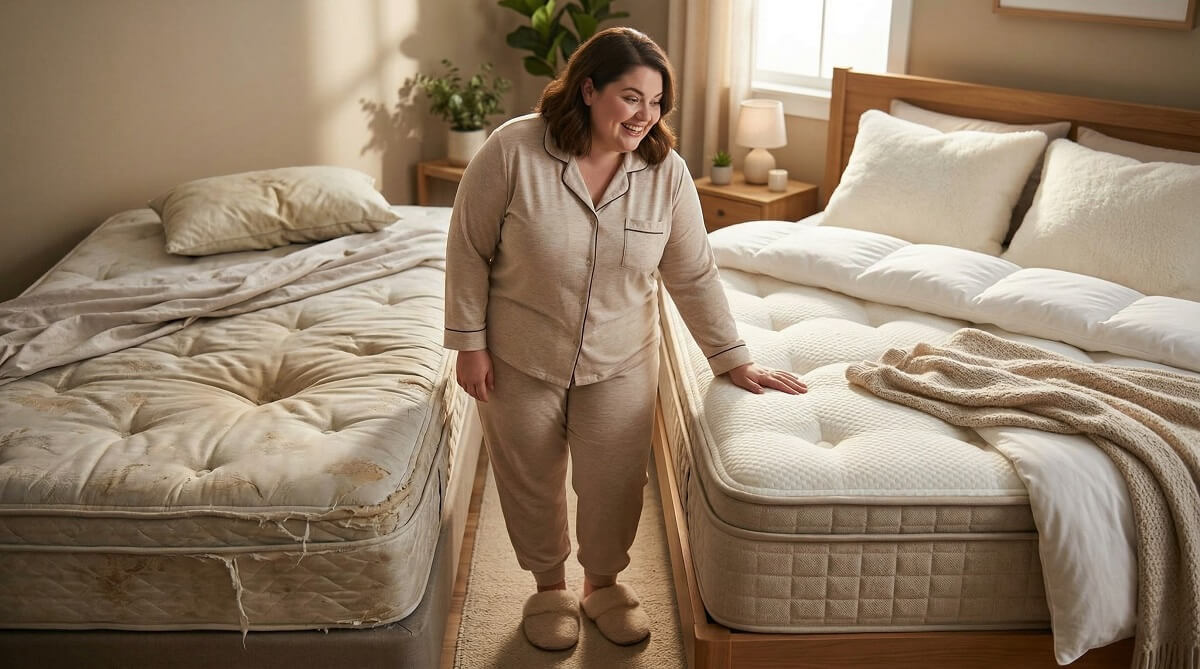
Most mattresses hold up for 7 to 10 years, but that’s only a starting point — not an expiration date. The more useful question is whether you’re still sleeping well on it. If you wake up stiff most mornings, notice the bed dipping under your weight, or consistently sleep better at a hotel than at home, those are the signals worth paying attention to — not the purchase receipt.
Mattress type matters too. According to the , latex beds tend to last the longest (7.5–8.5 years by conservative estimates, often more with proper care), while innerspring mattresses may give out in as few as 5.5 years. Your body’s needs also shift over time — weight changes, injuries, or a new sleeping partner can mean the mattress that felt perfect five years ago is the wrong fit today.
This guide covers the clearest warning signs, what the lifespan numbers actually mean for your specific mattress type, a few low-cost tricks to extend what you’ve got, and the best times of year to shop if you do decide it’s time.
Should You Replace Your Mattress? A Quick Check
✅ Probably time to replace if:
- Your mattress is 8+ years old and you’re sleeping poorly
- You wake up with neck, back, or hip soreness that fades within an hour of getting up
- There’s visible sagging or body impressions deeper than 1–1.5 inches
- You consistently sleep better at hotels or other people’s homes
- Allergy or asthma symptoms worsen at night without another obvious cause
- Coils squeak every time you shift position
❌ Probably don’t need to replace yet if:
- Your mattress is under 7 years old and you wake up feeling rested
- Morning soreness has other likely causes (new workout, different pillow, stress)
- A quality topper would close the comfort gap at a fraction of the replacement cost
- You haven’t tried rotating the mattress or adding a mattress protector
The 7-to-10-Year Rule — And Why It’s Only a Starting Point
Seven to ten years is the benchmark you’ll see almost everywhere. The Sleep Foundation recommends evaluating replacement at around the seven-year mark, even if the mattress doesn’t feel obviously broken down. The reasoning: internal materials can degrade before you consciously notice the effect on your sleep.
That said, this guideline doesn’t mean you need a new mattress the moment your calendar ticks past year seven. If you’re sleeping soundly, waking without pain, and the surface shows no visible damage, there’s no reason to retire it on a schedule. The rule is a prompt to start paying attention — not a mandate to buy.
What does matter more is the combination of age plus how you feel. A ten-year-old bed you sleep great on is probably fine. A five-year-old mattress that leaves you stiff every morning is probably not. to keep your current one performing its best.
How Long Does Your Mattress Type Actually Last?
The single biggest variable in mattress longevity isn’t how careful you are with it — it’s what the mattress is made of. Here’s what to expect from each type, based on Sleep Foundation data:
| Mattress Type | Average Lifespan | Key Warning Sign |
|---|---|---|
| Innerspring | 5.5–6.5 years | Sagging ≥ 1.5 inches, squeaking coils |
| Memory Foam | 6–7 years | Permanent indentation ≥ 0.75 inches when empty |
| Hybrid | 6.5–7.5 years | Edge sagging, coil noise, foam compression |
| Latex | 7.5–8.5 years (often longer with care) | Surface cracking, loss of firmness |
| Pillow-Top | 5–7 years | Pillow layer flattening, deep body impressions |
| Waterbed | 10–15 years | Slow leaks, temperature regulation issues |
Memory Foam
Memory foam mattresses tend to last 6–7 years by the Sleep Foundation’s estimate, though high-density foam from quality manufacturers can push beyond that. The diagnostic test: remove your bedding and look at the surface. If you can measure an indentation of 0.75 inches or deeper when nobody is lying on it, the foam has permanently compressed and is no longer providing consistent support.
Innerspring
Traditional coil mattresses have the shortest average lifespan — typically 5.5 to 6.5 years. The metal springs compress over time, and once they start to squeak or create a sagging center, the structural integrity is already compromised. The threshold to watch: a visible dip of 1.5 inches or more when the mattress is unoccupied is a clear replacement indicator and typically the point at which most warranties stop covering normal wear.
Latex
Natural latex is the most durable common mattress material, and quality versions can remain supportive well beyond the 7.5–8.5 year baseline. The signs of failure look different here: watch for surface cracking, drying (especially if the mattress is near a window), or a gradual softening that makes the bed feel more like quicksand than support. Synthetic latex behaves similarly to high-density foam — durability depends heavily on the blend.
Hybrid
Hybrids combine coil support with foam comfort layers, which gives them an edge in durability over all-foam beds. The coil structure resists edge sagging better than foam alone. Expect 6.5–7.5 years on average, with higher-quality coil systems lasting toward the upper end. for specific model comparisons.
7 Signs Your Mattress Is Done — Even If It Looks Okay
Surface appearance is often the last thing to go. Here’s what to look for beyond the obvious sag:
1. You Wake Up Sore — and It Clears Up Within an Hour
Morning stiffness that’s gone by the time you finish your coffee points squarely at the mattress. Soreness from an inadequate sleep surface tends to resolve quickly once you’re upright and moving, because your spine gets back into its natural position. If the pain sticks around all day, a medical cause is more likely and worth investigating separately.
This pattern — mattress-caused soreness that disappears after you get up — is backed by research. A study published in the Journal of Chiropractic Medicine followed 59 adults sleeping on mattresses averaging 9.7 years old. When participants switched to new medium-firm bedding, back pain dropped by 62.8%, shoulder pain by 62.4%, and sleep quality improved by 64.4%. The sample is small, but the results are consistent with what sleep clinicians observe in practice.
2. Visible Sagging or Body Impressions
Strip your bed and take a look across the surface at eye level. A slight body impression after years of use is normal. A measurable dip — 1.5 inches for innerspring or coil-based mattresses, 0.75 inches for memory foam — is the threshold where most mattress engineers and sleep specialists consider support to be compromised. At that point, the mattress is no longer keeping your spine in neutral alignment through the night.
3. You Sleep Better Everywhere Else
This is arguably the most reliable test. If you wake up refreshed after a night in a hotel, a guest room, or even on a friend’s couch — and you consistently feel worse in your own bed — that’s not coincidence. It’s a controlled comparison your body is running every time you travel. Trust the result.
4. Allergy or Asthma Symptoms Flare at Night
An older mattress can harbor tens of millions of dust mites along with their waste products, mold spores, and accumulated skin cells. If you’re waking up with congestion, eye irritation, or a scratchy throat during seasons when your outdoor allergies are typically quiet, your sleep surface may be the trigger. Washing your bedding more frequently and adding a dust-mite-proof mattress protector can help — — but if the mattress itself has visible mold or a persistent musty smell, it needs to go.
5. You’re Running Hotter Than You Used To
Foam — particularly dense memory foam — can restrict airflow as it degrades and softens. If you’ve started waking up sweaty on a mattress that used to sleep fine for temperature, the foam structure has likely broken down enough to trap more heat. Hybrid mattresses with coil systems are less prone to this because the interior airflow never fully closes off.
6. The Coils Are Talking
A squeaking or creaking noise every time you shift is almost always a sign of coil degradation in an innerspring or hybrid. Before blaming the mattress, check your box spring or bed frame — both can make similar sounds as they age. If the noise is definitely coming from the mattress itself, the springs have lost their structural resilience.
7. Your Needs Have Changed
Sometimes it’s not the mattress failing — it’s you (in the best possible way). Significant weight changes, a new sleeping partner, pregnancy, arthritis, sciatica, or aging joints can all shift what your body needs from a sleep surface. A mattress that was ideal for you at 30 might not be the right fit at 45. This isn’t a sign something went wrong; it’s just a prompt to reassess.
The Math That Makes Replacement Feel Less Painful
Mattresses are one of those purchases where the sticker price looms large because it’s all upfront. Amortize it out, and the math looks different.
A mid-range queen mattress — say, $600 — spread over eight years of use comes out to about $75 a year, or roughly $0.21 per night. A budget-tier queen on Amazon runs as low as $195–$238 (the Zinus Green Tea 10″ is a consistent bestseller in that range). Even a premium mattress at $1,500, if it lasts a decade, is $150 a year — less than most people spend on streaming subscriptions.
On Amazon, queen mattresses currently span from roughly $195 at the budget end to $1,900+ for premium hybrids, with the largest selection falling in the $300–$800 range. Check current prices before you buy — Amazon pricing shifts frequently, and holiday sales can bring mid-range models down significantly.
How to Get More Life Out of Your Current Mattress
Before you decide it’s time to buy, there are a few things worth trying first.
Add a Mattress Protector (If You Don’t Have One)
A waterproof, breathable mattress protector shields your bed from sweat, spills, and allergen buildup. It won’t fix a sleep surface that’s already structurally compromised, but it can meaningfully slow the degradation of a mattress that’s still in good shape. Most consider a mattress protector non-negotiable — and it also keeps warranty coverage intact by preventing stains.
Rotate Every 3–6 Months
Rotating your mattress 180 degrees head-to-foot distributes wear more evenly, particularly important if you sleep in the same position or spot every night. Most modern mattresses are single-sided (so no flipping), but rotation is still worthwhile. Casper, for example, specifically recommends rotating their mattresses every 3–6 months and emphasizes never flipping their models. A good habit: rotate when you change your smoke detector batteries.
Check Your Foundation
A broken bed slat or a sagging box spring will accelerate wear on even a new mattress. For queen and king sizes, a center support leg is generally recommended to prevent the middle from bowing. Platform beds with slats spaced more than 3 inches apart can also cause premature sagging — worth checking before blaming the mattress itself.
When a Topper Can (and Can’t) Help
A quality mattress topper — typically 2–3 inches of foam, latex, or microcoil material — can bridge a comfort gap if your mattress is otherwise structurally sound. If the bed feels slightly too firm or you want a bit more cushioning, a topper is a reasonable fix that costs far less than full replacement.
But a topper has clear limits. According to , toppers typically last just 3–5 years before compressing themselves. More critically, a topper placed over a mattress that’s already sagging or structurally failed is just papering over the problem — the sag will telegraph through. If hygiene is the concern (mold, mites, odors penetrating the foam), a topper won’t help at all. Those are replacement situations.
When to Buy: The Sale Windows Worth Waiting For
If your mattress isn’t an emergency situation, timing your purchase around holiday sales can save you real money. The mattress industry runs predictable promotional cycles.
| Sale Period | When | Typical Discount |
|---|---|---|
| Memorial Day | Late May | Up to 60% off select models |
| Black Friday / Cyber Monday | November | 30–40%+ across most brands |
| Presidents’ Day | February | 15–60% (varies by brand) |
| Labor Day | Early September | Strong clearance on outgoing models |
Memorial Day and Black Friday are consistently the strongest sale periods. Most major brands — Casper, Nectar, Helix, Saatva — run 20–35% off during these windows as a baseline, with some models discounted further. Months to avoid buying at full price: January, March, and October see the lightest promotional activity.
What to Do With Your Old Mattress
Getting rid of a mattress is its own logistical puzzle. A few options:
- Retailer take-back: Many mattress companies will haul away your old one during delivery. Ask before you order.
- Bye Bye Mattress program: If you live in California, Connecticut, Oregon, or Rhode Island, the Bye Bye Mattress program (run by the nonprofit Mattress Recycling Council) offers drop-off locations and has recycled over 17 million mattresses. Up to 80–90% of a mattress is recyclable — the foam becomes carpet underlayment, springs become scrap metal, fabric becomes industrial filters.
- Municipal bulk pickup: Most cities offer scheduled bulky item pickup. Check your waste hauler’s website.
- Third-party drop-off: Recycling facilities typically charge $40–$50 per mattress if no free program is available in your area.
- Donation: If the mattress is still in reasonable shape (no mold, no major sagging), local shelters or charitable organizations may accept it.
Don’t just leave it at the curb without checking local rules — illegal dumping fees can be steep, and the environmental case for recycling is solid.
Frequently Asked Questions
How often should you replace your mattress?
The general guideline is every 7–10 years, but age alone shouldn’t be the deciding factor. The Sleep Foundation recommends evaluating your mattress at the 7-year mark. If you’re sleeping well and see no visible damage, you may not need to replace it yet. If you’re waking up sore or sleeping better away from home, that’s a stronger signal than the calendar.
Can a mattress topper extend the life of a sagging mattress?
For minor comfort issues — a slightly too-firm feel or light surface wear — a topper can help and typically lasts 3–5 years according to WIRED’s sleep science coach Julia Forbes. But a topper placed over a mattress with structural sagging won’t fix the underlying problem; the sag will come through. And if your mattress has hygiene issues (mold, odors, mite infestation), a topper won’t address those at all.
Does body weight affect how quickly a mattress wears out?
Yes. Heavier sleepers compress foam and coils more deeply with each night’s use, which accelerates wear. If you’re above average weight, expect your mattress to land toward the lower end of its type’s lifespan range. Look for mattresses rated for higher weight capacities — they typically use denser foam or more robust coil systems.
What does a mattress warranty actually cover?
Most mattress warranties cover manufacturing defects, not normal wear and tear. As NY Mag’s Strategist reports, mattress expert Mike Magnuson of GoodBed.com puts it plainly: the warranty “is not the manufacturer telling you how long this mattress is going to last.” Warranty claims typically require a measurable sag (usually 1–1.5 inches when unoccupied) linked to a clear defect — not gradual comfort loss. Read the fine print before assuming your warranty is a safety net.
Is it okay to keep a mattress for 20 years if it feels fine?
Probably not, even if it feels comfortable. Beyond the structural question, a 20-year-old mattress has accumulated significant dust mites, dead skin cells, and moisture over two decades — regardless of how often you’ve washed the bedding. Sleep hygiene is part of the picture. That said, if you’re otherwise healthy and sleeping well, the priority level is lower than if you’re waking up in pain.
How often should you rotate your mattress?
Every 3–6 months is the standard recommendation for most single-sided mattresses. Rotating 180 degrees (head to foot) evens out wear in your primary sleeping spots. If you share the bed with a partner of significantly different weight, more frequent rotation — every 3 months — helps prevent uneven wear on one side.
What’s the fastest way to know if your mattress is causing back pain?
Sleep somewhere else for a few nights — a guest room, a hotel, anywhere with a different mattress. If your back pain improves noticeably, the mattress is the likely culprit. Mattress-caused soreness also has a pattern: it typically peaks in the morning and eases within an hour of being upright. If your pain persists all day or gets worse with movement, consult a doctor.
When is the cheapest time to buy a new mattress?
Memorial Day (late May) and Black Friday/Cyber Monday (November) consistently offer the deepest discounts — up to 60% off at some retailers during Memorial Day, and 30–40%+ across most major brands for Black Friday. Presidents’ Day in February has also become a strong sale event. Avoid buying at full price in January, March, or October if you can wait. Browse to narrow down your options before the next big sale.
When you’re ready to shop, check current prices and top-rated options on Amazon’s mattress best sellers. Setting a price alert before a major holiday sale window can save you several hundred dollars on mid-range and premium models.
