


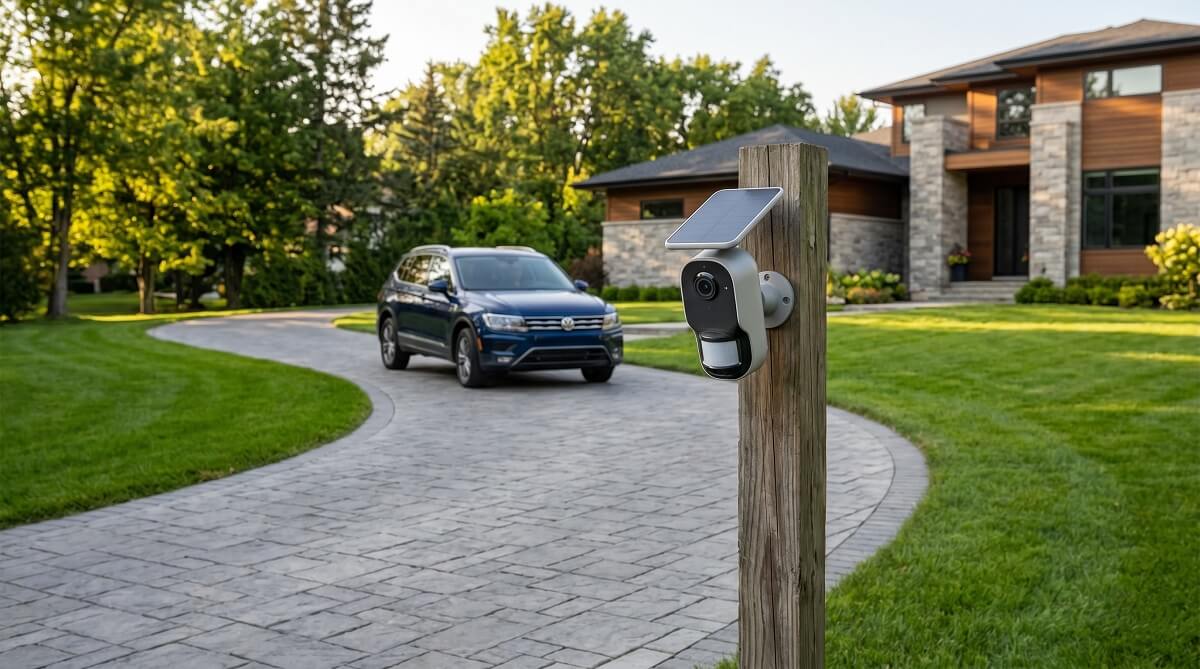
A driveway alarm with camera does something a bare motion detector can’t — it tells you someone’s there and lets you see exactly who triggered the alert. For most homeowners, an outdoor camera with built-in motion detection (like the Ring Floodlight Cam Pro at $219.99 or a Reolink Argus 4 Pro) handles both jobs in one unit. You get the chime, the phone notification, and a video clip, all without running wires to a separate alarm sensor. for a broader look at outdoor camera options.
The real decision isn’t just about brand — it’s about matching the right detection method to your property. A 40-foot suburban driveway needs something completely different than a 500-foot rural entrance. And if false alarms are your biggest frustration, the sensor technology matters far more than the camera resolution. can help you think through the broader setup before zeroing in on a single product.
Prices run from under $25 for a basic motion chime to around $220 for a wired floodlight camera with a built-in siren. Most buyers land somewhere in the $50–$130 range for a solid wireless system. Here’s what actually works.
Who Should (and Shouldn’t) Get a Driveway Alarm with Camera
✅ Best For
- Homeowners with driveways longer than 40 feet where you can’t see the entry from your door
- Anyone dealing with package theft — visual confirmation helps police reports
- Rural properties needing long-range detection (1/4 mile or more)
- Parents who want to know the moment a car pulls in
- DIY installers — most wireless systems mount in under 30 minutes, no electrician needed
❌ Skip If
- Your driveway is very short (under 30 feet) — a video doorbell covers it
- You already have outdoor cameras pointed at your driveway — just configure motion zones
- You need 24/7 continuous recording — driveway alarm cameras are event-triggered, not always-on
- Your HOA restricts visible sensors or cameras on exterior walls
How a Driveway Alarm with Camera Actually Works
There are two different setups people mean when they say “driveway alarm with camera.” Understanding the difference saves you from buying the wrong thing.
All-in-One vs. Paired Systems
An all-in-one system combines a camera and motion sensor in a single unit. When the sensor detects movement, the camera records a clip and your phone buzzes. Ring’s Floodlight Cam Pro is a good example — it has a 3D radar motion sensor, a 2K camera, a siren, and floodlights, all in one housing. You wire it into your home’s electricity and that’s it.
A paired system keeps the alarm sensor and camera separate. You mount a wireless sensor near the driveway entry — something like a Guardline GL-5000 or an eMACROS solar unit — and place a camera nearby to cover the same zone. The sensor sends an audible chime to an indoor receiver; the camera records independently. More setup, but more flexibility for unusual driveway layouts or long distances where running power isn’t practical.
The 3 Detection Methods Explained
PIR (Passive Infrared) is the most common. These sensors detect body heat in motion, which means they respond to people, animals, and vehicles. The upside: they catch everyone. The downside: large dogs, deer, blowing tree branches in direct sunlight, and even rapid temperature changes can trigger them. For most residential driveways, this is acceptable — but on rural properties with wildlife, false alerts add up fast.
Magnetic vehicle probes solve the false alarm problem by detecting only moving metal. The probe buries beside your driveway and only fires when a car passes over it. According to independent testing by Modern Survival Blog, “magnetic sensors only detect moving metal vehicles, not animals, wind, or weather” — a near-zero false alarm rate compared to PIR’s frequent pet and weather triggers. The tradeoff: they miss pedestrians, require buried installation (6–12 inches beside the driveway edge), and cost more.
Break-beam sensors use two posts with an infrared beam between them. Break the beam and the alert sounds. These are reliable and precise, but they work best at defined entry points like a gate or the end of a narrow lane — not a wide-open driveway. if you’re looking to expand an existing system with additional detection zones.
What to Look for Before You Buy
Detection Range
Measure your driveway from the street to your house, then add about 20% buffer for sensor placement flexibility. Budget PIR sensors like the 1byone cover around 24 feet of detection width — fine for a standard suburban driveway. Step up to the Guardline GL-5000 and you get 500 feet of wireless transmission range with a 40-foot detection arc. For rural properties, the Dakota Alert DCMA-4K Plus reaches a full mile, with a 100-foot detection width. According to SafeWise’s 2026 review, the Dakota Alert is their top pick for long driveways at $74.99.
Camera Resolution and Night Vision
For camera-integrated systems, 1080p is the floor — anything below that and license plates become unreadable at more than 15 feet. The Ring Floodlight Cam Pro steps up to 2K Retinal video and adds color night vision powered by its 2000-lumen floodlights, so you’re not squinting at grainy IR footage. Reolink’s Argus 4 Pro goes further with a 4K dual-lens panoramic setup covering 180 degrees — useful when your driveway fans out near the garage. According to Reolink’s official product review, the Argus 4 Pro’s AI detection distinguishes between people, vehicles, pets, and packages — reducing phantom alerts from passing headlights.
Power: Battery, Solar, or Wired
Your power option affects where you can place sensors and how much maintenance you’ll do. Battery-powered sensors like the Guardline GL-5000 run on C-cell batteries, lasting 1–2 years depending on traffic volume. YoLink’s LoRa-based sensors push that to 2+ years thanks to the protocol’s low energy draw — confirmed by Alarm Reviews’ 2026 comparison. Solar sensors like the eMACROS Pro 4 recharge during the day and include a base station with 3-day battery backup, so cloudy stretches don’t leave you dark. Wired cameras like the Ring Floodlight Cam Pro never need battery swaps but require an electrician or comfort with home wiring.
App Alerts and Smart Home Integration
If you want phone notifications, you need either a WiFi-connected outdoor cam or a detector with a smart hub. Ring cameras work natively with Alexa and include two-way talk. Reolink cameras pair with Alexa and Google Home with local storage on a microSD card — no monthly subscription required. YoLink connects via Alexa, Google Assistant, and IFTTT for automation routines. Basic entry alert systems like the Guardline GL-5000 send no phone alerts at all — just an audible chime to the indoor receiver. Know which you need before you buy. has a deeper look at choosing between walled-garden ecosystems like Ring and open-platform options like Reolink.
Top Driveway Alarms with Camera (and the Best Standalone Sensors) for 2026
Best Overall Camera System: Ring Floodlight Cam Wired Pro — $219.99
The Ring Floodlight Cam Pro is the go-to choice when you want a camera, alarm, and motion sensor that all work together out of the box. Its 3D radar detection maps a precise zone — you define your driveway, and anything outside that zone doesn’t trigger an alert. The 2K camera captures clear footage day and night, the 110dB siren can deter someone who’s already on your property, and the 2000-lumen floodlights snap on automatically. Ring’s app is polished and reliable.
The catch: it requires hardwiring to AC power and an optional Ring Protect subscription ($4.99/month) to save video history. Without the subscription, you can still view live footage but won’t be able to review past clips. If you already use Ring devices, adding this integrates cleanly. Check current price on Amazon.
Best No-Subscription Camera: Reolink Argus 4 Pro
The Argus 4 Pro earns its place for anyone who refuses to pay a monthly fee. It’s battery-powered (with solar charging via optional panel), records 4K footage across a 180-degree panoramic field, and uses AI to distinguish between people, vehicles, pets, and packages. All recordings go to a local microSD card or Reolink’s Home Hub — no cloud fees. Detection accuracy is strong enough that false alerts from passing cars or distant movement are rare. Pricing is typically in the $90–$120 range depending on bundle. See current listings on Reolink’s site or Amazon.
Best Smart Alarm Sensor (No Camera): YoLink SpeakerHub Kit — $54.99
The YoLink kit pairs an outdoor motion sensor with a SpeakerHub that handles app alerts, custom alarm sounds, and text-to-speech notifications. What sets YoLink apart is the LoRa radio protocol — sensors reach 1/4 mile with 2+ years of battery life, and you can expand the system up to 200 sensors across one hub. It works with Alexa, Google Home, and IFTTT. for more context on where YoLink fits into a larger setup. Available on Amazon. SafeWise named it the best overall driveway alarm of 2026.
Best Solar Alarm Sensor: eMACROS Pro 4 — ~$49.99
If you want a solar-powered sensor with app alerts and don’t want to spend Ring-level money, the eMACROS Pro 4 is the solid middle-ground option. It covers 1/2 mile wireless range, handles up to 64 sensors, sends push notifications to your phone, and runs on a solar sensor with a 3-day base station backup during cloudy weather. The IP65 weatherproofing holds up through rain, dust, and temperature swings. No camera — this pairs with your existing cameras. Check on Amazon.
Driveway Alarm Comparison Table
| System | Price | Detection Type | Range | Camera | Night Vision | App Alerts | Power |
|---|---|---|---|---|---|---|---|
| Ring Floodlight Cam Pro | $219.99 | 3D Radar (PIR) | Driveway zone | 2K | Color (floodlit) | Yes (Ring app) | Hardwired |
| Reolink Argus 4 Pro | ~$100–120 | PIR + AI | ~40 ft arc | 4K (180° dual) | Color (spotlight) | Yes (Reolink app) | Battery + Solar |
| YoLink SpeakerHub Kit | $54.99 | PIR (LoRa) | 1/4 mile | None | N/A | Yes (Alexa/Google) | Battery (2+ yr) |
| eMACROS Pro 4 | ~$49.99 | PIR | 1/2 mile | None | N/A | Yes (app) | Solar + 3-day backup |
| Guardline GL-5000 | $90–120 | PIR | 500 ft | None | N/A | No (chime only) | Battery (C cells) |
| Dakota Alert DCMA-4K Plus | $74.99 | PIR | 1 mile | None | N/A | No (chime only) | Battery |
| 1byone | $22.99 | PIR | 24 ft detect | None | N/A | No (chime only) | Battery |
Prices sourced from Amazon and SafeWise, March 2026. Check current pricing before purchasing.
Matching the Right System to Your Situation
✅ Good Fits
- Package theft victims: Camera evidence is what actually helps a police report. Go with Ring or Reolink — clear video, timestamped clips.
- Rural homeowners with 200+ foot driveways: Start with YoLink (smart alerts, 1/4 mile) or Dakota Alert (chime-only but 1-mile coverage).
- Vehicle-only detection needed: Look at the Dakota Alert DCPA-4000 magnetic probe. It buries beside the driveway and only triggers when a car passes. Near-zero false alarms from deer, dogs, or windblown debris.
- Off-grid properties: eMACROS solar or HTZSAFE solar sensors work without power outlets or network connections.
- Smart home users: YoLink (Alexa/Google), Ring (Alexa + Ring ecosystem), or Reolink (Alexa/Google, no subscription).
❌ Poor Fit Scenarios
- Renters without mounting permission: Most systems require screwing a sensor into a post, wall, or tree. Check with your landlord first.
- 24/7 continuous recording needs: Driveway alarm cameras are event-triggered. For always-on recording, you need a wired NVR camera system, not a driveway alarm.
- Facial recognition or license plate capture: These require dedicated cameras with higher optical zoom. A driveway alarm camera won’t reliably capture a plate beyond 20–30 feet.
Installation Tips Worth Knowing
Sensor placement makes or breaks your false alarm rate. Mount PIR sensors 4–5 feet off the ground and angle them slightly downward to reduce sky/tree line interference. For wide driveways, position the sensor on the side of the driveway rather than straight on — this gives more detection time as a car passes through the field. for step-by-step sensor placement diagrams.
If you’re going solar, placement matters beyond the driveway itself. The sensor panel needs at least 4–6 hours of direct sunlight daily. A panel mounted under a heavy tree canopy or on a permanently north-facing wall won’t charge reliably, regardless of brand. eMACROS and HTZSAFE both confirm in their specs that shaded locations will reduce backup power reserve.
For paired systems (separate sensor + camera), a Wyze Cam Outdoor or a Reolink Go series camera positioned at driveway entry works well without requiring AC power. Trigger the camera’s motion zone to match the sensor’s detection arc so you’re not capturing unrelated movement from the street.
Frequently Asked Questions
What’s the difference between a driveway alarm and a driveway camera?
A driveway alarm is primarily a detection-and-alert device — it senses movement and sends a chime or phone notification. A driveway camera records video. Many people use both together: the sensor catches motion early (before someone reaches the house), and the camera provides footage. Some products combine both in one unit.
Do driveway alarm cameras require a subscription?
It depends on the brand. Ring requires a Protect subscription ($4.99/month) to save video history and access cloud clips. Reolink stores footage locally on a microSD card or NVR — no subscription needed. Wyze cameras offer a free tier with 14-day cloud storage for events. Always check the storage model before buying.
How far can a wireless driveway alarm detect?
Wireless transmission range (how far the signal travels from sensor to receiver) and detection range (how wide the sensor sees) are different. A Guardline GL-5000 transmits 500 feet but only detects motion within a 40-foot arc around the sensor. The Dakota Alert DCMA-4K Plus transmits a full mile with a 100-foot detection width. For most suburban driveways, 1/4 mile transmission range is more than enough.
Will my driveway alarm trigger from animals?
PIR sensors will — deer, large dogs, and even raccoons can set them off. If you’re in a rural area with regular wildlife, consider a magnetic vehicle probe sensor, which only detects moving metal objects (cars and trucks). Nearly zero false alarms from animals, but it requires buried installation and won’t detect pedestrians.
Can I add a camera to an existing driveway alarm?
Yes. If you have a standalone alarm sensor like a Guardline or HTZSAFE, you can place any outdoor camera — Reolink, Wyze, Blink — nearby and configure both to cover the same zone. They operate independently. Some advanced setups use IFTTT or Home Assistant to link the sensor trigger to camera recording, but it’s not required for basic coverage.
Are driveway alarm cameras weatherproof?
Most outdoor models carry an IP65 or IP67 rating, which means they’re protected against rain and dust. Check the specific rating: IP65 handles rain and splashing; IP67 can survive brief submersion. For regions with heavy snow or extreme temperature swings, also verify the operating temperature range — HTZSAFE’s sensors work from -30°F to 150°F.
Do driveway alarms work with Ring or Nest?
Ring cameras work within Ring’s own ecosystem and integrate with Alexa, but not directly with Google Nest. Nest cameras integrate with Google Home. If you want to mix ecosystems, look at Reolink (works with both Alexa and Google) or YoLink (Alexa, Google, and IFTTT), which offer more flexibility across platforms.
What’s the best driveway alarm for a 500-foot driveway?
For a 500-foot driveway, the Dakota Alert DCMA-4K Plus ($74.99) is a reliable choice — it has a 1-mile transmission range and detects movement within 100 feet of the sensor. Place the detector at the driveway entrance, and you’ll get an alert well before a vehicle reaches the house. If you want smart alerts added, pair it with a YoLink sensor near the house end of the drive. walk through multi-zone configurations for longer entries.
Check current prices on Amazon or compare models at Best Buy. Prices and availability shift frequently, especially for solar models heading into spring.
