


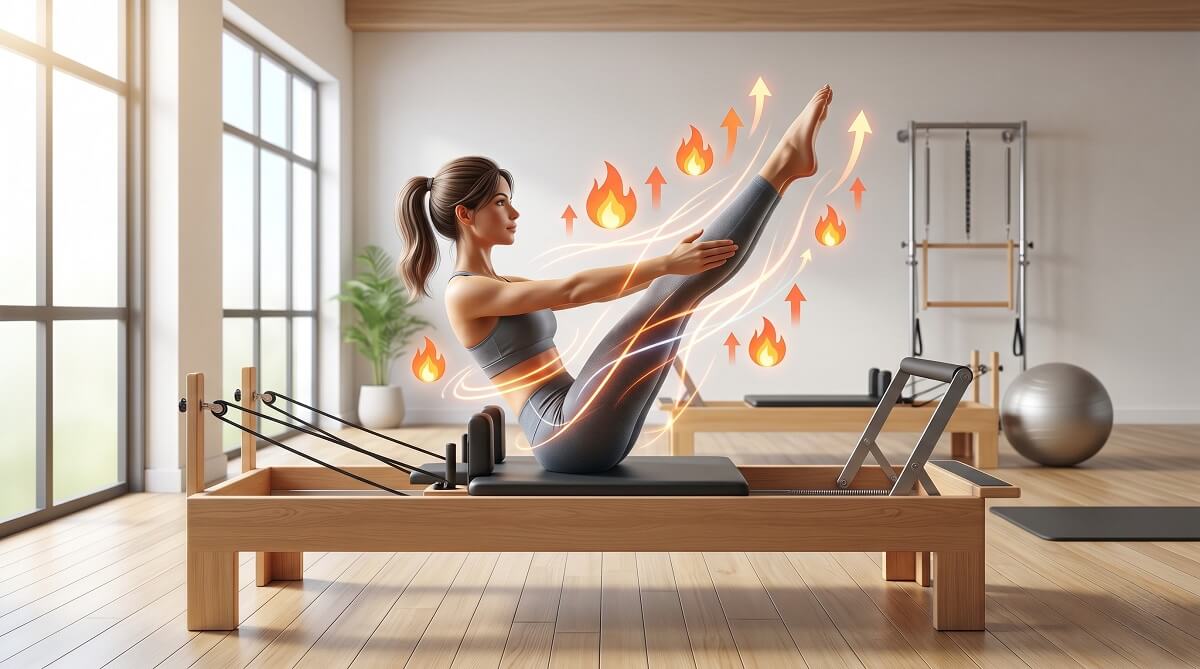
Pilates burns roughly 170 to 408 calories per hour, depending on whether you’re on a mat or a reformer, how much you weigh, and how hard you push. Mat pilates sits at the lower end—around 170–272 calories per hour for most people. Reformer pilates pushes that up to 255–408 per hour. High-intensity hybrid formats can go higher still.
For weight loss, pilates isn’t the fastest route on paper. Running and cycling burn significantly more calories per session. Where pilates earns its place is in what it builds alongside the calorie burn: lean muscle, which raises your resting metabolism, and core strength that carries over into everything else you do. Over weeks and months, that combination makes the math more favorable than a single session comparison suggests.
Below you’ll find a full calorie table across pilates types and body weights, the formula behind the numbers, and a plain-language answer to whether pilates is actually worth it for weight management.
Is Pilates Right for Your Calorie Goals?
✅ Good Fit If You:
- Want low-impact training that still contributes to a weekly calorie deficit
- Are pairing exercise with a calorie-controlled diet (where the combination does the heavy lifting)
- Need joint-friendly movement—recovering from injury, managing knee or back issues
- Want to build core strength and muscle tone alongside weight management
- Enjoy the mind-body focus and can commit to 3–4 sessions per week
❌ Worth Reconsidering If:
- Maximizing calories per session is your only priority—running, cycling, or HIIT outperform pilates here
- You have limited weekly workout time and weight loss is the primary goal
- You’re training for endurance sports that require cardiovascular conditioning
Pilates Calorie Burn by Type, Weight & Duration
These figures use the MET (Metabolic Equivalent of Task) formula—the same method used by the Compendium of Physical Activities, the peer-reviewed standard for exercise calorie estimates. Mat pilates has an assigned MET of 3.0; reformer pilates is 4.5. Expect individual variation of roughly ±15% based on your effort, fitness level, and how the class is structured.
Mat Pilates (MET 3.0)
| Body Weight | 30 Minutes | 45 Minutes | 60 Minutes |
|---|---|---|---|
| 125 lbs (57 kg) | 85 cal | 128 cal | 170 cal |
| 150 lbs (68 kg) | 102 cal | 153 cal | 204 cal |
| 175 lbs (79 kg) | 119 cal | 179 cal | 238 cal |
| 200 lbs (91 kg) | 136 cal | 204 cal | 272 cal |
Reformer Pilates (MET 4.5)
| Body Weight | 30 Minutes | 45 Minutes | 60 Minutes |
|---|---|---|---|
| 125 lbs (57 kg) | 128 cal | 191 cal | 255 cal |
| 150 lbs (68 kg) | 153 cal | 230 cal | 306 cal |
| 175 lbs (79 kg) | 179 cal | 268 cal | 357 cal |
| 200 lbs (91 kg) | 204 cal | 306 cal | 408 cal |
Calculated using the standard MET formula: Calories = MET × weight (kg) × time (hours). Source: Compendium of Physical Activities (Ainsworth et al.).
Which Type of Pilates Burns the Most Calories?
The gap between mat and reformer is real—and it comes down to resistance. The reformer adds spring tension, which forces more muscle activation per movement. More muscle working = more energy used = more calories burned. Here’s how the main formats compare.
Mat Pilates — Steady, Accessible, Moderate Burn
Mat work uses your bodyweight as the primary resistance. A typical 60-minute class burns around 170–272 calories depending on weight and pace. It’s the most accessible entry point—no equipment cost, doable at home, and easy to scale for beginners.
Research by Michele Olson, Ph.D., FACSM—who measured oxygen expenditure directly in 12 subjects across mat pilates intensity levels (as cited by LIT Method)—found that a beginner session burns about 4 calories per minute (240/hour), while advanced mat pilates reaches 7.5 calories per minute (450/hour). The difference is how much effort you’re actually putting in, not just what level is labeled on the class.
Reformer Pilates — Higher Resistance, Bigger Numbers
The reformer machine adds spring-based resistance to almost every movement, recruiting more muscle simultaneously. That drives the MET value up to 4.5, roughly 50% higher than mat work. A 150-lb person doing a standard reformer class for 45 minutes burns around 230 calories—versus 153 for the same duration on a mat.
Studio reformer classes typically run 45–55 minutes. The variation in class format matters a lot here: a slow, rehabilitation-style session will land closer to 200 calories per hour, while a high-intensity class with quick transitions and heavier spring loads can push 350–450 calories for a 150-lb person. According to body-weight-segmented data from Lagree Fit 415 (which cites VeryWellFit and Harvard Health methodology), a 150-lb person in a standard reformer class burns approximately 170–190 calories in 45 minutes—consistent with the MET-based calculations above.
Wall Pilates — Similar to Mat, Growing Fast
Wall pilates uses a flat surface for support and added leverage during bodyweight movements. Because it’s still fundamentally bodyweight resistance, calorie burn is comparable to mat pilates—roughly 170–260 calories per hour depending on your weight and pace. It’s not a higher-burn format, but it’s an effective option when you don’t have equipment or floor space.
High-Intensity Hybrid Formats
Some studio formats blend pilates principles with cardio intervals and reduced rest time. These classes aren’t traditional pilates—they borrow the equipment and movement vocabulary but push heart rates significantly higher. Calorie burn can reach 350–500+ calories per 45-minute session for an average-weight person, closer to what you’d see from a HIIT class than a classic reformer session.
The Math Behind Pilates Calorie Estimates
Every calorie estimate in this article (and most you’ll find elsewhere) comes from the same place: the MET formula. MET stands for Metabolic Equivalent of Task—it’s a ratio comparing the energy cost of an activity to sitting at rest.
The formula: Calories burned = MET × weight in kg × time in hours
Worked example: A 150-lb person (68 kg) doing reformer pilates (MET 4.5) for 45 minutes (0.75 hours):
4.5 × 68 × 0.75 = 230 calories
MET values for pilates come from the Compendium of Physical Activities, a peer-reviewed database maintained by exercise science researchers at Arizona State University. The 2024 update is the most current version. Mat pilates sits at approximately 3.0 MET; reformer is assigned 4.5.
One important caveat the Compendium itself notes: these figures are population averages. They don’t account for individual differences in body composition, age, movement efficiency, or fitness level. Your actual burn could run 10–20% above or below the estimate.
What Actually Affects How Many Calories You Burn
Body Weight — The Biggest Variable
More mass requires more energy to move. Looking at the tables above, a 200-lb person doing the same mat class as a 125-lb person burns about 60% more calories—272 vs. 170 per hour. This isn’t unique to pilates; it applies to every activity calculated using the MET formula.
Intensity and Resistance
On the reformer, more spring tension means more muscle recruitment, which directly raises your calorie expenditure. In mat work, the equivalent is moving through exercises with controlled effort rather than momentum. A class where you’re actively fatiguing the target muscles burns more than one where you’re going through the motions.
Your Current Fitness Level
Newcomers sometimes burn slightly more per session as their bodies adapt to unfamiliar movement patterns. As you get more conditioned, your body becomes more efficient—which means you need to add resistance, duration, or intensity to keep energy expenditure high.
Session Duration
Most pilates classes run 45–55 minutes. Shorter sessions obviously yield fewer total calories, but they’re not wasted—even 30 minutes of focused reformer work delivers 128–204 calories depending on body weight, plus the muscle-building benefit that accumulates over time.
Pilates vs. Other Workouts: Calorie Comparison
Context matters when evaluating pilates for weight management. Here’s how it stacks up against common alternatives for a 175-lb person in a 60-minute session, using MET-based calculations from Fitness Volt’s verified comparison table:
| Activity | Calories/Hour (175 lbs) | Impact Level |
|---|---|---|
| Mat Pilates | ~238 | Low |
| Reformer Pilates | ~357 | Low |
| Yoga (Hatha) | ~193 | Low |
| Walking (3.5 mph) | ~280 | Low-Med |
| Aerobics class | ~566 | Medium |
| CrossFit | ~480 | High |
| Spinning | ~600 | Medium-High |
| Running (6 mph) | ~680 | High |
Reformer pilates compares reasonably to walking and beats yoga on calorie burn while remaining genuinely low impact. For anyone managing joint pain, post-injury recovery, or simply preferring low-impact training, the reformer’s calorie output is solid. Where pilates can’t compete is with sustained cardio like running or cycling—those activities are simply more efficient at burning energy per hour.
Is Pilates Actually Good for Weight Loss?
The honest answer: yes, with conditions. Pilates alone—a few sessions per week, no dietary changes—will produce modest results. Paired with a reasonable calorie deficit from diet, it becomes a meaningful contributor to weekly energy expenditure.
The Math on Losing 1 Pound
One pound of body fat requires burning roughly 3,500 calories more than you consume. Running the numbers on pilates:
- Mat pilates at 150 lbs: ~204 calories/hour → roughly 17 one-hour sessions to burn 1 lb from exercise alone
- Reformer pilates at 150 lbs: ~306 calories/hour → roughly 11 one-hour sessions
That’s without any dietary adjustment. Add a modest 200-calorie daily deficit from food, do three 45-minute reformer sessions per week (burning ~690 calories total), and you’re looking at a combined weekly deficit of roughly 2,100 calories—about 0.6 lbs per week, or ~2.4 lbs per month. That’s a realistic, sustainable pace.
The Muscle-Building Bonus
Regular pilates builds lean muscle, which raises your basal metabolic rate—the calories your body burns at rest. This effect is modest for pilates compared to heavy strength training, but it’s real, and it compounds over months of consistent practice. More muscle means your body burns more energy throughout the day, not just during sessions.
How Often Should You Do Pilates for Weight Loss?
The research by Michele Olson found that meaningful weight loss results require at least 4 sessions per week at 45–60 minutes each—and that holds specifically for intermediate and advanced intensity levels, not beginner-paced classes. For most people, 3 sessions per week combined with dietary awareness is a realistic and sustainable starting point.
5 Ways to Burn More Calories During Pilates
- Increase reformer spring resistance. Heavier springs recruit more muscle, which directly lifts your energy expenditure. Progress resistance gradually rather than jumping to maximum tension.
- Cut rest time between exercises. Keeping the heart rate elevated through shorter transitions raises the overall caloric cost of the session—even without changing the exercises themselves.
- Choose higher-intensity class formats. Not all reformer classes are equal. Look for formats described as “cardio pilates,” “athletic pilates,” or classes that incorporate jumping on the reformer.
- Go four sessions per week instead of two. The cumulative weekly calorie total matters more than any single session. Adding one or two sessions per week roughly doubles your weekly pilates-related energy expenditure.
- Actually engage the muscles. Half-reps and passive movements waste the session. Full range of motion with deliberate muscle engagement burns significantly more than going through the motions. Quality matters more than speed in pilates.
Frequently Asked Questions
How many calories does 30 minutes of pilates burn?
A 150-lb person burns around 102 calories in 30 minutes of mat pilates, and about 153 calories in 30 minutes of reformer pilates. At 200 lbs, those figures climb to 136 and 204 calories respectively. Short sessions add up—even 30 minutes contributes to weekly energy expenditure and delivers the muscle-building benefit.
How many calories does 45 minutes of pilates burn?
For a 150-lb person: approximately 153 calories for mat pilates and 230 calories for reformer pilates over 45 minutes. A 175-lb person doing a 45-minute reformer class burns around 268 calories. These are the most practical numbers since most studio classes run 45–55 minutes.
How many calories does 1 hour of pilates burn?
A full hour of mat pilates burns between 170 and 272 calories depending on body weight (125–200 lbs range). Reformer pilates covers 255–408 calories over the same duration. Both figures are based on MET values of 3.0 and 4.5 respectively, from the Compendium of Physical Activities.
Does pilates burn more calories than yoga?
Mat pilates and Hatha yoga have similar MET values (both around 3.0), so calorie burn is comparable for a given body weight and session length. Reformer pilates, however, burns noticeably more than most yoga styles—roughly 50% more per hour. Vinyasa yoga is the yoga style closest to pilates in calorie output.
How many pilates sessions per week for weight loss?
Research suggests at least 3–4 sessions per week at 45–60 minutes each for meaningful weight management results. Fewer than 3 sessions per week produces limited calorie impact on its own—though any movement contributes when paired with dietary awareness.
Is reformer pilates worth the cost for calorie burn?
If calorie burn is your primary metric, the reformer delivers roughly 50% more calories per hour than a mat class. Whether that justifies studio membership costs depends on your budget and goals. For the combined benefits—core development, posture, joint health, plus the higher calorie output—many people find the investment worthwhile. A home reformer is an alternative if you’re committed long-term.
How accurate is my fitness tracker for pilates calories?
Wearables tend to overestimate calorie burn for low-impact, controlled-movement activities like pilates. Most fitness trackers calculate exercise calories primarily from heart rate, which doesn’t capture the muscular effort of slow, isometric pilates movements. Treat tracker numbers as a rough benchmark—the figures in this article based on MET values are generally more reliable for pilates specifically.
Can wall pilates help with weight loss?
Yes, at a rate similar to mat pilates. Wall pilates is bodyweight-based, so calorie expenditure is comparable to a mat session at the same intensity—around 170–272 calories per hour for most people. It’s a practical option when you don’t have floor space or equipment, and it builds the same core and postural benefits as traditional mat work.
Looking to pair pilates with the right home fitness gear? for equipment reviews and comparisons, or check out our for workout tips across formats.
