


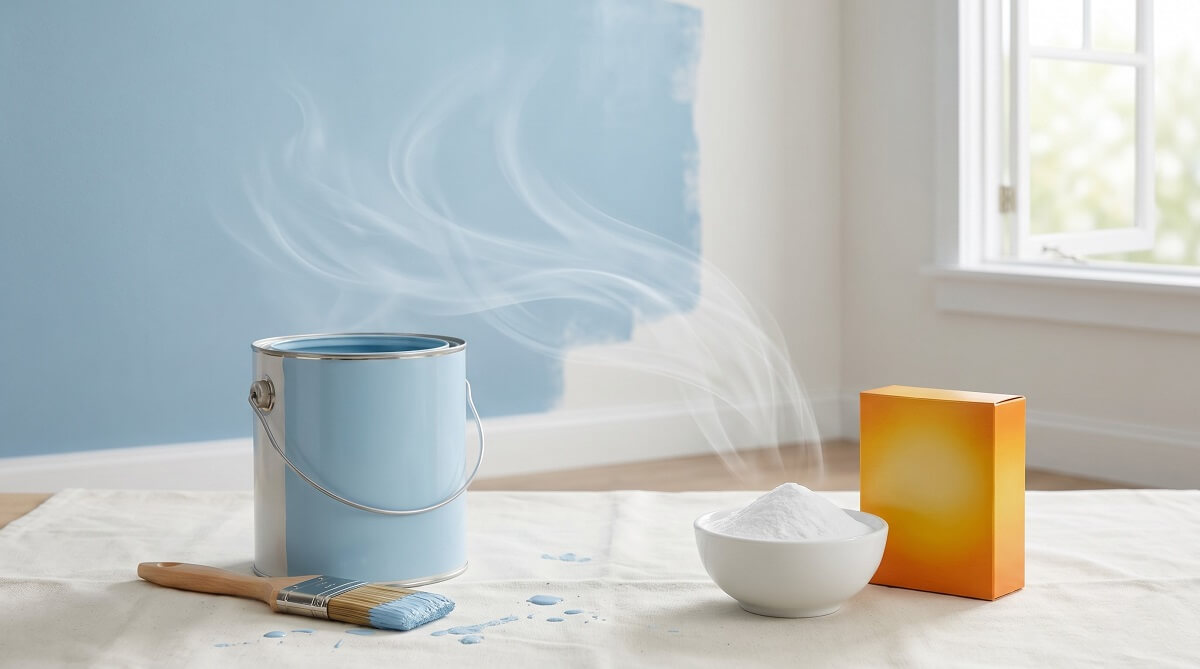
Baking soda absorbs paint smell — it doesn’t just cover it up. Scatter a few shallow bowls of it around a freshly painted room, leave them overnight, and you’ll notice a genuine reduction in odor by morning. It costs almost nothing, takes two minutes to set up, and is completely non-toxic. That’s a hard combination to beat.
The science behind it: paint smell comes from volatile organic compounds (VOCs) off-gassing as the paint dries. Baking soda (sodium bicarbonate) is an alkaline compound that reacts chemically with acidic VOC molecules, converting them into neutral, non-volatile salts with no smell. It also physically adsorbs some odor molecules at its surface. The catch is that baking soda works best on mild-to-moderate odors from water-based (latex) paint. Heavy oil-based paint fumes need more firepower — ventilation, activated charcoal, or an air purifier alongside it.
Should You Use Baking Soda for Paint Smell?
✅ Good choice if you:
- Just finished painting with latex or water-based paint
- Can leave baking soda out overnight (at least 8 hours)
- Want a non-toxic, child- and pet-safe option
- Are on a tight budget (a 4 lb box runs a few dollars at any grocery store)
❌ Don’t rely on it alone if you:
- Used oil-based paint — those fumes are stronger and longer-lasting
- Need the smell gone within 2 hours
- Have a large space with no ventilation
- Have household members with asthma, allergies, or respiratory sensitivities
Why Your Freshly Painted Room Smells Like That
VOCs: The Reason Behind the Fumes
Paint contains chemical solvents that keep it liquid in the can. As the paint dries, those solvents evaporate — a process called off-gassing — releasing volatile organic compounds (VOCs) into the air. That sharp, chemical smell you notice is VOCs doing their thing.
According to the US EPA, indoor VOC concentrations are typically 2 to 5 times higher than outdoor levels. During and immediately after painting, levels can spike to 1,000 times outdoor background concentrations. Most of those emissions happen in the first few days of drying.
Water-based (latex) paints have lower VOC levels and shorter off-gassing windows — usually the bulk of the smell clears within 24 to 48 hours. Oil-based paints are a different story: they carry more intense fumes that can linger for several days or even weeks.
Why Heat Makes the Smell Worse
Warm air speeds up evaporation, which means more VOCs releasing faster. If you’re painting in winter, hold off on turning the heat back on until the paint is fully dry. Painting on a mild spring or fall day — with windows open — is ideal for both drying time and odor control.
How Baking Soda Actually Absorbs Paint Odors
The Chemistry (Without the Jargon)
Baking soda is an alkaline compound, and VOCs from paint are largely acidic organic molecules. When they come into contact, a chemical reaction occurs: the bicarbonate reacts with the acid molecules to form non-volatile sodium salts. As McGill University chemist Joe Schwarcz explains, “It reacts with butyric acid to form sodium butyrate which has no smell because it is not volatile.” The odor molecule is neutralized — converted into something that can’t evaporate into the air anymore.
Physical adsorption also plays a role: sodium bicarbonate particles capture some VOC molecules at their surface. This is the same dual-action mechanism that Arm & Hammer officially describes: baking soda “absorbs and neutralizes odors… rather than simply masking them,” according to the Arm & Hammer brand.
One Key Limitation to Know About
Surface area matters a lot. A closed box of baking soda in the corner of a room accomplishes almost nothing. You need to spread it out across a wide, shallow surface so the maximum amount of baking soda is exposed to the air. That’s why bowls and plates are the right approach — not an open box.
Baking soda also gets “used up” as it reacts with odor molecules. Once the bicarbonate has reacted, it can’t pull in more. For persistent paint smells, replacing the bowls with fresh baking soda daily is more effective than leaving the same batch out indefinitely.
How to Use Baking Soda for Paint Smell: Step-by-Step
Method 1: The Bowl Method (For Rooms)
This is the standard approach and the most effective for newly painted walls and ceilings.
- Pour baking soda into shallow bowls or plates — about half a cup (4 oz) per bowl.
- Place one bowl roughly every 100 square feet of painted surface. For a 200 sq ft bedroom, two bowls spread around the room works well.
- Position them near walls and in corners — VOC concentrations tend to be higher closer to the painted surface.
- Leave overnight — at least 8 hours.
- Discard the used baking soda in the morning and replace with fresh if the smell persists. Don’t reuse the same batch.
For most water-based paint jobs, you’ll see noticeable improvement after the first overnight treatment. Repeat for 1 to 3 days if needed.
Method 2: Sprinkle on Carpet or Upholstery
If the paint fumes have settled into fabric — carpet, rugs, or soft furniture — baking soda can pull the odor out of those materials too.
- Sprinkle a generous layer of baking soda over the affected surface.
- Leave undisturbed for at least 8 hours (overnight is ideal).
- Vacuum thoroughly. Run the vacuum slowly to pick up all the baking soda.
Method 3: Daily Refresh for Stubborn Smells
If the odor lingers after the first night, swap out the bowls each morning with fresh baking soda. Most water-based paint odors resolve within 2 to 3 days using this approach. Oil-based paint may need 5 to 7 days, combined with active ventilation.
Baking Soda vs. Other Paint Odor Methods
Baking soda isn’t the only option, and for strong fumes it shouldn’t be the only one you use. Here’s how it stacks up against the main alternatives:
| Method | Approx. Cost | Time to Results | Best For | Limitations |
|---|---|---|---|---|
| Baking soda (bowls) | ~$1-2 | 8 hrs overnight | Mild-moderate odor, latex paint | Limited capacity; needs replacing daily |
| Ventilation (open windows + fans) | Free | 1–4 hrs | All paint types — the fastest method | Weather-dependent; not always possible |
| Activated charcoal | ~$10–20 | 12–24 hrs | Enclosed spaces; moderate-strong odors | Costs more; replace after a few days |
| HEPA air purifier | $50–200+ | 2–4 hrs (ongoing) | Large rooms; all paint types; long-term use | Upfront cost; HEPA alone doesn’t capture VOCs well (needs activated carbon filter) |
| Onions (halved) | ~$0.50 | 4–8 hrs | Mild paint odors | Replaces paint smell with onion smell temporarily |
The most effective approach is combining methods: ventilation + baking soda together works faster and more thoroughly than either alone.
Getting Faster Results: Stacking Methods
If you want the smell gone as quickly as possible, don’t pick just one approach. Layering multiple methods at the same time gives each one a narrower problem to solve.
- Ventilation first: Open windows and run box fans toward open windows during and after painting. The EPA recommends running ventilation fans continuously for 2 to 3 days after painting is complete.
- Baking soda overnight: Once painting is done, set out your baking soda bowls. They work quietly while you sleep, targeting residual VOCs that ventilation didn’t fully clear.
- Activated charcoal in enclosed areas: Closets, cabinets, or rooms with limited airflow benefit from activated charcoal alongside baking soda — charcoal has higher adsorption capacity for VOCs.
- Air purifier with activated carbon filter: A purifier handles airborne particles actively, 24/7. Look for models with an activated carbon stage (not just HEPA) — activated carbon is what traps VOC molecules.
- Plants long-term: Spider plants, peace lilies, and aloe vera can help reduce residual VOCs over weeks. Don’t count on them for immediate relief, but they’re a useful complement once the acute smell has cleared.
Is Paint Smell Harmful? What You Need to Know
A one-room paint job with latex paint isn’t going to put a healthy adult in the hospital. But VOCs are genuinely not great to breathe, and the exposure is real — especially in the first 24 to 48 hours after painting.
Short-term symptoms from VOC exposure include eye, nose, and throat irritation, headaches, dizziness, and nausea. Long-term or heavy exposure can affect the liver, kidneys, and nervous system, and some VOCs are listed as suspected carcinogens by the US EPA.
The practical guidance: don’t sleep in a freshly painted room for at least 24 to 48 hours. Keep children and pets out for that window too. High-risk groups — pregnant women, people with asthma, and the elderly — should avoid freshly painted spaces for longer and consult a doctor if they experience symptoms.
For oil-based paint, the fumes can continue off-gassing for several days to weeks. Sustained ventilation matters more here than baking soda alone.
Prevent the Problem Before It Starts: Low-VOC Paint
The most effective “odor removal” strategy is reducing the amount of VOCs in the paint you buy. Low-VOC and zero-VOC formulas have improved dramatically over the past decade — the finish quality is comparable to conventional paints, and the smell is significantly reduced.
- Sherwin-Williams Harmony Zero VOC: One of the better-known zero-VOC options. It not only emits zero VOCs itself but claims a formaldehyde-reducing technology that actively lowers VOC levels already present in the room. Check current pricing at sherwin-williams.com or your local SW store (full retail typically around $60-65/gallon; SW frequently runs 30-40% off promotions).
- Benjamin Moore Eco Spec: Holds the “Asthma & Allergy Friendly” certification, with VOC emissions confirmed below certification limits at both 24 hours and 14 days post-painting. Per Bob Vila’s review of zero-VOC paint brands, it’s one of the stronger performers for sensitive households.
One caveat: some zero-VOC base formulas can still off-gas if tinted with conventional colorants. Ask your paint store for zero-VOC tints when ordering custom colors.
Frequently Asked Questions
Does baking soda actually absorb paint smell, or does it just cover it up?
It absorbs and neutralizes — it doesn’t mask. When baking soda (an alkaline compound) contacts acidic VOC molecules from paint, a chemical reaction converts them into non-volatile salts that have no smell. The odor is eliminated, not hidden. That’s the key difference between baking soda and candles or air fresheners, which only mask the fumes.
How much baking soda do I need for a painted room?
A general rule: about half a cup of baking soda per bowl, and one bowl per roughly 100 square feet of painted surface. A standard 12×12 bedroom would need 1 to 2 bowls. Spread the baking soda in a wide, shallow layer — surface area is what makes it work.
How long should I leave baking soda out after painting?
At least 8 hours (overnight). For persistent smells, replace the bowls with fresh baking soda each morning and repeat for 1 to 3 days. Once-used baking soda has depleted its neutralizing capacity, so replacing it daily is more effective than leaving the same batch out for a week.
Can I put baking soda out while the paint is still wet?
Yes. Baking soda won’t affect the paint’s curing process, and starting it while the paint is still drying means it begins absorbing VOCs right when off-gassing is at its highest. Just don’t place bowls directly beneath freshly painted surfaces where drips could land in them.
Is baking soda safe around kids and pets?
Yes — baking soda is non-toxic in normal household use. Keep bowls out of reach of curious pets who might eat large amounts of it (a problem mainly with cats and dogs), but having it in the room is perfectly safe for children and animals.
Does baking soda work on oil-based paint smell?
Partially. Oil-based paint fumes are more intense and longer-lasting than latex, so baking soda alone won’t cut it. Use it as part of a multi-method approach: heavy ventilation plus activated charcoal plus daily baking soda bowl replacements. Plan for 5 to 7 days of treatment rather than 1 to 3.
What’s faster — baking soda or activated charcoal?
Activated charcoal has higher adsorption capacity and generally outperforms baking soda for strong or persistent paint odors. Baking soda has the edge on price (a few dollars vs. $10-20 for charcoal) and convenience. For mild odors, baking soda is perfectly adequate; for heavy fumes, charcoal or an air purifier with an activated carbon filter will work faster.
Can I sleep in a room where I’ve put baking soda bowls out?
Baking soda itself is completely safe to sleep near. The more important question is whether the freshly painted room is safe to sleep in at all — and the answer is generally no for the first 24 to 48 hours, especially with oil-based paint. Wait until the initial heavy off-gassing has passed, then baking soda bowls make the residual smell more manageable while you sleep.
Baking soda is available at every grocery store and major retailer. A 4 lb box (enough for several treatments) typically costs a few dollars — check current pricing at Amazon or your local Walmart or Target. For zero-VOC paint options, visit Sherwin-Williams or Benjamin Moore to find a store near you.
