


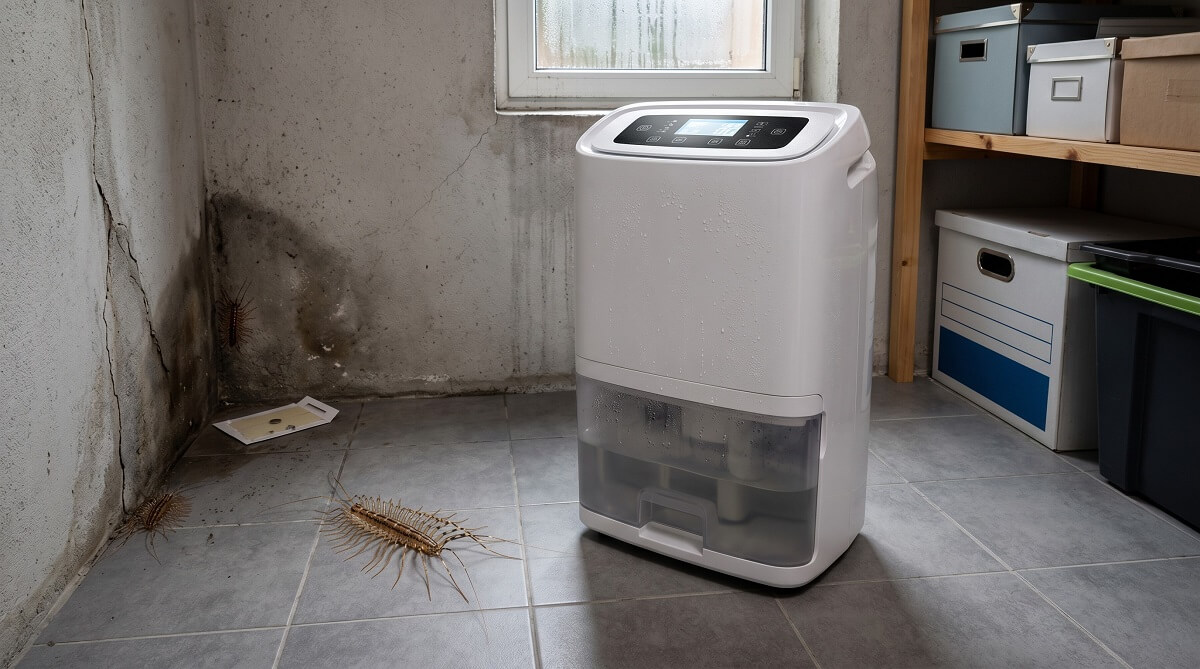
The short answer is yes—a dehumidifier can significantly reduce centipede activity in your home. House centipedes are moisture-dependent creatures; their bodies lose water rapidly in dry air, which means a damp basement or crawl space is essentially an open invitation. Drop the humidity and you take away the one thing they absolutely need to survive and breed.
According to the U.S. EPA’s moisture guidance, indoor relative humidity should stay below 60%—ideally between 30 and 50 percent. Pest control experts, including entomologists at Kansas State University Extension, specifically recommend dehumidifiers as a primary tool for reducing house centipede populations. This approach is non-toxic, works around the clock, and handles other moisture-loving pests at the same time. For a deeper look at what makes a good unit, .
That said, a dehumidifier is not a silver bullet. It takes a few weeks to see meaningful population decline, and it works best when paired with basic exclusion steps like sealing foundation cracks. Read on for the full picture.
Who Should (and Shouldn’t) Use a Dehumidifier for Centipedes
✅ A Dehumidifier Makes Sense If You Have:
- Centipedes regularly appearing in your basement, bathroom, or crawl space
- Condensation on pipes or walls — a sure sign of chronic dampness
- A musty smell in below-grade spaces
- No existing humidity control in your home’s lowest level
- Silverfish, springtails, or booklice (same fix applies)
❌ A Dehumidifier Alone Won’t Solve It If:
- Centipedes are entering through open foundation cracks or gaps — you need to seal those first
- You have an active water leak or standing water in the basement
- You’re expecting results overnight — expect 2–4 weeks minimum
- Your entire crawl space is unsealed or unencapsulated (may need a vapor barrier too)
Why Centipedes Set Up Shop in Damp Spaces
House centipedes (Scutigera coleoptrata) are not just uncomfortable to look at — they’re reliable indicators of a moisture problem. Unlike most pests, they don’t come for your food. They come because your home is damp enough to keep them hydrated and well-fed.
Their bodies cannot retain moisture efficiently, so they rely on high ambient humidity to stay functional. In dry air, they dehydrate quickly and die. But in a basement running at 70% or 80% relative humidity, they have everything they need: moisture to survive, mold and mildew as a food source for prey like silverfish and springtails, and dark corners to reproduce undisturbed.
As HowStuffWorks explains: “Roaches, silverfish, spiders and centipedes all love a moist environment. Keeping the air in your home relatively dry will drive away those unwanted tenants.” It’s not a complicated relationship — lower the humidity and you remove the conditions that make your home worth inhabiting for them.
for related tips on keeping your living space dry and pest-free.
How a Dehumidifier Disrupts the Centipede Life Cycle
Running a dehumidifier in your basement creates a cascade effect that works against moisture pests at multiple levels at once.
First, dropping the humidity below 50% directly stresses the centipedes themselves — they dehydrate faster and become less active. Second, lower humidity discourages mold and mildew growth, which cuts food sources for silverfish and springtails. Fewer of those prey insects means house centipedes lose their primary food supply. Third, drier conditions prevent centipede eggs from developing properly, slowing reproduction.
Kansas State University Extension entomologist Dr. Raymond Cloyd directly states that “using a dehumidifier can reduce the relative humidity inside homes” and recommends it as one of the primary steps to reduce house centipede populations. Cornell University’s Integrated Pest Management Program echoes this: “Lowering indoor humidity is an effective way to manage moisture-related pests. Using a dehumidifier to keep humidity below 60% reduces the conditions these pests depend on.”
According to Orkin’s centipede control guidance, “centipedes are less likely to appear in properly ventilated basements and crawl spaces, so a dehumidifier may be of use in combating an infestation.” Coming from a national pest control company, that’s a meaningful endorsement of a chemical-free approach. Not sure which unit fits your space? .
What Humidity Level Do You Need to Target?
The EPA’s official recommendation is to keep indoor relative humidity below 60%, with 30–50% being the ideal range. For centipede control specifically, most pest management experts aim for 45–50% — high enough to avoid issues for your wood floors and respiratory health, low enough to make the environment hostile for moisture pests.
Going below 30% is not advisable. Air that dry can cause wood to crack, skin irritation, and increased static electricity. The sweet spot is 40–50% for most households.
Most dehumidifiers include a built-in humidistat — a sensor that measures relative humidity and switches the unit on and off automatically once you set a target level. Set it to 45–50% and let it run. You don’t need to babysit it. A separate inexpensive humidity monitor (also called a hygrometer) lets you verify the readings in different areas of your basement. .
Choosing the Right Dehumidifier for a Centipede Problem
Sizing by Space
Choosing the wrong capacity is the most common mistake. A unit that’s too small runs constantly without reaching your humidity target; too large and you’re spending more than you need to.
Under the Department of Energy’s 2019 testing standards (which test at a more realistic 65°F rather than the older 80°F standard), here’s a practical sizing guide:
- Under 500 sq ft: 30–35 pint/day unit
- 500–1,000 sq ft: 50 pint/day unit
- Over 1,000 sq ft or heavily damp: 70+ pint/day commercial unit
Note: If your basement is unfinished and noticeably wet (standing water after rain, heavy condensation), size up one category.
Refrigerative vs. Desiccant
Most basement dehumidifiers use refrigerative (compressor) technology — the same principle as air conditioning. They work well in spaces above 60°F, which covers most inhabited basements.
If your crawl space or storage area stays below 50–60°F in winter, consider a desiccant dehumidifier instead. Desiccant units use a moisture-absorbing material (like silica gel) and work efficiently at low temperatures where compressor units struggle.
Features Worth Paying For
- Built-in humidistat — auto on/off at your target humidity level (standard on most units)
- Continuous drain hose port — run a hose to a floor drain and skip emptying the bucket entirely
- ENERGY STAR certification — under Version 6.0 (effective Oct 1, 2025), certified 50+ pint units must meet an Integrated Energy Factor of ≥3.30 L/kWh, roughly 15–20% more efficient than non-certified models; see the ENERGY STAR certified dehumidifier list
- Wi-Fi / app control — monitor humidity remotely and get alerts when the bucket is full (useful if you don’t check the basement often)
Dehumidifier Comparison: Top Picks for Basement Centipede Control
Prices current as of March 2026 — check retailer pages for the latest deals.
| Model | Capacity | Coverage | Price (Est.) | ENERGY STAR | Built-in Pump | Wi-Fi |
|---|---|---|---|---|---|---|
| Midea Cube MAD50PS1QWT | 50 pt/day | Up to 4,500 sq ft | ~$299–$389 | ✅ Yes (Most Efficient) | ✅ Yes | ✅ Yes (Alexa) |
| Frigidaire Gallery FGAC5045W1 | 50 pt/day | Up to 3,000 sq ft | ~$344 | ✅ Yes | ❌ No (hose port) | ✅ Yes |
| Frigidaire FFAD5033W1 | 50 pt/day | Up to 2,000 sq ft | Check current price | ✅ Yes | ❌ No (hose port) | ❌ No |
All three models include a continuous drain hose port. Midea’s Cube design collapses for compact storage. Frigidaire FFAD5033W1 is a solid no-frills option for tighter budgets.
Check current prices and availability: Midea MAD50PS1QWT at Lowe’s | Frigidaire FGAC5045W1 at Best Buy
Where to Place Your Dehumidifier for Best Results
Placement matters more than most people realize. Putting a 50-pint unit in one corner of a large, poorly-ventilated lower level may not lower dampness across the whole space evenly.
- Primary zone: The basement or crawl space — wherever centipede activity is highest
- Secondary zones: Laundry room, under-stairs storage, bathrooms on lower floors
- Clearance: Keep the unit at least 6–12 inches from walls and furniture so air can circulate freely
- Drain hose: Route to a floor drain, utility sink, or sump pump pit for continuous operation — this eliminates the bucket-emptying chore entirely
- Doors and windows: Keep them closed while the dehumidifier runs so you’re not fighting outdoor humidity
If your basement is large or oddly shaped, you may need two smaller units rather than one large one to cover the space evenly.
The Other Half of the Fix
A dehumidifier handles the humidity side. For faster and more complete results, pair it with these steps:
- Seal foundation cracks and entry points — gaps around pipes, windows, utility openings, and foundation walls are common centipede entry routes (Orkin recommends keeping mulch and compost at least 3 feet from the foundation)
- Fix pipe leaks and sweating pipes — even slow drips feed enough moisture to undermine your dehumidifier’s work; insulate cold pipes with foam pipe sleeves
- Remove outdoor clutter near the foundation — leaf piles, wood stacks, and dense plantings all hold moisture and provide shelter
- Use sticky traps along baseboards and wall edges — useful for monitoring activity levels and catching individuals
- Address the prey population — if you have a silverfish or springtail problem alongside centipedes, tackle both; centipede populations drop naturally when their food source disappears
if you want to dig into any of these steps further.
How Long Until You See Results?
Most homeowners notice fewer centipedes within 2–4 weeks of running a dehumidifier consistently. Argendon, citing pest control research, notes that “many users notice improvements within several days to a few weeks as humidity drops and pest activity declines.”
A full population decline — where you stop seeing them altogether — typically takes 1–3 months. This reflects the time needed to exhaust the existing population as breeding conditions are eliminated. Several variables affect the timeline:
- How bad the infestation was to begin with
- Whether you’ve also sealed entry points and fixed leaks
- How consistently the unit maintains your target humidity
- Whether the whole damp area is covered (not just one corner)
Check your hygrometer readings weekly for the first month. If humidity isn’t staying below 50%, your unit may be undersized or you may have an unaddressed water intrusion issue.
Frequently Asked Questions
Does a dehumidifier kill centipedes directly?
No — it doesn’t kill them outright. What it does is remove the damp conditions they need to survive and reproduce. Over time, the population declines as centipedes dehydrate faster, their prey disappears, and their eggs fail to develop.
What humidity level deters centipedes?
Target 45–50% relative humidity. The EPA recommends staying below 60% for general home health; for pest deterrence, the 45–50% range is where centipedes and other moisture pests start struggling to survive.
How long will it take for the centipedes to go away?
Plan for 2–4 weeks to notice a clear reduction in activity. A complete elimination of the population can take 1–3 months, especially in more severe cases.
Where should I put the dehumidifier?
Start in the basement or crawl space — wherever you see the most centipede activity. Then add a unit to the laundry room or bathroom if those spaces stay damp. Keep the unit away from walls for proper airflow, and connect a drain hose to a floor drain for uninterrupted operation.
Can a dehumidifier replace insecticides for centipede control?
For moisture-dependent pests like centipedes and silverfish, humidity control often outperforms chemical treatments because it addresses the underlying cause rather than the symptom. Orkin and university extension programs consistently recommend dehumidification as a first-line approach before resorting to sprays.
What size dehumidifier do I need for my basement?
For a typical 1,000 sq ft basement, a 50-pint/day unit is the standard recommendation. Smaller spaces under 500 sq ft can use a 30–35-pint model; large or very damp spaces over 1,000 sq ft may need a 70-pint commercial unit. The DOE tests dehumidifiers at 65°F — always use the current IEF-rated capacity, not older labeling.
Are house centipedes dangerous?
House centipedes rarely bite humans, and their venom is generally too mild to cause anything beyond minor irritation — similar to a bee sting for most people. They’re unpleasant to encounter but not a health threat. They do, however, indicate a moisture problem worth addressing regardless.
What other pests does a dehumidifier help with?
Plenty. Silverfish, springtails, booklice, cockroaches, and isopods (pill bugs) all depend on damp conditions. A single dehumidifier investment addresses the same root cause for all of them. to find the right unit for your situation.
Ready to Get Started?
Check current prices and availability for our top picks at major retailers — prices shift frequently, so it’s worth a quick look before buying:
