


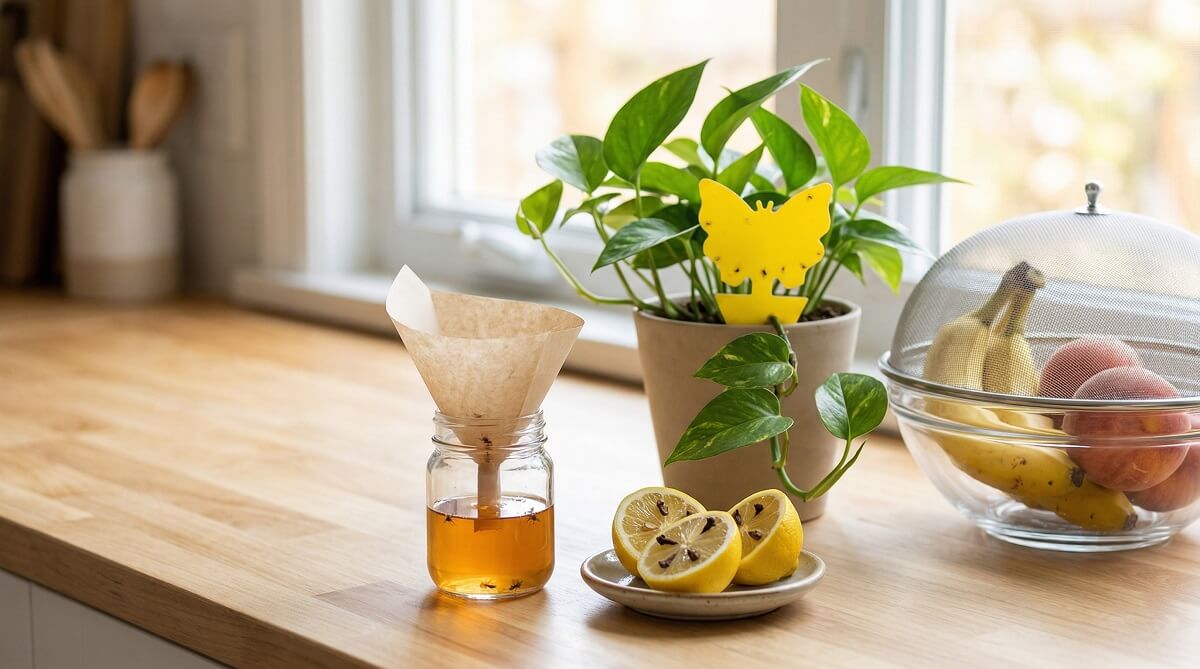
The fastest way to keep gnats away depends entirely on which type you’re dealing with. Biting gnats outdoors? Vanilla extract or a picaridin-based repellent buys you relief quickly. Kitchen gnats hovering around your fruit bowl? Remove the food source, then set a vinegar trap. Fungus gnats in your houseplants? You’re looking at a two-step treatment — sticky traps plus BTI (mosquito bits) — that takes 4-8 weeks to fully clear. None of this is complicated, but you have to match the solution to the right pest.
Most gnat frustration comes from trying one trick in isolation. Vinegar traps catch some adults but won’t fix an infestation. Letting your soil dry out helps, but won’t break an active fungus gnat cycle. The reason: these flies breed fast. Fungus gnats go from egg to adult in as little as 17-21 days under warm conditions, and a single female can lay over 100 eggs in her first week, according to . You have to hit them at multiple lifecycle stages simultaneously.
Below is a breakdown by gnat type, with honest notes on what works, what’s overhyped, and what you’ll actually need to solve the problem for good.
Which Gnats Are You Dealing With?
Before picking a fix, ID the problem. “Gnats” is a catch-all term for several different flying pests that need different approaches.
Outdoor / Biting Gnats (Midges, No-See-Ums)
- Swarm around faces, eyes, and ears — especially near water or in humid weather
- Most active at dusk and dawn; less bothersome on cool, breezy days
- Don’t breed indoors — the source is outside
- Fix: Repellents, physical barriers, timing your outdoor activities
Kitchen / Fruit Gnats (Fruit Flies)
- Hover near fruit bowls, trash cans, wine bottles, wet sponges
- Drawn to fermenting and decaying organic matter
- Breed inside your home — you have to find and remove the source
- Fix: Remove food sources, clean drains, set vinegar traps
Houseplant Fungus Gnats
- Tiny, slender, mosquito-like flies (not round like fruit flies) near potted plants
- Larvae live in moist soil and can damage roots of seedlings
- Adults are harmless to humans; their offspring are the real issue
- Fix: BTI soil treatment + sticky traps, adjusted watering
✅ Best For
- Anyone dealing with flying pests around food, plants, or outdoors
- People who’ve tried one method and had it fail — this guide explains why
- Houseplant owners dealing with recurring infestations
❌ Skip If
- You’re looking for one trick that eliminates all gnat types — there isn’t one
- You need same-day elimination of a heavy fungus gnat infestation (it takes weeks)
How to Keep Outdoor Gnats Away from Your Face and Body
Biting midges and no-see-ums are drawn to body heat, CO2 from your breath, moisture, and sweet-smelling body products. Warm, humid, still air is their preferred environment. Windy or cooler days cut down gnat activity significantly, per , so planning outdoor activities accordingly is one of the simplest adjustments you can make.
Natural Repellents That Help
A few options actually hold up in real-world use:
- Vanilla extract: Many people find dabbing vanilla extract on their temples, behind the ears, and neck keeps gnats at bay. The vanillin scent appears to discourage them. Use a cotton ball with about 1 tbsp of vanilla and reapply every couple of hours. Pure vanilla extract works best, though imitation also has some effect. Keep it away from your eyes.
- Essential oils: Lemongrass, lavender, peppermint, and eucalyptus have shown repellent properties in research. For a DIY spray, fill a 4 oz glass bottle halfway with distilled water, add 1 oz of witch hazel, then 50-75 drops of your preferred oil combination. Shake before each use. Reapply every hour or two — these don’t have the staying power of chemical repellents, but they’re a solid option for a backyard BBQ or afternoon in the garden.
- Cooking oil: Dabbing coconut or olive oil on exposed skin masks your natural scent. Not as effective as essential oils or repellents, but useful if that’s all you have on hand.
- Herbs and spices: Sprinkling cayenne pepper, cinnamon, or garlic powder around a patio seating area can deter gnats from settling nearby. Light, even coverage works better than heavy concentrations.
Physical Barriers
Simple and underrated. Gnats tend to target the highest point on your body, so a wide-brim hat or baseball cap diverts a lot of them away from your face. For heavy infestations — yard work, fishing near wetlands, hiking in humid woods — a hat with mosquito netting covers your face and neck entirely. Sunglasses or safety goggles take care of the eye-contact problem without any product application at all.
Avoid What’s Attracting Them
- Skip sweet-smelling lotions, perfumes, and fruity body sprays before going outside
- Avoid bright floral patterns, which can attract gnats along with bees
- Head outside on cooler, breezier days when possible — these tiny flies struggle to maintain flight in wind
- A box fan or portable fan on a patio pointed outward creates enough airflow to make the area inhospitable
When to Use Bug Spray
If natural options aren’t getting the job done, EPA-registered repellents are a reliable step up. The EPA has reviewed DEET extensively and concluded it does not present a health concern at normal use concentrations. Products with 20-30% DEET provide several hours of protection against mosquitoes and most biting insects. For a DEET-free alternative, picaridin at 20% concentration offers 8-14 hours of protection and is specifically noted to repel gnats and biting midges, according to California’s EPA-registered repellent guidance. Oil of Lemon Eucalyptus (OLE) is another strong EPA-registered choice that covers gnats and biting midges. Need help picking one? Browse our for product comparisons.
Apply to exposed skin and clothing, avoid eyes and mouth, and wash treated skin when you come back inside.
Getting Rid of Kitchen and Fruit Gnats
Fruit gnats breed in moist decaying matter — overripe produce, trash can residue, wet dish sponges, and drain buildup. You can set traps all day, but if the breeding source is still there, you’re fighting a losing battle. Source removal always comes first.
Step 1: Remove the Source
- Check your fruit bowl — anything overripe goes in the trash or fridge immediately
- Empty and rinse the trash can; replace the liner
- Wipe counters and clean up sticky spills, especially near the fruit bowl or recycling bin
- Rinse empty wine and beer bottles before tossing or recycling them — residue is a major draw
- Try the wine cork trick: place dry corks in your fruit bowl. Some people swear the material absorbs excess moisture and discourages gnats. Low effort, worth trying.
The Vinegar Trap (Honest Assessment)
Apple cider vinegar traps work because ACV emits acetic acid and ethanol — compounds that closely mimic the smell of fermenting fruit, according to research indexed by the National Institutes of Health. Fruit flies are drawn to it. The dish soap breaks the surface tension so they sink and can’t escape once they land.
To set one up: pour 1-2 tbsp of apple cider vinegar into a small dish or jar, add 3-5 drops of dish soap, and place it near the problem area. You should see a reduction in adult activity within 24-48 hours, with significant improvement in 3-5 days — as long as you’ve addressed the food source at the same time. The trap catches adults but won’t stop the ones still hatching from existing breeding sites.
Drain Gnats
See tiny flies emerging from your sink or bathtub drain? That’s likely a different pest — drain gnats (Phorid flies) — living in the organic film inside the pipe. The fix is mechanical, not chemical: flush the drain with boiling water weekly, or use an enzyme-based drain cleaner (Bio-Clean, Green Gobbler, and similar products are available at most hardware stores). These products break down the slick buildup that serves as a breeding site. Regular monthly cleaning prevents the problem from returning.
How to Get Rid of Fungus Gnats in Houseplants
Fungus gnats are the most stubborn gnat problem for plant owners, and the hardest to clear with home remedies alone. The key is hitting both the larvae (in the soil) and the adults (in the air) simultaneously. Targeting only one stage lets the other keep the cycle going.
The Two-Step Method That Works
Step 1 — Sticky traps: Place yellow sticky traps flat on the soil surface of affected plants, sticky side up. They catch adults as they emerge and crawl across the soil to lay eggs, reducing the number of new eggs being deposited while the soil treatment does its job. Replace them every 1-2 weeks or when they’re full.
Step 2 — BTI soil treatment: Summit Mosquito Bits contain BTI (Bacillus thuringiensis israelensis), a naturally occurring soil bacterium that specifically targets mosquito and fungus gnat larvae. It’s harmless to humans, pets, fish, birds, and beneficial insects — per Summit Chemical’s product documentation. To use: soak 4 tablespoons of mosquito bits in about 1 gallon of warm water for 30-60 minutes, then water your plants with the solution. Top-watering is more effective than bottom-watering since larvae concentrate near the surface. Check current pricing on Summit Mosquito Bits on Amazon.
Run both steps together every time you water, for at least 4-8 weeks. That timeline is grounded in biology: the full egg-to-adult cycle takes 3-4 weeks at normal room temperature, according to the University of New Hampshire Extension. You need at least two complete treatment cycles to break the breeding chain. Seeing fewer flies after week one is a good sign — keep going until the traps come up empty.
What Didn’t Work (Real-World Testing)
Several commonly recommended remedies consistently underperform for houseplant fungus gnats:
- Apple cider vinegar traps: Catch some adults, but won’t come close to clearing an infestation. The fungus in your soil keeps producing larvae faster than the trap removes egg-layers.
- Neem oil: Messy, inconsistent, and the smell is unpleasant. Multiple real-world accounts report mixed results against fungus gnats specifically.
- Watering less: Helps reduce new egg-laying by drying the soil surface, but if a population is already established in the soil, the larvae persist. Push it too far and you risk damaging your plants.
Watering Habits That Support Treatment
- Let the top 2 inches of soil dry between waterings — larvae concentrate near the moist surface and dislike dry conditions
- Every pot needs drainage holes — standing water at the bottom creates a secondary breeding ground
- When using BTI solution, top-water so it thoroughly saturates the top layer where larvae live
Keeping Them Away After Treatment
Once the infestation is cleared, a few habits prevent a repeat. Isolate new plants for 2-4 weeks before introducing them to the rest of your collection — these flies often arrive in nursery soil, hidden as eggs or larvae. See our for more on quarantine practices. A pumice-based gnat barrier sprinkled on the soil surface adds a physical layer of protection. Continuing BTI treatment preventatively at a lower dose every few weeks is also effective for keeping populations from rebounding.
Gnat Control Methods: Quick Comparison
| Method | Best For | Cost | Effort | How Fast |
|---|---|---|---|---|
| Vanilla extract / essential oil spray | Outdoor gnats on body | $ | Low | Immediate (reapply every 1-2 hrs) |
| Hat / mosquito netting | Outdoor face protection | $-$$ | Very low | Immediate |
| Picaridin or OLE repellent spray | Outdoor biting gnats, heavy exposure | $ | Low | Immediate (8-14 hrs for picaridin 20%) |
| Source removal (produce, drains) | Kitchen / fruit gnats | Free | Low | 1-3 days |
| Apple cider vinegar + dish soap trap | Kitchen / fruit gnats (adult capture) | $ | Very low | Visible reduction in 24-48 hrs |
| BTI (mosquito bits) + sticky traps | Houseplant fungus gnats | $$ | Medium | 4-8 weeks for full elimination |
| Reduce watering / let soil dry | Houseplant fungus gnats (supportive only) | Free | Low | Helpful but not sufficient alone |
5 Ways to Stop Gnats from Coming Back
- Fix moisture sources. Leaky pipes, overflowing gutters, standing water in plant saucers — all three types of gnats depend on moisture to breed. Eliminating these removes the conditions they need.
- Cover or refrigerate ripe produce. Don’t leave fruit sitting uncovered in warm weather. A covered bowl or the fridge is the difference between a fly problem and no fly problem.
- Inspect new houseplants before bringing them indoors. Check the soil surface for larvae — whitish, semi-transparent bodies with a black head. Quarantine new arrivals for at least two weeks and treat preventatively with BTI.
- Run a fan outdoors. Even a moderate breeze makes it hard for gnats to fly. A box fan pointed outward on a patio creates a gnat-free zone with zero chemicals involved.
- Clean drains monthly. An enzyme-based drain cleaner used regularly prevents the organic buildup that drain gnats need to establish themselves.
Frequently Asked Questions
What smell keeps gnats away?
Gnats dislike vanilla, peppermint, lavender, eucalyptus, and lemongrass. These work best as short-term personal repellents outdoors — reapplication every 1-2 hours is necessary. For longer-lasting coverage, picaridin-based sprays or Oil of Lemon Eucalyptus (OLE) are EPA-registered options that also deter biting gnats and midges. For product options, browse our .
Does vanilla actually repel gnats?
Yes, with caveats. Many people report solid results using vanilla extract dabbed on skin or clothing. The vanillin scent appears to discourage gnats from landing. Pure vanilla works better than imitation, though imitation contains the same vanillin compound and still has some effect. It’s a reasonable short-term option for personal protection outdoors, but it won’t handle a serious infestation and needs frequent reapplication.
How long does it take to get rid of fungus gnats?
Plan for 4-8 weeks with consistent treatment. Fungus gnats develop from egg to adult in about 3-4 weeks at normal indoor temperatures — as fast as 17-21 days under warm conditions — per UNH Extension research. You need at least two full lifecycle treatment cycles using BTI and sticky traps, applied consistently at every watering, to break the chain. Seeing fewer adults in week one is progress — keep going until the traps come up empty for two consecutive weeks.
Are gnats harmful to humans?
Non-biting gnats — fruit flies and fungus gnats — are completely harmless to people, just irritating. Biting gnats (midges, no-see-ums) cause itching and welts similar to mosquito bites. In the US, biting gnats do not transmit human diseases, though they can affect livestock in some regions. The health risk from any gnat inside your home is essentially zero beyond the annoyance factor.
What’s the difference between gnats and fruit flies?
Fruit flies (Drosophila) are round-bodied, sometimes with red eyes, and drawn to fermenting fruit and sugary spills. Fungus gnats are slender and mosquito-like, breeding in houseplant soil. Biting gnats (midges) are even smaller and found near outdoor water sources. “Gnats” covers all three — which is why a single solution rarely handles every situation.
Can gnats live in your drain?
Yes, though technically drain gnats (Phorid flies) are a distinct pest. They breed in the slick organic film that builds up inside drain pipes. If tiny flies are emerging from your sink or tub, an enzyme drain cleaner (not bleach — bleach doesn’t break down the organic buildup) used weekly will eliminate the breeding site and resolve the issue.
Do gnats go away on their own?
Outdoor biting gnats slow significantly when temperatures drop in fall. Kitchen fruit gnats won’t leave as long as a food source remains — remove it and they disappear quickly. Fungus gnats in houseplants won’t self-resolve; indoor temperatures stay warm year-round, so the breeding cycle runs continuously without treatment.
What’s the fastest way to reduce gnats indoors right now?
For kitchen gnats: remove overripe produce, clean the trash can, and set a vinegar trap today — visible reduction in adults within 24-48 hours. For houseplant fungus gnats: hang sticky traps immediately and pick up mosquito bits to start BTI treatment on your next watering. Full elimination takes weeks, but the population will start dropping within the first few days of combined treatment.
For houseplant fungus gnats, the BTI + sticky trap combination is the most dependable fix available. Check current prices on Summit Mosquito Bits on Amazon. Yellow sticky traps are available at most garden centers for a few dollars and . Stay consistent for 6-8 weeks and the problem will be behind you.
