


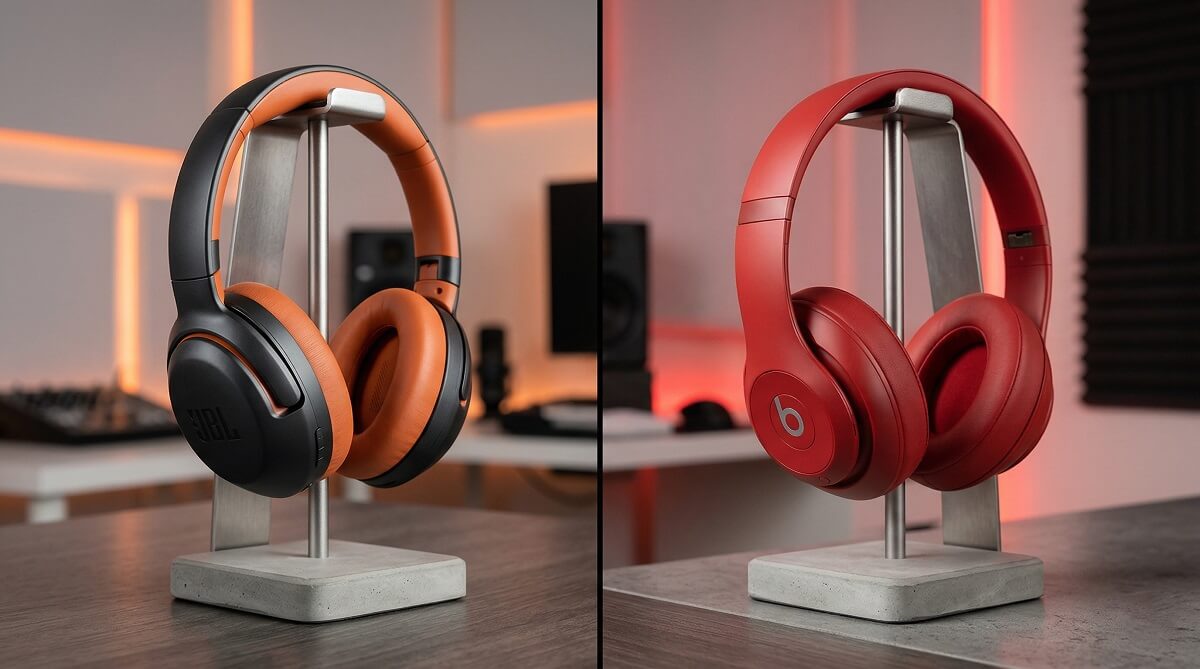
If you’re choosing between JBL and Beats headphones, here’s the short version: JBL wins on battery life, active noise cancellation per dollar, and all-day comfort. Beats wins on bass intensity and Apple ecosystem integration. For most shoppers — especially anyone not deeply invested in iPhone — JBL delivers more usable features for less money.
One thing worth flagging upfront: the Beats Solo 4 has no active noise cancellation. None. That catches a lot of people off guard, because the Beats name carries an assumption of premium tech. If you’re comparing the Solo 4 with JBL’s Tune 770NC specifically because you want ANC, you’re comparing the wrong models — the JBL wins by default.
Below, we break down how the two brands actually stack up across sound, ANC, comfort, battery, price, and Apple/Android compatibility — using real specs and so you can make a clear call. Prices noted are based on Amazon and Best Buy as of March 2026 and subject to change.
Quick Decision Guide — JBL or Beats?
Choose JBL If You…
- Want serious battery life — up to 70 hours on the Tune 770NC and Tour One M3
- Need reliable ANC without paying $300+
- Use Android or switch between devices
- Plan to wear headphones for hours at a stretch (over-ear comfort advantage)
- Prefer balanced sound that handles all genres, not just bass-heavy tracks
Choose Beats If You…
- Love deep, punchy bass above everything else
- Own an iPhone and want instant pairing, Find My support, and device switching
- Want a stylish, fashion-forward look — Beats has always delivered on aesthetics
- Are considering the Studio Pro specifically for USB-C lossless wired audio
Skip Beats If You…
- Assume all Beats models include ANC — the Solo 4 does not
- Are Android-only and want to maximize smart features (Beats app is iOS-first)
- Are comparing on raw value — at most price points, JBL covers more ground
Sound Quality: Two Different Philosophies
These two brands approach audio tuning from opposite ends. Knowing which philosophy matches your taste is really the core of this decision.
How Beats Tunes Its Headphones
Beats built its reputation on bass — and that reputation is largely earned. The Studio Pro delivers a V-shaped sound signature: boosted low end, elevated highs, and a midrange that can recede behind the lows. In (December 2025), the Beats Studio Pro scored 8.3 for bass, 7.3 for mids, and 7.2 for treble out of 10. That’s a capable headphone for genre-specific listening — hip-hop, EDM, pop with heavy production — but vocals and acoustic instruments don’t always cut through cleanly.
The Beats Solo 4 tells a different story. Despite the brand premium, its sound scores were considerably weaker: 5.3 bass, 5.2 mids, and only 2.8 treble. That low treble score translates to a dull, compressed-sounding high end — not what you’d expect for a $200 headphone.
How JBL Tunes Its Headphones
JBL aims for a more neutral, balanced profile. You get clear mids, articulate highs, and bass that’s present without smothering everything else. That makes JBL a better fit for listeners who rotate across genres — podcasts, acoustic tracks, classical, or anything where vocal clarity matters.
The JBL Tour One M3, the brand’s current flagship, scored 5.3 for bass, 6.2 for mids, and 6.3 for treble in the same TechGearLab tests. It’s not as dramatic as the Beats Studio Pro on bass, but the midrange and treble scores suggest a more cohesive listening experience. The budget JBL Tune 720 BT scored lower across the board (4.0 / 6.0 / 2.8), so it’s worth noting that JBL’s sound quality improves meaningfully as you move up the lineup.
Sound Verdict by Use Case
| Use Case | Better Pick | Why |
|---|---|---|
| Hip-hop, EDM, heavy bass | Beats Studio Pro | Stronger bass output, punchy low end |
| Podcasts, audiobooks, vocals | JBL | Better midrange clarity |
| Mixed genres (rock, pop, jazz) | JBL | More balanced across all frequencies |
| Classical, acoustic, instrumental | JBL | Less bass masking of instruments |
| Working out, high-energy sessions | Beats | Bass-driven sound boosts energy levels |
Noise Cancellation: The Difference That Surprises Most Buyers
This is where the comparison gets genuinely surprising — and where a lot of buyers end up disappointed after choosing Beats.
What Beats Actually Offers (and Doesn’t)
The Beats Solo 4 has zero active noise cancellation. It relies on passive blocking — the physical seal of the ear cups — which is the same “noise reduction” you get from a pair of foam earplugs. If you’re buying the Solo 4 expecting ANC because the Beats name suggests a premium product, that assumption is wrong.
The Beats Studio Pro does have ANC, but the numbers from TechGearLab’s independent lab tests tell a sobering story. The Studio Pro measured only 5.5 dB of low-frequency reduction, 14.6 dB mid, and 31.2 dB high. The low-frequency result is particularly weak — that’s where engine rumble, HVAC hum, and crowd noise live. According to TechGearLab, the Beats Studio Pro’s ANC “performs on par with or even less effective than those lacking the technology” in some frequency bands.
JBL’s ANC Range
JBL’s ANC performance varies significantly across its lineup. The Tour One M3 measured 25.8 dB (low), 26.9 dB (mid), and 41.5 dB (high) — numbers that put it in the same tier as Sony’s WH-1000XM5 and Bose’s QuietComfort series. For a headphone priced around $350, that’s competitive with the best ANC available.
The Tune 770NC offers adaptive ANC at a much lower price (~$100), though it doesn’t match the Tour One M3’s output. The budget Tune 720 BT barely registers at 0.8 dB low-frequency reduction — barely above zero.
The ANC table below shows the measured noise reduction in decibels across frequency ranges. Higher numbers mean more noise blocked:
| Model | ANC Low (dB) | ANC Mid (dB) | ANC High (dB) | Price (approx.) |
|---|---|---|---|---|
| JBL Tour One M3 | 25.8 | 26.9 | 41.5 | ~$350 |
| JBL Tune 770NC | ~Moderate | ~Moderate | ~Good | ~$100 |
| Beats Studio Pro | 5.5 | 14.6 | 31.2 | ~$199 (sale) |
| Beats Solo 4 | None (0 ANC) | None (0 ANC) | None (0 ANC) | ~$130 (sale) |
Lab data from TechGearLab’s Best Wireless Headphones of 2026 (tested December 2025).
Comfort: On-Ear vs Over-Ear Changes Everything
One design decision separates the brands more than any spec: the Beats Solo 4 is an on-ear headphone, while JBL’s Tune 770NC and Tour One M3 are over-ear. That distinction matters more than most people realize.
The On-Ear Reality with Beats Solo 4
On-ear headphones press directly against the ear’s cartilage rather than surrounding it. For short listening sessions — a commute, a workout — that’s usually fine. For longer sessions, the pressure builds. TechGearLab’s comfort testing found the Beats Solo 4 comfortable for only 1-2 hours before pressure points set in. Combine that with a tight clamping force and limited padding, and the Solo 4 isn’t a great choice for desk workers or anyone settling in for a long flight.
The Beats Studio Pro is over-ear, which helps, but TechGearLab still flagged it as one of the more disappointing comfort performers at its price tier — particularly when comparing to over-ear rivals like the Sony WH-1000XM series.
JBL’s Comfort Advantage
JBL’s over-ear models wrap around the ear, distributing pressure around the cartilage rather than on it. The Tune 770NC weighs 232 grams — lightweight for an ANC headphone — and uses a padded headband with soft ear cushions. Reviews from 2024–2025 consistently note it’s comfortable for extended wear, with the main complaint being that the ear cups run slightly small for larger ears.
The Tour One M3 steps up in build quality and padding, landing comfortably in the 7-8 hour wear range without significant fatigue. covers more detail on fit comparisons between over-ear designs.
Battery Life: JBL’s Clearest Advantage
Battery life is the one area where JBL dominates without debate. The Tune 770NC and Tour One M3 both deliver up to 70 hours of playback — about a week of daily use before reaching for a cable. The Tune 770NC maintains 44 hours with ANC and Bluetooth running simultaneously. A 5-minute Speed Charge adds 3 hours, which is handy when you’re rushing out the door.
Beats falls considerably shorter:
| Model | Battery (total) | With ANC | Quick Charge |
|---|---|---|---|
| JBL Tune 770NC | 70 hrs | 44 hrs | 5 min → 3 hrs |
| JBL Tour One M3 | 70 hrs | ~50 hrs (est.) | 5 min → 5 hrs |
| Beats Studio Pro | 40 hrs | 36 hrs | 10 min → 4 hrs |
| Beats Solo 4 | 50 hrs | N/A (no ANC) | 10 min → 5 hrs |
The Beats Solo 4 reaches 50 hours because it has no ANC to drain the battery — that’s an important caveat when the numbers look competitive. For context on how these runtime figures compare across all wireless options, tracks battery performance across the full market.
Price and Value: What You’re Actually Paying For
Pricing in this category shifts frequently with sales, so treat the figures below as a snapshot from early March 2026. Always check current listings before buying.
JBL Price Tiers
- Budget: JBL Tune 520BT / 720BT — around $50–$80; basic wireless, minimal ANC
- Mid: JBL Tune 770NC — approximately $99.95 on Amazon (as of March 2026); ANC, 70-hr battery, Bluetooth 5.3
- Premium: JBL Tour One M3 — approximately $349.95 on Amazon; flagship ANC, Hi-Res audio, LDAC, spatial sound
Beats Price Tiers
- Mid: Beats Solo 4 — MSRP $199.99, frequently on sale for approximately $129–$150 on Amazon; no ANC, on-ear design
- Premium: Beats Studio Pro — MSRP $349.99, frequently on sale for approximately $199 on Amazon (Feb–Mar 2026, 43% off); ANC, USB-C lossless audio
The value math here is stark. For around $100, the JBL Tune 770NC gives you ANC, 70-hour battery, Bluetooth 5.3, and over-ear comfort. At its sale price of $130, the Beats Solo 4 gives you no ANC, 50 hours, on-ear design — and a brand name. The Studio Pro becomes more competitive when it drops to $199, but even then the JBL Tour One M3 outperforms it on noise cancellation at a similar price point.
Beats charges for its brand cachet and Apple ecosystem features. If those matter to you, the premium may be worth it. If they don’t, JBL is the straightforward choice.
Apple Ecosystem: The One Area Beats Wins Clearly
If you’re an iPhone user, Beats has a real advantage that JBL can’t match. Both the Solo 4 and Studio Pro use a custom Beats chip (not Apple’s H1 or H2, but built on similar principles) that unlocks several iOS-specific features:
- One-touch pairing — open the case near an iPhone and it connects instantly
- Find My integration — locate lost headphones through Apple’s Find My network
- Personalized Spatial Audio with dynamic head tracking via built-in gyroscopes
- Hey Siri activation hands-free
- Over-the-air firmware updates through the iOS ecosystem
JBL headphones work with iPhones over standard Bluetooth — pairing is simple, sound quality is the same — but none of these Apple-specific perks apply. JBL’s app (available for both iOS and Android) offers custom EQ and ANC adjustments, which is a solid feature in its own right, but it’s not the same tight, native integration that Apple device users get with Beats.
If you use Android, a Windows PC, or split time between devices: JBL is the better all-around fit. covers cross-platform compatibility in more detail.
Head-to-Head: Key Models Compared
| Feature | JBL Tune 770NC | JBL Tour One M3 | Beats Solo 4 | Beats Studio Pro |
|---|---|---|---|---|
| Design type | Over-ear | Over-ear | On-ear | Over-ear |
| Active Noise Cancellation | Yes (Adaptive ANC) | Yes (8-Mic ANC 2.0) | NO | Yes (weak in lab) |
| ANC performance (low/mid/high dB) | Moderate / Moderate / Good | 25.8 / 26.9 / 41.5 dB | None | 5.5 / 14.6 / 31.2 dB |
| Battery life | 70 hrs (44 with ANC) | 70 hrs | 50 hrs (no ANC) | 40 hrs (36 with ANC) |
| Weight | 232g | N/A (check jbl.com) | N/A (check beatsbydre.com) | N/A (check beatsbydre.com) |
| Bluetooth | 5.3 | 5.3 LE | 5.3 | 5.3 |
| USB-C lossless audio | No | Yes (USB-C + 3.5mm) | Yes | Yes |
| Apple Find My / iOS features | No | No | Yes | Yes |
| Foldable | Yes | Yes | Yes | Yes |
| Approx. price (Mar 2026) | ~$100 | ~$350 | ~$130 (sale) | ~$199 (sale) |
ANC dB data from TechGearLab lab tests (December 2025). Prices reflect approximate Amazon pricing as of March 2026 — check current listings before buying.
Frequently Asked Questions
Does the Beats Solo 4 have active noise cancellation?
No. The Beats Solo 4 relies entirely on passive noise isolation — the physical fit of the ear cups blocking external sound. There is no electronic ANC. If noise cancellation is a priority, consider the Beats Studio Pro or any JBL model with ANC in the name (Tune 770NC, Tour One M3).
Which JBL headphone compares most directly to the Beats Studio Pro?
The JBL Tour One M3 sits at a similar price point (~$350) and significantly outperforms the Beats Studio Pro on noise cancellation. If the Studio Pro is on sale around $199, the JBL Tune 770NC (~$100) gives you comparable ANC at nearly half the price.
Are Beats headphones worth it for Android users?
The Apple ecosystem perks — instant pairing, Find My, Spatial Audio tracking — don’t apply on Android. Basic Bluetooth pairing works fine, but you’re paying the Beats premium without accessing most of what makes Beats special. JBL’s app works well on Android, so JBL is generally the stronger pick for non-iOS users.
Do JBL headphones pair with iPhones?
Yes, JBL headphones connect to iPhones over standard Bluetooth without any issues. You won’t get Apple-specific features like Find My or one-touch pairing, but audio quality and call performance are fully functional.
Which brand is better for commuting?
For daily commuting, JBL’s noise-cancelling models — particularly the Tour One M3 — provide measurably better ANC for blocking subway noise, traffic, and office environments. The Beats Studio Pro has ANC, but lab tests show it underperforms compared to competing headphones at the same price.
Which has better call quality, JBL or Beats?
JBL’s Tour One M3 earned strong marks for call quality in TechGearLab testing — one of the best performers across all wireless headphones tested. The JBL Tune 720 BT (budget tier) also performed surprisingly well. The Beats Solo 4 has solid call quality for casual use, while the Studio Pro includes six microphones for clearer calls in noisier environments.
Which brand is better for working out?
Both brands offer workout-capable headphones. JBL headphones are over-ear and tend to stay put well; the Tune 770NC is sweat-resistant and lightweight. Beats Powerbeats Pro (a separate product from what we’ve covered here) is Beats’ top gym option with ear hooks. For standard over-ear headphones, JBL’s lighter build and longer battery make it more practical for gym use.
What’s the longest battery life on a JBL headphone?
Both the JBL Tune 770NC and JBL Tour One M3 reach 70 hours of battery life — confirmed by JBL’s official specs. With ANC running, the Tune 770NC delivers 44 hours. A 5-minute Speed Charge provides 3 hours of additional playback.
Final Verdict: Which Brand Should You Choose?
For most people, JBL is the practical choice. The Tune 770NC at around $100 punches well above its price — ANC, 70-hour battery, Bluetooth 5.3, over-ear comfort. If you want to step up, the Tour One M3 is a legitimate premium pair with ANC performance that rivals models costing significantly more. Browse for deeper dives on individual models.
Beats earns its spot if you’re committed to the Apple ecosystem. The instant pairing, Find My tracking, and Spatial Audio head tracking genuinely improve the iPhone experience. The Studio Pro, when it drops to $199, becomes a reasonable buy for iPhone users who prioritize those features and want a stylish over-ear option. The Solo 4 at $130 is a decent on-ear option — but only if you know and accept what you’re giving up: no ANC, limited comfort for long sessions.
Pick by use case:
- Best overall value: JBL Tune 770NC (~$100) — ANC, 70 hrs battery, strong all-round performance
- Best premium ANC: JBL Tour One M3 (~$350) — rivals Sony and Bose in noise blocking
- Best for iPhone users: Beats Studio Pro (~$199 on sale) — Apple ecosystem, USB-C lossless, decent sound
- Best bass headphone: Beats Studio Pro — the Solo 4 underdelivers on sound for its price
Check current prices and availability: JBL Tune 770NC on Amazon | JBL Tour One M3 on Amazon | Beats Studio Pro on Amazon | Beats Solo 4 on Amazon
